
 100% FREE ACCESS
11th Standard Syllabus & Materials
11th Standard
TN 11th Tamil இயற்கை வேளாண்மை,சுற்றுச்சூழல் -செய்யுள் - மனோன்மணீயம் Important Questions And Answers Study Material - QB365 Set A
NEW11th Standard
TN 11th Tamil என்னுயிர் என்பேன் -துணைப்பாடம் - இசைத்தமிழர் இருவர் Important Questions And Answers Study Material - QB365 Set A
NEW11th Standard
TN 11th Tamil மொழி கலை -செய்யுள் - ஒவ்வொரு புல்லையும் Important Questions And Answers Study Material - QB365 Set A
NEW11th Standard
TN 11th Tamil பீடு பெற நில் - இலக்கணம் - பகுபத உறுப்புகள் Important Questions And Answers Study Material - QB365 Set A
NEW11th Standard
TN 11th Tamil பீடு பெற நில் - துணைப்பாடம் - வாடிவாசல் Important Questions And Answers Study Material - QB365 Set A
NEW11th Standard
TN 11th Tamil பீடு பெற நில் - செய்யுள் - குறுந்தொகை Important Questions And Answers Study Material - QB365 Set A

Published on: 13/05/2022
QB365 provides detailed and simple solution for every book back questions in class 11 Biology subject.It will helps to get more idea about question pattern in every book back questions with solution.
latest Book back QuestionsDownload Tamil Nadu 11th Standard Biology question papers, model tests, one-mark questions, important questions, and public exam papers in PDF format. Free study materials and answer keys for TN State Board students.
Questions + Answers key
Take MCQ Biology Test1.
List the disorders of the muscular system.
2.
With regards to toxicity and the need for dilution in water, how different are ureotelic and uricotelic excretions? Give examples of animals that use these types of excretion.
3.
How are the kidneys involved in controlling blood volume? How is the volume of blood in the body related to arterial pressure?
4.
What are the components of blood in frog?
5.
What is the difference between a Zoo and Wild Life Sanctuary?
6.
7.
Give the economic importance of Silkworm
8.
Explain the conditions which creates problems in oxygen transport.
9.
Diffusion of gases occurs in the alveolar region only and not in any other part of the respiratory system. Discuss
10.
Could the number of eggs or young ones produced by an oviparous and viviparous female be equal? Why?
11.
Write the clinical significance of ultra sonogram
12.
13.
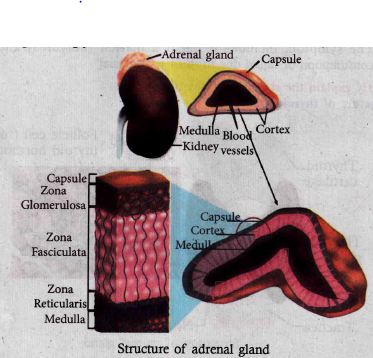
Name the layers of adrenal cortex and mention their secretions.
14.
Briefly explain the structure of thyroid gland.
15.
Describe the structures of olfactory receptors.
16.
17.
Explain the sliding-filament theory of muscle contraction.
18.
What are the bones that make the pelvic girdle?
19.
What are the different types of rib bones that form the rib cage?
20.
Discuss the various techniques adopted in cattle breeding.
21.
Identify the following structures and explain their significance in renal physiology?
(a) Juxtaglomerular apparatus
(b) Podocytes
(c) Sphincters in the bladder
22.
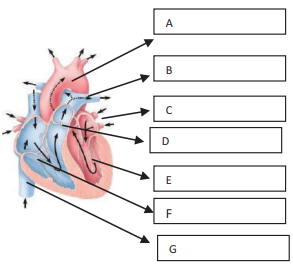
Name and Label the given diagrams to show A, B, C, D, E, F, and G
23.
Select the correct biological term
Lymphocytes, red cells, leucocytes, plasma, erythrocytes, white cells, haemoglobin, phagocyte, platelets, blood clot.
(a) Disc shaped cells which are concave on both sides.
(b) Most of these have a large, bilobed nucleus.
(c) Enable red cells to transport blood.
(d) The liquid part of the blood.
(e) Most of them move and change shape like an amoeba.
(f) Consists of water and important dissolved substances.
(g) Destroyed in the liver and spleen after circulating in the blood for four months.
(h) The substances which gives red cells their colour.
(i) Another name for red blood cells
(j) Blood that has been changed to a jelly
(k) A word that means cell eater.
(l) Cells without nucleus.
(m) White cells made in the lymphatic tissue.
(n) Blocks wound and prevent excessive bleeding.
(o) Fragment of cells which are made in the bone marrow.
(p) Another name for white blood cells.
(q) Slowly releases oxygen to blood cells.
(r) Their function is to help blood clot in wounds.
24.
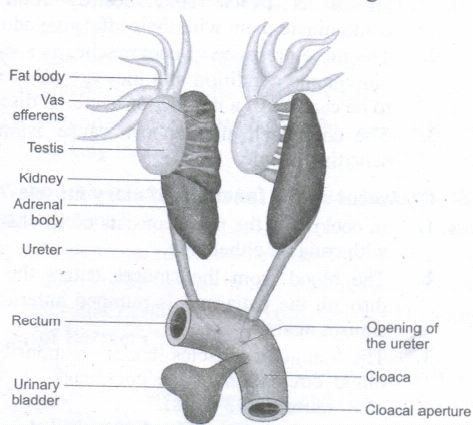
Explain the excretory system of frog.
25.
What is an epithelium? Enumerate the characteristic features of different epithelia.
1.
Myasthenia gravis, Tetany, Muscle pull, Muscle Fatigue, Atrophy, Dystrophy.
2.
(i) Urea is excreted by ureotelic animals
Eg: Earthworm, Frogs and mammals.
(ii) Uric acid is excreted by uricotelic animals
Eg: Insects, reptiles and Aves (birds).
3.
(i) Nephrons of kidneys absorb and reabsorb blood plasma (55%) and hand over it to venules of renal vein so that an average blood volume is maintained.
(ii) Oxygenated blood flows in the arterial system expresses the systolic pressure (120mm Hg) to balance the normal blood pressure towards the body organs.
4.
(i) Blood consists of 60% of plasma and 40% of blood cells.
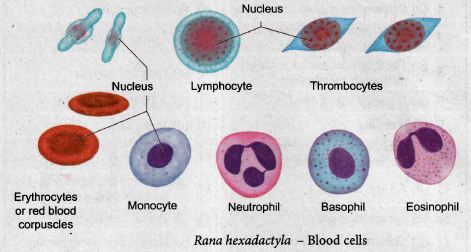
(ii) Red blood cells are nucleated containing haemoglobin (red pigment) and these are oval shaped.
(iii) Leucocytes are nucleated and circular in shape.
5.
| Zoo | Wild life sanctuary |
| Wild animals kept in protected environments under human care Eg: Zoological parks | Wild animals are maintained in the protected areas under various projects for various animals and maintained by the services of Government. |
6.
7.
Economic importance of Silk:
1. Silk fibers are utilized in preparing silk clothes. Silk fibers are now combined with other natural or synthetic fibers to manufacture clothes like Teri-silk, Cot-silk etc.
2. Silk is dyed and printed to prepare ornamented fabrics. They are generally made from Eri-silk or spun silk.
2. Silk is used in industries and for military purposes.
3. It is used in the manufacture of fishing fibers, parachutes, cartridge bags, insulation coils for telephone, wireless receivers, tyres of racing cars, filter fibres, in medical dressings and as suture materials.
8.
Conditions which create the problems in O2 transport:
(i) Poor ventilation.
(ii) Less quantity of haemoglobin.
(iii) Anaemia
(iv) Histotoxic conditions of tissue fluid.
(v) Inability for the transport of O2 into cell due to cellular disorder.
9.
(i) The alveolar regions of lungs are the centres of gaseous exchange for the association of Hb and O2 to form HbO2 and for the dissociation of HbCO2 into Hb and CO2.
(ii) But visceral regions of gaseous exchange constitute tissue fluids where dissociation of HbO2 into Hb and O2 and association of Hb and CO2 into HbCO2 occurs.
10.
(i) Eggs or young ones produced by an oviparous (egg laying) and viviparous (directly yield young ones) female animals may not be equal.
(ii) Numerous eggs are laid by oviparous, so the number of produced offspring is indefinite.
(iii) Eggs laid by oviparous, female may not develop into adults due to predators.
(iv) Oviparous female includes polyembryony.
(v) Viviparous produced by females need protection from predators associated with parental cares.
(vi) Development of young ones of oviparous female occurs in environment whereas the development of young ones of viviparous female occurs in the female reproductive system of adults.
11.
1. .Ultrasound waves are used to image the foetus at different stages of pregnancy to study the progress of the developing foetus.
2. They are used to hear foetal heart sound, blood flow, etc.
3. Used in echo cardiography to diagnose the damages in heart.
4. Used for diagnosis of tumours gall stones, kidney stones, obstructions in the genital tracts
12.
13.
(i) A pair of adrenal glands are located at the anterior end of the kidneys. The outer region is the cortex and the inner region is the medulla.
(ii) The adrenal cortex has three distinct zones, they are 1. Zona glomerulosa 2. Zona fasciculata and 3. Zona reticularis.
(iii) Zona glomerulosa an outer thin layer constitutes about 15% of adrenal cortex and its secretes mineralocorticoids.
(iv) Zona fasciculata, the middle layer constitutes about 75% of adrenal cortex and secretes glucocorticoids such as cortisol, corticosterone and trace amounts of adrenal androgen and oestrogen.
(v) Zona Reticularis, an inner zone of adrenal cortex constitute about 10% of adrenal cortex and secretes the adrenal cortex androgen, trace amount of oestrogen and glucocorticoids.
14.
Structure of thyroid gland:
Thyroid gland is the largest endocrine gland in the body.
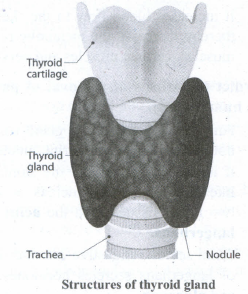
1. It is a butterfly shaped, bilobed gland located below the larynx on either side of upper trachea.
2. The two lateral lobes are connected by a median tissue mass called isthmus.
3. Each lobe is made up of many lobules. The lobules consist of follicles called acini.
4. Each acinus is lined with glandular, cuboidal or squamous epithelial cells. The lumen of acinus is filled with colloid, a thick glycoprotein mixture consisting of thyroglobulin molecules.
5. It secretes two hormones namely tri-iodothyronine [T3] and thyroxine or tetra-iodothyronine [T4].
6. The parafollicular cells or 'C' cells of thyroid gland secrete a hormone called thyrocalcitonin.
7. Iodine is essential for the normal synthesis of thyroid hormone.
8. Thyroid hormones shows a negative feedback effect on the hypothalamus and pituitary.
15.
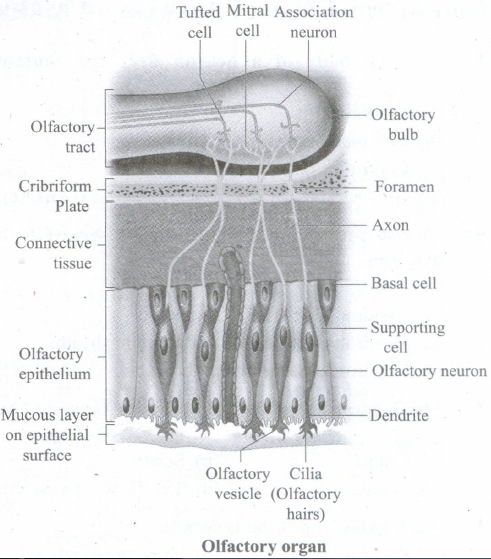
(i) The structure of chemoreceptors
(ii) The receptors for taste and smell are the chemoreceptors
(iii) The smell receptors are excited by airborne chemicals that dissolve in fluids.
(iv) The yellow coloured patches of olfactory epithelium form the olfactory organs that are located on the roof of the nasal cavity.
16.
17.
Mechanism of muscle contraction
(i) Sliding filament theory in 1954, Andrew F. Huxley and Rolf Niedergerke proposed the sliding-filament theory to explain muscle contraction.
(ii) According to this theory, overlapping actin and myosin filaments of fixed length slide past one another in an energy requiring process, resulting in muscle contraction.
(iii) The contraction of muscle fibre is a remarkable process that helps in creating a force to move or to resist a load.
(iv) The force which is created by the contracting muscle is called muscle tension.
(v) The load is a weight or force that opposes contraction of a muscle.
(vi) Contraction is the creation of tension in the muscle which is an active process and relaxation is the release of tension created by contraction.
(vii) Muscle contraction is initiated by a nerve impulse sent by the central nervous system (CNS) through a motor neuron.
(viii) The junction between the motor neuron and the sarcolemma of the muscle fibre is called the neuromuscular junction or motor end plate.
(ix) When nerve impulse reaches a neuromuscular junction, acetylcholine is released.
(x) It initiates the opening of multiple gated channels in sarcolemma. The action potential travels along the T-tubules and triggers the release of calcium ions from the sarcoplasmic reticulum.
(xi) The released calcium ions bind to troponin on thin filaments. The tropomyosin uncovers the myosin-binding sites on thin filaments.
(xii) Now the active sites are exposed to the heads of myosin to form a cross-bridge. During cross-bridge formation actin and myosin form a protein complex called actomyosin.
(xiii) Utilizing the energy released from hydrolysis of ATP, the myosin head rotates until it forms a 90° angle with the long axis of the filament.
(xiv) In this position myosin binds to an actin and activates a contraction relaxation cycle which is followed by a power stroke.
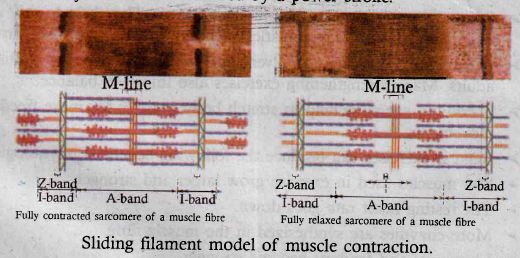
(xv) The power stroke (cross-bridge tilting) begins after the myosin head and hinge region tilt from a 90° angle to a 45° angle. The cross-bridge transforms into strong, high-force bond which allows the myosin head to swivel. When the myosin head swivels it pulls the attached actin filament towards the centre of the A-band.
(xvi) The myosin returns back to its relaxed state and releases ADP and phosphate ion. A new ATP molecule then binds to the head of the myosin and the cross-bridge is broken.
(xvii) At the end of each power stroke, each myosin head detaches from actin, then swivels back and binds to a new actin molecule to start another contraction cycle. This movement is similar to the motion of an oar on a boat.
(xviii) At the end of each power stroke, each myosin head detaches from actin, then swivels back and binds to a new actin molecule to start another contraction cycle.
(xix) The power stroke repeats many times until a muscle fibre contracts. The myosin heads bind, push and release actin molecules over and over as the thin filaments move toward the centre of the sarcomere.
(xx) The repeated formation of cross-bridge cycles cause the sliding of the filaments only but there is no change in the lengths of either the thick or thin filaments.
(xxi) The Z-discs attached to the actin filaments are also pulled inwards from both the sides, causing the shortening of the sarcomere (i.e. contraction). This process continues as long as the muscle receives the stimuli and with a steady flow of calcium ions.
(xxii) When motor impulse stops, the calcium ions are pumped back into the sarcoplasmic reticulum, results in the masking of the active sites of the actin filaments. The myosin head fails to bind with the active sites of actin and these changes cause the return of Z-discs back to their original position, i.e. relaxation.
18.
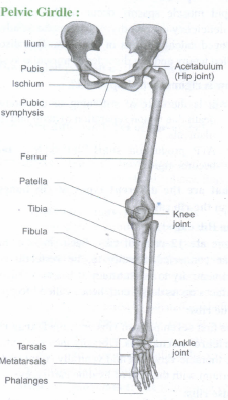
1. The pelvic girdle is a heavy structure specialized for weight bearing. It is composed of two hip bones called coxal bones that secure the lower limbs to the axial skeleton. Together, with the sacrum and coccyx, the hip bones form the basin-like bony pelvis.
2. Each coxal bone consists of three fused bones, ilium, ischium and pubis. At the point of fusion of ilium, ischium, and pubis a deep hemispherical socket called the acetabulum is present on the lateral surface of the pelvis.
3. It receives the head of the femur or thigh bone at the hip joint and helps in the articulation of the femur.
4. The ilium is the superior flaring portion of the hip bone. Each ilium forms a secure joint with the sacrum posteriorly. The ischium is a curved bar of bone. The V-shaped pubic bones articulate anteriorly at the pubic symphysis.
The Lower limb:
1. The lower limb consists of 30 bones which carries the entire weight of the erect body.
2. The bones of the lower limbs are thicker and stronger than the upper limbs. The three segments of each lower limb are the thigh, the leg or the shank and the foot.
3. The femur is the single bone of the thigh. It is the largest, longest and strongest bone in the body. The head of femur articulates with the acetabulum of the pelvis to form the hip joint.
4. Two parallel bones, the tibia and fibula, form the skeleton of the shank. A thick, triangular patella forms the kneecap, which protects the knee joint anteriorly and improves the leverage of thigh muscles acting across the knee.
5. The foot includes the bones of ankle, the tarsus, the metatarsus and the phalanges or toe bones. The foot supports our body weight and acts as a lever to propel the body forward while walking and running.
6. The tarsus is made up of seven bones called tarsals. The metatarsus consists of five bones called metatarsals. The arrangement of the metatarsals is parallel to each other. There are 14 phalanges in the toes which are smaller than those of the fingers.
19.
The Rib cage:
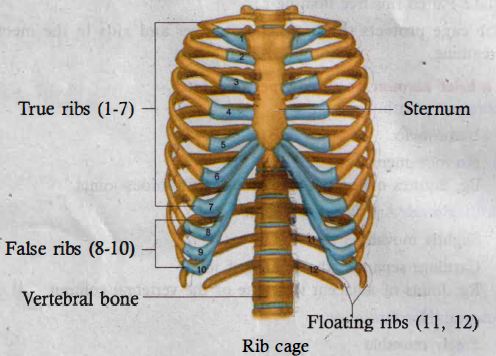
(i) There are 12 pairs of ribs.
(ii) Each rib is a thin flat bone connected dorsally to the vertebral column and ventrally to the sternum.
(iii) It has two articulation surfaces on its dorsal end hence called bicephalic.
(iv) The first seven pairs of ribs are called 'true ribs' or vertebro-sternal ribs.
(v) Dorsally they are attached to the thoracic vertebrae and ventrally connected to the sternum with the help of hyaline cartilages.
(vi) The 8th, 9th and 10th pairs of ribs do not articulate directly with the sternum but joined with the cartilaginous (hyaline cartilage) part of the seventh rib.
(vii) These are called 'false ribs' or vertebrochondral ribs.
(viii) The last 11th and 12th pairs of ribs are not connected ventrally. Therefore, they are called as 'floating ribs' or vertebral ribs.
(ix) Thoracic vertebrae, ribs and sternum together form the ribcage.
20.
There are various techniques adopted in cattle breeding.
1. Inbreeding:
i. Breeding between animals of the same breed for 4-6 generations is called inbreeding. Inbreeding increases homozygosity and exposes the harmful recessive genes.
ii. Continuous inbreeding reduces fertility and even productivity, resulting in "inbreeding depression" .
iii. This can be avoided by breeding selected animals of the breeding population and they should be mated with superior animals of the same breed but unrelated to the breeding population. It helps to restore fertility and yield.
2. Outbreeding:
(i) The breeding between unrelated animals is called outbreeding.
(ii) Outbreeding helps to produce new and favourable traits, to produce hybrids with superior qualities and helps to create new breeds. In outbreeding, there are another steps also involved.
i. Outcrossing:
It is the breeding between unrelated animals of the same breed but having no common ancestry. The offspring of such a cross is called outcross. This method is suitable for breeding animals below average in productivity.
ii. Crossbreeding: Breeding between a superior male of one breed with a superior female of another breed. The crossbred progeny has superior traits.
iii. Interspecific hybridization: Method of breeding between male and female of two different species. For eg male donkey is crossed with female horse the offspring is called as mule.
3. Artificial insemination:
(i). Another breeding method is Artificial insemination is a technique in which the semen collected from the male is injected to the reproductive tract of the selected female.
1. It is economical low cost.
2. No semen are wasted.
3. Cross breeding and outbreeding are favourable in this method.
21.
(a) Some nephrons, have very long loop of Henle that run deep into the medulla are called juxtamedullary nephrons which aid in filtration from glomerulus.
(b) Podocytes are the filtration slits.
(c) Sphincters of urinary bladder are internal paired (involuntary) and external paired (voluntary) control micturition.
22.
A. Aortic arch
B. Left Pulmonary Artery
C. Left Pulmonary Vein
D. Semilunar Valve
E. Left Ventricle
F. Right Ventricle
G. Inferior Vena Cava
23.
(a) Erythrocytes.
(b) Leucocytes (Not specific option)
(c) Question framed wrongly
(d) Plasma
(e) Phagocyte
(f) Plasma
(g) Erythrocyte
(h) Haemoglobin
(i) Erythrocyte
(j) Blood clot
(k) Phagocyte
(l) Erythrocytes / Platelets
(m) Leucocytes
(n) Blood clot
(o) Red Cells
(p) Leucocytes
(q) Haemoglobin
(r) Platelets
24.
(i) The process of elimination of nitrogenous wastes, salt and water balance from the body is called excretion.
(ii) This system consists of a paired kidneys, ureters, urinary bladder and cloaca.
(iii) Kidneys are dark red, long, flat organs situated on either sides of the vertebral column.
(iv) Kidneys are mesonephric type.
(v) The functional excretory units of kidneys are nephrons.
(vi) Nephrons separate nitrogenous wastes from the blood and excrete urea so frogs are ureotelic.
(vii) A paired long ureter emerges from the kidneys and opens into the cloaca.
(viii) A thin walled unpaired urinary bladder is present ventral to the rectum.
(ix) Rectum opens into the cloaca.
25.
Epithelium:
A grouped sheet of cells which covers the body surface or lines the body cavity forming epithelial tissues constitute epithelium.
Characteristic features of different epithelia
(1) Simple epithelium:
(a) Common Features:-
(i) It is composed of a single layer of cells (uniseriate).
(ii) This cells are found in the organs of absorption, secretion and filtration. It is further classified into
(A) Squamous epithelium
Features:-
(1) flattened cells form a thin single layer
(i) Formed layer has irregular boundaries
(ii) It is located in kidney glomeruli, alveoli/air sacs of lungs, lining of heart, blood vessels and lymphatic vessels.
Function:-
(i) Involved in functions like forming a diffusion boundary and filtration in sites where protection is unimportant.
(B) Cuboidal epithelium
Features:-
(i) Cube like cells form a single layer.
(ii) It is found in kidney tubules, ducts and secretory parts of small glands and surface of the ovary.
Function:-
It promotes secretion and absorption.
(C) Columnar epithelium
Features:-
(i) Tall pillar like cells form a single layer.
(ii) Nuclei are round or oval shaped located at the base of the cytoplasm.
(iii) It lines the digestive tract from the stomach to rectum (gastrointestinal tract).
(iv) Its lining shows two types of modifications.
(a) Cells show microvilli at their apical surfaces for absorption.
(b) Goblet cells secrete the protective lubricating mucus.
Functions:-
(i) Absorption, secretion of mucus, enzymes and other substances.
(ii) Ciliated type propels mucus by ciliary actions which is found on lining of small bronchioles, fallopian tubes and uterus.
(iii) Non-ciliated type lines most of the digestive tract, gall bladder and secretory ducts of glands for secretion.
(D) Pseudostratified epithelium
(i) Unequal sized columnar cells form a single layer.
(ii) It is naturally single layered but appears to be multilayered due to the various locations of nuclei in cytoplasm.
Function:-
(i) Protection, secretion and absorption.
(ii) Ciliated forms line the trachea and the upper respiratory tract for the passage of air.
(iii) Non-ciliated forms line the epididymis, large ducts of glands and tracts of male urethra for secretion and protection.
(2) Compound Epithelium
Common Features:-
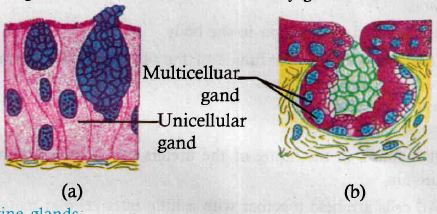
Glandular epithelium
(i) Specialized cuboidal and columnar cells constitute glandular epithelium for secretion.
(ii) Stratified epithelia are built for protection or to resist abrasion.
Types
(a) Unicellular:-
Eg: isolated glandular cells like goblet cells of alimentary canal.
(b) Multicellular:-
Eg: Cluster of cells found in salivary glands.
Exocrine glands
(i) Glands with ducts secrete mucus, saliva, ear wax, oil, milk, digestive enzymes and other cellular products.
Other features and functions of compound epithelium.
(i) Has a limited role in secretion and absorption.
(ii) It may be striated and transitional.
(iii) Cells form many layers (Strata).
Main functions:
(i) To provide protection against mechanical and chemical stresses.
(ii) Covers the dry surface of the skin, the moist surface of buccal cavity, pharynx, inner lining of salivary glands and pancreatic ducts.
Types:
There are four types
(a) Stratified squamous epithelium
(b) Stratified cuboidal epithelium
(c) Stratified columnar epithelium
(d) Transitional epithelium
(a) Stratified squamous epithelium Features:
Divisible into two types
(i) Keratinized
(ii) Non-keratinized
Functions:
(i) Keratinized:- forms the dry epidermis of the skin
(ii) Non-keratinized:- forms the moist lining of the oesophagus, mouth, conjunctiva of eyes and vagina.
(b) Stratified cuboidal epithelium:
Features:
(i) Cells are cubical forming multilayers mostly found in the ducts of sweat and mammary glands.
Function
(ii) Aids in protecting and promoting sweating and lactation.
(c) Stratified columnar epithelium Features:
(i) Has limited distribution in the body.
(ii) It is found around the lumen of the pharynx, male urethra and lining of some glandular ducts.
(d) Transitional epithelium Features:
(i) It is found in the lining of the ureters, urinary bladder and a part of urethra.
(ii) All cells are held together with a little intercellular material.
(iii) There are specialised junctions link between the structural and functional activities between its individual cells.
| S.No. | Types of junctions | Functions |
| (1) | Tight junctions | Help to stop substances from leaking across a tissue |
| (2) | Adhering junctions | Perform cementing to keep neighbouring cells together |
| (3) | Gap junctions | Facilitate the cells to communicate with each other by connecting the cytoplasm of adjoining cells for rapid transfer of ions, many small molecules and some big molecules. |

11th Standard Syllabus & Materials
11th Standard
TN 11th Tamil பீடு பெற நில் - செய்யுள் - காவடிச்சிந்து Important Questions And Answers Study Material - QB365 Set A
NEW11th Standard
TN 11th Tamil பீடு பெற நில் - உரைநடை - மலை இடப்பெயர்கள் : ஓர் ஆய்வு Important Questions And Answers Study Material - QB365 Set A
NEW11th Standard
TN 11th Tamil மாமழை போற்றுதும் - துணைப்பாடம் - யானை டாக்டர் Important Questions And Answers Study Material - QB365 Set A
NEW11th Standard
TN 11th Tamil மாமழை போற்றுதும் - செய்யுள் - ஐங்குறுநூறு Important Questions And Answers Study Material - QB365 Set A



Tamilnadu Stateboard 11th Standard Subjects

Maths

Commerce

Economics
Biology

Business Maths and Statistics

Accountancy

Computer Science

Physics

Chemistry
Maths
Biology
Economics
Physics
Chemistry

History
Business Maths and Statistics

Computer Science
Accountancy

Computer Applications
History
Computer Technology
Commerce
Computer Applications
Computer Technology

Tamil

English

French
Tamilnadu Stateboard Standards



