
 100% FREE ACCESS
11th Standard Syllabus & Materials
11th Standard
TN 11th Tamil இயற்கை வேளாண்மை,சுற்றுச்சூழல் -செய்யுள் - மனோன்மணீயம் Important Questions And Answers Study Material - QB365 Set A
NEW11th Standard
TN 11th Tamil என்னுயிர் என்பேன் -துணைப்பாடம் - இசைத்தமிழர் இருவர் Important Questions And Answers Study Material - QB365 Set A
NEW11th Standard
TN 11th Tamil மொழி கலை -செய்யுள் - ஒவ்வொரு புல்லையும் Important Questions And Answers Study Material - QB365 Set A
NEW11th Standard
TN 11th Tamil பீடு பெற நில் - இலக்கணம் - பகுபத உறுப்புகள் Important Questions And Answers Study Material - QB365 Set A
NEW11th Standard
TN 11th Tamil பீடு பெற நில் - துணைப்பாடம் - வாடிவாசல் Important Questions And Answers Study Material - QB365 Set A
NEW11th Standard
TN 11th Tamil பீடு பெற நில் - செய்யுள் - குறுந்தொகை Important Questions And Answers Study Material - QB365 Set A

Published on: 28/06/2021
QB365 provides detailed and simple solution for every Creative Questions in class 11 Biology Subject. It will helps to get more idea about question pattern in every Creative questions with solution.
Download Tamil Nadu 11th Standard Biology question papers, model tests, one-mark questions, important questions, and public exam papers in PDF format. Free study materials and answer keys for TN State Board students.
Questions + Answers key
Take MCQ Biology Test1.
Identify the parts marked as A, B, C and D for the below diagram
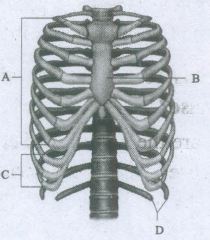
| A | B | C | D | |
|---|---|---|---|---|
| (a) | True ribs | Sternum | False ribs | Floating ribs |
| (b) | Sternum | False ribs | Floating ribs | True ribs |
| (c) | False ribs | Floating ribs | True ribs | Sternum |
| (d) | Floating ribs | True ribs | Sternum | False ribs |
2.
Explain the disorder of rheumatoid heart disease.
3.
What is hypertension?
4.
Distinguish between invertebrates and Vertebrates.
5.
All vertebrates are chordates but all chordates are not vertebrates.
6.
Bioluminence is advantageous to ctenophores.
7.
Why pig nosed frog in India is called Bhupathy's purple frog?
8.
What kind of adaptations extremophiles have to live in the extreme conditions.
9.
What is Five Kingdom classification? Who proposed this?
10.
What are the main criterias for systematics?
11.
What are the key characters of living organisms?
12.
Define "Bio-diversity".
13.
Name any four types of Synovial joints
14.
What is foramen magnum? what is its significance?
15.
What is elastase?
16.
What is the role of mucus cells during respiration?
17.
Why do we breathe faster during any kind of hard physical work?
18.
Write dental formula for human milk teeth.
19.
Certain enzymes are produced in an inactive form and need to be activated before digestion of food. Give reason.
20.
Why is spleen called as graveyard of RBC?
21.
Name the functions of Albumin and Globulin
22.
Do earthworms have power of regeneration?
23.
Differentiate Male & female cockroach.
24.
Name the functions of epithelial tissue
25.
How are muscles classified?
1.
A - True ribs, B - Sternum, C . False ribs, D - Floating ribs
2.
Rheumatic fever is an autoimmune disease which occurs 2-4 weeks after throat infection usually a streptococcal infection. The antibodies developed to combat the infection cause damage to the heart. Effects include fibrous nodules on the mitral valve, fibrosis of the connective tissue and accumulation of fluid in the pericardial cavity.
3.
Hypertension is the most common circulatory disease. The normal blood pressure in man is 120/80 mm Hg. In cases when the diastolic pressure exceeds 90 mm Hg and the systolic pressure exceeds 150 mm Hg persistently, the condition is called hypertension. Uncontrolled hypertension may damage the heart, brain, and kidneys.
4.
| Invertebrates | Vertebrates | ||
| 1. | The major group of animals which do not have notochord or vertebral column are Invertebrates. | 1. | The major group of animals which have vertebral column are vertebrates |
| 2. | These are lower animals | 2. | These are higher animals. |
5.
All Vertebrates have notochord during embryonic development. Later it is replaced by the vertebral column. But in lower chordates like prochordates, vertebral column is not present.
They have only notochord in the adult or larval stage. Hence it is said that all vertebrates are chordates but all chordates do not have vertebrate characters.
6.
Ctenophores are exclusively marine. They emit light. It helps the animals in finding food, mate and escape from the predators.
7.
Scientists have discovered a new and unusual species of frog in the Western Ghats mountain range in India.
The frog has shiny, purple skin. The scientists have called the new species as Bhupathy's purple frog, in honour of their colleague Dr. Subramaniam Bhupathy, a respected herpetologist who lost his life in the Western Ghats in 2014.
8.
(i) Extremophiles are capable of synthesizing their food without sunlight and oxygen by utilizing hydrogen sulphide and other chemicals from the volcanic vents.
(ii) Methanogens produced methane.
(iii) Halophiles live in salty environments and thermoacidophiles thrive in acidic environments and high temperatures.
9.
Five kingdom classification defined by R.H. Whittaker as Monera, Protista, Fungi, Plantae, and Animalia based on the cell structure, mode of nutrition, mode of reproduction and phylogenetic relationships.
10.
The main criteria of systematics is identifying, describing, naming, arranging, preserving and documenting the organisms. Apart from the above said features, evolutionary history of the species and the environmental adaptations and interrelationship between species are also being investigated in systematics.
11.
The key characters of living organisms are, cellular organization, nutrition, respiration, metabolism, growth, response to stimuli, movement, reproduction, excretion, adaptation, and homeostasis.
12.
The presence of a large number of species in a particular ecosystem is called "Biological diversity" or in short 'Bio-diversity'.
13.
a) Pivot joint
b) Gliding joint
c) Ball and Socket joint
d) Hinge joint
14.
(i) It is a large opening which lies at the posterior base of the skull.
(ii) Medulla oblongata of the hind brain descends down the spinal cord through the foramen magnum.
15.
1. Healthy lungs contain large amounts of elastic connective tissue around the alveoli, containing elastin, which makes the lung tissue elastic.
2. People with emphysema and bronchitis have difficulty in exhaling because the enzyme elastase destroys the elastin around the alveoli and reduces the elasticity of the lungs.
16.
1. Mucus membrane lining the airway contains goblet cells which. secrete mucus a slimy material rich in glycoprotein
2. Microorganisms and dust particles attach in the mucus films and are carried upwards to pass down the gullet during normal swallowing.
17.
1. During hard physical work, we require more energy.
2. The metabolism of food increases. This increases the amount of CO2 in the blood.
3. The increase of CO2 concentration in the blood stimulates the respiratory centre of the brain.
4. The brain sends stimulus through nerves for the increase in the rate of respiration. Thus we breathe faster during any kind of hard physical work.
18.
\(I\frac { 2 }{ 2 } ,C\frac { 1 }{ 1 } ,PM\frac { 0 }{ 0 } ,M\frac { 2 }{ 2 } \times 2=20\)
19.
Enzymes like trypsin, pepsin etc. can act on proteins of the tissue lining the digestive tract if food is not available for digestion. Hence they are produced in an inactive form and are activated when food enters the alimentary canal. Salivary amylase is not found in inactive form since it breaks starch. Starch is not a component of tissues.
20.
The average life span of RBC is about 120 days after which they are destroyed in the spleen which is called the graveyard of RBC
21.
Albumin: Maintains the osmotic pressure of the blood.
Globulin: Transports molecules such as oxygen and carbon dioxide.
22.
1. Earthworms have their most important organ in the first 20 segments.
2. If earthworm gets cut after the 20th segment, the anterior half can regenerate, while the posterior half shall disintegrate after some time.
23.
| S.No | Character | Male cockroach | Female cockroach |
| 1 | Abdomen | Long and narrow | Short and broad |
| 2 | Segments | In the abdomen, nine segments are visible | In the abdomen, seven segments are visible |
| 3 | Anal styles | present | Absent. |
24.
The functions of epithelium include protection, absorption, filtration, excretion, secretion and sensory reception
25.
Skeletal muscle, Smooth muscle and Cardiac muscle

11th Standard Syllabus & Materials
11th Standard
TN 11th Tamil பீடு பெற நில் - செய்யுள் - காவடிச்சிந்து Important Questions And Answers Study Material - QB365 Set A
NEW11th Standard
TN 11th Tamil பீடு பெற நில் - உரைநடை - மலை இடப்பெயர்கள் : ஓர் ஆய்வு Important Questions And Answers Study Material - QB365 Set A
NEW11th Standard
TN 11th Tamil மாமழை போற்றுதும் - துணைப்பாடம் - யானை டாக்டர் Important Questions And Answers Study Material - QB365 Set A
NEW11th Standard
TN 11th Tamil மாமழை போற்றுதும் - செய்யுள் - ஐங்குறுநூறு Important Questions And Answers Study Material - QB365 Set A



Tamilnadu Stateboard 11th Standard Subjects

Maths

Commerce

Economics
Biology

Business Maths and Statistics

Accountancy

Computer Science

Physics

Chemistry
Maths
Biology
Economics
Physics
Chemistry

History
Business Maths and Statistics

Computer Science
Accountancy

Computer Applications
History
Computer Technology
Commerce
Computer Applications
Computer Technology

Tamil

English

French
Tamilnadu Stateboard Standards



