
 100% FREE ACCESS
11th Standard Syllabus & Materials
11th Standard
TN 11th Tamil இயற்கை வேளாண்மை,சுற்றுச்சூழல் -செய்யுள் - மனோன்மணீயம் Important Questions And Answers Study Material - QB365 Set A
NEW11th Standard
TN 11th Tamil என்னுயிர் என்பேன் -துணைப்பாடம் - இசைத்தமிழர் இருவர் Important Questions And Answers Study Material - QB365 Set A
NEW11th Standard
TN 11th Tamil மொழி கலை -செய்யுள் - ஒவ்வொரு புல்லையும் Important Questions And Answers Study Material - QB365 Set A
NEW11th Standard
TN 11th Tamil பீடு பெற நில் - இலக்கணம் - பகுபத உறுப்புகள் Important Questions And Answers Study Material - QB365 Set A
NEW11th Standard
TN 11th Tamil பீடு பெற நில் - துணைப்பாடம் - வாடிவாசல் Important Questions And Answers Study Material - QB365 Set A
NEW11th Standard
TN 11th Tamil பீடு பெற நில் - செய்யுள் - குறுந்தொகை Important Questions And Answers Study Material - QB365 Set A

Published on: 28/06/2021
QB365 provides detailed and simple solution for every Creative Questions in class 11 Biology Subject. It will helps to get more idea about question pattern in every Creative questions with solution.
Download Tamil Nadu 11th Standard Biology question papers, model tests, one-mark questions, important questions, and public exam papers in PDF format. Free study materials and answer keys for TN State Board students.
Questions + Answers key
Take MCQ Biology Test1.
Is haemoglobin a conjugated protein?
2.
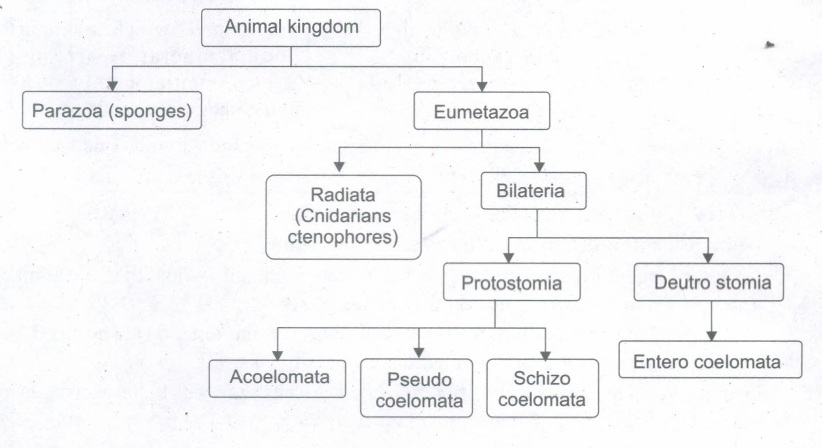
Classify the animal kingdom.
3.
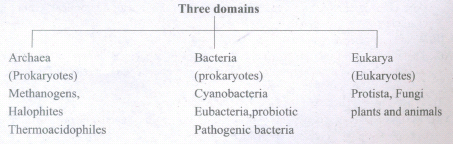
Distinguish Archaea, Bacteria and Eukarya
4.
Describe three domain classification.
5.
Give an account of the General features of subphylum caphalochorelata.
6.
Write few examples for the phylum, Arthopoda.
7.
Write down the difference between the male and female cockroaches.
8.
Write about the type of receptors found in earthworm.
9.
Give an account on the structure of large intestine and its associated structures.
10.
On an educational tour to Nilgiris, Nitish and his friends observed the local people. Few of them were with swollen neck.
Is it a disease? If so what is the cause? How is the disease treated?
11.
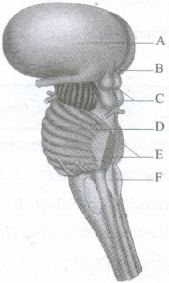
In the diagram given below label any 4 parts.
12.
Differentiate Blind spot and Yellow spot.
13.
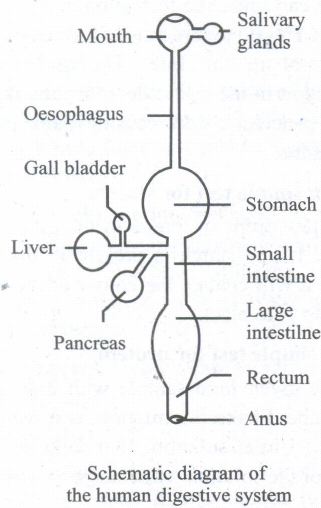
Give a schematic diagram of the human digestive system.
14.
What are the functions of the liver other than secretion of bile?
15.
What is the cause for heart burn?
16.
When blood volume drops down abruptly, what happens to the stroke volume? State whether it increases or decreases?
17.
Draw the dorsal view of brain of frog and label the parts.
18.
How do earthworms sense activity in their habitat without eyes, ears or a nose?
19.
Compare the advantages and disadvantages of direct and indirect development?
20.
How is cephalisation advantageous to animals in finding food?
21.
What is the Significance of Thermus aquaticus?
22.
What is meant by Extremophiles?
23.
Distinguish between Shared character and Derived character
24.
Differentiate between Frog and Toad.
25.
What is called mandibulate or orthopterous type of mouth parts?
1.
Haemoglobin belongs to the class of conjugated protein.
1. The iron containing pigment portion haem constitutes 4%.
2. The colourless protein of the histone class is called globin.
3. Each molecule of Haemoglobin contains four atoms of iron, each of which can combine with a molecule of oxygen.
2.
3.
| S.No | Archaea | Bacteria | Eukarya |
| 1 | Prokaryotic | Prokaryotic | Eukaryotic |
| 2 | They live in environment with extreme conditions like volcano vents, hot springs and polar ice caps | They live in air, water land and on the body of other organisms | They live in all environments. |
| 3 | They use hydrogen sulphide to synthesize food. | They are autotrophic saprophytic and parasitic |
They are autotrophic heterotrophic. |
| 4 | Single-celled | No nucleus DNA as a circular chromosome do not have membrane bound organelles |
have true nucleus DNA as a linear chromosome with histone ribosomes are of the 80s in the cytosol and 70s in chloroplast and mitochondria. |
4.
Three domain classification was proposed by Carl Woese (1977) and his co-workers. They classified organisms based on the difference in 16s rRNA genes. This adds the taxon. domain higher than the kingdom. In this system, prokaryotes are divided into two domains-bacteria and Archaea. All eukaryotes are placed under the domain Eukarya. Archie appears to have common features with Eukarya. Archaea differ from bacteria in cell wall composition and differ from bacteria and eukaryotes in membrane composition and rRNA types.
5.
Cephalochordates are marine forms, found in shallow waters, leading a burrowing mode of life. They are small fish like coelomate forms with chordate characters such us notochord, dorsal tubular nerve cord and pharyngeal gill slits throughout their life. Closed type of circulatory system is seen without heart. Excretion is by protonephridia. Sexes are separate, Fertilization is external. eg. Branchiostoma.
6.
(i) Limulus (King crab, a living fossil)
(ii) Palamnaeus (Scorpion)
(iii) Eupagarus (Hermit crab)
(iv) Apis (Honey bee)
(v) Musca (House fly)
(vi) Vectors - Anopheles, Culex, Aedes (mosquitoes)
(vii) Economically important insects - Apis- (Honey bee), Bombyx (Silk worm)
(viii) Laccifer (Lac insects)
(ix) Living fossils Limulus-(King crab)
7.
| Character | Male Cockroach | Female Cockroach |
|---|---|---|
| Abdomen | Long and narrow. | Short and broad |
| Segments | In the abdomen, nine segments are visible. | In the abdomen, seven segments are visible. |
| Analstyles | Present. | Absent. |
| Terga | 7th tergum covers 8th tergum. | 7th tergum covers 8th and 9th terga |
| Brood pouch | Absent. | Present. |
| Antenna | Longer in length. | Shorter in length |
| Wings | Extends beyond the tip of abdomen | Extends up to the end of abdomen |
8.
The earthworm's receptors are stimulated by a group of slender columnar cells connected with nerves. The Photoreceptors (sense of light) are found on the dorsal surface of the body" Gustatory (sense of taste) and olfactory receptors (sense of smell) are found in the buccal "cavity. Tactile receptors (sense of touch), chemoreceptors (detect chemical changes) and thermoreceptors (changes in temperature) are present in the prostomium and the body wall.
9.
The large intestine consists of caecum, colon and rectum. The caecum is a small blind pouch-like structure that opens into the colon and it possesses a narrow finger-like tubular projection called vermiform appendix. Both caecum and vermiform appendix are large in herbivorous animal and act as an important site for cellulose digestion with the help of symbiotic bacteria. The colon is divided into four regions - an ascending, a transverse, a descending part and a sigmoid colon. The colon is lined by dilations called haustra (singular - haustrum). The "S" shaped sigmoid colon (pelvic colon) opens into the rectum. Rectum is concerned with temporary storage of faeces. The rectum open out through the anus. The anus is guarded by two anal sphincter muscles. The anal mucosa is folded into several vertical folds and contains arteries and veins called anal columns. Anal column may get enlarged. and causes piles or haemorrhoids.
10.
1. Swollen neck is due to Simple goitre, a disease caused by hyposecretion of thyroxine by thyroid gland.
2. It is due to deficiency of iodine which is obtained from salt.
3. In coastal areas the salt content of the soil is good and all fruits, vegetables etc are rich in salts.
4. In hilly areas, the soil has very little salt content so people do not get enough iodine through their diet.
5. Treatment is done by medication.
11.
Brain stem
A- Thalamus
B- Pineal gland
C- Corpora quadrigemina
D- Pons
E- Cerebral peduncle
F- Medulla oblongata
12.
| Blind spot | Yellow spot |
| It is located at the region where the optic nerve and retinal blood vessels enter the eye below posterior pole. | The centre of posterior region of retina is called macula lutea. Which has the yellow spot at the centre |
| It is devoid of photoreceptor cells. | This is rich in cones |
13.
14.
1. Destroys aging and defective blood cells.
2. Stores glucose in the form of glycogen or disperses glucose into the bloodstream with the help of pancreatic hormones.
3. Stores fat soluble vitamins and iron.
4. Detoxifies toxic substances.
15.
If the cardiac sphincter does not contract properly during the churning action of the stomach the gastric juice with acid may flow back into the oesophagus and cause heart burn, resulting in GERD (Gastro Oesophagus Reflex Disorder).
16.
Stroke volume SV = EDV - ESV
EDV - Amount of blood getting collected in ventricle during diastole.
ESV - Volume of blood remaining in ventricle after contraction.
1. Heart's pumping action maintains balance between cardiac output and venous return, Heart is a double pump.
2. Each side of the heart can fail independently of the other.
3. Increase in EDV can increase SV, On the other hand decrease in venous return and EDV can decrease Sv.
4. Similarly changes ·of EDV and ESV on SV are not independent.
17.
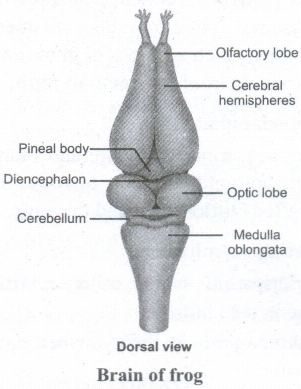
18.
1. The Photoreceptors (sense of light) are found on the dorsal surface of the body.
2. Gustatory (sense of taste) and olfactory receptors (sense of smell) are found in the buccal cavity.
3. Tactile receptors (sense of touch), chemoreceptors (detect chemical changes) and thermoreceptors (changes in temperature) are present in the prostomium and the body wall.
4. Hence they can sense activity in their habitat easily without eyes, ears or a nose.
19.
| Direct development | Indirect development |
| In oviparous animals, the newly hatched young ones resemble the adult. Such a development is called direct development Eg: Cockroach |
The young ones hatched from the eggs do not resemble the adult. They lead an independent life for some time and finally undergo changes to become an adult. these changes from larva to adult are called metamorphosis. Eg: Frog |
Direct Development:
Advantages:
1. The young ones resemble the adult directly and no larval stages occur.
2. The eggs of these animals have lot of yolk for the young ones to grow or are fed by the mother's tissues. (human being) in the larval stages.
3. Parental care is seen in many cases.
Disadvantages:
1. Since the parents and young ones are found in the same habitat. they have to share the same resources.
2. In case of calamities/disasters, they will perish together.
Indirect Development: Advantages:
1. The larval forms are much different from the adult and thrive on different food resources
2. They also grow in a different ecological habitat. Hence in case of calamities, they may continue to exist even if the adults perish.
3. Indirect development is a better means for the species to survive.
Disadvantages:
1. Chances of all larvae developing into adult cannot be assumed.
2. Eggs have very little yolk.
3. Parental care is not seen.
20.
Differentiation of a definite head at the anterior end is called cephalization. The nervous tissue is concentrated in the head (brain) with formation of sense organs.
1. Since the head forms the anterior part of the body, cephalization helps the animal to sense the surroundings with the help of sense organs.
2. They can detect the source of food and also protect themselves from enemies.
3. Formation of head also leads to formation of appendages such as antennae which will be of use in finding food.
21.
1. Thermus aquaticus is a bacterium which can tolerate high temperatures.
2. The first DNA polymerase enzyme was isolated from T. aquaticus. It is used in PCR (Polymerase Chain Reaction) for DNA amplification.
22.
Prokaryotes which have the ability to grow in extreme conditions like volcanic vents, hot springs and polar ice caps are called extremophiles. They have adaptations such as :
1. Capacity to synthesize their food without sunlight and oxygen by utilizing hydrogen sulphide and other chemicals from the volcanic vents.
2. Some of them produce methane (Methanogens).
3. Some live in salty environments (Halophiles).
4. Some are thermoacidophiles which thrive in acidic environments and at high temperature.
23.
1. In a cladogram, a shared character is one that two lineages have in common
2. Derived character is one that evolved in the lineage leading up to a clade.
24.
| S.No | Characters | Frog | Toad |
| 1. | Family | Ranidae | Bufonidae |
| 2. | Body shape | Slender | More Bulky |
| 3. | Legs | Longer | Shorter |
| 4. | Webbed feet | Hind limbs are only webbed | Web Absent |
| 5. | Skin | Smooth and moist skin | Dry and covered with wart like glands |
| 6. | Teeth | Maxillary and Vomerine teeth | Toothless |
| 7. | Egg formation | Lays egg in clusters | Lays eggs in strings |
25.
(i) The appendages form mouth parts, which are of biting and chewing type. This is called mandibulate or orthopterous type.
(ii) So cockroach belong to mandibulata
(iii) This type of mouth part is called as the fundamental type as in human beings.

11th Standard Syllabus & Materials
11th Standard
TN 11th Tamil பீடு பெற நில் - செய்யுள் - காவடிச்சிந்து Important Questions And Answers Study Material - QB365 Set A
NEW11th Standard
TN 11th Tamil பீடு பெற நில் - உரைநடை - மலை இடப்பெயர்கள் : ஓர் ஆய்வு Important Questions And Answers Study Material - QB365 Set A
NEW11th Standard
TN 11th Tamil மாமழை போற்றுதும் - துணைப்பாடம் - யானை டாக்டர் Important Questions And Answers Study Material - QB365 Set A
NEW11th Standard
TN 11th Tamil மாமழை போற்றுதும் - செய்யுள் - ஐங்குறுநூறு Important Questions And Answers Study Material - QB365 Set A



Tamilnadu Stateboard 11th Standard Subjects

Maths

Commerce

Economics
Biology

Business Maths and Statistics

Accountancy

Computer Science

Physics

Chemistry
Maths
Biology
Economics
Physics
Chemistry

History
Business Maths and Statistics

Computer Science
Accountancy

Computer Applications
History
Computer Technology
Commerce
Computer Applications
Computer Technology

Tamil

English

French
Tamilnadu Stateboard Standards



