
 100% FREE ACCESS
11th Standard Syllabus & Materials
11th Standard
TN 11th Tamil இயற்கை வேளாண்மை,சுற்றுச்சூழல் -செய்யுள் - மனோன்மணீயம் Important Questions And Answers Study Material - QB365 Set A
NEW11th Standard
TN 11th Tamil என்னுயிர் என்பேன் -துணைப்பாடம் - இசைத்தமிழர் இருவர் Important Questions And Answers Study Material - QB365 Set A
NEW11th Standard
TN 11th Tamil மொழி கலை -செய்யுள் - ஒவ்வொரு புல்லையும் Important Questions And Answers Study Material - QB365 Set A
NEW11th Standard
TN 11th Tamil பீடு பெற நில் - இலக்கணம் - பகுபத உறுப்புகள் Important Questions And Answers Study Material - QB365 Set A
NEW11th Standard
TN 11th Tamil பீடு பெற நில் - துணைப்பாடம் - வாடிவாசல் Important Questions And Answers Study Material - QB365 Set A
NEW11th Standard
TN 11th Tamil பீடு பெற நில் - செய்யுள் - குறுந்தொகை Important Questions And Answers Study Material - QB365 Set A

Published on: 26/06/2021
QB365 provides detailed and simple solution for every Creative Questions in class 11 Biology Subject. It will helps to get more idea about question pattern in every Creative questions with solution.
Download Tamil Nadu 11th Standard Biology question papers, model tests, one-mark questions, important questions, and public exam papers in PDF format. Free study materials and answer keys for TN State Board students.
Questions + Answers key
Take MCQ Biology Test1.
Explain the process of absorption of the digested food.
2.
Explain the digestion in the stomach.
3.
Explain the internal structure of the gut.
4.
Explain the structure of the liver with diagram. Add a note on its functions.
5.
Explain the process of physiology of digestion of fats.
1.
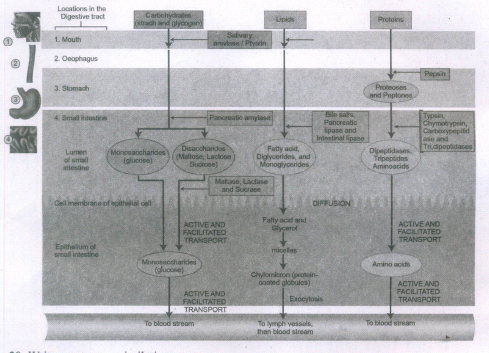
Absorption is a process by which the end product of digestion passes through the intestinal mucosa into the blood and lymph. The villi in the lumen of ileum are the absorbing units, consisting of a lacteal duct in the middle surrounded by fine network of blood capillaries. The process of absorption involves active, passive and facilitated transport. Small amounts of glucose, amino acids and electrolytes like chloride ions are generally absorbed by simple diffusion. The passage of these substances into the blood depends upon concentration gradients. However, some of the substances like fructose are absorbed with the help of the carrier ions like Na". This mechanism is called facilitated transport. Nutrients like amino acids, glucose and electrolytes like Na" are absorbed into the blood against the concentration gradient by active transport. The insoluble substances like fatty acids, glycerol and fat-soluble vitamins are first incorporated into small, spherical water-soluble droplets called micelles and are absorbed into the intestinal mucosa where they are re-synthesized into protein coated fat globules called chylomicrons which are then transported into the lacteals within the intestinal villi and eventually empty into lymphatic duct. The lymphatic ducts ultimately release the absorbed substances into the blood stream. While the fatty acids are absorbed by the lymph duct, other materials are absorbed either actively or passively by the capillaries of the villi (Figure). Water-soluble vitamins are absorbed by simple diffusion or active transport. Transport of water depends upon the osmotic gradient. Absorption of substances in the alimentary canal takes place in mouth, stomach, small intestine and large intestine. However maximum absorption takes place in the small intestine. Absorption of simple sugars, alcohol and medicines takes place in the stomach. Certain drugs are absorbed by blood capillaries in the lower side of the tongue and mucosa of mouth. Large intestine is also involved in absorption of more amounts of water, vitamins, some minerals and certain drugs.
2.
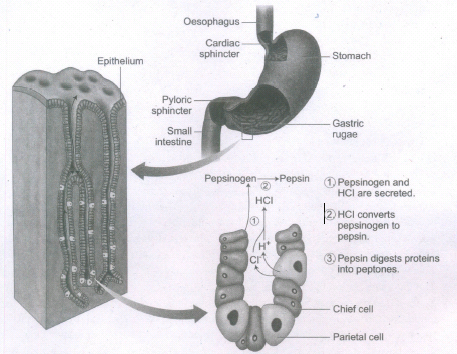
Food remains in the stomach for 4 to 5 hours, the rhythmic peristaltic movement churns and mixes the food with gastric juice and make it into a creamy liquid called chyme. The gastric secretion is partly controlled by autonomic reflexes. The secretion of gastric juice begins when the food is in the mouth. The gastric juice contains HCI and proenzymes. The proenzyme pepsinogen, on exposure to HCI gets converted into the active enzyme pepsin which converts proteins into proteoses and peptones (peptides). The HCI provides an acidic medium (pH 1.8) which is optimum for pepsin, kills bacteria and other harmful organisms and avoids putrifaction. The mucus and bicarbonates present in the gastric juice play an important role in lubrication and protection of the mucosal epithelium from the eroding nature of the highly acidic HCI (Figure). Another proteolytic enzyme found in gastric juice of infants is rennin which helps in the digestion of milk protein, caseinogen to casein in the presence of \ calcium ions. This enzyme secretion gradually reduces with aging.
3.
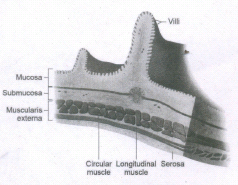
The wall of the alimentary canal from oesophagus to rectum consists of four layers (Figure) namely serosa, muscularis, sub-mucosa and mucosa. The serosa (visceral peritoneum) is the outermost layer and is made up of thin squamous epithelium with some connective tissues. Muscularis is made of smooth circular and longitudinal muscle fibres with a network of nerve cells and parasympathetic nerve fibres which controls peristalsis. The submucosal layer is formed of loose connective tissue containing nerves, blood, lymph vessels and the sympathetic nerve fibres that control the secretions of intestinal juice. The innermost layer lining the lumen of the alimentary canal is the mucosa which secretes mucous.
4.
Structure of the Liver:
1. The liver, the largest gland in our body is situated in the upper right side of the abdominal cavity, just below the diaphragm.
2. The liver consists of two major left and right lobes; and two minor lobes. These lobes are connected with the diaphragm. Each lobe has many hepatic lobules (functional unit of the liver) and is covered by a thin connective tissue sheath called the Glisson's capsule.
3. Liver cells (hepatic cells) secrete bile which is stored and concentrated in a thin muscular sac called the gallbladder.
4. The duct of gallbladder (cystic duct) along with the hepatic duct from the liver forms the common bile duct. The bile duct passes downwards and joins with the main pancreatic duct to form a common duct called hepato-pancreatic duct.
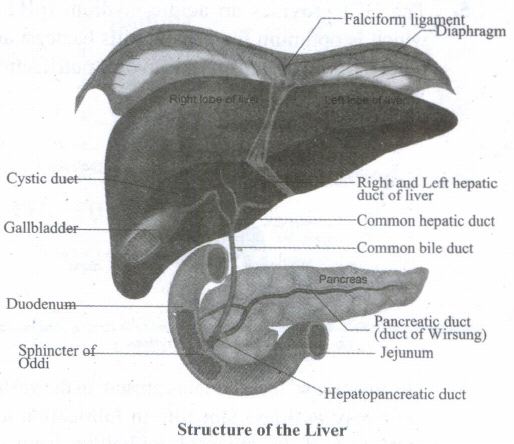
5. The opening of the hepato-pancreatic duct into' the duodenum is guarded by a sphincter called the sphincter of Oddi. The liver has the high power of regeneration and liver cells are replaced by new ones every 3-4 weeks.
Apart from bile secretion, the liver also performs several functions. They are
1. Destroys ageing and defective blood cells.
2. Stores glucose in the form of glycogen or disperses glucose into the bloodstream with the help of pancreatic hormones.
3. Stores of fat-soluble vitamins and iron.
4. Detoxifies toxic substances.
5. Involves in the synthesis of non-essential amino acids and urea
5.
(a) Stomach
(i) Weak lipase found in gastric juice emulsifies and saponifies fats in the presence of HCl.
(b) Duodenum of small intestine
(i) Pancreatic lipase acts on fats or emulsified and saponified fats in duodenum
Enzyme reaction
Lipase + fats → Di and monoglycerides
(c) Jejunum of small intestine
(i) Intestinal juice or succus entericus contains lipases enzymes.
Enzymatic reaction
Diglycerides and Monoglycerides \(\underrightarrow { Lipases } \) Fatty acids + Glycerol

11th Standard Syllabus & Materials
11th Standard
TN 11th Tamil பீடு பெற நில் - செய்யுள் - காவடிச்சிந்து Important Questions And Answers Study Material - QB365 Set A
NEW11th Standard
TN 11th Tamil பீடு பெற நில் - உரைநடை - மலை இடப்பெயர்கள் : ஓர் ஆய்வு Important Questions And Answers Study Material - QB365 Set A
NEW11th Standard
TN 11th Tamil மாமழை போற்றுதும் - துணைப்பாடம் - யானை டாக்டர் Important Questions And Answers Study Material - QB365 Set A
NEW11th Standard
TN 11th Tamil மாமழை போற்றுதும் - செய்யுள் - ஐங்குறுநூறு Important Questions And Answers Study Material - QB365 Set A



Tamilnadu Stateboard 11th Standard Subjects

Maths

Commerce

Economics
Biology

Business Maths and Statistics

Accountancy

Computer Science

Physics

Chemistry
Maths
Biology
Economics
Physics
Chemistry

History
Business Maths and Statistics

Computer Science
Accountancy

Computer Applications
History
Computer Technology
Commerce
Computer Applications
Computer Technology

Tamil

English

French
Tamilnadu Stateboard Standards



