
 100% FREE ACCESS
11th Standard Syllabus & Materials
11th Standard
TN 11th Tamil இயற்கை வேளாண்மை,சுற்றுச்சூழல் -செய்யுள் - மனோன்மணீயம் Important Questions And Answers Study Material - QB365 Set A
NEW11th Standard
TN 11th Tamil என்னுயிர் என்பேன் -துணைப்பாடம் - இசைத்தமிழர் இருவர் Important Questions And Answers Study Material - QB365 Set A
NEW11th Standard
TN 11th Tamil மொழி கலை -செய்யுள் - ஒவ்வொரு புல்லையும் Important Questions And Answers Study Material - QB365 Set A
NEW11th Standard
TN 11th Tamil பீடு பெற நில் - இலக்கணம் - பகுபத உறுப்புகள் Important Questions And Answers Study Material - QB365 Set A
NEW11th Standard
TN 11th Tamil பீடு பெற நில் - துணைப்பாடம் - வாடிவாசல் Important Questions And Answers Study Material - QB365 Set A
NEW11th Standard
TN 11th Tamil பீடு பெற நில் - செய்யுள் - குறுந்தொகை Important Questions And Answers Study Material - QB365 Set A

Published on: 26/06/2021
QB365 provides detailed and simple solution for every Creative Questions in class 11 Biology Subject. It will helps to get more idea about question pattern in every Creative questions with solution.
Download Tamil Nadu 11th Standard Biology question papers, model tests, one-mark questions, important questions, and public exam papers in PDF format. Free study materials and answer keys for TN State Board students.
Questions + Answers key
Take MCQ Biology Test1.
2.
Write short note on the following:
(i) Indigestion,
(ii) Constipation,
(iii) Vomiting,
(iv) Jaundice,
(v) Liver cirrhosis,
(vi) Gall stones,
(vii) Appenditicitis,
(viii) Hiotus hernia.
3.
Explain the process of digestion in the stomach (OR)
What happens when food enters the stomach and explain the role of HCI in digestion process.
4.
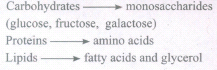
Explain the process of physiology digestions of proteins.
5.
How does digestion occur in buccal cavity?
1.
2.
(i) Indigestion: It is a digestive disorder in which the food is not properly digested leading to a feeling of fullness of stomach. It may be due to inadequate enzyme secretion, anxiety, food poisoning, overeating and spicy food.
(ii) Constipation: In this condition, the faeces are retained within the rectum because of irregular bowel movement due to poor intake of fibre in the diet and lack of physical activities.
(iii) Vomiting: It is reverse peristalsis. Harmful substances and contaminated food from stomach are ejected through the mouth. This action is controlled by the vomit centre located in the medulla oblongata. A feeling of nausea precedes vomiting.
(iv) Jaundice: It is the condition in which liver is affected and the defective liver fails to break down haemoglobin and to remove bile pigments from the blood. Deposition of these pigments changes the colour of eye and skin yellow. Sometimes, jaundice is caused due to hepatitis viral infections.
(v) Liver cirrhosis: Chronic disease 'of liver results in degeneration and destruction of liver cells resulting in abnormal blood vessel and bile duct leading to the formation of fibrosis.
(vi) Gall Stones: Any alteration in the composition of the bile can cause the formation of stones in the gallbladder. The stones are mostly formed of crystallized cholesterol in the bile. The gallstone causes obstruction in the cystic duct, hepatic duct and also hepato-pancreatic duct causing pain, jaundice and pancreatitis.
(vii) Appendicitis: It is the inflammation of the vermiform appendix, leading to severe abdominal pain. The treatment involves the removal of appendix by surgery. If treatment is delayed the appendix may rupture and results in infection of the abdomen, called peritonitis.
(viii) Hiatus hernia (Diaphragmatic hernia): It is a structural abnormality in which superior part of the stomach protrudes slightly above the diaphragm. In some people, injury or other damage may weaken muscle tissue, by applying too much pressure (repeatedly) on the muscles around the stomach while coughing, vomiting, and straining during bowel movement and lifting a heavy object. Heart bum is also common in those with a hiatus hernia. In this condition, stomach contents travel back into the oesophagus or even into oral cavity and causes pain in the centre of the chest due to the eroding nature of acidity.
3.
Digestion in the stomach:
1. Food remains in the stomach for 4 to 5 hours, the rhythmic peristaltic movement churns and mixes the food with gastric juice and make it into a creamy liquid called chyme.
2. The gastric secretion is partly controlled by autonomic reflexes.
3. The secretion of gastric juice begins when the food is in the mouth.
4. The gastric juice contains HCI and proenzymes. The proenzyme pepsinogen, on exposure to HCI gets converted into the active enzyme pepsin which converts proteins into proteoses and peptones (peptides).
5. The HCI provides an acidic medium (PH1.8) which is optimum for pepsin, kills bacteria and other harmful organisms and avoids putrefaction.
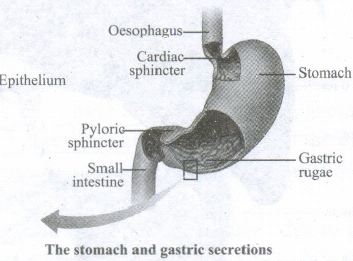
6. The mucus and bicarbonates present in the gastric juice play an important role in lubrication and protection of the mucosal epithelium from the eroding nature of the highly acidic HCI.
7. Another proteolytic enzyme found in gastric juice of infants is rennin helps in the digestion of milk protein, caseinogen to casein in the presence of calcium ions. This enzyme secretion gradually reduces with aging.
4.
(a) Stomach
(i) The acidic medium of gastric juice (1.8 pH) mainly aids in the digestion of proteins
(ii) The digestion of proteins starts in the stomach.
(iii) After a meal gastric artery supplies more oxygenated blood for the stomach for the digestion of proteins.
(iv) HCI secreted by oxyntic cells activates the pepsinogen and rennin for the digestion of proteins.
(v) Inactive pepsinogen and inactive rennin are the precursors of active enzymes found in gastric juice secreted by parietal cells
Enzymatic reactions
(i) Proteins + pepsinogen + HCl → pepsin
(ii) Pepsin proteins → polypeptides + tri, dipeptides + amino acids
(iii) Rennin + HCl + milk protein casein → curd
(b) Duodenum
(i) Pancreatic juice containing inactive enzymes like chymotrypsinogen and trypsinogen and active carboxyl peptidase involves in the digestion of proteins
(ii) The catalytic enzyme converts in active enzyme chymotrypsinogen into active chymotrypsin and inactive, trypsinogen into active trypsin
Enzymatic reactions:
(i) Chymotrypsin + proteins → polypeptides + tri, dipeptides and amino acids
(ii) Trypsin + protein →polypeptides + tri, di peptides and amino acids
(iii) Carboxyl peptidase + polypeptides + tri, di peptides → free amino acids
(c) Small intestine
(i) Intestinal juice or succus entericus contains an enzyme peptidase
Enzymatic reaction
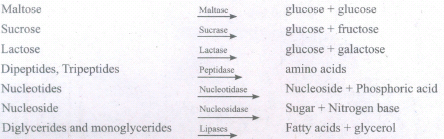
Dipeptides, Tripeptides + Peptidase → Free amino acids
5.
(i) The mechanical stimulation of smell, sight and taste is responded.
(ii) This stimulation results in the secretion of saliva.
(iii) Grinding, chewing, cutting and tearing of food in the mouth refer to mechanical functions by teeth. It is called as mastication.
(iv) Water, electrolytes (Na+, K+, Cl-, HCO3-), salivary amylase (ptyalin).
(v) An antibacterial enzyme lysozome and a lubricating agent mucus (glycoprotein) are the constituents of saliva.
(vi) 30% of starch is hydrolysed by ptyalin.
(vii) Cooked starch in ingested food is converted into a disaccharide (maltose)

11th Standard Syllabus & Materials
11th Standard
TN 11th Tamil பீடு பெற நில் - செய்யுள் - காவடிச்சிந்து Important Questions And Answers Study Material - QB365 Set A
NEW11th Standard
TN 11th Tamil பீடு பெற நில் - உரைநடை - மலை இடப்பெயர்கள் : ஓர் ஆய்வு Important Questions And Answers Study Material - QB365 Set A
NEW11th Standard
TN 11th Tamil மாமழை போற்றுதும் - துணைப்பாடம் - யானை டாக்டர் Important Questions And Answers Study Material - QB365 Set A
NEW11th Standard
TN 11th Tamil மாமழை போற்றுதும் - செய்யுள் - ஐங்குறுநூறு Important Questions And Answers Study Material - QB365 Set A



Tamilnadu Stateboard 11th Standard Subjects

Maths

Commerce

Economics
Biology

Business Maths and Statistics

Accountancy

Computer Science

Physics

Chemistry
Maths
Biology
Economics
Physics
Chemistry

History
Business Maths and Statistics

Computer Science
Accountancy

Computer Applications
History
Computer Technology
Commerce
Computer Applications
Computer Technology

Tamil

English

French
Tamilnadu Stateboard Standards



