
 100% FREE ACCESS
11th Standard Syllabus & Materials
11th Standard
TN 11th Tamil இயற்கை வேளாண்மை,சுற்றுச்சூழல் -செய்யுள் - மனோன்மணீயம் Important Questions And Answers Study Material - QB365 Set A
NEW11th Standard
TN 11th Tamil என்னுயிர் என்பேன் -துணைப்பாடம் - இசைத்தமிழர் இருவர் Important Questions And Answers Study Material - QB365 Set A
NEW11th Standard
TN 11th Tamil மொழி கலை -செய்யுள் - ஒவ்வொரு புல்லையும் Important Questions And Answers Study Material - QB365 Set A
NEW11th Standard
TN 11th Tamil பீடு பெற நில் - இலக்கணம் - பகுபத உறுப்புகள் Important Questions And Answers Study Material - QB365 Set A
NEW11th Standard
TN 11th Tamil பீடு பெற நில் - துணைப்பாடம் - வாடிவாசல் Important Questions And Answers Study Material - QB365 Set A
NEW11th Standard
TN 11th Tamil பீடு பெற நில் - செய்யுள் - குறுந்தொகை Important Questions And Answers Study Material - QB365 Set A

Published on: 13/05/2022
QB365 provides detailed and simple solution for every Creative Questions in class 11 Biology Subject. It will helps to get more idea about question pattern in every Creative questions with solution.
latest Creative QuestionsDownload Tamil Nadu 11th Standard Biology question papers, model tests, one-mark questions, important questions, and public exam papers in PDF format. Free study materials and answer keys for TN State Board students.
Questions + Answers key
Take MCQ Biology Test1.
Malfunctioning of the kidneys can be treated by haemodialysis? Explain.
2.
Explain the tubular reabsorption process of urine formation.
3.
Write a note on
a) Uremia
b) Renal Calculi
4.
Explain the structure of nephron.
5.
Describe the features of human kidney.
1.
1. Malfunctioning of the kidneys can lead to accumalation of urea and other toxic substances, leading to kidney failure. In such patients toxic urea can be removed from the blood by a process called haemodlalysis
2. A dialysing machine or an artificial kidney is connected to the patient's body. A dialysing machine consists of a long cellulose tube surrounded by the dialysing fluid in a water bath.
3. The patient's blood is drawn from a convenient artery and pumped into the dialysing unit after adding an anticoagulant like heparin.
4. The tiny pores in the dialysis tube allows small molecules such as glucose, salts and urea to enter into the water bath, whereas blood cells and protein molecules do not enter these pores.
5. This stage is similar to the filtration process in the glomerulus. The dialysing liquid in the water bath consists of solution of salt and sugar in correct proportion in order to prevent loss of glucose and essential salts from the blood.
6. The cleared blood is then llutnQed back. to the. body through a vein.
2.
This is the second step in process of urine formation Tubular Reabsorption:
1. This involves movement of the filtrate back into the circulation.
2. The volume of filtrate formed per day is around 170-180 L and the urine released is around 1.5 L per day, i.e., nearly 99% of the glomerular filtrate that has to be reabsorbed by the renal tubules as it contains certain substances needed by the body. This process is called selective reabsorption.
3. Reabsorption takes place by the tubular epithelial cells in different segments of the nephron either by active transport or passive transport, diffusion and osmosis.
4. Proximal convoluted Tubule (PCT) Glucose, lactate, amino acids, Na+ and water in the filtrate is reabsorbed in the PCT. Sodium is reabsorbed by active transport through sodium- potassium (Na+ - K+) pump in the PCT. Small amounts of urea and uric acid are also reabsorbed.
5. Descending limb of Henle's loop is permeable to water due the presence of aquaporins, but not permeable to salts. Water is lost in the descending limb, hence Na+ and cr gets concentrated in the filtrate.
6. Ascending limb of Henle's loop is impermeable to water but permeable to solutes such as Na+, CI- andK+.
7. The distal convoluted tubule recovers water and secretes potassium into the tubule. Na+, Cland water remains in the filtrate of the DCT.
8. Most of the reabsorption from this point is dependent on the body's need and is regulated by hormones. Reabsorption of bicarbonate (HC03-) takes place to regulate the blood pH. Homeostasis of K+ and Na+ in the blood is also regulated in this region.
9. Collecting duct is permeable to water, secretes K+ (potassium ions are actively transported into the tubule) and reabsorbs Na+ to produce concentrated urine. The change in permeability to water is due to the presence of number of water-permeable channels called aquaporins.
3.
Uremia:
1. Uremia is characterized by increase in urea and other non-protein nitrogenous substances like uric acid and creatinine in blood.
2. Normal urea level in human blood is about 17-30mg/LOOmL of blood. The urea concentration rises as 10 times of normal levels during chronic renal failure.
Renal calculi:
1. Renal calculi, also called renal stone or nephrolithiasis, is the formation of hard stone like masses in the renal tubules of renal pelvis.
2. It is mainly due to the accumulation of soluble crystals of salts of sodium oxalates and certain phosphates.
3. This result in severe pain called "renal colic pain" and can cause scars in the kidneys. Renal stones can be removed by techniques like pyleothotomy or lithotripsy.
4.
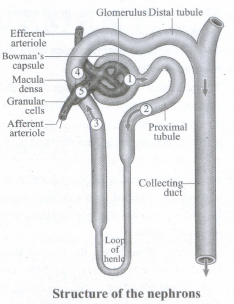
Nephrons
(i) Functional units of kidneys.
(ii) Consists of head as filtering malpighian body/capsule and a renal tubule.
(iii) Renal tube opens into a longer tubule called collecting duct.
(iv) Malpighian capsule is double walled.
(v) Capsule encloses a glomerulus formed of afferent and efferent arterioles.
(vi) Bowman's cup/capsule and glomerulus are together called as renal capsule.
(vii) The minute apertures called fenestrae are found in endothelium of glomerulus.
(viii) Peripheral layer of capsule is made up of squamous epithelium.
(ix) The visceral layer of capsule is made up of modified epithelial cells called podocytes.
(x) Podocytes end in foot process closer to basement membrane of the glomerulus.
(xi) Filtration slits lie between the foot processes.
(xii) The proximal convoluted tubule(PCT) starts from capsule.
(xiii) PCT is followed by 'U' shaped Henle's loop(HL) found with descending and ascending limbs.
(xiv) Ascending limb opens into distal convoluted tubule(DCT).
(xv) DCT of many nephrons open into a straight tube called collecting duct(CD).
(xvi) CD runs through the renal/medullary pyramids in the site of pelvis of ureter.
(xvii) CDs fuse to form papillary duct(PD).
(xviii) PD delivers urine into the calyces which finally open into pelvis.
(xix) PCT and DCT are found in an outer cortex of kidney.
(xx) HL is found in an inner medulla of kidney.
(xxi) Mostly nephrons of HL are very short and extend into cortical nephrons in peripheral area of medulla.
(xxii) Nephrons with a long loop of HL run deep into medulla and are called Juxta medullary nephrons(JMN).
(xxiii) The first capillary bed of the nephrons is the glomerulus and the other is the peritubular capillaries.
(xxiv) The glomerular capillary bed is supplied by the afferent drained by the efferent arterioles.
(xxv) A fine capillary network around the renal tubule forms peritubular capillaries.
(xxvi) The efferent arteriole serving the JMN forms the bundles of long straight vessel called vasa recta.
(xxvii) The vasa recta runs parallel to the HL.
(xxviii) Vasa recta is absent or reduced in cortical nephrons.
5.
Kidneys-external
(i) A paired bean-shaped kidney lie one on either side of the vertebral column.
(ii) Kidneys are covered by renal capsule.
(iii) Kidneys are reddish brown in colour.
(iv) Each kidney weighs about 120-170 grams.
(v) The envelops of kidney are
(a) Renal fascia
(b) Peritoneal fat capsule
(c) Fibrous capsule
(vi) In the superior lumbar region lies the kidney at the levels of the last thoracic vertebra(T12) and third lumbar vertebra(L3).
(vii) The right kidney is placed slightly lower than the left kidney because a large right lobe of liver occupies more space in lower abdominal cavity.
Kidneys-Internal Region
(i) The longitudinal section(Ls) of kidney shows two regions
(a) cortex
(i) An outer region of kidney extends in between medullary pyramids as the renal columns of Bertini.
(ii) Renal artery enters the kidney.
(iii) Renal vein and pelvis of ureter come out of kidney.
(iv) An inner concave surface shows a notch called hilum.
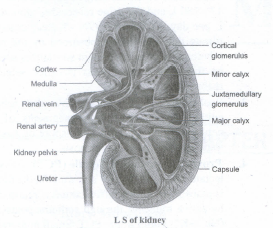
(b) Medulla
(i) An inner medulla is divisible into few conical tissue masses called renal pyramids or medullary pyramids.
(ii) Hilum is the passage of blood vessels, pelvis of ureter and nerves.
(iii) Inner to the hilum is a broad funnel shaped space called renal pelvis found with projections called calyces.
(iv) Pelvis is continuous with the ureter.
(v) The walls of the calyces, pelvis and ureter have smooth muscles which contract rhythmically.
(vi) The calyces collect the urine and empties into the ureter.
(vii) Bladder stores urine temporarily.
(viii) Bladder opens into urethra.
(ix) Urethra opens exterior to release out urine.

11th Standard Syllabus & Materials
11th Standard
TN 11th Tamil பீடு பெற நில் - செய்யுள் - காவடிச்சிந்து Important Questions And Answers Study Material - QB365 Set A
NEW11th Standard
TN 11th Tamil பீடு பெற நில் - உரைநடை - மலை இடப்பெயர்கள் : ஓர் ஆய்வு Important Questions And Answers Study Material - QB365 Set A
NEW11th Standard
TN 11th Tamil மாமழை போற்றுதும் - துணைப்பாடம் - யானை டாக்டர் Important Questions And Answers Study Material - QB365 Set A
NEW11th Standard
TN 11th Tamil மாமழை போற்றுதும் - செய்யுள் - ஐங்குறுநூறு Important Questions And Answers Study Material - QB365 Set A



Tamilnadu Stateboard 11th Standard Subjects

Maths

Commerce

Economics
Biology

Business Maths and Statistics

Accountancy

Computer Science

Physics

Chemistry
Maths
Biology
Economics
Physics
Chemistry

History
Business Maths and Statistics

Computer Science
Accountancy

Computer Applications
History
Computer Technology
Commerce
Computer Applications
Computer Technology

Tamil

English

French
Tamilnadu Stateboard Standards



