
 100% FREE ACCESS
11th Standard Syllabus & Materials
11th Standard
TN 11th Tamil இயற்கை வேளாண்மை,சுற்றுச்சூழல் -செய்யுள் - மனோன்மணீயம் Important Questions And Answers Study Material - QB365 Set A
NEW11th Standard
TN 11th Tamil என்னுயிர் என்பேன் -துணைப்பாடம் - இசைத்தமிழர் இருவர் Important Questions And Answers Study Material - QB365 Set A
NEW11th Standard
TN 11th Tamil மொழி கலை -செய்யுள் - ஒவ்வொரு புல்லையும் Important Questions And Answers Study Material - QB365 Set A
NEW11th Standard
TN 11th Tamil பீடு பெற நில் - இலக்கணம் - பகுபத உறுப்புகள் Important Questions And Answers Study Material - QB365 Set A
NEW11th Standard
TN 11th Tamil பீடு பெற நில் - துணைப்பாடம் - வாடிவாசல் Important Questions And Answers Study Material - QB365 Set A
NEW11th Standard
TN 11th Tamil பீடு பெற நில் - செய்யுள் - குறுந்தொகை Important Questions And Answers Study Material - QB365 Set A

Published on: 26/06/2021
QB365 provides detailed and simple solution for every Creative Questions in class 11 Biology Subject. It will helps to get more idea about question pattern in every Creative questions with solution.
Download Tamil Nadu 11th Standard Biology question papers, model tests, one-mark questions, important questions, and public exam papers in PDF format. Free study materials and answer keys for TN State Board students.
Questions + Answers key
Take MCQ Biology Test1.
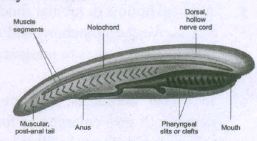
Explain the distinct features of Phylum Chordata.
2.
Write the general characters of the Class mammalia.
3.
What are the fundamental distinct features of all chordates?
4.
List the differences between Flatworms and Roundworms.
5.
List the salient features of phylum Annelida.
1.
Chordata is the largest phylum with most familiar group of animals, such as fishes, amphibians, reptiles, birds and mammals and less known forms such as lancelets (Amphioxus) and tunicates (Ascidian). All chordates possess three fundamental distinct features at some stage of their life cyele.
1. Presence of elongated rod like notochord below the nerve cord and above the alimentary canal. It serves as a primitive internal skeleton.
2. It may persist throughout life in lancelets and lampreys. In adult vertebrates, it may be partially or completely replaced by backbone or vertebral column.
3. A dorsal hollow or tubular fluid filled nerve cord lies above the notochord and below the dorsal body wall. It serves to integrate and co-ordinate the body functions
2.
(i) Their body is covered by hair, a unique feature of mammals. Some of them are adapted to fly or live in water.
(ii) Presence of mammary glands-is the most unique feature of mammals.
(iii) They have two pairs of limbs adapted for walking, running, climbing, burrowing, swimming and flying.
(iv) Their skin is glandular in nature, consisting of sweat glands, scent glands and sebaceous glands.
(v) Exoskeleton includes horny epidermal horns, spines, scales, claws, nails, hooves and bony dermal plates.
(vi) Teeth are thecodont, heterodont and diphyodont.
(vii) External ears or pinnae are present.
(viii) The heart is four chambered and possess a left systematic arch. Mature RBCs are circular, biconcave and non nucleated.
(ix) Mammals have a large brain when compared to other animals.
(x) They show greatest intelligence among all animals. Their kidneys are metanephric and are ureotelic.
(xi) All are homeothermic, sexes are separate and fertilization is internal.
(xii) eg. Platypus, Kangaroo, Monkey, Elephant.
3.
All chordates possess three fundamental distinct features at some stage of their life cycle, they are:
(i) Presence of elongated rod like notochord below the nerve cord and above the alimentary canal. It serves as a primitive internal skeleton. It may persist throughout life in lancelets and lampreys. In adult vertebrates, it may be partially or completely replaced by backbone or vertebral column.
(ii) A dorsal hollow or tubular fluid filled nerve cord lies above the notochord and below the dorsal body wall. It serves to integrate and co-ordinate the body functions. In higher chordates, the anterior end of the nerve cord gets enlarged to form the brain and the posterior part becomes the spinal cord, protected inside the vertebral column.
(iii) Presence of pharyngeal gill slits or clefts in all chordates at some stage of their life cycle. It is a series of gill slits or clefts that perforates the walls of pharynx and appears during the development of every chordate. In aquatic forms, pharyngeal gill slits are vascular, lamellar and form the gills for respiration. In terrestrial chordates, traces of non-functional gill clefts appear during embryonic developmental stages and disappear later. Besides the above said features, chordates are bilaterally symmetrical, triploblastic, coelomates with organ system level of organisation; they possess post anal tail, closed circulatory system with a ventral myogenic heart except in Amphioxus.
4.
| Flatworm | Roundworms |
| 1. Mostly parasitic but some are free living Eg: Taenia |
Mostly endoparasites but some are free-living. Eg: Ascaris |
| 2. Body dorsoventrally flattened, triploblastic. | Body bilaterally symmetrical, elongated. |
| 3. Acoelomate worms | Pseudocoelomate worms. |
| 4. Excretion by flame cells. | Excretory system consists of Rennet glands. |
| 5. Digestive system is absent or incomplete. | Alimentary canal is complete with well-developed mouth, muscular pharynx and anus. |
| 6. Sexes are not separate. | Sexual dimorphism is seen. |
5.
Salient features of phylum Annelida:
1. Annelids were the first segmented animals to evolve. They are aquatic or terrestrial, free-living but some are parasitic.
2. They are triploblastic, bilaterally symmetrical, schizocoelomates and exhibit organ system level of body organisation. The coelom with coelomic fluid creates a hydrostatic skeleton and aids in locomotion.
3. Their elongated body is metamerically segmented and the body surface is divided into segments or metameres.
4. Internally the segments are divided from one another by partitions called septa. This phenomenon is known as metamerism. The longitudinal and circular muscles in the body wall help in locomotion.
5. Aquatic annelids like Nereis have lateral appendages called parapodia, which help in swimming. Chitinous setae in Earthworms, and suckers in Leech help in locomotion.
6. The circulatory system is of closed type and the respiratory pigments are hemoglobin and chlorocruorin.
7. Nervous system consists of paired ganglia connected by the lateral nerves to the double ventral nerve cord.
8. They reproduce sexually. Development is direct or indirect and includes a trochophore larva. Some are monoecious (earthworms) while some are dioecious (Nereis and Leech).
9. Eg: Lampito mauritii (earthworm), Nereis (sand worm), Hirudinaria (leech).

11th Standard Syllabus & Materials
11th Standard
TN 11th Tamil பீடு பெற நில் - செய்யுள் - காவடிச்சிந்து Important Questions And Answers Study Material - QB365 Set A
NEW11th Standard
TN 11th Tamil பீடு பெற நில் - உரைநடை - மலை இடப்பெயர்கள் : ஓர் ஆய்வு Important Questions And Answers Study Material - QB365 Set A
NEW11th Standard
TN 11th Tamil மாமழை போற்றுதும் - துணைப்பாடம் - யானை டாக்டர் Important Questions And Answers Study Material - QB365 Set A
NEW11th Standard
TN 11th Tamil மாமழை போற்றுதும் - செய்யுள் - ஐங்குறுநூறு Important Questions And Answers Study Material - QB365 Set A



Tamilnadu Stateboard 11th Standard Subjects

Maths

Commerce

Economics
Biology

Business Maths and Statistics

Accountancy

Computer Science

Physics

Chemistry
Maths
Biology
Economics
Physics
Chemistry

History
Business Maths and Statistics

Computer Science
Accountancy

Computer Applications
History
Computer Technology
Commerce
Computer Applications
Computer Technology

Tamil

English

French
Tamilnadu Stateboard Standards



