
 100% FREE ACCESS
11th Standard Syllabus & Materials
11th Standard
TN 11th Tamil இயற்கை வேளாண்மை,சுற்றுச்சூழல் -செய்யுள் - மனோன்மணீயம் Important Questions And Answers Study Material - QB365 Set A
NEW11th Standard
TN 11th Tamil என்னுயிர் என்பேன் -துணைப்பாடம் - இசைத்தமிழர் இருவர் Important Questions And Answers Study Material - QB365 Set A
NEW11th Standard
TN 11th Tamil மொழி கலை -செய்யுள் - ஒவ்வொரு புல்லையும் Important Questions And Answers Study Material - QB365 Set A
NEW11th Standard
TN 11th Tamil பீடு பெற நில் - இலக்கணம் - பகுபத உறுப்புகள் Important Questions And Answers Study Material - QB365 Set A
NEW11th Standard
TN 11th Tamil பீடு பெற நில் - துணைப்பாடம் - வாடிவாசல் Important Questions And Answers Study Material - QB365 Set A
NEW11th Standard
TN 11th Tamil பீடு பெற நில் - செய்யுள் - குறுந்தொகை Important Questions And Answers Study Material - QB365 Set A

Published on: 26/06/2021
QB365 provides detailed and simple solution for every Creative Questions in class 11 Biology Subject. It will helps to get more idea about question pattern in every Creative questions with solution.
Download Tamil Nadu 11th Standard Biology question papers, model tests, one-mark questions, important questions, and public exam papers in PDF format. Free study materials and answer keys for TN State Board students.
Questions + Answers key
Take MCQ Biology Test1.
Write an account on different types of muscles with a neat diagram.
2.
Write an account on different varieties of loose connective tissue.
3.
Write about the different types of compound epithelium.
4.
Write about the modified columnar epithelium.
5.
Write about the special features of simple epithelium, its location, and its different types. Draw suitable diagrams also.
1.
Muscles are of three types, skeletal, smooth and cardiac. They are - (i) Skeletal muscle, (ii) Smooth muscle, (iii) Cardiac muscle.
(i) Skeletal muscle:
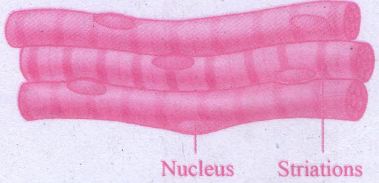
Skeletal muscle tissue is closely attached to skeletal bones. In a typical muscle such as the biceps, the striated (striped) skeletal muscle fibres are bundled together in a parallel fashion. A sheath of tough connective tissue encloses several bundles of muscle fibres.
(ii) Smooth muscle:
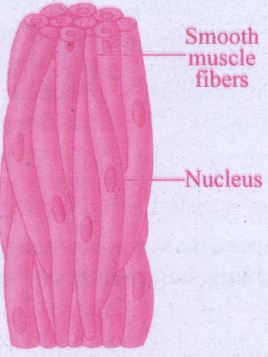
The smooth muscle fibres taper at both ends (fusiform) and do not show striations. Cell junctions hold them together and they are bundled together in a connective tissue sheath. The walls of internal organs such as the blood vessels, .stomach and intestine contain this type of muscle tissue. Smooth muscles are 'involuntary' as their functions cannot be directly controlled. Unlike the smooth muscles, skeletal muscles can not, b~ controlled by merely thinking.
(iii) Cardiac muscle:
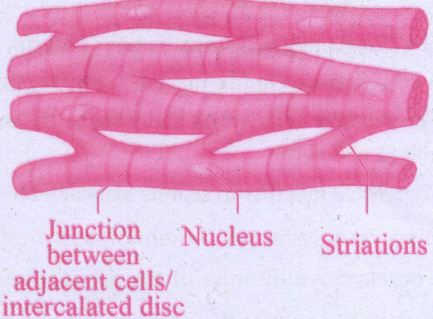
Cardiac muscle tissue is a contractile tissue present only in the heart. Cell junctions fuse the plasma membranes of cardiac muscle cells and make them stick together. Communication junctions (intercalated discs) at some fusion points allow the cells to contract as a unit, i.e., when one cell receives a signal to contract, its neighbours are also stimulated to contract.
2.
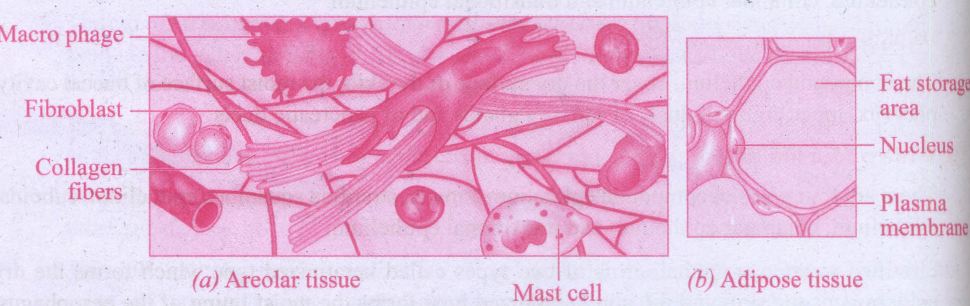
(i) In this tissue the cells and fibres are loosely arranged in a semifluid ground substance,
(ii) It contains fibroblasts, macrophages, and mast cells.
(iii) The Areolar connective tissue beneath the skin acts as a support framework for epithelium and acts as a reservoir of water and salts for the surrounding body tissues, hence aptly called tissue fluid.
(iv) Adipose tissue is similar to areolar tissue in structure and function and located beneath the skin. Adipocytes commonly called adipose or fat cells predominate and account for 90% of this tissue mass.
(v) While fasting, these cells maintain our life by producing and supplying energy as fuel. Adipose tissues are also found in subcutaneous tissue, surrounding the kidneys, eyeball, heart, etc. Adipose tissue is called 'white fat' or white adipose tissue. The adipose tissue which contains abundant mitochondria is called 'Brown fat' or Brown adipose tissue. White fat stores nutrients whereas brown fat is used to heat the blood stream to warm the body. Brown fat produces heat by non-shivering thermogenesis in neonates.
3.
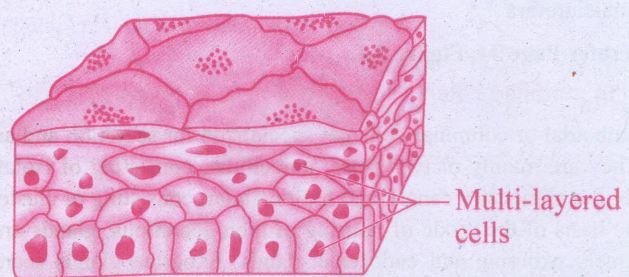
There are four types of compound epithelium namely, stratified squamous epithelium, cuboidal epithelium, columnar epithelium and transitional epithelium.
Stratified squamous epithelium is of two types called keratinized type which forms the dry epidermis of the skin and the non keratinized type forms the moist lining of the esophagus, mouth, conjunctiva of the eyes and vagina. Stratified cuboidal epithelium mostly found in the ducts of sweat glands and mammary glands. Stratified columnar epithelium has limited distribution in the body, found around the lumen of the pharynx, male urethra and lining of some glandular ducts.
Transitional Epithelium is found lining the ureters, urinary bladder and part of the urethra. This epithelium allows stretching and is protective in function.
4.
Some of the cuboidal or columnar cells get specialized for secretion and are called glandular epithelium. They are mainly of two types: unicellular, consisting of isolated glandular cells (goblet cells of the alimentary canal), and multicellular, consisting of cluster of cells (salivary gland). On the basis of the mode of pouring of their secretions, glands are divided into two categories namely exocrine and endocrine glands. Exocrine glands secrete mucus, saliva, earwax, oil, milk, digestive enzymes and other cell products. These products are released through ducts or tubes. In contrast endocrine glands do not have ducts. Their secretions called hormones are secreted directly into the fluid bathing the gland. The exocrine glands are classified as unicellular and multicelluar glands. The multicelluar glands are further classified based on the structure as simple and compound glands, based on their secretory units as tubular, alveolar (Acinus) and tubulo alveolar.
5.
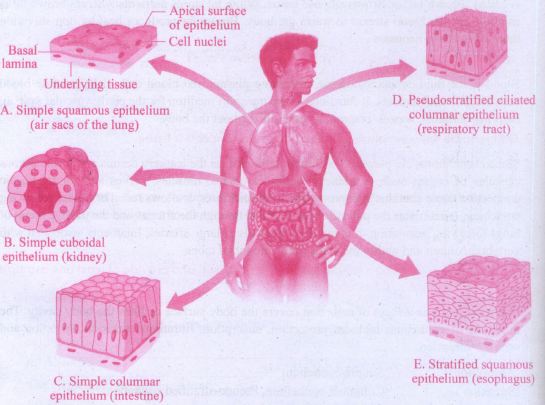
(i) Simple epithelium is composed of a single layer of cells. They are found in the organs of absorption, secretion and filtration. Simple epithelial tissue is further classified into squamous epithelium, cuboidal epithelium, columnar epithelium, ciliated epithelium and pseudostratified epithelium. The squamous epithelium is made of a single thin layer of flattened cells with irregular boundaries. They are found in the kidney glomeruli, air sacs of lungs, lining of heart, blood vessels and lymphatic vessels and are involved in functions like forming a diffusion boundary and filtration in sites where protection is not important.
(ii) The cuboidal epithelium is made of a single layer of cube-like cells. This tissue is commonly found in the kidney tubules, ducts and secretory portions of small glands and surface of the ovary. Its main functions are secretion and absorption.
(iii) The columnar epithelium is composed of single layer of tall cells with round to oval nuclei at the base. It lines the digestive tract from the stomach to the rectum.
(iv) The functions of this epithelium include absorption, secretion of mucus, enzymes and other substances.
(v) This ciliated type propels mucus by ciliary actions and it lines the small bronchioles, fallopian tubes, and uterus. Nonciliated type lines most of the digestive tract, gallbladder and secretory ducts of glands.
(vi) Pseudo-stratified epithelial cells are columnar but unequal in size. Although the epithelium is single layered yet it appears to be multi-layered because the nuclei lie at different levels in different cells. Hence, it is also called pseudostratified epithelium and its functions are protection, secretion and absorption. Ciliated forms line the trachea and the upper respiratory tract. The non ciliated forms, line the epididymis, large ducts of a glands and tracts of male urethra

11th Standard Syllabus & Materials
11th Standard
TN 11th Tamil பீடு பெற நில் - செய்யுள் - காவடிச்சிந்து Important Questions And Answers Study Material - QB365 Set A
NEW11th Standard
TN 11th Tamil பீடு பெற நில் - உரைநடை - மலை இடப்பெயர்கள் : ஓர் ஆய்வு Important Questions And Answers Study Material - QB365 Set A
NEW11th Standard
TN 11th Tamil மாமழை போற்றுதும் - துணைப்பாடம் - யானை டாக்டர் Important Questions And Answers Study Material - QB365 Set A
NEW11th Standard
TN 11th Tamil மாமழை போற்றுதும் - செய்யுள் - ஐங்குறுநூறு Important Questions And Answers Study Material - QB365 Set A



Tamilnadu Stateboard 11th Standard Subjects

Maths

Commerce

Economics
Biology

Business Maths and Statistics

Accountancy

Computer Science

Physics

Chemistry
Maths
Biology
Economics
Physics
Chemistry

History
Business Maths and Statistics

Computer Science
Accountancy

Computer Applications
History
Computer Technology
Commerce
Computer Applications
Computer Technology

Tamil

English

French
Tamilnadu Stateboard Standards



