
 100% FREE ACCESS
11th Standard Syllabus & Materials
11th Standard
TN 11th Tamil இயற்கை வேளாண்மை,சுற்றுச்சூழல் -செய்யுள் - மனோன்மணீயம் Important Questions And Answers Study Material - QB365 Set A
NEW11th Standard
TN 11th Tamil என்னுயிர் என்பேன் -துணைப்பாடம் - இசைத்தமிழர் இருவர் Important Questions And Answers Study Material - QB365 Set A
NEW11th Standard
TN 11th Tamil மொழி கலை -செய்யுள் - ஒவ்வொரு புல்லையும் Important Questions And Answers Study Material - QB365 Set A
NEW11th Standard
TN 11th Tamil பீடு பெற நில் - இலக்கணம் - பகுபத உறுப்புகள் Important Questions And Answers Study Material - QB365 Set A
NEW11th Standard
TN 11th Tamil பீடு பெற நில் - துணைப்பாடம் - வாடிவாசல் Important Questions And Answers Study Material - QB365 Set A
NEW11th Standard
TN 11th Tamil பீடு பெற நில் - செய்யுள் - குறுந்தொகை Important Questions And Answers Study Material - QB365 Set A

Published on: 26/06/2021
QB365 provides detailed and simple solution for every Creative Questions in class 11 Biology Subject. It will helps to get more idea about question pattern in every Creative questions with solution.
Download Tamil Nadu 11th Standard Biology question papers, model tests, one-mark questions, important questions, and public exam papers in PDF format. Free study materials and answer keys for TN State Board students.
Questions + Answers key
Take MCQ Biology Test1.
Write a note on types of chicken breeds.
2.
What are the advantages of aquaponic gardening?
3.
Explain the stages involved in rearing of poultry.
4.
How is a pearl formed?
5.
Write a note on the characteristics of cultivable fishes.
1.
Types of Chicken breeds: There are more than 100 breeds. The commonly farmed chicken breeds are categorized into five based on the purpose for which it is farmed. They are egg layers, broiler type, dual type, games and ornamental types.
1. Egg layers: These are farmed mainly for the production of egg.
Leghorn: This is the most popular commercial breed in India and originated from Italy. They are small, compact with a single comb and wattles with white, brown or black colour. They mature early and begin to lay eggs at the age of 5 or 6 months. Hence these are preferred in commercial farms. They can also thrive well in dry areas.
Chittagong: It is the breed chiefly found in West Bengal. They are golden or light yellow coloured. The beak is long and yellow in colour. Ear lobes and wattles are small and red in colour. They are good egg layers and are delicious.
2. Broiler type: These are well known for fast growth and soft quality meat.
White Plymouth rock: They have white plumage throughout the body. It is commonly used in broiler production. This is an American breed. It is a fast growing breed and well suitable for growing intensively in confined farms.
3. Dual purpose breeds: These are for both meat and egg production purpose.
Brahma: It is a breed popularly known for its massive body having heavy bones, well feathered and proportionate body. Pea comb is one of the important breed characters. It has two common varieties namely, Light Brahma and Dark Brahma.
4. Game breeds: Since ancient times, special breed of roosters have been used for the sport of cockfighting.
Aseel: This breed is white or black in colour. The hens are not good egg layers but are good in incubation of eggs. It is found in all states of India. Aseel is noted for its pugnacity, high stamina, and majestic gait and dogged fighting qualities. This breed is well-known for their meat qualities.
5. Ornamental breeds: Ornamental chicken are reared as pets in addition to their use for egg production and meat.
Silkie: It is a breed of chicken has a typical fluffy plumage, which is said to feel like silk and satin. The breed has numerous additional special characters, such as black skin and bones, blue earlobes, and five toes on each foot, while the majority chickens only have four. They are exhibited in poultry shows, and come out in various colours. Silkie chicken is especially simple to maintain as pets.
2.
(i) Water is conserved because no need of water discharge and recharge as the water is maintained by recycling process
(ii) Bottom soil may be loaded with fresh water
(iii) Microbes in water can convert the wastes into usable forms like ammonia into NO3- which are in turn used by plants for the synthesis of proteins
(iv) Soil fertility increases
(v) Utilization of pesticides can be avoided
(vi) Growth of weeds is arrested
(vii) Plants utilize more nutrients available
(viii) Plants wastes and decayed plant
(ix) Parts are being used as food for fishes
(x) Fertilizers can be minimum used
(xi) The cultivable fishes like tilapia, trout, koi, gold fish, bass etc are cultured in aquaponics
(xii) The common cultivable plants like tomato, pepper, lettuce, cucumber and rose are co-cultivated in this method.
3.
Stages involved in rearing: There are some steps involved in rearing of chicken.
1. Selection of the best layer: An active intelligent looking bird, with a bright comb, not obese should be selected.
2. Selection of eggs for hatching: Eggs should be selected very carefully. Eggs should be fertile, medium sized, dark brown shelled and freshly laid eggs are preferred for rearing. Eggs should be washed, cleaned and dried.
3. Incubation and hatching: The maintenance of newly laid eggs in optimum condition till hatching is called incubation. The fully developed chick emerges out of egg after an incubation period of 21 - 22 days. There are two types of incubation namely natural incubation and artificial incubation.
i. Natural incubation: In this method, only a limited number of eggs can be incubated by a mother hen.
ii. Artificial incubation: In this method, more number of eggs can be incubated in a chamber (Incubator).
4. Brooding: Caring and management of young chicks for 4 - 6 weeks immediately after hatching is called brooding. It can also be categorized into two types, namely natural brooding and artificial brooding.
5. Housing of Poultry: To protect the poultry from sun, rain and predators it is necessary to provide housing to poultry. Poultry house should be moistureproof, rat proof and it should be easily cleanable and durable.
6. Poultry feeding: The diet of chicks should contain adequate amount of water, carbohydrates, proteins, fats, vitamins and minerals.
4.
Pearl Formation:

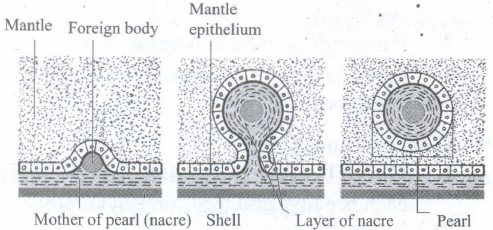
1. When a foreign particle accidentally enters into the space between mantle and shell of the oyster it adheres to the mantle.
2. The mantle epithelium encloses it like a sac and starts to secrete concentric layers of nacre around it as a defensive mechanism.
3. Nacre is secreted continuously by the epithelial layer of the mantle and is deposited around the foreign particle and over a period of time the formation of repeated layers of calcium carbonate makes the hard and glossy pearl.
4. When the pearl enlarges the oyster dies.
5. The shell is then carefully opened and the pearls are manually separated and graded.
5.
Characteristics of cultivable fishes:
The special characteristic features of cultivable fishes are:
1. Fishes should have high growth rate in short period for culture.
2. They should accept supplementary diet.
3. They should be hardy enough to resist some common diseases and infection of parasites.
4. Fishes proposed for polyculture should be able to live together without interfering or attacking other fishes.
5. They should have high conversion efficiency so that they can effectively utilize the food.

11th Standard Syllabus & Materials
11th Standard
TN 11th Tamil பீடு பெற நில் - செய்யுள் - காவடிச்சிந்து Important Questions And Answers Study Material - QB365 Set A
NEW11th Standard
TN 11th Tamil பீடு பெற நில் - உரைநடை - மலை இடப்பெயர்கள் : ஓர் ஆய்வு Important Questions And Answers Study Material - QB365 Set A
NEW11th Standard
TN 11th Tamil மாமழை போற்றுதும் - துணைப்பாடம் - யானை டாக்டர் Important Questions And Answers Study Material - QB365 Set A
NEW11th Standard
TN 11th Tamil மாமழை போற்றுதும் - செய்யுள் - ஐங்குறுநூறு Important Questions And Answers Study Material - QB365 Set A



Tamilnadu Stateboard 11th Standard Subjects

Maths

Commerce

Economics
Biology

Business Maths and Statistics

Accountancy

Computer Science

Physics

Chemistry
Maths
Biology
Economics
Physics
Chemistry

History
Business Maths and Statistics

Computer Science
Accountancy

Computer Applications
History
Computer Technology
Commerce
Computer Applications
Computer Technology

Tamil

English

French
Tamilnadu Stateboard Standards



