
 100% FREE ACCESS
11th Standard Syllabus & Materials
11th Standard
TN 11th Tamil இயற்கை வேளாண்மை,சுற்றுச்சூழல் -செய்யுள் - மனோன்மணீயம் Important Questions And Answers Study Material - QB365 Set A
NEW11th Standard
TN 11th Tamil என்னுயிர் என்பேன் -துணைப்பாடம் - இசைத்தமிழர் இருவர் Important Questions And Answers Study Material - QB365 Set A
NEW11th Standard
TN 11th Tamil மொழி கலை -செய்யுள் - ஒவ்வொரு புல்லையும் Important Questions And Answers Study Material - QB365 Set A
NEW11th Standard
TN 11th Tamil பீடு பெற நில் - இலக்கணம் - பகுபத உறுப்புகள் Important Questions And Answers Study Material - QB365 Set A
NEW11th Standard
TN 11th Tamil பீடு பெற நில் - துணைப்பாடம் - வாடிவாசல் Important Questions And Answers Study Material - QB365 Set A
NEW11th Standard
TN 11th Tamil பீடு பெற நில் - செய்யுள் - குறுந்தொகை Important Questions And Answers Study Material - QB365 Set A

Published on: 13/05/2022
QB365 provides detailed and simple solution for every Book back Questions in class 11 Business Maths Subject. It will helps to get more idea about question pattern in every book back questions with solution.
latest Book back QuestionsDownload Tamil Nadu 11th Standard Business Maths and Statistics question papers, model tests, one-mark questions, important questions, and public exam papers in PDF format. Free study materials and answer keys for TN State Board students.
Questions + Answers key
Take MCQ Business Maths and Statistics Test
1.
Show that the function f(x) = |x| is not differentiable at x = 0.
2.
If cosA =\(\frac{4}{5}\)and cosB =\(\frac{12}{13}\),
3.
Determine whether the points P(0,1), Q(5,9), R(–2, 3) and S(2, 2) lie outside the circle, on the circle or inside the circle x2+y2-4x+4y-8 = 0.
4.
In a screw factory machines A, B, C manufacture respectively 30%, 40% and 30% of the total output of these 2%, 4% and 6% percent are defective screws. A screws is drawn at random from the product and is found to be defective. What is the probability that it was manufactured by Machine C?
5.
Gopal invested Rs. 8,000 in 7% of Rs. 100 shares at Rs. 80. After a year he sold these shares at Rs. 75 each and invested the proceeds (including his dividend) in 18% for Rs. 25 shares at Rs. 41. Find
(i) his dividend for the first year
(ii) his annual income in the second year
(iii) The percentage increase in his return on his original investment
6.
The equations of two lines of regression obtained in a correlation analysis are the following 2X = 8 – 3Y and 2Y = 5 – X. Obtain the value of the regression coefficients and correlation coefficient.
7.
For the demand function p =100 - 6x2, find the marginal revenue and also show that MR = \(p\left[ 1-\frac { 1 }{ { n }_{ d } } \right] \)
8.
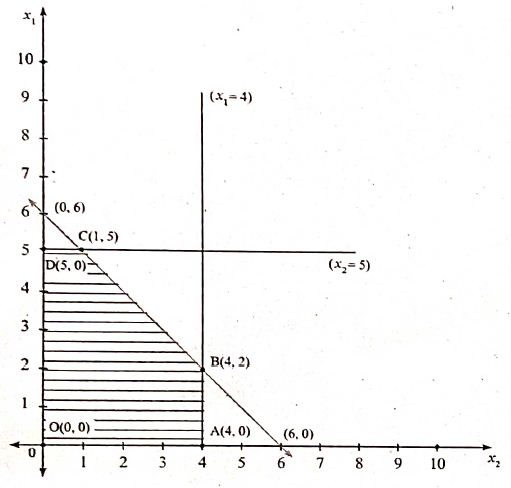
Solve the following linear programming problem graphically.
Maximize Z = 3x1 + 5x2 subject to the constraints x1 + x2 ≤ 6, x1 ≤ 4; x2 ≤ 5, and x1, x2 ≥ 0
9.
How many code symbols can be formed using 5 out of 6 letters A, B, C, D, E, F so that the letters
a) cannot be repeated
b) can be repeated
c) cannot be repeated but must begin with E
d) cannot be repeated but end with CAB.
10.
A sales person Ravi has the following record of sales for the month of January, February and March 2009 for three products A, B and C. He has been paid a commission at fixed rate per unit but at varying rates for products A, B and C.
| Months | Sales in Units | Commission | ||
| A | B | C | ||
| January | 9 | 10 | 2 | 800 |
| February | 15 | 5 | 4 | 900 |
| March | 6 | 10 | 3 | 850 |
Find the rate of commission payable on A, B and C per unit sold using matrix inversion method.
1.
\(f(x)=|x|=\left\{\begin{array}{cll} x & \text { if } & x \geq 0 \\ -x & \text { if } & x<0 \end{array}\right.\)
\(\mathrm{L}\left[f^{\prime}(0)\right]=\lim _{x \rightarrow 0^{-}} \frac{f(x)-f(0)}{x-0}\)
\(=\lim _{h \rightarrow 0} \frac{f(0-h)-f(0)}{0-h-0}, x=0-h\)
\(=\lim _{h \rightarrow 0} \frac{f(-h)-f(0)}{-h}\)
\(=\lim _{h \rightarrow 0} \frac{|-h|-|0|}{-h}\)
\(=\lim _{h \rightarrow 0} \frac{|-h|}{-h}\)
\(=\lim _{h \rightarrow 0} \frac{h}{-h}\)
\(=\lim _{h \rightarrow 0}(-1)=-1\)
\(\mathrm{R}\left[f^{\prime}(0)\right]=\lim _{x \rightarrow 0^{+}} \frac{f(x)-f(0)}{x-0}\)
\(=\lim _{h \rightarrow 0} \frac{f(0+h)-f(0)}{0+h-0}, x=0+h\)
\(=\lim _{h \rightarrow 0} \frac{f(h)-f(0)}{h}\)
\(=\lim _{h \rightarrow 0} \frac{|h|-|0|}{h}\)
\(=\lim _{h \rightarrow 0} \frac{|h|}{h}\)
\(=\lim _{h \rightarrow 0} \frac{h}{h}\)
\(=\lim _{h \rightarrow 0} 1=1\)
\(\text { Here, } \mathrm{L}\left[f^{\prime}(0)\right] \neq \mathrm{R}\left[f^{\prime}(0)\right]\)
\(\therefore\) f(x) is not differentiable at x = 0
2.
Since \(\cfrac { 3\pi }{ 2 } <\left( A,B \right) <2\pi \) ,both A and B lie in the fourth quadrant,
\(\therefore \) sinA and sinB are negative
Given \(\cos A=\frac{4}{5} \text { and } \cos B=\frac{12}{13}\)
Therefore, \(\sin A=-\sqrt{1-\cos ^2 A}\)
\(=-\sqrt{1-\frac{16}{25}}\)
\(=-\sqrt{\frac{25-16}{25}}\)
\(=-\frac{3}{5}\)
\(\operatorname{Sin} \mathrm{B}=-\sqrt{1-\cos ^2 B}\)
\(=-\sqrt{1-\frac{144}{169}}\)
\(=-\sqrt{\frac{169-144}{169}}\)
\(=-\frac{5}{13}\)
\( \cos (A+B)= \cos A \cos B- \sin A \sin B \)
\(=\frac{4}{5} \times \frac{12}{13}-\left(\frac{-3}{5}\right) \times\left(\frac{-5}{13}\right)\)
\(=\frac{48}{65}-\frac{15}{65}=\frac{33}{65}\)
3.
The equation of the circle is \({ x }^{ 2 }+{ y }^{ 2 }-4x+4y-8=0\)
\({ PT }^{ 2 }={ x }_{ 1 }^{ 2 }+{ y }_{ 1 }^{ 2 }-{ 4x }_{ 1 }+{ 4y }_{ 1 }-8\)
At \(P(0,1)\)
\({ PT }^{ 2 }=0+1+0+4-8=-3<0\)
\(At \ Q(5,9)\)
\({ QT }^{ 2 }=25+81-20+36-8=114>0\)
\(At \ R(-2,3)\)
\({ RT }^{ 2 }=4+9+12-8=25>0\)
\(At \ S(2,2)\)
\(ST^{ 2 }=4+4-8+8-8=0\)
\(\therefore \) The point P lies inside the circle. The points Q and R lie outside the circle and the point S lies on the circle.
4.
Let E1, E2, E3 and A be the events defined as
E1 = Screw is manufactured by machine A
E2 = Screw is manufactured by machine B
E3 = Screw is manufactured by machine C
A → screws drawn is defective
\(P({ E }_{ 1 })=\frac { 30 }{ 100 } \), \(P({ E }_{ 2 })=\frac { 40 }{ 100 } \), \(P({ E }_{ 3 })=\frac { 30 }{ 100 } \)
P(A/E1) =\(\frac { 20 }{ 100 } \), P(A/E2) = \(\frac { 4 }{ 100 } \), P(A/E3) \(=\frac { 6 }{ 100 } \)
\(P({ E }_{ 3 }/A)=\frac { P({ E }_{ 3 }).P(A/{ E }_{ 3 }) }{ P({ E }_{ 1 }).P(A/E_{ 1 })+P({ E }_{ 2 }).P(A/{ E }_{ 2 })+P({ E }_{ 3 }).P(A/{ E }_{ 3 }) } \)
\(=\frac { \frac { 30 }{ 100 } \times \frac { 6 }{ 100 } }{ \frac { 30 }{ 100 } \times \frac { 2 }{ 100 } +\frac { 40 }{ 100 } \times \frac { 4 }{ 100 } +\frac { 30 }{ 100 } \times \frac { 6 }{ 100 } } \)
\(=\frac{180}{60+160+180}\)
\(=\frac { 180 }{ 400 } \)
= 0.45
5.
\(\text {(i) Number of shares }=\frac{\text { Investment }}{M \cdot V}\)
\(=\frac{8000}{80}=100\)
\(\text {Amount of dividend }=100 \times 100 \times \frac{7}{100}= 700\)
\(\text {(ii) SP of } 100 \text { shares }=75 \times 100= 7500\)
\(\text {Investment }=\mathrm{SP}+\text { Dividend }\)
\(=7500+700= 8200\)
\(\text {Income }=\frac{\text { Investment }}{\mathrm{M} . \mathrm{V}} \times \mathrm{FV} \times \text { Rate of dividend }\)
\(=\frac{8200}{41} \times 25 \times \frac{18}{100}= 900 \text {. }\)
\(\text {(iii) Increase in his return }=900-700\)
\(\text { = } 200\)
\(\% \text { of increase in return }=\frac{\text { Increase in return }}{\text { Investment }} \times 100\)
\(=\frac{200}{8000} \times 100=2.5 \% \)
6.
2X = 8 - 3Y
Regression equation of X on Y is
\(X=4-\frac{3}{2} Y \)
\(b_{x y}=-\frac{3}{2}<1\)
Regression equation of Y on X be
2Y = 5 - X
\(Y=\frac{5}{2}-\frac{X}{2} \)
\(b_{y x}=-\frac{1}{2}<1\)
\(\because\) both are negative, r is - ve.
\(r =-\sqrt{b_{x y} \cdot b_{y x}} \)
\(=-\sqrt{\left(\frac{1}{2}\right)\left(\frac{3}{2}\right)}=\frac{-\sqrt{3}}{2} \)
\(=-\frac{1.732}{2}=-0.866\)
7.
\(p=100-6 x^2\)
\(R=p x=100 x-6 x^3\)
\(\text { LHS }=\text { Marginal Revenue }=\frac{d R}{d x}=100-18 x^2\)
\(\frac{d p}{d x}=-12 x\)
\(\text { Elasticity of demand }=\eta_d=\frac{-p}{x} \frac{d x}{d p}\)
\(=\frac{-\left(100-6 x^2\right)}{x} \cdot\left(\frac{-1}{12 x}\right)\)
\(=\frac{100-6 x^2}{12 x^2}\)
\(R H S=p\left[1-\frac{1}{\eta_d}\right]=\left(100-6 x^2\right)\left[1-\frac{12 x^2}{100-6 x^2}]\right.\)
\(=\left(100-6 x^2\right)\left[\frac{100-6 x^2-12 x^2}{100-6 x^2}\right]=100-18 x^2\)
\(\therefore \text { From (1) and (2), }\)
\(M R=p\left[1-\frac{1}{\eta_d}\right] \)
8.
First we have to find the feasible region using the given conditions.
Since both the decision variables x1 and x2 are non-negative, the solution lies in the first quadrant write all the inequalities of the constraints in the form of equations.
\(\therefore \) We have the lines \(x_1+x_2 \leq 6 ; x_1 \leq 4; x_2 \leq 5\)
\({ x_{ 1 } }+{ x }_{ 2 }=6\) is a line passing through the points (0,6) and (6,0).
x1 = 4 is a line parallel to x2 axis at a distance of 4 units.
x2 = 5 is a line parallel to x1 axis at a distance of 5 units.
Now we draw the graph
| Corner points | Z = 3x1 + 5x2 |
| O(0,0) | 0 |
| A(4,0) | 12 |
| B(4,2) | 12 + 10 = 22 |
| C(1,5) | 3 + 25 = 28 |
| D(5,0) | 15 |
The optimal solution is occurs at C(1,5)
x1 = 1, x2 = 5, Zmax = 28
Verification
\(If \ x_1=4, \quad x_2=2 \quad \mathrm{~B}(4,2) \)
\(If \ x_2=5, \quad x_1=1 \quad C(1,5)\)
9.
(a) Since letters cannot be repeated, number of ways = nPr
\(=6 P_5=6 \times 5 \times 4 \times 3 \times 2=720\)
(b) Since letters can be repeated Number of ways \(=n^r=65=7776\)
(c) Since the first place is filled with E the remaining 5 letters can be filled in 4 places in \(5 P_4 \text { ways }=5 \times 4 \times 3 \times 2=120\)
(d) Since the last 3 letters are already filled the remaining 3 letters can be filled in first 2 places in \(3 P_2 \text { ways }=3 \times 2=6\)
10.
Let x, y, z represent the rate of commission payable on A, B and C respectively.
Then, 9x + 10y + 2z = 800
15x + 5y + 4z = 900
6x + 10y + 3z = 850
\(\begin{bmatrix}9&10&2\\15&5&4\\6&10&3\end{bmatrix}\begin{bmatrix} x\\y\\z \end{bmatrix}=\begin{bmatrix} 800\\900\\850 \end{bmatrix}\)
AX = B
\(X=A^{-1} B\)
Where A \(=\begin{bmatrix} 9&10&2\\15&5&4\\6&10&3 \end{bmatrix},X=\begin{bmatrix} x\\y\\z \end{bmatrix}\) and B = \(\begin{bmatrix} 800\\900\\850 \end{bmatrix}\)
= 9 (15 - 40) - 10 (45 - 24) + 2 (150 - 30)
= 9 (- 25) - 10 (21) + 2 (120)
= - 225 - 210 + 240 = - 195 \(\neq0\):
\(\therefore\) A-1 exists.
Co-factor matrix \(=\begin{bmatrix} -25&-21&120\\-10& 15&-30\\30&-6&-105 \end{bmatrix}\)
\({A}^{-1}={{1}\over{|A|}}adj\ A={{-1}\over{195}}\begin{bmatrix} -25&-10 &30\\-21&15&-6\\120&-30&-105 \end{bmatrix}\)
X = A-1 B
= \({{-1}\over{195}}\begin{bmatrix} -25&-10&30\\-21&15&-6\\120&-30&-105 \end{bmatrix}\begin{bmatrix}800\\900\\850 \end{bmatrix}={{-1}\over{195}}\begin{bmatrix} -20,000&-9,000&+25,5000\\ -16,8000&+13,500&-5,1000\\96,000&-27,000&-89,250 \end{bmatrix}\)
\(={{-1}\over{195}}\begin{bmatrix} -3500\\-8400\\-20,250 \end{bmatrix}=\begin{bmatrix} {{3500}\over{195}} \\{{8400}\over{195}}\\{{20,250}\over{195}} \end{bmatrix}\)
\(\begin{bmatrix} x\\y\\z \end{bmatrix}=\begin{bmatrix} 17.95\\43.05\\103.85 \end{bmatrix}\)
\(x=17.95, y=43.08, z=103.85\)

11th Standard Syllabus & Materials
11th Standard
TN 11th Tamil பீடு பெற நில் - செய்யுள் - காவடிச்சிந்து Important Questions And Answers Study Material - QB365 Set A
NEW11th Standard
TN 11th Tamil பீடு பெற நில் - உரைநடை - மலை இடப்பெயர்கள் : ஓர் ஆய்வு Important Questions And Answers Study Material - QB365 Set A
NEW11th Standard
TN 11th Tamil மாமழை போற்றுதும் - துணைப்பாடம் - யானை டாக்டர் Important Questions And Answers Study Material - QB365 Set A
NEW11th Standard
TN 11th Tamil மாமழை போற்றுதும் - செய்யுள் - ஐங்குறுநூறு Important Questions And Answers Study Material - QB365 Set A



Tamilnadu Stateboard 11th Standard Subjects

Maths

Commerce

Economics

Biology
Business Maths and Statistics

Accountancy

Computer Science

Physics

Chemistry
Maths
Biology
Economics
Physics
Chemistry

History
Business Maths and Statistics

Computer Science
Accountancy

Computer Applications
History
Computer Technology
Commerce
Computer Applications
Computer Technology

Tamil

English

French
Tamilnadu Stateboard Standards


