
 100% FREE ACCESS
11th Standard Syllabus & Materials
11th Standard
TN 11th Tamil இயற்கை வேளாண்மை,சுற்றுச்சூழல் -செய்யுள் - மனோன்மணீயம் Important Questions And Answers Study Material - QB365 Set A
NEW11th Standard
TN 11th Tamil என்னுயிர் என்பேன் -துணைப்பாடம் - இசைத்தமிழர் இருவர் Important Questions And Answers Study Material - QB365 Set A
NEW11th Standard
TN 11th Tamil மொழி கலை -செய்யுள் - ஒவ்வொரு புல்லையும் Important Questions And Answers Study Material - QB365 Set A
NEW11th Standard
TN 11th Tamil பீடு பெற நில் - இலக்கணம் - பகுபத உறுப்புகள் Important Questions And Answers Study Material - QB365 Set A
NEW11th Standard
TN 11th Tamil பீடு பெற நில் - துணைப்பாடம் - வாடிவாசல் Important Questions And Answers Study Material - QB365 Set A
NEW11th Standard
TN 11th Tamil பீடு பெற நில் - செய்யுள் - குறுந்தொகை Important Questions And Answers Study Material - QB365 Set A

Published on: 02/07/2021
QB365 provides detailed and simple solution for every
Creative Questions in class 11 Business Maths Subject.It will helps to get more idea about question pattern in every Creative questions with solution.
Download Tamil Nadu 11th Standard Business Maths and Statistics question papers, model tests, one-mark questions, important questions, and public exam papers in PDF format. Free study materials and answer keys for TN State Board students.
Questions + Answers key
Take MCQ Business Maths and Statistics Test
1.
Obtain the two regression lines from the following
| X | 6 | 2 | 10 | 4 | 8 |
| Y | 9 | 11 | 5 | 8 | 7 |
2.
A factory has 3 machines A1, A2, A3 producing 1000, 2000, 3000 bolts per day respectively. A1 produces 1% defectives, A2 produces 1.5% and A3 produces 2% defectives. A bolt is chosen at random and found defective. What is the probability that it comes from machine A1?
3.
Reshma wishes to mix two types of food P and Q in such a way that the Vitamin contents of the mixture contain at least 8 units of vitamin A and 11 units of vitamin B. Food P costs Rs.60/kg and Food Q costs Rs.80/kg. Food P contains 3 units 1 kg of vitamin A and 5 units 1 kg of vitamin B while food Q contains 4 units 1 kg of vitamin A and 2 units 1 kg of vitamin B. Determine the minimum cost of the mixture.
4.
A man, deposits Rs.75 at the end of 6 months in a bank which pays interest at 8% compounded semiannually. How much is to his credit at the end of 10 years?
5.
Find the maximum and minimum values of x3-6x2+7
6.
Prove that the tangents to the circle x2 + y2 = 169 at (5,12) and (12,-5) are perpendicular to each other.
7.
Prove that (sin 3x + sin x) sin x + (cos 3x - cos x) cos x = 0.
8.
If the function \(f\left( x \right) =\begin{cases} 6ax+3b\quad if\quad x>1 \\ ax-2b\quad if\quad x<1\quad is\quad continuous\quad at\quad x=1 \\ 15\quad if\quad x=1 \end{cases}\) Find the value of a and b.
9.
In how many ways can the following prizes be given away to a class of 30 students, first and second in mathematics, first and second in physics, first in chemistry and first in English?
10.
Without expanding show that \(\Delta =\left| \begin{matrix} { cosec }^{ 2 }\theta & { cot }^{ 2 }\theta & 1 \\ { cot }^{ 2 }\theta & { cosec }^{ 2 }\theta & -1 \\ 42 & 40 & 2 \end{matrix} \right| =0\)
1.
Here N=5
| X | Y | X2 | Y2 | XY |
| 6 | 9 | 36 | 81 | 54 |
| 2 | 11 | 4 | 121 | 22 |
| 10 | 5 | 100 | 25 | 50 |
| 4 | 8 | 16 | 64 | 32 |
| 8 | 7 | 64 | 49 | 56 |
| 30 | 40 | 220 | 340 | 214 |
\(\overline { X } =\frac { \sum { X } }{ N } =\frac { 30 }{ 5 } \)=6
\(\overline { Y } =\frac { \sum { Y } }{ N } =\frac { 40 }{ 5 } \)=8
\({ b }_{ xy }=\frac { N\sum { XY-(\sum { X } )(Y) } }{ N\sum { { X }^{ 2 }-{ (\sum { Y } ) }^{ 2 } } } =\frac { 5(214)-(30)(40) }{ 5(340)-{ (40) }^{ 2 } } \)
=\(\frac { 1070-1200 }{ 1700-1600 } =-\frac { 130 }{ 100 } \)=-1.3
byx=\({ b }_{ xy }=\frac { N\sum { XY-(\sum { X } )(Y) } }{ N\sum { { X }^{ 2 }-{ (\sum { X } ) }^{ 2 } } } =\frac { 5(214)-(30)(40) }{ 5(2200)-{ (30) }^{ 2 } } \)
\(=\frac { 1070-1200 }{ 1700-900 } =\frac { -130 }{ 200 } \)=-0.65
Regression equation of X on Y is
\(\Rightarrow\)X-\(\bar{X}\)=bxy(Y-\(\bar{Y}\))
X-6=-1.3(Y-8)
X=-1.3Y+10.4+6
X=-1.3Y+16.40
Regression equation of Y on X is
Y-\(\bar{Y}\) =byx(X-\(\bar{X}\))
Y-8=-0.65(X-6)
Y=-0.065X+3.9+8
Y=-0.65X+11.90
2.
Total Number of bolts produced = 1000 + 2000 + 3000 = 6000
\(P({ A }_{ 1 })=\frac { 1000 }{ 6000 } =\frac { 1 }{ 6 } \)
\(P({ A }_{ 2 })=\frac { 2000 }{ 6000 } =\frac { 1 }{ 3 } \)
\(P({ A }_{ 3 })=\frac { 3000 }{ 6000 } =\frac { 1 }{ 2 } \)
Let B be the event of selecting defective bolts.
\(\therefore \) P(B/A1) = 1% = \(\frac { 1 }{ 100 } \) = 0.01
P(B/A2) = 1.5% = 0.015
and (P(B/A3) = 2% = 0.02
\(\therefore P(A_{ 1 }/B)=\frac { P({ A }_{ 1 }).P\left( B/{ A }_{ 1 } \right) }{ P({ A }_{ 1 }).P(B/{ A }_{ 1 })+P({ A }_{ 2 }).P\left( B/{ A }_{ 2 } \right) +P({ A }_{ 3 }).P\left( B/{ A }_{ 3 } \right) } \)
\(=\frac { \frac { 1 }{ 6 } \times 0.01 }{ \frac { 1 }{ 6 } \times 0.01+\frac { 1 }{ 3 } \times 0.015+\frac { 1 }{ 2 } \times 0.02 } =\frac { 1 }{ 600 } \times 60=\frac { 1 }{ 10 } \)
\(\therefore P(A_{ 1 }/B)=0.1\)
3.
Let Reshma mix x1 kg of food P and x2 kg of food Q to make the mixture.
Let Z be the total cost of mixture
| Food P | Food Q | Minimum requirement | |
|---|---|---|---|
| Vitamin A | 3 | 4 | 8 |
| Vitamin B | 5 | 2 | 11 |
| Cost | Rs.60 | Rs.80 |
Thus, the mathematical formation of the given LPP is minimize Z = 60x1+ 80x2
Subject to the constraints
\(3{ x }_{ 1 }+4{ x }_{ 2 }\ge 8\quad 5{ x }_{ 1 }+2{ x }_{ 2 }\ge 11\quad and\quad { x }_{ 1 },{ x }_{ 2 }\ge 0\)
Consider the equations
\(3{ x }_{ 1 }+4{ x }_{ 2 }=8\)
| \({ x }_{ 1 }\) | 0 | 8/3 |
| \({ x }_{ 2 }\) | 2 | 0 |
\(5{ x }_{ 1 }+2{ x }_{ 2 }=11\)
| \({ x }_{ 1 }\) | 0 | 8/3 |
| \({ x }_{ 2 }\) | 2 | 0 |
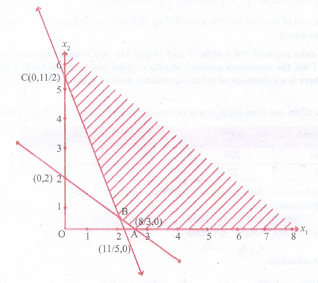
The feasible region is ABC and its co-ordinates are A\(\left( \frac { 8 }{ 3 } ,0 \right) \), C\(\left( 0,\ \frac { \pi }{ 2 } \right) \)and B is the point of intersection of the lines 3x1 + 4x2 = 8 ..... (1) and 5x1 + 2x2 = 11 .... (2)
Verification of B:
\((1) \Rightarrow 3{ x }_{ 1 }+4{ x }_{ 2 }=8\)
\( (-)\quad (-)\quad \quad (-)\)
\((2)\times 2\Rightarrow 10{ x }_{ 1 }+4{ x }_{ 2 }=22\)
\(--------------\)
\( -7x_{ 1 }=-14 \Rightarrow { x }_{ 1 }=2\)
\(From(1), 3(2)+4{ x }_{ 2 }=8\)
\(4{ x }_{ 2 }=8-6=2\Rightarrow { x }_{ 2 }=\frac { 1 }{ 2 } \)
\( \therefore \ B\ is\ \left( 2,\frac { 1 }{ 2 } \right) \)
| Corner Points | Z = 60x1+ 80x2 |
|---|---|
| A(8/3,0) | \(60\times \frac { 8 }{ 3 } =160\) |
| B (2, 1/2) | \(120+80\times \frac { 1 }{ 2 } =160\) |
| C(0,11/2) | \(80\times \frac { 11 }{ 2 } =440\) |
Minimum of Z occurs at \(A\left( \frac { 8 }{ 3 } ,0 \right) and\quad B\left( 2,\frac { 1 }{ 2 } \right) \)
Hence, least cost of mixture is n60 when 8/3 kg of food P and 0 kg of food Q and 2 kg of food P and 112kg of food Q are mixed
4.
Given a = Rs.75, i=\(\cfrac { 8 }{ 12 } \)% = 4% = 0.004,n = 10 X 2 =20
A = \(\cfrac { a }{ i } \left[ \left( 1+i \right) ^{ n }-1 \right] \)
=\(\cfrac { 75 }{ 0.04 } \) [(1.04)20-1]
=1875 (2.1878-1)
= 1875(1.878)
= Rs.2227
(1.04)40 = 20 log (1.04)
= 20(0.0170)
= 0.34
Antilog of 0.34 is 2.1878
5.
Let y=x3-6x2+7
Differentiating w.r.t. 'x' we get,
\({dy\over dx}=3x^2-12x\)
\({dy\over dx}=0\)
\(\Rightarrow3x^2-12x=0\)
\(\Rightarrow3x(x-4)=0\)
\(\Rightarrow x=0 \ or \ x=4\)
\({d^2y\over dx^2}=6x-12\)
when x=0 \({d^2y\over dx^2}=-12<0\)
\(\therefore \) y is maximum at x=0
\(\therefore \) maximum value=03-6(0)2+7=7
when x=4, \({d^2y\over dx^2}=-6(4)-12=12>0\)
\(\therefore \) y is minimum at x=4
\(\therefore \) Minimum value =44-6(4)2+7=64-96+7=-25
Hence maximum value is 7 and minimum value is -25.
6.
Given equation of the circle is x2 + y2 = 169...(1)
Equation of the tangent at (x1, y1) to circle (1) is xx1 + yy1 = 169
Now, Equation of the tangent at (5,12) to circle (1) is
x(5) + y(12) = 169 ⇒ 5x + 12y - 169 = 0...(2)
and equation of the tangent at (12,-5) to circle (1) is
x(12) + y(-5) = 169 ⇒ 12x - 5y = 169 = 0...(3)
Let m1 and m2 be the slopes of the tangents (2) and (3)
ஃ m1=\(\frac { -Co-efficient\quad of\quad x }{ Co-efficient\quad of\quad y } =\frac { -5 }{ 12 } \)
Similarly m2 = \(\frac { -12 }{ -5 } =\frac { 12 }{ 5 } \)
Consider m1m2 = \(\left( \frac { -5 }{ 12 } \right) \left( \frac { 12 }{ 5 } \right) =-1\)
Since m1m2 = -1, the tangents at (5,12) and (12,-5) to the circle x2 + y2 = 169 are perpendicular to each other.
7.
LHS = (sin 3x + sin x) sin x + (cos 3x - cos x) cos x
= sin 3x sin x + sin2x + cos 3x cos x - cos2x
= sin 3x sin x + cos 3x cos x - (cos2x - sin2x)
= cos (3x - x) - cos 2x [∴ cosA cosB + sinA sinB = cos(A - B) and cos2A - sin2A = cos2A]
= 0 = RHS. Hence proved
8.
Given \(f(x)=\left\{ \begin{matrix} 6ax+3b & if\quad x>1 \\ ax-2b & if\quad x<1 \\ 15 & if\quad x=1 \end{matrix} \right\} \)
\(L[{ f(x)] }_{ x=1 }=\lim _{ x\rightarrow { 1 }^{ - } }{ f(x)
=\lim _{ h\rightarrow 0 }{ f(1-h)=\lim _{ h\rightarrow 0 }{ a(1-h)-2b\quad [\because f(x)=ax-2b\quad if\quad x<1] } } } \)
\(=\lim _{ h\rightarrow 0 }{ a-ah-2b=a-2b } \) .....(1)
R[f(x)]x=1=\(\lim _{ x\rightarrow { 1 }^{ + } }{ f(x)=\lim _{ h\rightarrow 0 }{ f(1+h) } } \)
\(=\lim _{ x\rightarrow { 1 }^{ + } }{ 6a(1+h)+3b\quad [\because f(x)=6ax+3b\quad if\quad x>1] } \)
= 6(91+0) + 3b = 6a + 3b ....(2)
Also, f(1) = 15 ....(3)
Since f(X) is continuous at x =1,
L[f(x)]x=1=R[f(x)]x=1=f(1)
\(\Rightarrow\) a - 2b = 6a + 3b = 15 [using (1), (2) and (3)]
\(\Rightarrow\) a - 2b = 15 ....(4)
and 6a+3b=15 \(\Rightarrow\) 2a + b =5 ..(5)
(4) \(\times\) 2 \(\rightarrow \) 2a - 4b = 30
- - -
(5) \(\rightarrow \) 2a + b = 5
____________________
-5b = 25 \(\Rightarrow\) b = -5
Substituting b = -5 in (4) we get,
a - 2(-5) = 15
\(\Rightarrow\) a + 10 = 15
\(\Rightarrow\) a = 15 - 10 = 5
\(\therefore\) a = 5 and b = -5.
9.
I and II prizes Mathematics can be given in (30 x 29) ways.
I & II prizes in physics also can be given in (30 x 29) ways.
I prize in chemistry can be given in 30 ways.
I prize in English can be given in 30 ways.
Hence, the number of ways to give prizes in all the four subjects = (30 x 29) x (30 x29)x 30 x 30
= 6.8121 x 10⁸
10.
Given \(\Delta =\left| \begin{matrix} { cosec }^{ 2 }\theta & { cot }^{ 2 }\theta & 1 \\ { cot }^{ 2 }\theta & { cosec }^{ 2 }\theta & -1 \\ 42 & 40 & 2 \end{matrix} \right| =0\)
Applying C1\(\rightarrow\)C1 - C2, we get,
\(\Delta =\left| \begin{matrix} { cosec }^{ 2 }\theta -{ cot }^{ 2 }\theta & { cot }^{ 2 }\theta & 1 \\ { cot }^{ 2 }\theta -{ cosec }^{ 2 }\theta & { cosec }^{ 2 }\theta & -1 \\ 42-40 & 40 & 2 \end{matrix} \right| \)
\(=\left| \begin{matrix} 1 & { cot }^{ 2 }\theta & 1 \\ -1 & { cosec }^{ 2 }\theta & -1 \\ 2 & 40 & 2 \end{matrix} \right| \) [\(\because\) cosec2 \(\theta\) - cot2 \(\theta\) =1]
= 0
\(\Delta =0\) [\(\because\) C1 \(\equiv \) C3]

11th Standard Syllabus & Materials
11th Standard
TN 11th Tamil பீடு பெற நில் - செய்யுள் - காவடிச்சிந்து Important Questions And Answers Study Material - QB365 Set A
NEW11th Standard
TN 11th Tamil பீடு பெற நில் - உரைநடை - மலை இடப்பெயர்கள் : ஓர் ஆய்வு Important Questions And Answers Study Material - QB365 Set A
NEW11th Standard
TN 11th Tamil மாமழை போற்றுதும் - துணைப்பாடம் - யானை டாக்டர் Important Questions And Answers Study Material - QB365 Set A
NEW11th Standard
TN 11th Tamil மாமழை போற்றுதும் - செய்யுள் - ஐங்குறுநூறு Important Questions And Answers Study Material - QB365 Set A



Tamilnadu Stateboard 11th Standard Subjects

Maths

Commerce

Economics

Biology
Business Maths and Statistics

Accountancy

Computer Science

Physics

Chemistry
Maths
Biology
Economics
Physics
Chemistry

History
Business Maths and Statistics

Computer Science
Accountancy

Computer Applications
History
Computer Technology
Commerce
Computer Applications
Computer Technology

Tamil

English

French
Tamilnadu Stateboard Standards


