
 100% FREE ACCESS
11th Standard Syllabus & Materials
11th Standard
TN 11th Tamil இயற்கை வேளாண்மை,சுற்றுச்சூழல் -செய்யுள் - மனோன்மணீயம் Important Questions And Answers Study Material - QB365 Set A
NEW11th Standard
TN 11th Tamil என்னுயிர் என்பேன் -துணைப்பாடம் - இசைத்தமிழர் இருவர் Important Questions And Answers Study Material - QB365 Set A
NEW11th Standard
TN 11th Tamil மொழி கலை -செய்யுள் - ஒவ்வொரு புல்லையும் Important Questions And Answers Study Material - QB365 Set A
NEW11th Standard
TN 11th Tamil பீடு பெற நில் - இலக்கணம் - பகுபத உறுப்புகள் Important Questions And Answers Study Material - QB365 Set A
NEW11th Standard
TN 11th Tamil பீடு பெற நில் - துணைப்பாடம் - வாடிவாசல் Important Questions And Answers Study Material - QB365 Set A
NEW11th Standard
TN 11th Tamil பீடு பெற நில் - செய்யுள் - குறுந்தொகை Important Questions And Answers Study Material - QB365 Set A

Published on: 02/07/2021
QB365 provides detailed and simple solution for every
Creative Questions in class 11 Business Maths Subject.It will helps to get more idea about question pattern in every Creative questions with solution.
Download Tamil Nadu 11th Standard Business Maths and Statistics question papers, model tests, one-mark questions, important questions, and public exam papers in PDF format. Free study materials and answer keys for TN State Board students.
Questions + Answers key
Take MCQ Business Maths and Statistics Test
1.
The total revenue (TR) for commodity x is \(TR=12x+{x^2\over2}-{x^3\over 3}\)S.T. at the highest point of average revenue (AR), AR = MR
2.
For the following observations, find the regression co-efficient byx and bxy and hence find the correlation co-efficient (4,2)(2,3)(3,2)(4,4)(2,4).
3.
Calculate the earliest start time, earliest finish time, latest start time and latest finish time of each activity of the project given below and determine the critical path of the project and duration to complete the project.
| Activity | 1-2 | 1-3 | 1-5 | 2-3 | 2-4 | 3-4 | 3-5 | 3-6 | 4-6 | 5-6 |
| Duration (in week) | 7 | 6 | 11 | 3 | 9 | 2 | 4 | 9 | 6 | 3 |
4.
A box contains 4 red, 6 green balls. Two balls are picked out one by one at random without replacement. What is the probability that the second is green given that the first one is green?
5.
A bank pays interest at the rate of 8% p.a. compounded quarterly. Find how much should be deposited in the bank at the beginning of each of 3 months for 5 years in order to accumulate to Rs.10,000 at the of 5 years.
6.
Prove that cos 6x = 32 cos6x - 48 cos4x + 18 cos2x - 1.
7.
If a parabolic reflector is 20 cm in diameter and 5 cm deep, find the focus.
8.
If \(y={ e }^{ a\cos ^{ -1 }{ x } }\) , show that \(\left( 1-{ x }^{ 2 } \right) \frac { { d }^{ 2 }y }{ { dx }^{ 2 } } -x\frac { dy }{ dx } -{ a }^{ 2 }y=0\)
9.
Using binomial theorem, find the value of \({ \left( \sqrt { 2 } +1 \right) }^{ 5 }+{ \left( \sqrt { 2 } -1 \right) }^{ 5 }\)
10.
An amount of Rs. 5000 is put into three investments at the rate of interest of 6%, 7% and 8% per annum respectively. The total annual income is Rs. 358. If the combined income from the first two investment is Rs. 70 more than the income from the third, find the amount of each investment by matrix method.
1.
Given \(TR=12x+{x^2\over2}-{x^3\over 3}\)
Average Revenue \(AR={TR\over x}={12x+x^2/2-x^3/3\over x}\)
\(AR=12+{x\over2}-{x^2\over3}\) ...(1)
Let y \(=12+{x\over2}-{x^2\over3}\)
\({dy\over dx}={1\over2}-{2x\over 3}\)
Condition for maximum is
\({dy\over dx}=0\ and\ {d^2 y\over dx^2}<0\)
\(∴\ {1\over2}-{2x\over3}=0⇒{1\over2}={2x\over 3}\)
\(x={1\over2}\times{3\over 2}={3\over 4}\)
\({d^2y\over dx^2}={-2\over3}<0\)
∴ AR is maximum at x=3/4
when x=3/4, \(AR=12+{3/4\over2}-{\left(3/4\right)^2\over 3}\) [From )1)]
\(=12+{3\over8}-{9\over 48}=12.1875\) ....(2)
\(MR={{dR\over dx}}={d\over dx}\left(12x+{x^2\over 2}-{x^3\over 3}\right)=12+x-x^2\)
when x = 3/4, \(MR=12+{3\over 4}-\left(3\over4\right)^2=12+{3\over4}-{9\over 16}=12.1875 \) ..(3)
From (2) and (3), at the highest point of AR,
AR = MR = 12.1875
2.
| x | y | x2 | y2 | xy |
| 4 | 2 | 16 | 4 | 8 |
| 2 | 3 | 4 | 9 | 6 |
| 3 | 2 | 9 | 4 | 6 |
| 4 | 4 | 16 | 16 | 16 |
| 2 | 4 | 4 | 16 | 8 |
| 15 | 15 | 49 | 49 | 44 |
Here n=5,
byx=\(\frac { n\sum { xy } -(\sum { x } )(\sum { y } ) }{ n\sum { { x }^{ 2 }-{ (\sum { x } ) }^{ 2 } } } \)
=\(\frac { 5(44)-(15)(15) }{ 5(49)-{ (15) }^{ 2 } } \)
=\(\frac { 220-225 }{ 245-225 } =\frac { -5 }{ 20 } =\frac { -1 }{ 4 } \)
bxy=\(\frac { n\sum { xy } -(\sum { x } )(\sum { y } ) }{ n\sum { { y }^{ 2 }-{ (\sum { y } ) }^{ 2 } } } \)
=\(\frac { 5(44)-15(15) }{ 5(49)-{ (15) }^{ 2 } } \)
\(\frac { 220-225 }{ 245-225 } =\frac { -5 }{ 20 } =\frac { -1 }{ 4 } \)
bxy and byx are negative, r is also negative.
\(\therefore\)Correlation co-efficient
r(x,y)=-\(\sqrt { { b }_{ xy }.{ b }_{ yx } } \)
=-\(\sqrt { \left( \frac { -1 }{ 4 } \right) \left( \frac { -1 }{ 4 } \right) } =\frac { -1 }{ 4 } \)
r=-0.25
3.
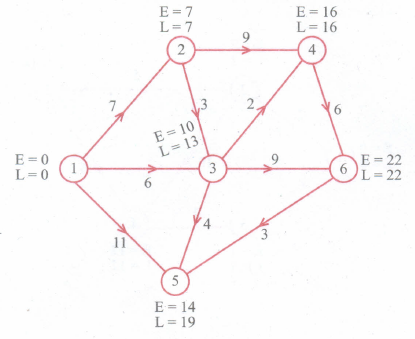
| E1 =0 | L6 =22 |
| E2 = 0+7=7 | L5 =(22 - 3) = 19 |
| E3 =(7 + 3) or (0 + 6) Whichever is maximum = 0 |
L4 =22 - 6 = 16 . |
| E4 =(7 + 9) or (10 + 2) Whichever is maximum=16 |
L3 =(22 - 9) or (16 - 8) Whichever is minimum=13 |
| E5 =(0+ 11)or(10+4) Whichever is maximum=14 |
L2 =16 - 9 = 7 |
| E6 =(16 + 6) or (10 + 9) or (14 + 3) Whichever is maximum = 22 |
L1 =7-7=0 |
| Activity | Duration | EST | EFT=EST+tij | LST | LFT |
|---|---|---|---|---|---|
| 1-2 | 7 | 0 | 7 | 7-7=0 | 7 |
| 1-3 | 6 | 0 | 6 | 13-6=7 | 13 |
| 1-5 | 11 | 0 | 11 | 19-11=8 | 19 |
| 2-3 | 3 | 7 | 10 | 13-3=10 | 13 |
| 2-4 | 9 | 7 | 16 | 16-9=7 | 16 |
| 3-4 | 2 | 13 | 15 | 19-4=15 | 16 |
| 3-5 | 4 | 13 | 17 | 19-4=15 | 19 |
| 3-6 | 9 | 10 | 19 | 22-9=13 | 22 |
| 4-6 | 6 | 16 | 22 | 22-6=16 | 22 |
| 5-6 | 3 | 14 | 17 | 22-3=19 | 22 |
EFT and LFT are same in the activity, 1 - 2, 2 - 4 and 4 - 6.
Hence the critical path is 1 - 2 - 4 - 6 and the project completion time is 22 Weeks.
4.
Let A = {First ball drawn is green}
B = {Second ball drawn is green}
\(P(A)=\frac { n(A) }{ n(S) } =\frac { 6 }{ 10 } \) [\(\because\) Total number of balls = 4+6 = 10]
Let C = {getting green ball after taking out first green ball}
\(P(C)=\frac { 5{ C }_{ 1 } }{ 9{ C }_{ 1 } } =\frac { 5 }{ 9 } \) [\(\because\) First ball is not replaced]
\(\therefore\) P(getting green ball) = P(A).P(C) = \(\frac { 6 }{ 10 } \times \frac { 5 }{ 9 } \)
\(\therefore P(A\cap B)=\frac { 1 }{ 3 } \)
\(P(B/A)=\frac { P(A\cap B) }{ P(A) } =\frac { \frac { 1 }{ 3 } }{ \frac { 6 }{ 10 } } \)
\(P(B/A)=\frac { 1 }{ 3 } \times \frac { 10 }{ 6 } =\frac { 5 }{ 9 } \)
5.
Given A = 10,000 r = \(\cfrac { 8 }{ 100 } \times \cfrac { 1 }{ 4 } \) = 2% = 0.02, n = 5 X 4 =20
A = \(\cfrac { a }{ i } \left( 1+i \right) \left[ \left( 1+i \right) ^{ n }-1 \right] \)
10,000 = \(\cfrac { a }{ 0.02 } \) (1.02)[(1.02)20-1]
\(\cfrac { 10,000\times 0.02 }{ 1.02 } \) = a[1.4859-1]
196.08 = a[0.4859]
a =\(\cfrac { 196.08 }{ 0.4859 } \) = Rs.403.53
a = Rs.404
(1.02)20 =20 log(1.02)
= 20(0.0086)
= 0.172
Antilog of 0.172 is 1.4859
6.
LHS = cos 6x
= cos 3(2x) = 4 cos32x- 3cos2x [∴ cos 3\(\theta\) = 4 cos3\(\theta\) - 3 cos\(\theta\)]
= 4 (2cos2x - 1)3- 3(2cos2x - 1) [∴ cos2x = 2cos2x - 1]
= 4 (8 cos6x-12 cos4x + 6 cos2x-1) - 6 cos2x + 3
= 32 cos6x - 48 cos4x + 18 cos2x - 1
= RHS. Hence proved.
7.
Taking vertex of the parabola as reflector at origin, x-axis along the axis of the parabola, equation of the parabola is y2 = 4ax
Given depth = 5 cm, diameter = 20 cm
\(\therefore\) (5, 10) lies on the parabola
\(\therefore\) 102 = 4a(5) ⇒ 100 = 20a ⇒ a = \(\frac{100}{20}\) = 5
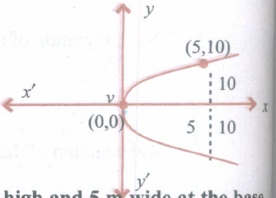
\(\therefore\) Focus is (a, 0) = (5, 0) which is the mid-point of the given diameter
8.
Given y = ea cos-1 x ...(1)
Differentiating with respect to 'x' we get,
\({{dy}\over{dx}}={e}^{a\ {cos}^{-1}x}.{{d}\over{dx}}\left( a\ {\cos}^{-1}x \right)={e}^{a\ {cos}^{-1}x}.\left( {{-a}\over{\sqrt{1-{x}^{2}}}} \right)\)
\(={{-ay}\over{\sqrt{1-{x}^{2}}}}\) [ using (1) ]
\(\Rightarrow\sqrt{1-x^2}.{{dy}\over{dx}}=-ay\)
Squaring both sides we get,
\((1-x^2).{\left( {{dy}\over{dx}} \right)}^{2}=a^2y^2\)
Differentiating again with respect to 'x' we get,
\(\left( (1-x^2).2\left( {{dy}\over{dx}} \right)\left({{d^2y}\over{dx^2}} \right) +{\left({{dy}\over{dx}} \right)}^{2}(-2x)=a^2(2y)\left( {{dy}\over{dx}} \right) \right)\)
Dividing throughout by 2 \(\left({{dy}\over{dx}} \right)\) we get,
\((1-x^2).\left({{d^2y}\over{dx^2}} \right)-x\left( {{dy}\over{dx}} \right)=a^2 y\Rightarrow(1-x^2)\left( {{d^2y}\over{dx^2}} \right)-x\left( {{dy}\over{dx}} \right)-a^2y=0.\)
Hence proved.
9.
Given \(({\sqrt{2}+1})^{5}+{(\sqrt{2}-1)}^{5}\)
=[\({ \left( \sqrt { 2 } \right) }^{ 5 }\)+ 5CI \({ \left( \sqrt { 2 } \right) }^{ 4}\) (1)1 + 5C2 \({ \left( \sqrt { 2 } \right) }^{ 3 }\) .(1)2 + 5C3 \({ \left( \sqrt { 2 } \right) }^{ 2 }\) . (1)3+ 5C4 \({ \left( \sqrt { 2 } \right) }^{ 1}\) .(1)4 + (1)5] +[\({ \left( \sqrt { 2 } \right) }^{ 5 }\) - 5CI \({ \left( \sqrt { 2 } \right) }^{ 4}\) (l)1 + 5C2 \({ \left( \sqrt { 2 } \right) }^{ 3 }\) (1)2 - 5C3 \({ \left( \sqrt { 2 } \right) }^{ 2 }\) (1)3+ 5C4 \({ \left( \sqrt { 2 } \right) }^{ }\) (1)4 -15 ]
=2[\({ \left( \sqrt { 2 } \right) }^{ 5 }\) + 10\({ \left( \sqrt { 2 } \right) }^{ 3 }\) +5 \({ \left( \sqrt { 2 } \right) }^{ }\)] = 2[ 4\(\sqrt { 2 } \) + 20\(\sqrt 2\) + 5.\(\sqrt 2\)] = 2[29.\( \sqrt { 2 } \)] = 58\( \sqrt 2\)
10.
Let x, y and z be the investments at the rate of interest 6%, 7% and 8% per annum respectively.
Then x + y + z = 5000 ...(1)
Also, \(\frac{6x}{100}+\frac{7y}{100}+\frac{8z}{100}=358\)
\(\Rightarrow\) 6x + 7y + 8z = 35800 ...(2)
And \(\frac{6x}{100}+\frac{7y}{100}=70+\frac{8z}{100}\) (Given)
\(\Rightarrow\) 6x + 7y - 8z = 7000 ...(3)
From (1), (2) and (3),
\(\left[ \begin{matrix} 1 & 1 & 1 \\ 6 & 7 & 8 \\ 6 & 7 & -8 \end{matrix} \right] \left[ \begin{matrix} x \\ y \\ z \end{matrix} \right] =\left[ \begin{matrix} 5000 \\ 35800 \\ 7000 \end{matrix} \right] \)
AX = B where A = \(\left[ \begin{matrix} 1 & 1 & 1 \\ 6 & 7 & 8 \\ 6 & 7 & -8 \end{matrix} \right] ,\quad X=\left[ \begin{matrix} x \\ y \\ z \end{matrix} \right] ,\quad Z=\left[ \begin{matrix} 5000 \\ 35800 \\ 7000 \end{matrix} \right] \)
\(\therefore |A|\) \(=\begin{bmatrix} 1&1&1\\6&7&8\\6&7&-8 \end{bmatrix}=1(-56-56)-1(-48-48)1(42-42)\)
\(=-16\neq0\Rightarrow{A}^{-1}\) exists.
A11 = -112, A12 = 96, A13= 0
A21 = 15, A22 = -14 A23 = -1
A31 = 1, A32 = -2, A33 = -1
\(\therefore \ adj\ A=\begin{bmatrix} -112&96&0\\15&-14&-1\\1&-2&1 \end{bmatrix}^{T}=\begin{bmatrix} -112&15&1\\96&-14&-2\\0&-1&1\end{bmatrix}\)
\(\therefore \quad A^{ -1 }=\quad \frac { 1 }{ |A| } adjA=-\frac { 1 }{ 16 } \left[ \begin{matrix} -112 & 15 & 1 \\ 96 & -14 & -2 \\ 0 & -1 & 1 \end{matrix} \right] \)
Hence, the solution is given by
\(X={A}^{-1}B=-\frac{1}{16}\begin{bmatrix} -112&15&1 \\96 &-4&-2\\0&-1&1 \end{bmatrix}\begin{bmatrix} 5000\\35800\\7000 \end{bmatrix}=-{{1}\over{16}}\begin{bmatrix} -560000+537000+7000\\480000-501200-14000\\0-35800+7000 \end{bmatrix}\)
\(X=\begin{bmatrix} 1000\\2200\\1800 \end{bmatrix}\) [ \(\because\) x = 1000, y = 2200, z = 1800]
Hence, the three investment are of Rs. 1000,Rs. 2200 and Rs. 1800.

11th Standard Syllabus & Materials
11th Standard
TN 11th Tamil பீடு பெற நில் - செய்யுள் - காவடிச்சிந்து Important Questions And Answers Study Material - QB365 Set A
NEW11th Standard
TN 11th Tamil பீடு பெற நில் - உரைநடை - மலை இடப்பெயர்கள் : ஓர் ஆய்வு Important Questions And Answers Study Material - QB365 Set A
NEW11th Standard
TN 11th Tamil மாமழை போற்றுதும் - துணைப்பாடம் - யானை டாக்டர் Important Questions And Answers Study Material - QB365 Set A
NEW11th Standard
TN 11th Tamil மாமழை போற்றுதும் - செய்யுள் - ஐங்குறுநூறு Important Questions And Answers Study Material - QB365 Set A



Tamilnadu Stateboard 11th Standard Subjects

Maths

Commerce

Economics

Biology
Business Maths and Statistics

Accountancy

Computer Science

Physics

Chemistry
Maths
Biology
Economics
Physics
Chemistry

History
Business Maths and Statistics

Computer Science
Accountancy

Computer Applications
History
Computer Technology
Commerce
Computer Applications
Computer Technology

Tamil

English

French
Tamilnadu Stateboard Standards


