
 100% FREE ACCESS
11th Standard Syllabus & Materials
11th Standard
TN 11th Tamil இயற்கை வேளாண்மை,சுற்றுச்சூழல் -செய்யுள் - மனோன்மணீயம் Important Questions And Answers Study Material - QB365 Set A
NEW11th Standard
TN 11th Tamil என்னுயிர் என்பேன் -துணைப்பாடம் - இசைத்தமிழர் இருவர் Important Questions And Answers Study Material - QB365 Set A
NEW11th Standard
TN 11th Tamil மொழி கலை -செய்யுள் - ஒவ்வொரு புல்லையும் Important Questions And Answers Study Material - QB365 Set A
NEW11th Standard
TN 11th Tamil பீடு பெற நில் - இலக்கணம் - பகுபத உறுப்புகள் Important Questions And Answers Study Material - QB365 Set A
NEW11th Standard
TN 11th Tamil பீடு பெற நில் - துணைப்பாடம் - வாடிவாசல் Important Questions And Answers Study Material - QB365 Set A
NEW11th Standard
TN 11th Tamil பீடு பெற நில் - செய்யுள் - குறுந்தொகை Important Questions And Answers Study Material - QB365 Set A

Published on: 08/09/2018
TWO MARK TEST
Download Tamil Nadu 11th Standard Chemistry question papers, model tests, one-mark questions, important questions, and public exam papers in PDF format. Free study materials and answer keys for TN State Board students.
Questions + Answers key
Take MCQ Chemistry Test
1.
Calculate the entropy change in surroundings when 1 mol of H20(I) is formed under standard conditions. Given \(\Delta { H }^{ \ominus }\) = - 286 kJ mol-1.
2.
The equilibrium constant for the reaction is 10. Calculate the value of \(\Delta { G }^{ \ominus }\); Given R = 8.314 JK-1 mol-1; T = 300 K.
3.
Calculate the pressure exerted by 2 moles of sulphur hexafluoride in a steel vessel of volume 6 dm3 at 70°C assuming it is an ideal gas.
4.
Calculate the molar mass of the following.
Sucrose (C12H22O11)
5.
Calculate the molar mass of the following.
Potassium dichromate (K2Cr2O7)
6.
Calculate the molar mass of the following.
Potassium permanganate (KMnO4)
7.
8.
The density of carbon dioxide is equal to 1.977 kg m-3 at 273 K and 1 atm pressure. Calculate the molar mass of CO2
9.
The electron gain enthalpy of chlorine is 348 kJ mol-1. How much energy in kJ is released when 17.5 g of chlorine is completely converted into Cl- ions in the gaseous state?
10.
The first ionisation energy (lE1) and second ionisation energy (lE2) of elements X, Y and Z are given below.
| Element | IE1(kJ mol-1) | IE2(kJ mol-1) |
| X | 2370 | 5250 |
| Y | 522 | 7298 |
| Z | 1680 | 3381 |
Which one of the above elements is the most reactive metal, the least reactive metal and a noble gas?
11.
Predict the position of the element in periodic table satisfying the electronic configuration (n-1)d2, ns2 where n =5
12.
The element with atomic number 120 has not been discovered so far. What would be the IUPAC name and the symbol for this element? Predict the possible electronic configuration of this element.
13.
What is the basic difference in approach between Mendeleev's periodic table and modern periodic table?
14.
Balance the following equations by oxidation number method - \({ KMn }O_{ 4 }+{ H }_{ 2 }{ C }_{ 2 }{ O }_{ 4 }+{ H }_{ 2 }{ SO }_{ 4 }\longrightarrow { K }_{ 2 }{ SO }_{ 4 }+{ MnSO }_{ 4 }+{ CO }_{ 2 }+{ H }_{ 2 }O\)
15.
Balance the following equations by oxidation number method - \(Cu+{ HNO }_{ 3 }\longrightarrow Cu\left( { No }_{ 3 } \right) _{ 2 }+{ No }_{ 2 }+{ H }_{ 2 }O\)
16.
Balance the following equations by oxidation number method - \({ K }Mno_{ 4 }+{ Na }_{ 2 }{ So }_{ 3 }\longrightarrow { MnO }_{ 2 }+{ Na }_{ 2 }{ So }_{ 4 }+KOH\)
17.
Identify the state and path function out of the following:
a) Enthalpy
b) Entropy
c) Heat
d) Temperature
e) Work
f) Free energy.
18.
State the third law of thermodynamics.
19.
Give Kelvin statement of second law of thermodynamics.
20.
What is lattice energy?
21.
Define enthalpy of neutralization
22.
Define the calorific value of food. What is the unit of calorific value?
23.
Define molar heat capacity. Give its unit
24.
Define enthalpy of combustion.
25.
Define Gibbs' free energy.
26.
Predict the feasibility of a reaction when
(i) both ΔH and ΔS positive
(ii) both ΔH and ΔS negative
(iii) ΔH decreases but ΔS increases
27.
What is the usual definition of entropy? What is the unit of entropy?
28.
Explain intensive properties with two examples
29.
Define Hess's law of constant heat summation.
30.
State the first law of thermodynamics.
31.
Consider the following electronic arrangements for the d5 configuration.
(a)
| \(\upharpoonleft \downharpoonright \) | \(\upharpoonleft \downharpoonright \) | \(\upharpoonleft \) |
(b)
| \(\upharpoonleft \) | \(\upharpoonleft \) | \(\upharpoonleft \) | \(\upharpoonleft \downharpoonright \) |
(c)
| \(\upharpoonleft \) | \(\upharpoonleft \) | \(\upharpoonleft \) | \(\upharpoonleft \) | \(\upharpoonleft \) |
which of these represents the ground state
32.
Which quantum number reveal information about the shape, energy, orientation and size of orbitals?
33.
Write balanced chemical equation for the following processes
Heating calcium in oxygen
34.
Give the systematic names for the following
Milk of magnesia
35.
Explain what is meant by efflorescence.
36.
How many radial nodes for 2s, 4p, 5d and 4f orbitals exhibit? How many angular nodes
37.
How many orbitals are possible for n = 4?
38.
The stabilisation of a half filled d - orbital is more pronounced than that of the p-orbital why?
39.
Calculate the average atomic mass of naturally occurring magnesium using the following data.
| Isotope | Isotopic atomic mass | Abundance(%) |
|---|---|---|
| Mg24 | 23.99 | 78.99 |
| Mg25 | 24.99 | 10.00 |
| Mg26 | 25.98 | 11.01 |
40.
Calculate the molar mass of the following compounds.
Sulphuric Acid [H2 SO4]
41.
Calculate the molar mass of the following compounds.
Boric Acid [H3 BO3]
42.
Calculate the molar mass of the following compounds.
Acetone [CH3 COCH3]
43.
Calculate the molar mass of the following compounds.
i) urea [CO(NH2)2]
ii) Acetone [CH3 COCH3]
iii) Boric Acid [H3 BO3]
iv) Sulphuric Acid [H2 SO4]
44.
Give the general electronic configuration of lanthanides and actinides.
45.
What do you understand by the term oxidation number ?
46.
Define equivalent mass.
47.
What do you understand by the term mole ?
48.
49.
Discuss the three types of Covalent hydrides.
50.
An ice cube at 0°C is placed in some liquid water at 00C, the ice cube sinks - Why? An ice cube at 0°C is placed in some liquid water at 0°C, the ice cube sinks. What is the nature of water? Justify.
51.
An ice cube at 0° C is placed in some liquid water at 00C, the ice cube sinks - Why? What will happen to ice at 00C placed in liquid water at 00C?
52.
How would you explain the fact that the second ionisation potential is always higher than first ionisation potential?
53.
Define electro negativity.
54.
Magnesium loses electrons successively to form Mg+, Mg2+ and Mg3+ ions. Which step will have the highest ionisation energy and why?
55.
Is the definition given below for ionisation enthalpy correct?
"Ionisation enthalpy is defined as the energy required to remove the most loosely bound electron from the valence shell of an atom.
56.
What is effective nuclear charge?
57.
What are isoelectronic ions? Give examples.
58.
Define modern periodic law.
59.
An engine operating between 127°C and 47°C takes some specified amount of heat from a high temperature reservoir. Assuming that there are no frictional losses, calculate the percentage efficiency of an engine.
60.
Energy of an electron in hydrogen atom in ground state is -13.6 eV. What is the energy of the electron in the second excited state?
61.
What are spontaneous reactions? What are the conditions for the spontaneity of a process
62.
Hydrogen peroxide is an oxidising agent. It oxidises ferrous ion to ferric ion and reduced itself to water. Write a balanced equation.
63.
How many moles of ethane is required to produce 44 g of CO2(g) after combustion.
64.
When ammonia combines with HCL, NH4CI is formed as white dense fumes. Why do more fumes appear near HCL ?
65.
What is the difference between molecular mass and molar mass ? Calculate the molecular mass and molar mass for carbon monoxide.
66.
Give the electronic configuration of Mn2+ and Cr3+
67.
Aerosol cans carry clear warning of heating of the can. Why?
68.
Which of the following gases would you expect to deviate from ideal behaviour under conditions of low temperature F2, Cl2 or Br2? Explain.
69.
For each of the following, give the sub level designation, the allowable m values and the number of orbitals
(i) n = 4, l = 2
(ii) n = 5, l = 3
(iii) n = 7, l = 0
70.
How fast must a 54g tennis ball travel in order to have a de Broglie wavelength that is equal to that of a photon of green light 5400\(\overset { 0 }{ A } \) ?
71.
In a reaction x + y + z2 \(\longrightarrow \) xyz2 identify the Limiting reagent if any, in the following reaction mixtures.
i) 200 atoms of x + 200 atoms of y + 50 molecules of z2
ii) 1 mol of x + 1 mol of y + 3 mol of z2
iii) 50 atoms of x + 25 atoms of y + 50 molecules of z2
iv) 2.5 mol of x + 5 mol of y + 5 mol of z2
72.
Give the uses of gypsum.
73.
How is plaster of paris prepared ?
74.
Beryllium halides are Covalent whereas magnesium halides are ionic why ?
75.
Mention the uses of plaster of paris
76.
Substantiate lithium fluoride has the lowest solubility among group one metal fluorides.
77.
Write balanced chemical equation for each of the following chemical reactions.
Lithium metal with nitrogen gas.
78.
Suppose there is a tiny sticky area on the wall of a container of gas. Molecules hitting this area stick there permanently. Is the pressure greater or less than on the ordinary area of walls?
79.
Which contains the greatest number of moles of oxygen atoms
i) 1 mol of ethanol
ii) 1 mol of formic acid
iii) 1 mol of H2O
80.
The density of carbon dioxide is equal to 1.965 kgm-3 at 273 K and 1 atm pressure. calculate the molar mass of CO2.
81.
Distinguish between oxidation and reduction.
82.
Why interstitial hydrides have a lower density than the parent metal.
83.
Write chemical equation for the following reactions.
i) reaction of hydrogen with tungsten (VI) oxide on heating.
(ii) hydrogen gas and chlorine gas.
84.
Predict which of the following hydrides is a gas on a solid
(a) BCI
(b) NaH
Give your reason.
85.
Explain why hydrogen is not placed with the halogen in the periodic table.
86.
An atom of an element contains 35 electrons and 45 neutrons. Deduce
(i) the number of protons
(ii) the electronic configuration for the element
(iii) All the four quantum numbers for the last electron
87.
Balance the following equations by oxidation number method
i) \({ K }_{ 2 }{ Cr }_{ 2 }{ O }_{ 7 }+KI+{ H }_{ 2 }SO_{ 4 }\longrightarrow { K }_{ 2 }{ SO }_{ 4 }+{ Cr }_{ 2 }({ SO }_{ 4 })+{ I }_{ 2 }+{ H }_{ 2 }O\)
ii) \({ K }Mno_{ 4 }+{ Na }_{ 2 }{ So }_{ 3 }\longrightarrow { MnO }_{ 2 }+{ Na }_{ 2 }{ So }_{ 4 }+KOH\)
iii) \(Cu+{ HNO }_{ 3 }\longrightarrow Cu\left( { No }_{ 3 } \right) _{ 2 }+{ No }_{ 2 }+{ H }_{ 2 }O\)
iv) \({ KMn }O_{ 4 }+{ H }_{ 2 }{ C }_{ 2 }{ O }_{ 4 }+{ H }_{ 2 }{ SO }_{ 4 }\longrightarrow { K }_{ 2 }{ SO }_{ 4 }+{ MnSO }_{ 4 }+{ CO }_{ 2 }+{ H }_{ 2 }O\)
88.
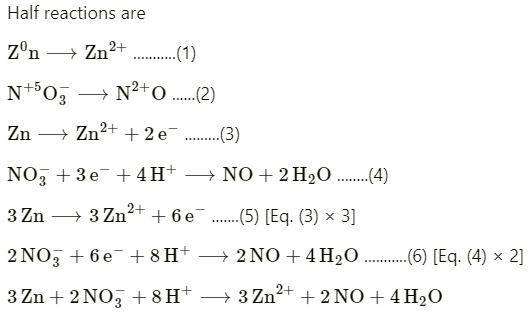
Balance the following equations by ion electron method
\(Zn+{ NO }_{ 3 }^{ - }\longrightarrow { Zn }^{ 2+ }+No\)
89.
Balance the following equations by ion electron method.
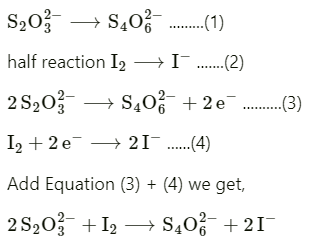
\({ Na }_{ 2 }{ S }_{ 2 }{ O }_{ 3 }+{ I }_{ 2 }\longrightarrow { Na }_{ 2 }{ S }_{ 4 }{ O }_{ 6 }+NaI\)
90.
Balance the following equations by ion electron method
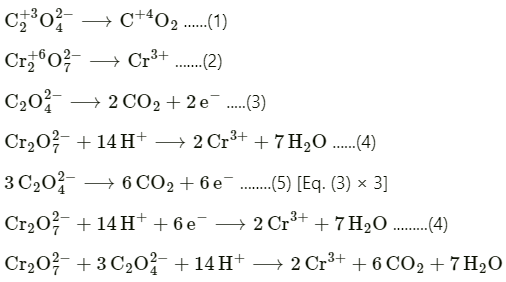
\({ C }_{ 2 }{ O }_{ 4 }^{ 2- }+{ Cr }_{ 2 }{ O }_{ 7 }^{ 2- }\longrightarrow { Cr }^{ 3+ }+{ CO }_{ 2 }\) (in acid medium)
91.
Balance the following equations by ion electron method.
i) \({ KMn }O_{ 4 }+{ SnCl }_{ 2 }+HCI\longrightarrow MnCI_{ 2 }+{ SnCI }_{ 4 }+{ H }_{ 2 }O+KCI\)
ii) 
iii) 
iv) 
92.
A Compound on analysis gave Na = 14.31% S = 9.97% H = 6.22% and 0 = 69.5%.
Calculate the molecular formula of the compound if all the hydrogen in the compound is present in combination with oxygen as a water of crystallization. (molecular mass of the compound is 322).
93.
Calculate the empirical and molecular formula of a compound containing 76.6% carbon, 6.38 % hydrogen and rest oxygen its vapour density is 47.
94.
The reaction between aluminium and ferric oxide can generate temperatures up to 3273 K and is used in welding metals. (Atomic mass of Al = 27 u atomic mass of O = 16 u )
2Al + Fe2O3 \(\longrightarrow \) Al2O3 + 2Fe; If in this process, 324 g of aluminum is allowed to react with 1.12 kg of ferric oxide
i) Calculate the mass of Al2O3 formed
ii) How much of the excess reagent is left at the end of the reaction ?
95.
Why do astronauts have to wear protective suits when they are on the surface of moon?
96.
What is the empirical formula of the following?
i) Fructose (C6 H12 O6) Found in honey
ii) Caffeine (C8 H10 N4 O2) a substance found in tea and Coffee
97.
Mass of one atom of an element is 6.645 x 10⁻²³g. How many moles of element are there in 0.320 kg.
98.
Distinguish between diffusion and effusion.
99.
Define orbital ? what are the n and 1 values for 3px and 4dx2-y2 electron ?
100.
NH3 has exceptionally high melting point and boiling point as compared to those of the hydrides of the remaining element of group 15. Explain.
1.
\(q_{rev}= (-\Delta_f H^{\ominus})=-286 kJ\ mol^{-1}=286000\ J\ mol^{-1}\)
\(\Delta{S}{_{(Surroundmgs)}}=\frac{q_{rev}}{T}=\frac{286000\ J\ mol^{-1}}{298\ K}\) = 959 J K-1 mol-1.
2.
\(\Delta { G }^{ \ominus }\) = -RT ln K = -2.303 RT log K.
R = 8.314 JK-1 mol-1;T = 300 K; K=10
\(\Delta { G }^{ \ominus }=-2.303 \times 8.314 \) JK-1 mol-1 x (300 K) x log 10
= -5527 J mol-1= -5.527 kJ mol-1
3.
We will use the ideal gas equation for this calculation as below:
\({P=nRT\over V}={{2mol\times 0.0821Latm.K^{-1}.mo^l{-1}\times (70+273K)}\over{6dm^3}}\)
= 9.39 atm.
4.
= (12 x 12) + (22 x 1) + (11 x 16)
= 342 g /mol
5.
= (39 x 2) + (2 x 52) + (7 x 16)
= 294 g mol.
6.
= (1 x 39) + (1 x 55) + (4 x 16)
= 158 g / mol
7.
8.
Molecular mass = Density x Molar volume
Molar volume of CO2 = 2.24 x 10⁻²m3
Density of CO2 1.977 kg m-3
\(\therefore \text { Molecular mass of } \mathrm{CO}_{2}=1.977 \times 10^{3} \mathrm{~g} \mathrm{~m}^{\not -3} \times 2.24 \times 10^{-2} \mathrm{~m}^{\not -3}\)
= 1.977 X 101 x 2.24
= 44g
9.
Cl(g) + e- ⟶Cl-(g) AH = 348 kJ mol-1
For one mole (35.5g) 348 kJ is released.
\(\therefore \text { For } 17.5 \mathrm{~g} \text { chlorine, } \frac{348 \mathrm{~kJ}}{35.5 \mathrm{~\not g}} \times 17.75 \mathrm{~\not g} \text { energy leased. }\)
∴ The amount of energy released =\(\frac { 348 }{ 2 } \) =174 kJ
10.
Noble gases: Ioniation energy ranging from 2372 KJmol-1 to 1037 kJ mol-1.
For element X, the IE1 value is in the range of noble gas, moreover for this element both IE1 and IE2 are higher and hence X is the noble gas.
For Y, the first ionisation energy is low and second ionisation energy is very high and hence Y is most reactive metal. For Z, both IE1 and IE2 are higher and hence it is least reactive.
11.
Electronic Configuration: (n - 1)d2 ns2
for n = 5, the electronic configuration is,
1s2 2s2 2p6 3s2 3p6 4s2 3d10 4p6 4d2 5s2
Atomic number: 40
4th group 5th period (d block element) = Zirconium
12.
Atomic number: 120
IUPAC temporary symbol: Unbinilium
IUPAC temporary symbol: Ubn
Possible electronic configuration :[Og] 8s2
13.
The main basic difference between Mendeleev's periodic table and modem periodic table is that first one is constructed on the basis of atomic weight and the later is constructed on the basis of atomic number.
14.
(iv) \({ K }\overset { +7 }{ \underset { \underset { 2\times { 3e }^{ - } }{ \downarrow } }{ M } } n{ O }_{ 4 }+{ H }_{ 2 }\overset { -1 }{ \underset { { 1e }^{ - } }{ \underset { \uparrow }{ C_{ 2 } } } } { O }_{ 4 }+{ H }_{ 2 }{ SO }_{ 4 }\longrightarrow { K }_{ 2 }{ SO }_{ 4 }+\overset { +2 }{ M } n{ SO }_{ 4 }+\overset { +4 }{ C } { O }_{ 2 }+{ H }_{ 2 }O\)
2KMnO4 + 5H2C2O4 + H2S04 \(\longrightarrow \) Mn02 + Na2S04 + KOH
2KMnO4+ 5H2C2O4 + H2S04 \(\longrightarrow \) K2SO4 + 2MnSO4 + 10CO2 + H2O
2KMnO4 + 5H2C2O4 + 3H2S04 \(\longrightarrow \) K2S04 + 2MnS04 + lOC02 + 8H20
15.
(iii) \(\overset { 0 }{ \underset { \underset { 2e^{ - } }{ \downarrow } }{ Cu } } { O }_{ 7 }+H\overset { +5 }{ \underset { { 1e }^{ - } }{ \underset { \uparrow }{ N } } } { O }_{ 3 }\longrightarrow \overset { +2 }{ Cu } \left( { No }_{ 3 } \right) _{ 2 }+\overset { +4 }{ N } { O }_{ 2 }+{ H }_{ 2 }O\)
Cu +2HNO3 \(\longrightarrow \) Cu(NO3)2 + NO2 + H2O
Cu + 2HNO3 + 2HNO3 \(\longrightarrow \) Cu(NO3)2 + 2NO2 + 2H2O
Cu + 4HNO3 \(\longrightarrow \) Cu (NO3)2 + 2No2 + 2H2O
16.
(ii) \({ K }\overset { +7 }{ \underset { \underset { 3e^{ - } }{ \uparrow } }{ M } } n{ O }_{ 4 }+{ Na }_{ 2 }\overset { +4 }{ \underset { { 2e }^{ - } }{ \underset { \downarrow }{ S } } } { O }_{ 3 }\longrightarrow \overset { +4 }{ M } { nO }_{ 2 }+{ Na }_{ 2 }\overset { +6 }{ s } { O }_{ 4 }+KOH\)
\(\Rightarrow\) 2KMnO4 + 3Na2SO3 \(\longrightarrow \) MnO2 + Na2SO4 + KOH
\(\Rightarrow\) 2KMnO4 + 3Na2SO3 \(\longrightarrow \) 2MnO2 + 3Na2SO4 + KOH
\(\Rightarrow\) 2KMNO4 + 3NaSO3 + H2O \(\longrightarrow \) 2MnO2 + 3Na2SO4 +2KOH
17.
State Function: Enthalpy, entropy, temperature, free energy
Path Function: Heat, work.
18.
(i) The third law of thermodynamics states that the entropy of pure crystalline substance at absolute zero is zero.
(ii) It can also be stated as it is impossible to lower the temperature of an object to absolute zero in a finite number of steps
(iii) Mathematically, \(\lim _{ T\rightarrow 0 }{ S=0 } \) for a perfectly ordered crystalline state.
19.
It is impossible to construct a machine that absorbs heat from a hot source and converts it completely into work by a cyclic process without transferring a part of heat to a cold sink
20.
Lattice energy is defined as "The amount of energy required to completely remove the constituent ions from its crystal lattice to an infinite distance." It is also referred as lattice enthalpy
21.
The heat of neutralisation is defined as "The change in enthalpy when one gram equivalent of an acid is completely neutralised by one gram equivalent of a base or vice versa in dilute solution"
22.
The calorific value is defined as "The amount of heat produced in calories (or joules) when one gram of the substance is completely burnt." The SI unit of calorific value is J kg-1. It is usually expressed in cal g -1.
23.
Molar heat capacity is defined as "The amount of heat absorbed by one 'mole of the substance to raise its temperature by 1 kelvin". The SI unit of molar heat capacity is JK-1 mol-1
24.
The heat of combustion of a substance is defined as "The change in enthalpy of a system when one mole of the substance is completely burnt in excess of air or oxygen". It is denoted by ΔHC
25.
Gibbs free energy is defined as G = H - TS
26.
(i) non-spontaneous
(ii) non-spontaneous
(iii) spontaneous
27.
(i) Entropy is a measure of the molecular disorderliness (randomness) of a system. dS = dqrev/T
(ii) The entropy (S) is equal to heat energy exchanged (q) divided by the temperature (T) at which the exchange takes place. Therefore, The SI unit of entropy is JK-1
28.
The property that is independent of the mass or the size of the system is called an intensive property.
Examples: Refractive index, Surface tension, density, temperature, Boiling point, Freezing point, molar volume, etc.,
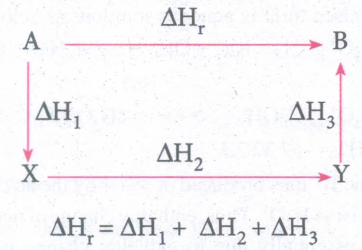
29.
The enthalpy change of a reaction either at constant volume or constant pressure is the same whether it takes place in a single or multiple steps provided the initial and final states are same.
30.
The first law of thermodynamics, also known as the law of conservation of energy, states that "The total energy of an isolated system remains constant though it may change from one form to another."
The mathematical statement of the First Law is: ΔU=q+w
Where q - the amount of heat supplied to the system; w - work done on the system
31.
(i) ground state :
| \(\upharpoonleft \) | \(\upharpoonleft \) | \(\upharpoonleft \) | \(\upharpoonleft \) | \(\upharpoonleft \) |
This type of electronic configuration have ten possible arrangement (i.e. Half filled configuration is More).
32.
a) Principal quantum number defines energy and size of an orbital.
b) Azimuthal quantum number defines shape of an orbital
c) Magnetic quantum number defines spatial orientation (direction) of an orbital.
33.
2Ca + O2 ⟶ 2CaO
34.
Mg (OH)2 ; Magnesium hydroxide.
35.
Efflorescence is the spontaneous loss of water by a hydrated salt, which occurs when the aqueous vapor pressure of the hydrate is greater than the partial pressure of the water vapour in the air. This is the property of salts
Ex: Glauber's salt- Na2SO4·10H2O
Epsom salt - MgSO4·7H2O
36.
| Orbital | n | 1 | Radial node n-1-1 | Angular node 1 |
| 2s | 2 | 0 | 1 | 0 |
| 4p | 4 | 1 | 2 | 1 |
| 5d | 5 | 2 | 2 | 2 |
| 4f | 4 | 3 | 0 | 3 |
37.
| n | l | m | orbitals | Total no of orbitals |
| 0 | 0 | 1 | (1- 4s +3 - 4P orbital +5 - 4d orbital +7 - 4f orbital) =16 |
|
| 4 | 1 | -1 0 +1 |
3 | |
| 2 |
-2 |
5 | ||
| 3 |
-3 |
7 |
38.
Energy electrons symmetry
This is due to the symmetrical distribution and exchange energy of given d- electrons. Symmetry leads to stability.
Exchange energy:
If two or more electrons with the same spin are present in degenerate orbitals, there is a possibility for exchanging their positions. During exchange process, the energy is released and the released energy is called exchange energy. If more number of exchanges are possible, more exchange energy in released. More number of exchanges are possible only in case of half filled and fully filled configurations.
For example, in chromium the electronic configuration is [Ar]3d5 4s1. The 3d orbital is half filled and there are ten possible exchanges as shown in figure. On the other hand only six exchanges are possible for [Ar]3d4 4s2 configuration. Hence, exchange energy for the half filled configuration is more. This increases the stability of half filled 3d orbitals.
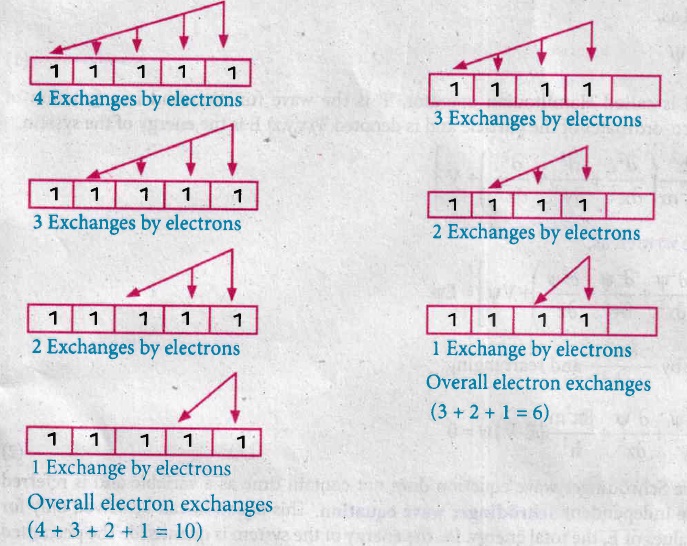
The exchange energy is the basis for Hund's rule, which allows maximum multiplicity, that is electron pairing is possible only when all the degenerate orbitals contain one electron each.
39.
Average atomic mass
= \(\frac { (78.99\times 23.99)+(10\times 24.99)+(11.01\times 25.98) }{ 100 } \)
= \(\frac { 2430.9 }{ 100 } \)
= 24.31 u
40.
Mol.mass = 2(H) + 1(S) + 4(0)
= 2(1) + 1(32) + 4(16)
= 2 + 32 + 64 = 98
41.
Mol.mass = 3(H) + 1(B) + 3(0)
= 3(1) + 1(11) + 3(16)
= 3 + 11 + 48 = 62
42.
Mol.mass = 3(C) + 6(H) + 1(0)
= 3(12) + 6(1) + 1(16)
= 36 + 6 + 16 = 58
43.
i) urea [CO(NH2)2]
Mol.mass = 1 (C) + 2(N) + 4(H) + 1(0)
= 1(12) + 2(14) + 4(1) + 1(16)
= 12 + 28 + 4 + 16 = 60
ii) Acetone [CH3 COCH3]
Mol.mass = 3(C) + 6(H) + 1(0)
= 3(12) + 6(1) + 1(16)
= 36 + 6 + 16 = 58
iii) Boric Acid [H3 BO3]
Mol.mass = 3(H) + 1(B) + 3(0)
= 3(1) + 1(11) + 3(16)
= 3 + 11 + 48 = 62
iv) Sulphuric Acid [H2 SO4]
Mol.mass = 2(H) + 1(S) + 4(0)
= 2(1) + 1(32) + 4(16)
= 2 + 32 + 64 = 98
44.
Lanthanides: [54Xe] 4f1-14 5d1 6s2
Actinides : [86Rn] 5f0-146d0-2 7s2
45.
It is defined as the imaginary charge left on the atom when all other atoms of the compound have been removed in their usual oxidation states that are assigned according to set of rules.
46.
Gram equivalent mass of an element, compound or ion is the mass that combines or displaces 1.008 g hydrogen or 8 g oxygen or 35.5 g chlorine.
47.
One mole is the amount of substance of a system, which contains as many elementary particles as there are atoms in 12 g of carbon -12 isotope.
48.
49.
a) Electron-precise hydrides:
These have required number of electron to represent their conventional d lewis structure. All the elements of carbon group (14) form such hydrides.
Eg CH4, C2H6, SiH4, GeH4
b) Electron - deficient hydrides:
There act as Lewis acids (ie) electron acceptors. The elements from group (13) form such hydrides.
Eg: B2H6
c) Electron - rich hydrides:
There have excess electron, which are present as lone pairs. Elements of group 15-17 form such hydrides. They behave as Lewis bases (ie) electron donors.
Eg: NH3 ,H2O, HF
50.
NOTE :
At any condition ice cube does not sink in water.
At 0°C, ice and liquid water will be in equilibrium and will coexist. Hence no freezing or melting will occur.
51.
NOTE:
At any condition ice cube does not sink in water.
At 00C, ice and liquid water will be in equilibrium and will coexist. Hence no freezing or melting will occur.
52.
The total number of electrons are less in the cation than the neutral atom while the nuclear charge remains the same. Therefore the effective nuclear charge of the cation is higher than the corresponding neutral atom. Thus the successive ionisation energies, always increase in the following order
IE1 < IE2 < IE3 < .....
53.
It is defined as the relative tendency of an element present in a covalently bonded molecule, to attract the shared pair of electrons towards itself.
54.
Mg + I.E1 ⟶ Mg+ +1e- .....(i)
Mg+ + I.E2 ⟶ Mg2+ + 1e- ....(ii)
Mg2+ + I.E3 ⟶ Mg3+ + 1e- ....(iii)
(i) The step (iii) which involves the formation of Mg3+ requires higher ionisation energy.
(ii) Mg2+ consist of 10 electrons (2, 8) attaining the stable noble gas configuration of argon (Z = 10).
(iii) Since the valence orbital is completely filled, more energy will be required to remove electrons.
55.
No the above definition is incorrect. The correct definition is Ionization energy is defined as the minimum amount of energy required to remove the most loosely bound electron from the valence shell of the isolated neutral gaseous atom in its ground state.
56.
The net nuclear charge experienced by valence electrons in the outermost shell is called the effective nuclear charge.
Zeff=Z-S
Where Z is the atomic number and 'S' is the screening constant.
57.
Ions of different elements having the same number of electrons are called isoelectronic ions.
| Ions of different elements | Na+ | Mg+2 | Al+3 | F- | O2- | N3- |
| No. of electrons | 10 | 10 | 10 | 10 | 10 | 10 |
58.
The modem periodic law states that, "the physical and chemical properties of the elements are periodic functions of their atomic numbers.
59.
Given
T1 = 127°C = 127 + 273 = 400 K
T = 47°C = 47 + 273 = 320 K
% efficiency η = ?
η = \(\left[ \frac { { T }_{ 1 }-{ T }_{ 2 } }{ { T }_{ 1 } } \right] \) x 100
η =\(\left[ \frac { 400-320 }{ 400 } \right] \) x 100
η = \(\left[ \frac { 80 }{ 400 } \right] \) x 100
η = 20%
60.
\(\mathrm{E}_{n}=\frac{-13.6}{\mathrm{n}^{2}} \mathrm{eV}\)
Second excited state
\(\therefore E_{3}=\frac{-13.6}{9} \mathrm{eV}\)
n = 3
E3 = -1.51 eV
61.
(i) spontaneous reaction: A reaction that occurs under the given set of conditions without any external driving force is called a spontaneous reaction.
(ii) Criteria for spontaneity of a process: The spontaneity of any process depends on three different factors.
ΔH = -ve, ΔS = +ve, ΔG = -ve.
62.
\({ H }_{ 2 }\overset { -1 }{ \underset { \overset { \uparrow }{ (ie\times 2) } }{ { O }_{ 2 } } } +{ \underset { \overset { \downarrow }{ Ie^{ - } } }{ Fe } }^{ 2 }+\rightarrow { Fe }^{ 3+ }+\overset { -2 }{ {H}_{2} O} \)
\({ H }_{ 2 }{ O }_{ 2 }+{ 2Fe }^{ 2+ }+\rightarrow Fe^{ 3+ }+{ H }_{ 2 }O\)
\(\Rightarrow \) \({ H }_{ 2 }{ O }_{ 2 }+{ 2Fe }^{ 2+ }+{ 2 }H^{ + }\rightarrow 2Fe^{ 3+ }+{ 2H }_{ 2 }O\)
63.
The balanced equation for the combustion of ethane
C2H6 + \(\frac { 7 }{ 2 } \)O2 \(\longrightarrow \) 2CO2 +3H2O
2C2H6 + 7O2 \(\longrightarrow \) 4CO2 + 6H2O
To produce 4 moles of CO2, 2 moles of ethane is required
To produce 1 moles (44 g) of CO2 required
Number of moles of ethane
\(=\frac{2 \mathrm{~mol} \text { ethane }}{4 \not \mathrm{molCO}_{2}} \times 1 \not \mathrm{molCO}_{2}\)
= \(\frac { 1 }{ 2 } mole\quad of\quad ethane\)
= 0.5 mole of ethane
64.
Rate of diffusion \(\text { (r) } \alpha \frac{1}{\sqrt{M}}\)
\(\mathrm{M}_{\mathrm{NH}_{3}}=17 ; \mathrm{M}_{\mathrm{HCl}}=36.5
\)
\(\therefore \mathrm{r}_{\mathrm{NH}_{3}}>\mathrm{r}_{\mathrm{HCl}}
\)
Hence white fumes are first formed near HCL.
65.
1) The unit of molecular mass is atomic mass unit [amu]. The unit of molar mass is gram per mole.
2) Molecular mass is the mass of one molecule while molar mass is the mass of one mole of molecules (6.022 x 10²³)
(i) Molecular mass of CO2 = 1(C) + 2(0) = 12 + 32 = 44 amu
or 7.304 x 10⁻²³ g
(ii) Molar mass of CO2 = 44 g mol-1.
66.
i) 25Mn - 1s2, 2S2, 2p6, 3s2, 3p6, 4s2, 3d5
23Mn2+ - 1s2, 2S2, 2p6, 3s2, 3p6, 3d5
ii) 24Cr - 1s2, 2S2,2p6, 3s2, 3p6, 4s1, 3d3
21Cr3+ - 1s2, 2S2,2p6, 3s2, 3p6, 3d3
67.
On heating incineration might take place due to the increase of pressure
68.
The larger the size of the molecule, the greater will be Van der Waals' attraction. Therefore greater the deviation from ideal behaviour. So bromine will deviate more from ideal behaviour because it has bigger atoms.
69.
| n | 1 | Sub Energy | m1values | Number of orbitals |
| 4 | 2 | 4d | -2,-1,0+1,+2 | Five 4d orbitals |
| 5 | 3 | 5f | -3,-2,-1,0,+1,+2,+3, | seven 5f orbitals |
| 7 | 0 | 7s | 0 | one 7s orbitals |
70.
De Broglie wavelength of the tennis ball equal to 5400 \(\overset { 0 }{ A } \).
m = 54 g
V = ?
\(\lambda=\frac{h}{mV}\)
\(V=\frac{h}{m\lambda}\)
\(\mathrm{v}=\frac{6.626 \times 10^{-34} \mathrm{JS}}{54 \times 10^{-3} \mathrm{~kg} \times 5400 \times 10^{-10} \mathrm{~m}}=2.27 \times 10^{-26} \mathrm{~ms}^{-1}\)
71.
| Question | Number of moles of reactants allowed to react | Number of moles reactants consumed during reaction | Limiting reagent | ||||
|---|---|---|---|---|---|---|---|
| x | y | z2 | x | y | z2 | ||
| (a) | 200 atoms | 200 atoms | 50 molecules | 50 atoms | 50 atoms | 50 molecules | z2 |
ii) 1 mol of x + 1 mol of y + 3 mol of z2
| Question | Number of moles of reactants allowed to react | Number of moles reactants consumed during reaction | Limiting reagent | ||||
|---|---|---|---|---|---|---|---|
| x | y | z2 | x | y | z2 | ||
| (a) | 1 mol | 1 mol | 3 mol | 1 mol | 1 mol | 1 mol | x and y |
ii) 50 atoms of x + 25 atoms of y + 50 molecules of z2
| Question | Number of moles of reactants allowed to react | Number of moles reactants consumed during reaction | Limiting reagent | ||||
|---|---|---|---|---|---|---|---|
| x | y | z2 | x | y | z2 | ||
| (a) | 50 atom | 25 atom | 50 molecules | 25 atom | 25 atom | 25 molecules | y |
| Question | Number of moles of reactants allowed to react | Number of moles reactants consumed during reaction | Limiting reagent | ||||
|---|---|---|---|---|---|---|---|
| x | y | z2 | x | y | z2 | ||
| (a) | 2.5 mol | 5 mol | 5 mol | 2.5 mol | 2.5 mol | 2.5 mol | x |
72.
1. Gypsum is used in making drywalls or plaster boards.
2. Another important use of gypsum is the production of plaster of Paris. Gypsum is heated to about 300 degree Fahrenheit to produce plaster of paris, which is also known as gypsum plaster. It is mainly used as a sculpting material.
3. Gypsum is used in making surgical and orthopedic casts, such as surgical splints and casting moulds.
4. Gypsum plays an important role in agriculture as a soil additive, conditioner, and fertilizer. It helps loosen up compact or clay soil, and provides calcium and sulphur, which are essential for the healthy growth of a plant.
5. Gypsum is used in toothpastes, shampoos, and hair products.
6. Gypsum is a component of portland cement, where it acts as a hardening retarder to control the speed at which concrete sets.
73.
Calcium Sulphate (plaster of paris), CaSO4. 1/2H2O :
It is a hemihydrate of calcium sulphate. It is obtained when gypsum, CaSO4 .2H2O,is heated to 393 K
2(CaSO4.2H2O) ⟶ 2CaSO4,H2O + 3H2O
Above 393 K, no water of crystallisation is left and anhydrous calcium sulphate, CaSO4 is formed. This is a known 'dead burnt plaster'.
It has a remarkable property of setting with water. on mixing with an adequate quantity of water it forms a plastic mass that gets into hard solid in 5 to 15 minutes.
74.
This is due to the smaller size and relatively high charge as Be2+ ion. Moreover Beryllium is a non - metal. But Magnesium is a metal. In the case of beryllium the ionisation energy and electronegativity of the halides are almost similar; but there is a vast difference in IE and electronegativity between Mg and halides.
75.
The largest use of plaster of paris is in the building industry as well as plasters. It is used for immobilising the affected part of organ where there is a bone fracture or sprain. It is also employed in dentistry, in ornamental work and for making casts of statues and busts.
76.
The lattice energy of LiF is higher due to the smaller size of Li+ and F-. So LiF has lower solubility.
77.
6Li + N2 ⟶ 2Li3 N
78.
If there is a tiny sticky area on the walls of the container of a gas, then the collision of the molecules will not be elastic. So the gas will behave as a real gas. So the pressure will be less than the calculated value.
79.
| Compound | Given No.of moles | No.of oxygen atoms |
|---|---|---|
| Ethanol - C2H5OH | 1 | 1\(\times\)6.022\(\times\)1023 |
| Formic acid - HCOOH | 1 | 2\(\times\)6.022\(\times\)1023 |
| Water - H2O | 1 | 1\(\times\)6.022\(\times\)1023 |
| Formic acid | ||
80.
Molar mass = density x Molar volume
= 1.965 x 2.24 x 10-2
= 4.4016 x 10⁻² kg/mol
= 4.4016 x 10-2 x 103 g/mol
= 44.016 g/mol
81.
| Oxidation | Reduction | |
| 1. | Addition of oxygen | Addition of Hydrogen |
| 2. | Removal of Hydrogen | Removal of oxygen |
| 3. | Addition of an electronegative element. | Addition of an electro positive element |
| 4. | Removal of an electro positive element | Removal of an electro negative element |
| 5. | Loss of electron | Gain of electron |
| 6. | Increase in oxidation state / number | Decrease in oxidation state/ number. |
82.
Interstitial hydrides have metallic bonding. These are non - stoichiometric; their composition varies with temperature and pressure. The crystal lattice expands due to the inclusion of dihydrogen and there is distortion of crystal lattice. So they have lower density than the parent metal. Recent studies have shown that except the hydrides of Ni, Pd, Ce & Ac, other hydride are different from the parent metals.
83.
(i) WO3 + 3H2 ➝ W + 3H2O
(ii) H2 + Cl2 ➝ 2HCl.
84.
a) HCl is a gas. It is an electron rich covalent hydride. It is a covalent molecule with strong covalent bond. However the forces between the molecules are not as strong.
b) NaH is a solid. It is an ionic hydride of group I sodium metal. It is an insoluble hydride
85.
Hydrogen has electronic configuration 1s1. So it resembles ns1 general valence shell configuration of alkali metals.
Its similarity with alkali metals are:
1. Form uni positive (H+) ions like Na+, K+, Cs+
2. Form halides, (HX), oxides (H2O) peroxides (H2O2) and sulphides (H2S) like (Nax, Na2O, Na2O2, Na2S)
3. Acts as reducing agent.
4. Has +1 oxidation state.
5. If it is placed in the halogen family it should be the most electro negative element which is not true.
86.
(i) no. of electrons: 35 (given)
no. of protons : 35
(ii) Electronic configuration
1s2 2S2 2p6 3s2 3p6 4s2 3d10 4p5
(iii) Last electron:
| \(\downharpoonleft\upharpoonright\) | \(\upharpoonleft\downharpoonright\) | \(\upharpoonleft\) |
4Px 4Py 4pz
last electron present in 4Py orbital y
n = 4, l = 1 m1 = either + 1 or -1 and s = -1/2
87.
(i) \({ K }_{ 2 }\overset { +6 }{ \underset { \underset { 2\times { 3e }^{ - } }{ \uparrow } }{ Cr_{ 2 } } } { O }_{ 7 }+K\overset { -1 }{ \underset { { 1e }^{ - } }{ \underset { \downarrow }{ I } } } +{ H }_{ 2 }{ SO }_{ 4 }\longrightarrow { K }_{ 2 }{ SO }_{ 4 }+{ \overset { +3 }{ Cr } }_{ 2 }({ SO }_{ 4 })_{ 3 }+\overset { 0 }{ I } _{ 2 }+{ H }_{ 2 }O\)
K2Cr2O7 + 6KI + H2SO4 \(\longrightarrow \) K2SO4 + Cr2(SO4)3 + I2 + H2O
K2Cr2O7 + 6KI + H2SO4 \(\longrightarrow \) K2SO4 + Cr2(SO4)3 + 3I2 + H2O
K2Cr2O7 + 6KI + 7H2SO4 \(\longrightarrow \) 4k2SO4 + Cr2(SO4)3 + 3I2 + 7H2
ii) \({ K }Mno_{ 4 }+{ Na }_{ 2 }{ So }_{ 3 }\longrightarrow { MnO }_{ 2 }+{ Na }_{ 2 }{ So }_{ 4 }+KOH\)
\({ K }\overset { +7 }{ \underset { \underset { 3e^{ - } }{ \uparrow } }{ M } } n{ O }_{ 4 }+{ Na }_{ 2 }\overset { +4 }{ \underset { { 2e }^{ - } }{ \underset { \downarrow }{ S } } } { O }_{ 3 }\longrightarrow \overset { +4 }{ M } { nO }_{ 2 }+{ Na }_{ 2 }\overset { +6 }{ s } { O }_{ 4 }+KOH\)
\(\Rightarrow\) 2KMnO4 + 3Na2SO3 \(\longrightarrow \) MnO2 + Na2 SO4 + KOH
\(\Rightarrow\) 2KMnO4 + 3Na2SO3 \(\longrightarrow \) 2MnO2 + 3Na2SO4 + KOH
\(\Rightarrow\) 2KMNO4 + 3NaSO3 + H2O \(\longrightarrow \) 2MnO2 + 3Na2 SO4 + 2KOH
iii) \(Cu+{ HNO }_{ 3 }\longrightarrow Cu\left( { No }_{ 3 } \right) _{ 2 }+{ No }_{ 2 }+{ H }_{ 2 }O\)
\(\overset { 0 }{ \underset { \underset { 2e^{ - } }{ \downarrow } }{ Cu } } { O }_{ 7 }+H\overset { +5 }{ \underset { { 1e }^{ - } }{ \underset { \uparrow }{ N } } } { O }_{ 3 }\longrightarrow \overset { +2 }{ Cu } \left( { No }_{ 3 } \right) _{ 2 }+\overset { +4 }{ N } { O }_{ 2 }+{ H }_{ 2 }O\)
Cu +2HNO3 \(\longrightarrow \) Cu(NO3)2 + NO2 + H2O
Cu + 2HNO3 + 2HNO3 \(\longrightarrow \) Cu(NO3)2 + 2NO2 + 2H2O
Cu + 4HNO3 \(\longrightarrow \) Cu (NO3)2 + 2No2 + 2H2O
iv) \({ KMn }O_{ 4 }+{ H }_{ 2 }{ C }_{ 2 }{ O }_{ 4 }+{ H }_{ 2 }{ SO }_{ 4 }\longrightarrow { K }_{ 2 }{ SO }_{ 4 }+{ MnSO }_{ 4 }+{ CO }_{ 2 }+{ H }_{ 2 }O\)
\({ K }\overset { +7 }{ \underset { \underset { 2\times { 3e }^{ - } }{ \downarrow } }{ M } } n{ O }_{ 4 }+{ H }_{ 2 }\overset { -1 }{ \underset { { 1e }^{ - } }{ \underset { \uparrow }{ C_{ 2 } } } } { O }_{ 4 }+{ H }_{ 2 }{ SO }_{ 4 }\longrightarrow { K }_{ 2 }{ SO }_{ 4 }+\overset { +2 }{ M } n{ SO }_{ 4 }+\overset { +4 }{ C } { O }_{ 2 }+{ H }_{ 2 }O\)
2KMnO4 + 5 H2C2O4 + H2S04 \(\longrightarrow \) Mn02 + Na2S04 + KOH
2KMnO4+ 5 H2C2O4 + H2S04 \(\longrightarrow \) K2SO4 + 2MnSO4 + 10CO2 + H2O
2KMnO4 + 5 H2C2O4 + 3H2S04 \(\longrightarrow \) K2S04 + 2MnS04 + 10C02 + 8 H20
88.
\(\overset { o }{ Z } n\longrightarrow { Z }n^{ 2+ }\)
\(\overset { +5 }{ N } { O }_{ 3 }^{ - }\longrightarrow \overset { 2+ }{ NO } \)
(1) \(\Rightarrow \) Zn \(\rightarrow\) Zn2+ +2e- .....(3)
(2) \(\Rightarrow \) \({ NO }_{ 3 }^{ - }+{ 3e }^{ - }+{ 4H }^{ + }\longrightarrow NO+{ 2H }_{ 2 }O\)......(4)
.png)
89.
half reaction \(\Rightarrow \) \({ S }_{ 2 }{ O }_{ 3 }^{ 2- }\longrightarrow { S }_{ 4 }{ O }_{ 6 }^{ 2- }\)
\({ I }_{ 2 }\longrightarrow { I }^{ - }\)
.png)
90.
\(\overset { +3 }{ C } _{ 2 }{ O }_{ 4 }^{ 2- }\longrightarrow \overset { +4 }{ C } { O }_{ 2 }\)
\(\overset { +6 }{ Cr } _{ 2 }{ O }_{ 7 }^{ 2- }\longrightarrow { Cr }^{ 3+ }\)
(1) \(\Rightarrow \) \({ C }_{ 2 }{ O }_{ 4 }^{ 2- }\longrightarrow { 2CO }_{ 2 }+{ 2e }^{ - }\)
\({ Cr }_{ 2 }{ O }_{ 7 }^{ 2- }\longrightarrow { 2Cr }^{ 3+ }+{ 7H }^{ 2 }O\)
.png)
91.
Half reactions are:
\(\overset { +7 }{ M } { nO }_{ 4 }^{ - }\longrightarrow { Mn }^{ 2+ }\)
and \({ Sn }^{ 2+ }\longrightarrow { Sn }^{ 4+ }\)
(1) \(\Rightarrow \) \({ MnO }_{ 4 }^{ - }+{ 8H }^{ - }+5e^{ - }\longrightarrow { Mn }^{ 2+ }+{ 4H }_{ 2 }O\)
(2) \(\Rightarrow \) \({ Sn }^{ 2+ }\longrightarrow { Sn }^{ 4+ }+{ 2e }^{ - }\)
.png)
ii)
iii)
iv)
92.
| Element | % | Relative number of atoms | Simple Ratio |
| Na | 14.31 | \(\frac { 14.31 }{ 23 } =0.62\) | \(\frac { 0.62 }{ 0.31 } =2\) |
| S | 9.97 | \(\frac { 9.97 }{ 32 } =0.31\) | \(\frac { 0.31 }{ 0.31 } =1\) |
| H | 6.22 | \(\frac { 6.22 }{ 1 } =6.22\) | \(\frac { 6.22 }{ 0.31 } =20\) |
| O | 69.5 | \(\frac { 69.5 }{ 16 } =4.34\) | \(\frac { 4.34 }{ 0.31 } =14\) |
Empirical formula = Na2 SH20 O14
\(\left[ \begin{matrix} { Na }_{ 2 }{ SH }_{ 20 }{ O }_{ 14 } \\ =(2\times 23)+(1\times 32)+(20\times 1)+14(16) \\ =46+32+20+234 \\ =322 \end{matrix} \right] \)
n = \(\frac { molar\quad mass }{ caluclated\quad empirical\quad formula\quad mass } =\frac { 322 }{ 322 } =1\)
Molecular formula = Na2 SH20O14
Since all the hydrogen in the compound are present as water
\(\therefore \) The molecular formula is Na2 SO4 10H2O.
93.
| Element | Percentage | Atomic mass | Relative number of atoms | simple ratio | Whole no |
| C | 76.6 | 12 | \(\frac { 76.6 }{ 12 } =6.38\) | \(\frac { 6.38 }{ 1.06 } =6\) | 6 |
| H | 6.38 | 1 | \(\frac { 6.38 }{ 1 } =6.38\) | \(\frac { 6.38 }{ 1.06 } =6\) | 6 |
| 0 | 17.02 | 16 | \(\frac { 17.02 }{ 16 } =1.06\) | \(1.06\frac { 1.06 }{ 1.06 } =1\) | 1 |
Empirical Formula = C6 H6O
n = \(\frac { molar\ mass }{ calculated\ eprirical\ formula\ mass } \)
= \(\frac { 2\times \ vapour\ density }{ 94 } \frac { 2\times 47 }{ 94 } =1,\)
Molecular formula (C6H6O) x 1 = C6H6O.
94.
2Al + Fe2O3 \(\longrightarrow \) Al2O3 + 2Fe
| Reactants | Products | |||
| Al | Fe2O3 | Al2O3 | Fe | |
| Amount of reactant allowed to react | 324 g | 1.12 kg | - | - |
| Number of moles allowed to react | \(\frac { 324 }{ 27 } =12mol\) | \(\frac { 1.12\times { 10 }^{ 3 } }{ 160 } =7mol\) | - | - |
| Stoichiometric Co-efficient | 2 | 1 | 1 | 2 |
| Number of moles consumed during reaction | 12 mol | 6 mol | - | - |
| Number of moles of reactant unreacted and number of moles of product formed | - | 1 mol | 6 mol | 12 mol |
Molar mass of Al2O3 format = 6 mol x 102 g mol-1 = 612 g
[ Al2O3 : (2 x 27) + 3(16) = 54 + 48 = 102] = 612 g
Excess reagent = Fe2O3
Amount of excess reagent left at the end of the reaction = 1 mol x 160 g mol-1
= 160g [ Fe2O3 : (2 x 56) + (3 x 16) = 112 + 48 = 160] = 160 g
95.
Astronauts must wear space suits filled with air, whenever they leave a space craft and are exposed to the environment of space.
Dangers experienced on moon's space :
1. In space there is no air to breathe and no air pressure.
2. Space is extremely cold and filled with dangerous radiations.
3. If they do not wear space suits, there may be bleeding due to high body pressure.
4. The space suits prevent astronauts from impacts of small bits of space dust.
5. There is no atmosphere on the moon and there are dangers from micro-meteorite impacts.
6. The astronauts are protected from these dangers on wearing space suits.
96.
| Compound | Molecular formula | Empirical Formula |
|---|---|---|
| Fructose | C6 H12O6 | C H2O |
| Caffeine | C8 H10 N4 O2 | C4 H5 N2O |
97.
mass of one atom = 6.645 x 10⁻²³ g
\(\therefore\) mass of 1 mole of an atom = 6.645 x 10-23 g x 6.022 x 1023 = 40 g
\(\therefore\) number of moles of element in 0.320 kg = \(\frac { 1\quad mole }{ 40g } \times 0.320kg\)
= \(\frac { 1mol\times 320g }{ 40g } \)
= 8 mol
98.
| S.NO | diffusion | effusion |
| 1 | It is the spreading of molecules of a substance throughout a space or second substance | It is the escape of the gas molecules through a very small hole (orifice) in a membrane into an evacuated area. |
| 2 | It is typically used to describe statistical properties of a gas at length scales that are much larger than mean free path. | The diameter of the hole should be smaller than mean free path of the molecules. |
| 3 | It is the spreading of gases. | It is the pouring out of gases. |
99.
The solution to Schrodinger equation gives the permitted total energy values called eigen values and the corresponding wave function represent atomic orbitals.
| Orbital | n | l |
| 3px | 3 | 1 |
| 4dx2-y2 | 4 | 2 |
100.
(i) Due to small size of Nitrogen atom.
(ii) Due to polar nature of N-H bond.
(iii) Due to inter molecular H- bonding which are stronger than London forces present in other hydrides. Other hydrides lack H - bonding

11th Standard Syllabus & Materials
11th Standard
TN 11th Tamil பீடு பெற நில் - செய்யுள் - காவடிச்சிந்து Important Questions And Answers Study Material - QB365 Set A
NEW11th Standard
TN 11th Tamil பீடு பெற நில் - உரைநடை - மலை இடப்பெயர்கள் : ஓர் ஆய்வு Important Questions And Answers Study Material - QB365 Set A
NEW11th Standard
TN 11th Tamil மாமழை போற்றுதும் - துணைப்பாடம் - யானை டாக்டர் Important Questions And Answers Study Material - QB365 Set A
NEW11th Standard
TN 11th Tamil மாமழை போற்றுதும் - செய்யுள் - ஐங்குறுநூறு Important Questions And Answers Study Material - QB365 Set A



Tamilnadu Stateboard 11th Standard Subjects

Maths

Commerce

Economics

Biology

Business Maths and Statistics

Accountancy

Computer Science

Physics
Chemistry
Maths
Biology
Economics
Physics
Chemistry

History
Business Maths and Statistics

Computer Science
Accountancy

Computer Applications
History
Computer Technology
Commerce
Computer Applications
Computer Technology

Tamil

English

French
Tamilnadu Stateboard Standards
