
 100% FREE ACCESS
11th Standard Syllabus & Materials
11th Standard
TN 11th Tamil இயற்கை வேளாண்மை,சுற்றுச்சூழல் -செய்யுள் - மனோன்மணீயம் Important Questions And Answers Study Material - QB365 Set A
NEW11th Standard
TN 11th Tamil என்னுயிர் என்பேன் -துணைப்பாடம் - இசைத்தமிழர் இருவர் Important Questions And Answers Study Material - QB365 Set A
NEW11th Standard
TN 11th Tamil மொழி கலை -செய்யுள் - ஒவ்வொரு புல்லையும் Important Questions And Answers Study Material - QB365 Set A
NEW11th Standard
TN 11th Tamil பீடு பெற நில் - இலக்கணம் - பகுபத உறுப்புகள் Important Questions And Answers Study Material - QB365 Set A
NEW11th Standard
TN 11th Tamil பீடு பெற நில் - துணைப்பாடம் - வாடிவாசல் Important Questions And Answers Study Material - QB365 Set A
NEW11th Standard
TN 11th Tamil பீடு பெற நில் - செய்யுள் - குறுந்தொகை Important Questions And Answers Study Material - QB365 Set A

Published on: 08/09/2018
THREE MARK TEST
Download Tamil Nadu 11th Standard Chemistry question papers, model tests, one-mark questions, important questions, and public exam papers in PDF format. Free study materials and answer keys for TN State Board students.
Questions + Answers key
Take MCQ Chemistry Test
1.
Calculate \(\triangle_r{G}^{\ominus}\) for conversion of oxygen to ozone, \({3\over 2}{O}_{{2}_{(g)}}\rightarrow{O}_{{3}_{(g)}}\) at 298 K. If Kp for this conversion is 2.47 X 10⁻²⁹.
2.
Enthalpy for the oxidation of graphite to CO2 and CO to CO2 can easily be measured. For these conversions, the heat of combustion values are -393.5 kJ and - 283.5 kJ respectively.
3.
Predict which of the following hydrides is a gas on a solid
(a) HCI
(b) NaH
Give your reason.
4.
How much volume of chlorine is required to form 11.2 L of HCI at 273 K and 1 atm pressure?
5.
How much volume of carbon dioxide is produced when 50 g of calcium carbonate is heated completely under standard conditions ?
6.
How many moles of hydrogen is required to produce 10 moles of ammonia ?
7.
(a) Under what condition, the heat evolved or absorbed in a reaction is equal to its free energy change?
(b) Calculate the entropy change for the following reversible process.
\(H_2 O \rightleftharpoons H_2O_{I} \) Δfus H is 6 kJ mol-1
8.
The enthalpy of formation of methane at constant pressure and 300 K is - 78.84 k.l, What will be the enthalpy of formation at constant volume?
9.
Calculate the enthalpy of combustion of ethylene at 300 K at constant pressure, if its heat of combustion at constant volume (ΔU) is -1406 kJ .
10.
Calculate the value of \(\Delta\)U and \(\Delta\)H on heating 128 g of oxygen from O°C to 100°C. Cv and Cp on an average are 21 and 29 J mol-1 K-1. (The difference is 8 J mol-1 K-1 which is approximately equal to R)
11.
The standard enthalpies of formation of \(C_2 H_5 OH_{I}, CO_{2{g}}\) and \(H_2 O(_{I})\) are -277, -393.5 and -285.5 kJ mol-1 respectively. Calculate the standard enthalpy change for the reaction \(C_2O_5 OH_{(I)}+3O_{2{g}} \rightarrow 2CO_{2{g}}+3 H_2 O_{(I)}\). The enthalpy of formation of O2(g) in the standard state is zero, by definition.
12.
A gas contained in a cylinder fitted with a frictionless piston expands against a constant external pressure of 1 atm from a volume of 5 litres to a volume of 10 litres. In doing so it absorbs 400 J of thermal energy from its surroundings. Determine the change in internal energy of system.
13.
Urea on hydrolysis produces ammonia and carbon dioxide. The standard entropies of urea, H2O, CO2, NH3 are 173.8, 70, 213.5 and 192.5 J mole-1K-1 respectively. Calculate the entropy change for this reaction.
14.
From the following data at constant volume for combustion of benzene, calculate the heat of this reaction at constant pressure condition.
C6H6(I) + \(\frac { 7 }{ 2 } \)O2(g) ⟶ 6CO2(g) + 3H2O(I) ΔU at 25°C = -3268.12 kJ
15.
Calculate the amount of heat necessary to raise 180 g of water from 25°C to 100°C. Molar heat capacity of water is 75.3 J mol-1K-1.
16.
An unknown gas diffuses at a rate of 0.5 time that of nitrogen at the same temperature and pressure. Calculate the molar mass of the unknown gas.
17.
A mixture of gases contains 4.76 mole of Ne, 0.74 mole of Ar and 2.5 mole of Xe. Calculate the partial pressure of gases, if the total pressure is 2 atm. at a fixed temperature. Solve this problem using Dalton's law.
18.
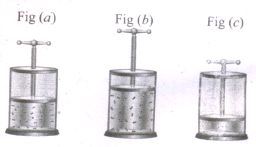
In the below figure, let us find the missing parameters [volume in (b) and temperature in (c)]
PI = 1 atm, P2 = 1 atm, P3 = 1 atm
V1 = 0.3 dm3, V2 = ? dm3, V3 = 0.15 dm3
T1 = 200 K, T2 = 300 K, T3 = ? K.
19.
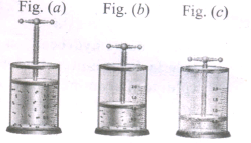
In the below figure, let us find the missing parameters [volume in (b) and pressure in (c)]
P1 = 1 atm, P2 = 2 atm, P3 = ? atm
V1 = 1dm3, V2 =? dm3, V3 = 0.25 dm3
T1 = 298 K, T2 = 298 K, T3 = 298 K.
20.
A student reported the ionic radii of isoelectronic species X3+,Y2+ and Z- as 136 pm,64 pm and 49 pm respectively.Is that oreder correct?Comment
21.
Explain the meaning of the symbol 4f2. Write all the four quantum numbers for these electrons.
22.
How many unpaired electrons are present in the ground state of Fe3+ (z = 26), Mn2+(z = 25) and argon (z = 18)?
23.
0.456 g of a metal gives 0.606g of its chloride Calculate its equivalent mass
24.
Calculate the equivalent mass of the following : Sodium
25.
Calculate the equivalent mass of the following : nitrate ion (NO3-)
26.
Calculate the equivalent mass of the following : Zn
27.
Calculate the molar volume of the following 3.0115 \(\times\)1023 molecules of SO2 gas
28.
Calculate the molar volume of the following 460g of formic acid
29.
Calculate the molar volume of the following 5 moles of methane
30.
Calculate the molar volume of the following 88 g of CO2
31.
Calculate the number of moles present in the following 19.5g of potassium
32.
Calculate the number of moles present in the following 90 g of magnesium oxide
33.
Calculate the number of moles present in the following 46g of ethanol
34.
Calculate the number of moles present in the following 120g of sodium hydroxide
35.
Calculate the number of moles present in the following 50g of calcium chloride
36.
Calculate the number of atoms/molecules present in the following 1Kg of acetic acid
37.
Calculate the number of atoms/molecules present in the following 100 g of sulphur dioxide
38.
Calculate the number of atoms/molecules present in the following 1.8 g of water
39.
Calculate the number of atoms/molecules present in the following : 10 g of Hg
40.
Calculate the molecular mass of the following Methane
41.
Calculate the molecular mass of the following Crystalline oxalic acid
42.
Calculate the molecular mass of the following KMnO4
43.
Calculate the oxidation number of underlined atoms of the following :
NO3-
44.
Calculate the oxidation number of underlined atoms of the following:
K2CrO4
45.
Calculate the oxidation number of underlined atoms of the following:
K2 MnO4
46.
Calculate the mass of the atom in amu
47.
How many moles of barium sulphate is precipitated when 1 mole of aluminium sulphate reacts completely with barium chloride ?
48.
Calculate the oxidation number of nitrogen in nitrous acid and nitric acid
49.
Calculate the Formula Weights of the following compounds.Mg(OH)2
50.
Calculate the Formula Weights of the following compounds. NaOH
51.
Calculate the Formula Weights of the following compounds.C6H12O6 - Glucose
52.
Calculate the Formula Weights of the following compounds. NO2
53.
How much mass (in gram units) is represented by the following?
5.14 mol of H5IO6
54.
How much mass (in gram units) is represented by the following ?
3.0 mol of CO2
55.
How much mass (in gram units) is represented by the following ?
0.2 mol of NH3
56.
One million silver atoms weigh 1.79 x 10⁻¹⁶ g. Calculate the atomic mass of silver.
57.
Calculate the mass of the following : 1 molecule of water.
58.
Calculate the mass of the following : 1 molecule of benzene
59.
Calculate the mass of the following : 1 atom of silver
60.
Calculate the number of atoms in the following 52 moles of He.
61.
Calculate the number of atoms in the following 52 g of He
62.
State the various statements of second law of thermodynamics.
63.
Enthalpy of neutralization is always a constant when a strong acid is neutralized by a strong base: account for the statement
64.
The equilibrium constant of a reaction is 10, what will be the sign of ΔG? Will this reaction be spontaneous?
65.
What are state and path functions? Give two examples
66.
Consider the reactions,
(i) H3PO2(aq) + 4AgNO3(aq)+ 2H2O(l) \(\longrightarrow\) H3PO4(aq)+ 4Ag(s)+ 4HNO3(aq)
(ii) H3PO2(aq) + 2CuSO4(aq) + 2H2O(l) \(\longrightarrow\) H3PO4(aq)+ 2Cu(s) + H2SO4(aq)
(iii) C6H5CHO(l) + 2[Ag(NH3)2]+(aq) + 3OH-(aq) \(\longrightarrow\) C6H5COO-(aq) + 2Ag(s)+ 4NH3(aq) + 2H2O(l)
(iv) C6H5CHO(l) + 2Cu2+(aq) + 5OH-(aq) \(\longrightarrow\) No change observed.
What interference do you draw about the behavior of Ag+ and Cu2+ from these reactions?
67.
Determine the values of all the four quantum numbers of the 8th electron in O- atom and 15th electron in Cl atom.
68.
Calculate the uncertainty in position of an electron, if Δv = 0.1% and \(\upsilon \) = 2.2 x 10⁶ ms-1.
69.
Why alkaline earth metals are harder than alkali metals.
70.
An alkali metal (x) forms a hydrated sulphate, X2SO4 • 10 H2O. Is the metal more likely to be sodium (or) potassium.
71.
Would it be easier to drink water with a straw on the top of Mount Everest?
72.
When the driver of an automobile applies brake, the passengers are pushed toward the front of the car but a helium balloon is pushed toward back of the car. Upon forward acceleration the passengers are pushed toward the front of the car. Why?
73.
Show that the circumference of the Bohr orbit for the hydrogen atom is an integral multiple of the de Broglie wave length associated with the electron revolving around the nucleus.
74.
Suggest why there is no hydrogen (H2) in our atmosphere. Why does the moon have no atmosphere?
75.
Arrange NH3, H2O and HF in the order of increasing magnitude of hydrogen bonding and explain the basis for your arrangement.
76.
How do you expect the metallic hydrides to be useful for hydrogen storage?
77.
Mention the uses of deuterium.
78.
Explain the exchange reactions of deuterium.
79.
Give the uses of heavy water?
80.
What are isotopes? Write the names of isotopes of hydrogen.
81.
What is water-gas shift reaction?
82.
Hydrogen peroxide can function as an oxidising agent as well as reducing agent. Substantiate this statement with suitable examples.
83.
Complete the following chemical reactions and classify them into
(a) hydrolysis (b) redox (c) hydration reactions.
(1) KMnO4 + H2O2 ➝
(2) CrCl3 + H2O ➝
(3) CaO + H2O ➝
84.
What are ideal gases? In what way real gases differ from ideal gases.
85.
Name two items that can serve as a model for Gay Lussac's law and explain.
86.
A balloon filled with air at room temperature and cooled to a much lower temperature can be used as a model for Charle's law.
87.
State Boyle's law.
88.
Explain briefly the time independent schrodinger wave equation?
89.
Mention any two anomalous properties of second period elements.
90.
91.
Elements a, b, c and d have the following electronic configurations:
a: 1s2, 2s2, 2p6
b: 1s2, 2s2, 2p6, 3s2, 3p1
c: 1s2, 2s2, 2p6, 3s2, 3p6
d: 1s2, 2s2, 2p1
Which elements among these will belong to the same group of periodic table.
92.
Justify that the fifth period of the periodic table should have 18 elements on the basis of quantum numbers.
93.
In what period and group will an element with Z = 118 will be present?
94.
The electronic configuration of atom is one of the important factor which affects the value of ionisation potential and electron gain enthalpy. Explain.
95.
Energy of an electron in the ground state of the hydrogen atom is -2.8 x 10⁻¹⁸ J. Calculate the ionisation enthalpy of atomic hydrogen in terms of kJ mol-1.
96.
Balance the following equation using oxidation number method
As2 S3 + HNO3 + H2O \(\rightarrow\) H3 AsO4 + H2 SO4 + NO
97.
A Compound on analysis gave the following percentage composition C = 54.55%, H = 9.09%, O = 36.36%. Determine the empirical formula of the compound.
98.
Define the following terms
(a) isothermal process (b) adiabatic process
(c) isobaric process (d) isochoric process
99.
Which would you expect to have a higher melting point magnesium oxide or magnesium fluoride ? Explain your reasoning.
100.
Describe the Aufbau principle
101.
How do you convert para hydrogen into ortho hydrogen?
102.
State and explain pauli exclusion principle.
103.
Calculate ΔHr0 for the reaction CO2(g) + H2(g) ⟶ CO(g) + H2O (g) given that ΔHf0 for CO2 (g), CO (g) and H2O (g) are - 393.5, - 111.31 and - 242 kJ mol-1 respectively.
104.
Which ion has the stable electronic configuration? Ni2+ or Fe3+.
105.
How many orbitals are possible in the 4th energy level? (n = 4)
106.
Do you think that heavy water can be used for drinking purposes?
107.
The quantum mechanical treatment of the hydrogen atom gives the energy value:
\({ E }_{ n }=\frac { -13.6 }{ { n }_{ 2 } } ev{ \ atom }^{ -1 }\)
(i) use this expression to find ΔE between n = 3 and n = 4
(ii) Calculate the wavelength corresponding to the above transition.
108.
Write the chemical equations for the reactions involved in solvay process of preparation of sodium carbonate.
109.
Why sodium hydroxide is much more water soluble than chloride ?
110.
Give suitable explanation for the following facts about gases.
Gases don't settle at the bottom of a container.
111.
Write the expected formulas for the hydrides of 4th period elements. What is the trend in the formulas? In what way the first two members of the series different from the others?
112.
Can a Van der Waals gas with a = 0 be liquefied? explain
113.
Give the mathematical expression that relates gas volume and moles.
1.
We know \(\triangle_r{G}^{\ominus}\) = -2.303 RO log Kp
and R = 8.314 JK-1 mol-1
Therefore, \(\triangle_r{G}^{\ominus}\) = -2.303 (8.314 J K-1 mol-1) x (log 2.47 x 10⁻²⁹)
= 163000 J mol-1 = 163 mol-1
2.
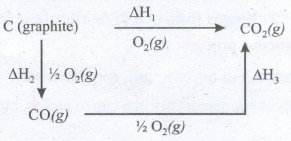
According to Hess law, \(\Delta\)H1 = \(\Delta\)H2 + \(\Delta\)H3
-393.5 kJ = X - 283.5 kJ
X = -110.5 kJ
3.
(i) At room temperature, HCI is a colourless gas and the solution of HCI in water is called hydrochloric acid and it is in liquid state.
(ii) Sodium hydride NaH is an ionic compound and it is made of sodium cations (Na+) and hydride (H-) anions. It has the octahedral crystal structure. It is an alkali metal hydride.
4.
The balanced equation for the formation of HCI is,
H2(g) + CI2(g) \(\rightarrow\) 2 HCI (g)
As per the stoichiometric equation, under given conditions,
To produce 2 moles of HCI, 1 mole of chlorine gas is required.
To produce 44.8 litres of HCI, 22.4 litres of chlorine gas are required.
\(\therefore\) To produce 11.2 litres of HCI,
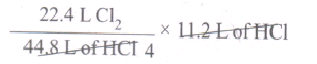
= 5.6 litres of chlorine are required.
5.
The balanced chemical equation is,
\({ CaCO }_{ 3 }\left( s \right) \overset { \triangle }{ \longrightarrow } { CaO }_{ (s) }+{ CO }_{ 2 }(g)\)
As per the stoichiometric equation,
1 mole (100g) CaC03 on heating produces 1 mole CO2
.png)
At STP, 1 mole of CO2 occupies a volume of 22.7 liters
At STP, 50 g of CaCO3 on heating produces,
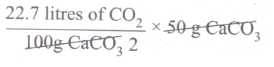
= 11.35 liters of CO2
6.
The balanced stoichiometric equation for the formation of ammonia is
N2(g) + 3H2 (g) \(\rightarrow\) 2NH3 (g)
As per the stoichiometric equation,
To produce 2 moles of ammonia, 3 moles of hydrogen are required.
\(\therefore\) to produce 10 moles of ammonia,
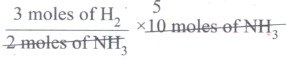
= 15 moles of hydrogen are required.
7.
H2O \(\rightleftharpoons\) H2O(1) \(\triangle_{fus}\) H is 6 kJ mol-1
(a) ΔG=ΔH-TΔS
When the reaction is carried out at 0°K
or ΔS=0
ΔG=ΔH
(b) \(H_2O_{s} \rightleftharpoons H_2O{_{(I)}}\)
\(\Delta_{fus}H= 6\) kJ mol-1
= 6000 kJ mol-1
\(\Delta_{fus}H= 6\) kJ mol-1
= 6000 J mol-1
8.
The equation representing the enthalpy of formation of methane is:
\(C_{(s)}+2H_{2_{(g)}} \rightarrow CH_{4_{(g)}}\) ΔH = -78.84 kJ
ΔH = 78.84 kJ; Δng = 1 - 2 = -1 mol
R= \(8.314 \times 10 ^{-3}\)kJ-1 K-1 mol-1; T=300 K
According to the relation,
ΔH = ΔU + Δng RT
ΔU = ΔH + Δng RT
=(-78.84 kJ) - (1 mol) x (\(8.314 \times 10 ^{-3}\)kJ K-1 mol-1) х 300 K
= -78.84-2.49 = -81.35 kJ.
9.
The complete ethylene combustion reaction can be written as,
\(C_2H_{4_(g)}+30_{2_(g)} \rightarrow 2CO_{2(g)}+2H_2O_{(I)}\)
ΔU= -1406kJ
Δn=\(n_{p(g)}-n_{r(g)}\)
Δn= 2-4= -2
ΔH=ΔU+RTΔng
ΔH=-1406+(8.314x10-3x300x(-2))
ΔH= -1410.9 kJ
10.
We know ΔU=n CV(T2-T1)
ΔH=n CP(T2-T1)
Here \(n=\frac{128}{32}=4\)moles;
T2 = 100°C = 373 K; T1 = 0°C = 273 K
ΔU = n CV (T2 - T1)
ΔU = 4 x 21 x (373-273)
ΔU = 8400 J
ΔU = 8.4 kJ
ΔH =n Cp(T2-T1)
ΔH = 4 x 29 x (373 - 273)
ΔH = 11600 J
ΔH = 11.6 kJ
11.
The standard enthalpy change for the combustion of ethanol can be calculated from the standard enthalpies of formation of \(C_2 H_5 OH_{I}, \)\(CO_{2{g}}\) and \(H_2 O(_{I})\). The enthalpies of formation are -277, - 393.5 and -285.5 kJ mol-1 respectively.
\(C_2O_5 OH_{(I)}+3O_{2{g}} \rightarrow 2CO_{2{g}}+3 H_2 O_{(I)}\)
\(\Delta H^{0}_{1} = [(\Delta H^{0}_{f})_{products}-(\Delta H^{0}_{f})_{reactants})]\)
\(\Delta H^{0}_{r}=[2(\Delta H^{0}_{f})_{CO_{2}}+3(\Delta H^{0}_{f})_{H_2O}]-[1(\Delta H^{0}_{f})_{C_2H_5OH}+3(\Delta H^{0}_{f})_{O_2}]\)
\(\triangle {H}_{r}^{0}=\begin{bmatrix} 2\ mol(-393.5)\ kJ\ {mol}^{-1} \\ +3\ mol(-285.5)\ kJ\ {mol}^{-1} \end{bmatrix}-\begin{bmatrix} 1\ mol(-227)\ kJ\ {mol}^{-1} \\ +3\ mool(0)\ kJ\ {mol}-1^{} \end{bmatrix}\)
= [-787-856.5]-[-277]
=-1643.5+277
\(\Delta H^{0}_{r}\)= -1366.5 kJ
12.
Given data q = 400 J; V1= 5L; V2 = 10L
Δu = q- w (heat is given to the system (+q); work is done by the system(-w)
Δu=q-PdV
=400 J - 1 atm (10 - 5)L
= 400 J - 5 atm L
[∴ 1L atm=101.33 J]
= 400 J - 5 x 10l.33 J
= 400 J - 506.65 J
= - 106.65 J
13.
Given:
S0 (urea) = 173.8 J mol-1 K-1
S0 (H2O) = 70 J mol-1 K-1
S0 (CO2) = 213.5 J mol-1K-1
S0 (NH3) = 192.5 J mol-1K-1
NH2 - CO - NH2 + H2O ⟶ 2NH3 + CO2
ΔSr0 = Σ(S0)products - Σ(S0)reactants
ΔSr0 = [2 S0(NH3) + S0(CO2)] - [S0(urea) + S0(H2O)]
ΔSr0 = [2 x 192.5 + 213.5]-[173.8+70]
ΔSr0 = [598.5] - [243.8]
ΔSr0 = 354.7 J mol-1K-1.
14.
Given:
T = 25°C = 298K;
ΔU = -3268.12 kJ mol-1
ΔH = ?
ΔH = ΔU + ΔngRT
ΔH = (ΔU + (np - nr)RT
ΔH = 3268.12 + \(\left( 6-\frac { 7 }{ 2 } \right) \) x 8.314 x 10-3 x 298
ΔU = -3268.12 + (1.5 x 8.314 x 10-3 x 298)
ΔU = -3268.12 - 3.72
ΔU = -3274.84 kJ mol-1
15.
Given: Number of moles of water n = \(\frac { 180g }{ 18g\ mol^{ -1 } } =10\) mol molar heat capacity of water
Cp = 75.3 J K-1 mol-1
T2 = 100°C = 373 K
T1 = 25°C = 298K
ΔH = ?
ΔH = nCp(T2-T1)
ΔH = 10 mol x 75.3 J mol-1K-1 x (373 - 298)K
ΔH = 56475 J
ΔH = 56.475 KJ.
16.
\(\frac{rate_{unknown}}{rateN_2}=\sqrt{\frac{M_{N_2}}{M_{unknown}}}\)
\(0.5=\sqrt{\frac{28\ g\ mol^{-1}}{M_{unknown}}}\)
Squaring on both sides
\((0.5)^2=\frac{28gmol^{-1}}{M_{unknown}}\)
\(\Rightarrow M_{unknown}=\frac{28}{0.25}\) = 112 g mol-1
17.
PNe = XNe PTotal
\(X_{Ne}=\frac{n_{Ne}}{n_{Ne}+n_{Ar}+n_{Xe}}\)
\(=\frac{4.76}{4.76+0.74+2.5}=0.595\)
\(X_{Ar}=\frac{n_{Ar}}{n_{Ne}+n_{Ar}+n_{Xe}}\)
\(=\frac{0.74}{4.76+0.74+2.5}=0.0093\)
\(X_{Xe}=\frac{n_{Xe}}{n_{Ne}+n_{Ar}+n_{Xe}}\)
\(=\frac{2.5}{4.76+0.74+2.5}=0.312\)
PNe = XNe PTotal = 0.595 x 2
= 1.19 atm.
PAr = XAr PTotal = 0.093 x 2
= 0.186 atm.
PXe = XXe PTotal = 0.312 x 2
= 0.624 atm.
18.
According to Charles' law,
\(\frac{V_1}{T_1}=\frac{V_2}{T_2}=\frac{V_3}{T_3}\)
\(\frac{0.3dm^3}{200K}=\frac{V_2}{300K}=\frac{0.15dm^3}{T_3}\)
\(\frac{V_2}{300K}=\frac{0.3dm^3}{200K}\)
.png)
V2 = 0.45 dm3 and
\(\frac{0.15dm^3}{T_3}=\frac{0.3dm_3}{200K}\)
.png)
T3 = 100 K.
19.
According to Boyle's law, at constant temperature for a given mass of gas at constant temperature,
P1VI = P2V2 = P3V3
1 atm x 1 dm3 = 2 atm x V2 = P3 x 0.25 dm3
\(\therefore\) 2 atm x V2 = 1 atm x 1 dm3
.png)
\(\boxed{V_2=0.5\ dm^3}\)
and P3 x 0.25 dm3 = 1 atm x 1 dm3
.png)
\(\boxed{P_3=4\ atm}\)
20.
X3+,Y2+, Z- are isoelectronic.
∴ Effective nuclear charge is in the order
(Zeff)Z-< (Zeff)y2+< (Zeff)X3+ and hence
ionic radius should be in the order rz- > ry2+ >rX3+
∴ The correct values are
| Species | Ionic raddi |
| Z- | 136 |
| Y2+ | 64 |
| X3+ | 49 |
21.
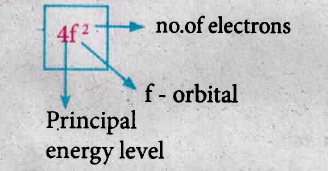
n = 4; f orbital l = 3 \(\Rightarrow\) m1= - 3, -2,-1, 0, +1, +2, +3
out of two electrons, one electron occupies 4f orbital with m1 = -3 and another electron occupies 4f orbital with m1 = -2.
All the four quantum numbers for the two electrons are
| Electron | n | l | m1 | m |
| 1e- | 4 | 3 | -3 | +1/2 |
| 2e- | 4 | 3 | -2 | +1/2 |
22.
Electronic configuration of Fe3+ 1s22s22p63s23p63d64s2
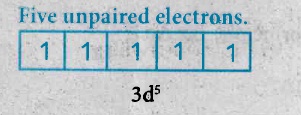
Electronic configuration of mn2+ is 1s2 2s2 2p6 3s2 3p6 4s2 3d5
Five unpaired electrons
Electronic configuration of Ar is 1s2 2s2 2p6 3s2 3p6
no unpaired electrons.
23.
Mass of chloride = 0.606 - 0.456
= 0.146 g
0.146g of chlorine combines with 0.456 g of metal
∴ 35.5 g of chlorine will combine with
= \(\frac { 35.5\times 0.456 }{ 0.146 } \)
= 110.8 g of metal
∴ equivalent mass of metal = 110.8g equ-1
24.
Equivalent mass = \(\frac { Atomic\ mass }{ Valency } \)
Equivalent mass of sodium = \(\frac { 23 }{ 1 } \) = 23
25.
Equivalent mass of an ion = \(\frac { Formula\ mass }{ Change\ of\ ion } \)
Equivalent mass of NO3- = \(\frac { 62 }{ 1 } \) = 62
26.
Equivalent mass = \(\frac { Atomic\ mass }{ Valency } \)
= \(\frac { 65 }{ 2 } \) = 32.5 q eq-1
27.
6.023 1023 molecules = 1 mole
3.0115 \(\times\)1023 molecules = \(\frac { 1 }{ 6.023\times { 10 }^{ 23 } } \times 3.0115\times { 10 }^{ 23 }\)
= 0.5 moles
Molar volumes of 1 mole of SO2 = 2.24 \(\times\)10-2m3
Molar volumes of 0.5 moles of SO2 = 2.24 \(\times\) 10-2 \(\times\)0.5
= 1.12 \(\times\) 10-2 m3
28.
Molar mass of formic acid = 46 g
Molar volume of 46 g (1 mole) of formic acid = 2.24 \(\times\) 10-2 m3
Molar volume of 460 g of (10 moles) of formic acid = \(\frac { 2.24\times { 10 }^{ -2 }\times 460 }{ 46 } \)
= 2.24 \(\times\) 10-2 m3
29.
Molar mass of methane = 16 g
Molar volume of 16g (1 mole) of methane = 2.24 \(\times\) 10-2 m3
volume of 5 moles(80 g) of methane = \(\frac { 2.24\times { 10 }^{ -2 }\times 80 }{ 16 } \)
= 11.2 \(\times\) 10-2 m3
30.
Molar mass of CO2 = 44 g
Molar volume of 44 g (1 mole) of CO2
= 2.24 \(\times\) 10-2 m3
The volume of 88g (2 moles) = \(\frac { 2.24\times { 10 }^{ -2 }\times 88 }{ 44 } \)
= 4.48 \(\times\) 10-2 m3
31.
Atomic mass of potassium = 39
No. of moles = \(\frac { Mass }{ Molar\ mass } \)
No.of moles = \(\frac { 19.5 }{ 39 } \) = 0.5 moles
32.
Molar mass of MgO = 40
No .of moles = \(\frac { Mass }{ Molar\ mass } \)
No .of moles = \(\frac { 90 }{ 40 } \) = 2.25 moles
33.
Molar mass of ethanol = 46
No.of moles = \(\frac { Mass }{ Molar\ mass } \)
No.of moles (n) = \(\frac { 46 }{ 46 } \) = 1 mole
34.
Molar mass of sodium hydroxide = 40
No.of moles = \(\frac { Mass }{ Molar\ mass } \)
No.of moles (n) = \(\frac { 120 }{ 40 } \)
= 3 moles
35.
Molar mass of calcium chloride = 111
No. of moles = \(\frac { Mass }{ Molar\ mass } \)
No. of moles = \(\frac { 50 }{ 111 } \)
= 0.450 moles
36.
Molecular mass of acetic acid = 60
60g of acetic acid contains = 6.023 \(\times\) 1023
Molecules of acetic acid
∴ 1000g of acetic acid contains
= \(\frac { 100\times 6.023\times { 10 } }{ 60 } \)
= 100 \(\times\) 1023
Molecules of acetic acid
37.
Molecular mass of SO2 = 64
64 g of sulphur dioxide contains = 6.023 \(\times\) 1023
Molecules of SO2
∴ 100g of SO2 contains = \(\frac { 100\times 6.023\times { 10 }^{ 23 } }{ 64 } \)
= 9.41
Molecules of SO2
38.
1 mole of water = 18 g mol-1
18 g of water contains 6.023 \(\times\)1023 molecules of water
1.8 g of water contains = \(\frac { 1.8\times 6.023\times { 10 }^{ 23 } }{ 18 } \)
= 0.602 \(\times\)1023
= 6.02 \(\times\) 1024
Molecules of water
39.
Atomic mass of Hg = 200 gmol-1
200 g of mercury contains 6.023 \(\times\) 1023 atoms of mercury.
10g of mercury contains = \(\frac { 10\times 6.023\times { 10 }^{ 23 } }{ 200 } \)
= 0.301 \(\times\)1023
= 3.01\(\times\) 1024
atoms of mercury
40.
C ⟶ 1 \(\times\)12 =12
H ⟶ 4\(\times\) 1 = 4
\(\underline { \overline { 16 } } \)
∴ Molecular mass of CH4 = 16
41.
\(\overset { COOH }{ \underset { COOH }{ |\quad \quad \quad } } .2{ H }_{ 2 }O\)
C ⟶ 1 \(\times\) 12 = 24
O ⟶ 4 \(\times\) 16 = 64
H2 \(\times\) 1 = 2
\(\underline { \overline { 90 } } \)
4\(\times\) 1 = 4
2 \(\times\)16 = 32
\(\underline { \overline { 126 } } \)
∴ Molecular mass of oxalic acid 126
42.
1 atomic mass of K = 1 \(\times\) 39 = 39
Mn = 1\(\times\) 55 = 55
O = 4\(\times\) 16 = 63
\(\overline { \underline { 158 } } \)
∴ Molecular mass of KMnO4 = 158
43.
NO3-
x + 3(-2) = -1
x - 6 = -1
x = -1 + 6
x = +5
Oxidation number of N in NO3- is +5
44.
K2CrO4
2(1) + x + 4(-2) = 0
2 + x - 8 = 0
x - 6 = 0
x = +6
Oxidation number of Cr in K2CrO4 is +6
45.
K2MnO4
Oxidation number of Mn be x
2 (1) + x + 4 (-2) = 0
2 + x - 8 = 0
x - 6 = 0
x = 6
Oxidation number of Mn in K2MnO4 is +6
46.
Oxygen
Mass of oxygen atom = 2.656 x 10⁻²³ gram
1 amu = 1.6605 x 10⁻²⁴g
The mass of oxygen atom in amu = \(\frac { 2.656\times { 10 }^{ -23 } }{ 1.66056\times { 10 }^{ -24 } } \approx 15.99\quad amu\)
47.
Al2(SO4)3 + 3 BaCl2 \(\longrightarrow\) 3 BaSO4 + 2 AlCl3
When 1 mole of aluminium sulphate reacts with barium chloride, 3 moles of BaSO4 is precipitated.
48.
(i) Nitrous acid: HNO2
+ 1 + x - 2 x 2 = 0
x = +3
(ii) Nitric acid: HNO3
+ 1 + x - 2 x 3 =0
x = +5.
49.
1 x AW of Mg = 1 x 24.305 = 24.305 amu
2 x AW of O = 2 x 16 = 32.000 amu
2 x AW of H = 2 x 1.008 = 2.016 amu
Formula weight of Mg(OH)2 is = 58.321 amu
Formula weight of Mg(OH)2 is = 58 amu.
50.
1 x AW of Na = 1 x 22.99 = 22.99 amu
1 x AW of O = 1x 16 = 16.00 amu
1 x AW of H = 1 x1.008 = 1.008 amu
Formula weight of NaOH is = 39.998 amu
51.
6 x AW of C = 6x12.01 = 72.06 amu
12 x AW of H = 12x1.008 = 12.096 amu
6 x AW of O = 6 x16 = 96.0 amu
Formula weight of Glucose is = 180.156 am
52.
1 x AW of N = 1 x 14 = 14amu
2 x AW of O = 2 x16 = 32 amu
Formula weight of NO2 = 46 amu
53.
Molar mass of H5IO6 = (5x1 + 1x127 + 6x16)
= 228 g mol-1
Mass of 5.14 mol of H5IO6 =5.14 mol x 228g mol-1
= 1171.9 g.
54.
Molar mass of CO2 = (1 x 12 + 2 x 16)
= 44 g mol-1
Mass of 3 moles of CO2 = 3 mol x 44g mol-1
= 132 g
55.
Molar mass of NH3 = (1 x 14 + 3 x 1) = 17g mol-1
Mass of 0.2 mol of NH3 = 0.2 mol x 17g mol-1
= 3.4 g
56.
No. of silver atoms = 1 million = 1 x 10⁶
Mass of one million Ag atoms = 1.79 x 10⁻¹⁶g
Mass of 6.023 x 10²³atoms of silver
= \(\frac { 1.79\times { 10 }^{ -16 }g }{ 1\times { 10 }^{ 6 } } \times 6.023\times { 10 }^{ 23 }\)
= 107.8 g.
Atomic mass of silver = 6.023 x 10²³ atoms of Ag
\(\therefore\) The atomic mass of Ag = 107.8 g
57.
Molecular mass of water = (2 x 1u) + (1 x 16u)
= 18 u
Molar mass of water = 18 g mol-1
Mass of 1 molecule of water
= \(\frac { Molar\ mass\ of\ water }{ Avogadro's\ number } \)
= \(\frac { 18\ g\ { mol }^{ -1 } }{ 6.023\times { 10 }^{ 23 }\ { mol }^{ -1 } } \)
= 2.99 x 10⁻²³ g
Mass of 1 molecule of water = 2.99 x 10⁻²³ g
58.
Molecular mass of benzene (C6H6) = (6 x 12.01 u) + (6 x 1 u) = 78.06 u
Molar mass of benzene = 78.06 g mol-1
Then, mass of [molecule of benzene = \(\frac { Molar\ mass }{ Avogadro's\ number } \)
= \(\frac { 78.06g\ { mol }^{ -1 } }{ 6.023\times { 10 }^{ 23 }\ { mol }^{ -1 } } \)
= 12.96 x 10⁻²³ g
59.
Molecular mass of silver (Ag) = 107.87 u
Molar mass of Ag = 107.87 g mol-1
\(\therefore\) Mass of 1 atom of Ag = \(\frac { Molar\ mass }{ Avogadro's\ number } \)
= \(\frac { 107.87g\ { mol }^{ -1 } }{ 6.023\times { 10 }^{ 23 }\ { mol }^{ -1 } } \)
= 17.91 x 10⁻²³g
Mass of 1 atom of Ag = 17.91 x 10⁻²³ g.
60.
52g of He contains 7.83 x 1024 He atoms.
1 mol of He contains 6.023 x 10²³ He atoms
\(\therefore\) 52 moles of He contains = \(\frac { 6.023\times { 10 }^{ 23 }\times 52 }{ 1} \)
= 3.132 x 1025
52 moles of He contains 3.132 x 1025 He atoms
61.
1 mol of He \(\equiv\) 4g \(\equiv\) 6.022 x 10²³ He atoms
(ie) 4g of He contains 6.022 x 10²³ He atoms
\(\therefore\) 52g of He contains = \(\frac { 6.023\times { 10 }^{ 23 }\times 52 }{ 4 } \)
= 7.83 x 1024
62.
(i) Kelvin-Planck statement: It is impossible to construct a machine that absorbs heat from a hot source and converts it completely into work by a cyclic process without transferring a part of heat to a cold sink.
(ii) Clausius statement: It is impossible to transfer heat from a cold reservoir to a hot reservoir without doing some work.
(iii) Entropy statement: The entropy of an isolated system increases during a spontaneous process
63.
Strong acids and strong bases exist in the fully ionised form in aqueous solutions as below:
H3O+ + CI- + Na+ + OH- ⟶ Na+ + CI + 2H2O
(or)
H3O+(aq)+OH-(aq)⟶2H2O(1)0
ΔHo =-57.32 KJ.
The H+ions produced in water by the acid molecules exist as H3O+. Thus, enthalpy change of neutralisation is essentially due to enthalpy change per mole of water formed from H3O+ and OH- ions. Therefore, irrespective of the chemical nature, the enthalpy of neutralisation of strong acid by strong base is a constant value which is equal to -57.32 KJ
64.
Given Keq= 10
Gas constant R = 8.314 JK-1 mol-1
T=300K
The relationship between Free energy change ΔG and equilibrium constant K is ΔGo=-RTlnK
Since K, T and R are positive values, ΔGo will be negative.
When ΔG is -ve, the process is spontaneous and feasible
65.
(i) State function: A state function is a thermodynamic property of a system, which has a specific value for a given state and does not depend on the path (or manner) by which the particular state is reached.
Example: Pressure (P), Volume (V), Temperature(T)
(ii) Path functions: A path function is a thermodynamic property of the system whose value depends on the path by which the system changes from its initial to final states.
Example: Work (w), Heat (q).
66.
(i) In reactions, (i) & (ii) AgNO3 and CuSO4 act as oxidising agents. They oxidise H3PO2 (hypophosphorous acid) to (orthophosphoric acid)
(ii) In reaction (iii) [Ag (NH3)2]+ (aq) oxidises C6H5CHO to C6H5COOH.
(iii) In reaction (iv) Cu2+ does not oxidise C6H5 to C6H5COOH.
(iv) This indicates that Ag+ is a strong oxidising agent than Cu.
67.
Electronic configuration of oxygen
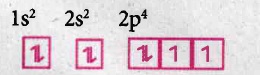
ஃ 8th electron present in 2px orbital and the quantum numbers are
n = 2,l = 1,m1 = either + 1 or -1 and s = -1/2
Electronic configuration of chlorine
.png)
15th electron present in 3Pz orbital and the quantum numbers are n = 3, l = 1, m1 = either +1 or -1 and ms = +1/2
68.
\(\triangle x.\triangle p\ge \frac { h }{ 4\pi } \)
\(\triangle x.\triangle p\ge 5.28 \times{ 10 }^{ -35 }Kg{ m }^{ 2 }{ s }^{ -1 }\)
\(\triangle x.(m\triangle v)\ge 5.28 \times{ 10 }^{ -35 }Kg{ m }^{ 2 }{ s }^{ -1 }\)
Given \(\triangle\)v = 0.1%
v = 2.2 x 10⁶ ms-1
m = 9.1 x 10⁻³¹Kg
\(\triangle\)v = \(\frac{0.1}{100}\times2.2\times{10}^{6}ms^{-1}\)
= \(2.2\times{10}^{6}ms^{-1}\)
\(\therefore \triangle x\ge \frac { { 5.28\times 10 }^{ -35 }{ Kgm }^{ 2 }{ s }^{ -1 } }{ 9.1\times { 10 }^{ -31 }Kg\times 2.2\times { 10 }^{ 3 }m{ s }^{ -1 } } \)
\(\\ \triangle x\ge 2.64\times { 10 }^{ -8 }m\)
69.
Alkali metals have one eo in their outer most shell. Alkaline earth metals have 2 eo in their outer most shell. More valence electrons and more positively charged nucleii leads to greater opportunity for metallic bonding.
70.
In Na2 SO4.10 H2O. So the metal will be Na (sodium). The salt is washing soda.
71.
It will be more difficult to drink water with a straw on the top of a Mount Everest. This is because the reduced atmospheric pressure is less effective in pushing water up into the straw, below the water surface.
The force that propels water through a straw is atmospheric pressure, which is less at high altitude.
72.
The passenger in a moving bus falls in the forward direction, when brakes are applied suddenly is in accordance with Newton's first law of motion.
When breaks are applied, the automobile comes to rest but the passenger due to inertia of motion tend to continue to move in forward direction hence fall forward.
The movement of helium balloon in the opposite direction is due to the difference in the density of surrounding air. When the car stops suddenly, the air moves forward due to inertia of motion.
As a result the air in the front of the car is more dense that at the rear of the car creating more pressure on the front side of the balloon. This causes the balloon move towards the rear of the car where air is less dense.
The body is at rest but the car is forward motion, due to inertia the passengers are pushed toward the front of the car on forward acceleration.
73.
Circumference of the orbit - 2\(\pi\)r .... ...(1)
Circumference of the orbit of H - atom (n = 1) - n\(\lambda\), .........(2)
(1) = (2) \(2 \pi r=\lambda \text { (or) } 2 \pi r=\frac{\mathrm{h}}{\mathrm{mv}}\)
74.
a) Hydrogen is the lightest gas in the atmosphere. So it rises up and other gases which are heavier like O2 & N2 come down towards the surface of the earth according to Graham's law of diffusions \(\mathrm{r} \alpha \sqrt{\frac{1}{M}}\). Hydrogen diffuses very fast. Its mean speed in greater than the escape velocity from the earth. As a consequence, H2 would have escaped from the atmosphere long time ago.
b) The acceleration due to gravity 'g' on moon surface is small. The value of escape velocity is also small. The molecules of the atmospheric gases on the moon's surface have thermal velocities greater than the escape velocity.
All the molecules have escaped. So the atmosphere is so thin.
75.
(i) The order : NH3 < H2O
(ii) Strength of H bond depends upon the atomic size and electronegativity of the other atom to which H atom is covalently bonded.
Since electronegativity of F > O > N, the strength of H-bond is in the order H-F......H > H - O......H > H-N......H.
H-bonds are much weaker than covalent bonds.
76.
Metal Hydride (Hydrogen Sponge):
The best studied binary hydrides are the palladium - hydrogen system. Hydrogen interacts with palladium in a unique way, and forms a limiting monohydride, PdH. Upon heating, H atoms diffuse through the metal to the surface and recombine to form molecular hydrogen. Since no other gas behaves this way with palladium, this process has been used to separate hydrogen gas from other gases.
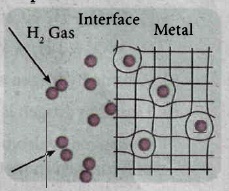
\(2 \mathrm{Pd}(\mathrm{s})+\mathrm{H}_{2}(\mathrm{~g}) \rightarrow 2 \mathrm{PdH}(\mathrm{s})\)
The hydrogen molecule readily adsorbs on the palladium surface, where it dissociates into atomic hydrogen. The dissociated atoms dissolve into the interstices or voids (octahedral/tetrahedral) of the crystal lattice.
Technically, the formation of metal hydride is by chemical reaction but it behaves like a physical storage method, i.e., it is absorbed and released like a water sponge. Such a reversible uptake of hydrogen in metals and alloys is also attractive for hydrogen storage and for rechargeable metal hydride battery applications.
77.
1. Deuterium is used in heavy water moderated fission reactors, usually as liquid D2O to slow neutrons
2. To prepare D2O (heavy water)
3. To prepare deuterated halides
4. To prepare compounds like deutero methane, deutero ammonia etc..
5. To manufacture deuterium lamps with quartz or UV glass bulb.
78.
When compounds containing hydrogen are treated with D2O, hydrogen undergoes an exchange for deuterium
\(
2 \mathrm{NaOH}+\mathrm{D}_{2} \mathrm{O} \rightarrow 2 \mathrm{NaOD}+\mathrm{HOD}
\)
\(\mathrm{HCl}+\mathrm{D}_{2} \mathrm{O} \rightarrow \mathrm{DCl}+\mathrm{HOD}
\)
\(\mathrm{NH}_{4} \mathrm{Cl}+4 \mathrm{D}_{2} \mathrm{O} \rightarrow \mathrm{ND}_{4} \mathrm{Cl}+4 \mathrm{HOD}\)
These exchange reactions are useful in determining the number of ionic hydrogens present in a given compound.
For example, when D2O is treated with of hypo-phosphorus acid only one hydrogen atom is exchanged with deuterium. It indicates that, it is a monobasic acid.
\(\mathrm{H}_{3} \mathrm{PO}_{2}+\mathrm{D}_{2} \mathrm{O} \rightarrow \mathrm{H}_{2} \mathrm{DPO}_{2}+\mathrm{HDO}\)
79.
1. Heavy water is widely used as moderator in nuclear reactors as it can lower the energies of fast neutrons
2. It is commonly used as a tracer to study organic reaction mechanisms and mechanism of metabolic reactions
3. It is also used as a coolant in nuclear reactors as it absorbs the heat generated.
80.
Elements having same atomic number but different mass numbers are called isotopes. These are variant, of an element which differ in neutron numbers, which contain equal number of protons. They differ in relative atomic mass but not in chemical properties.
The isotopes of hydrogen are:
1. Protium \(\left(\mathrm{H}^{1} \text { or } \mathrm{H}\right)\) [Predominant form]
2. Deuterium (or) Heavy hydrogen \(\left({ }_{1} \mathrm{H}^{2} \text { or }{ }_{1} \mathrm{D}^{2}\right)\)
3. Tritium \(\left({ }_{1} \mathrm{H}^{3} \text { or }{ }_{1} \mathrm{T}^{3}\right)\)
81.
The carbon monoxide of the water gas can be converted to carbon dioxide by mixing the gas mixture with more steam at 400oC and passed over a shift converter containing iron/copper catalyst. This reaction is called as water-gas shift reaction.
CO + H2O ➝ CO2 + H2
82.
a) Oxidation is performed in acidic medium:
Eg : H2O2 Oxidises FeSO4 to Fe (SO4)3
H2O2 + 2H++ 2e- ➝ 2H2O (E0 = +1.77 V)
2FeSO4 + H2SO4 + H2O2 ➝ Fe2(SO4)3 + 2H2O
b) Reduction is performed in basic medium:
Eg : H2O2 reduces KMnO4 to MnO2
HO2- + OH- ➝ H2O + 2e- (E0 = +0.08 V)
\(2 \mathrm{KMnO}_{4}+3 \mathrm{H}_{2} \mathrm{O}_{2} \rightarrow 2 \mathrm{MnO}_{2}+2 \mathrm{KOH}+2 \mathrm{H}_{2} \mathrm{O}+3 \mathrm{O}_{2}\)
83.
(i) 2KMnO4 + 3H2O2 ➝ 2MnO2 + 2KOH + 2H2O + 3O2 (Redox reaction)
(ii) CrCl3 + 6H2O ➝ [Cr Cl2 (H2O)CI. 2H2O [Hydration reaction]
(iii) CaO + H2O ➝ Ca(OH)2 (Hydration reaction)
84.
Gases which obey Boyle's Law and Charle's law or ideal gas equation PV = nRT are called ideal gases.
All gases whose behaviour is consistent with the assumption of kinetic theory of gases under all condition are called ideal gases.
| Ideal Gas | Real gas | |
|---|---|---|
| (i) | Ideal gases obey all gas laws under all conditions of temperature and pressure | Real obey gas law only at low pressures and high temperature. |
| (ii) | The volume occupied by a gas molecule is negligible when compared to the total volume of the gas. | The volume occupied by a gas molecule is not negligible when compared to the total volume of the gas. |
| (iii) | The attractive forces between the molecules are negligible | The force of attraction are not negligible at all temperatures and pressures. |
| (iv) | They obey the ideal gas equation: PV = nRT | They obey the Vander waal's equation: \(\left(P+\frac{n^{2} a}{V^{2}}\right)(V-n b)=n R T\) |
| (v) | The collision between the molecules are elastic | The collision between the molecules are not elastic |
| (vi) | No energy is involved during, the collision of the molecules of ideal gas | Collision of molecules in real gas have attractive energy |
85.
The following table gives the pressure of a gas with increasing temperature at constant volume for two cylinders.
| ToC | 32oC | 69oC | 94oC | 130oC |
| P (atm) 50 L container |
0.51 | 0.56 | 0.6 | 0.66 |
| P (atm) 75 L container |
0.34 | 0.37 | 0.40 | 0.44 |
Both the models explain Gay - Lussac's Law. P \(\propto\) T are constant V & n
For 50 L container:
The pressure increases with rise in temperature (at constant volume)
For 75 L container:
The pressure increases with rise in temperature (at constant volume)
86.
Charles law states that "At constant pressure, the volume of a given mass of an ideal gas is directly proportional to its temperature." According to Charles Law, if we were to take a balloon filled with air and increase the temperature of the air inside, the volume of air would increase causing the balloon to expand. This is caused by the heating of the molecules of air inside the balloon causing them to move rapidly. In the same manner if we cooled the balloon in a freezer, the volume of air decreases, making the balloon look partially deflated.
87.
At a given temperature the volume occupied by a fixed mass of a gas is inversely proportional to its pressure.
\(V\alpha \frac { 1 }{ P }\) at constant T& n.
Mathematical form: P1V1 = P2 V2 = K
88.
Erwin Schrodinger expressed the wave nature of electron in terms of a differential equation. This equation determines the change of wave function in space depending on the field of force in which the electron moves. The time independent Schrodinger equation can be expressed as,
\(\overset { \wedge }{ H } \psi =E\psi \) .........(1)
Where \(\overset { \wedge }{ H } \) is called Hamiltonian operator, \(\psi \) is the wave function and is a function of position coordinates of the particle and is denoted as \(\psi \) (x, y, z) E is the energy of the system
\(\overset { \wedge }{ H } =\left[ \frac { { -h }^{ 2 } }{ 8{ \pi }^{ 2 } } \left( \frac { { \partial }^{ 2 }\psi }{ { \partial x }^{ 2 } } +\frac { { \partial }^{ 2 }\psi }{ { \partial y }^{ 2 } } +\frac { { \partial }^{ 2 }\psi }{ { \partial z }^{ 2 } } \right) +V \right] \)
can be written as
\(\left[ \frac { { -h }^{ 2 } }{ 8{ \pi }^{ 2 }m } \left( \frac { { \partial }^{ 2 }\psi }{ { \partial x }^{ 2 } } +\frac { { \partial }^{ 2 }\psi }{ { \partial y }^{ 2 } } +\frac { { \partial }^{ 2 }\psi }{ { \partial z }^{ 2 } } \right) +V\Psi \right] =E\Psi \)
Multiply by \(\frac { 8{ \pi }^{ 2 }m}{ { -h }^{ 2 } } \)and rearranging
\(\frac { { \partial }^{ 2 }\psi }{ { \partial x }^{ 2 } } +\frac { { \partial }^{ 2 }\psi }{ { \partial y }^{ 2 } } +\frac { { \partial }^{ 2 }\psi }{ { \partial z }^{ 2 } } +\frac { 8{ \pi }^{ 2 }m }{ { -h }^{ 2 } } (E-V)\Psi =0\) ........(2)
The above Schrodinger wave equation does not contain time as a variable and is referred to as time independent Schrodinger wave equation. This equation can be solved only for certain values of E, the total energy. i.e. the energy of the system is quantised. The permitted total energy values are called eigen values and corresponding wave functions represent the atomic orbitals.
89.
(i) Lithium and beryllium form more covalent compounds, unlike the alkali and alkali earth metals which predominantly form ionic compounds.
(ii) The elements of the second period have only four orbitals (2s & 2p) in the valence shell and have a maximum co-valence of 4, whereas the other members of the subsequent periods have more orbitals in their valence shell and shows higher valences. For example, boron forms BF4- and aluminium forms AIF63-.
90.
91.
In the periodic table vertical columns are called groups.
Elements in the same vertical column possess similar number of electrons in the outer orbitals.
∴ Elements a and c belongs to group 18
Elements b and d belongs to group 13
92.
(i) According to aufbau's principle 5th period has nine orbital (one 5s, five 4d and three 6p) to be filled.
(ii) Nine orbitals can accommodate a maximum of 18 electrons. Hence fifth period of the periodic table should has 18 elements from rubidium (2 = 37) to Xenon (Z = 54).
93.
Z = 118; [86Rn] 5f14 6d10 7s2 7p6
In the periodic table the element with Z = 118 is located in p-block,
Period no = 7 (as n = 7 for valence shell)
Group no. = 18 (group no = 10+ ns electrons + np electrons) (n - outer most shell)
94.
(i) Electronic configuration is the arrangement of electrons in an atom. The outermost electron shell is often referred to as the "valence shell"determines the chemical properties.
(ii) Ionization energy and electron affinity is the amount of energy released or required in pulling out or adding an electron to a neutral atom. So both depend on electronic configuration of the element.
95.
Ionisation energy is the amount of energy required to remove the electron from the ground state (EI) to excited state (E∞)
E1=-2.18 x 10⁻¹⁸ J; E∞=0
ΔE=E∞-E1
=0-(-2.18 x 10⁻¹⁸ J)=2.18 x 10⁻¹⁸ J
I.E per hydrogen atom = 2.18 x 10⁻¹⁸ J
I.E per mole of H-atom =2.18 x 10-18 J x 6.023 x 1023
=13.13 x 10⁵ J mol-1
96.
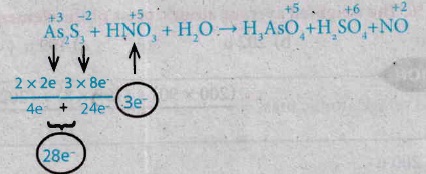
Equate the total no. of electrons in the reactant side by cross multiplying.
\(\Rightarrow 3 \mathrm{As}_{2} \mathrm{~S}_{3}+28 \mathrm{HNO}_{3}+\mathrm{H}_{2} \mathrm{O} \rightarrow \mathrm{H}_{3} \mathrm{AsO}_{4}+\mathrm{H}_{2} \mathrm{SO}_{4}+\mathrm{NO}\)
Based on reactant side, balance the products
\(\Rightarrow 3 \mathrm{As}_{2} \mathrm{~S}_{3}+28 \mathrm{HNO}_{3}+\mathrm{H}_{2} \mathrm{O} \rightarrow 6 \mathrm{H}_{3} \mathrm{AsO}_{4}+9 \mathrm{HSO}_{4}+28 \mathrm{NO}\)
Product side : 36 hydrogen atoms & gg Orygen atoms
Reactant side : 28 hydrogen atoms & 74 Orygen atoms
Difference is 8 hydrogen atoms & 4 oxygen atoms
∴ Add 4 H2O molecule on the reactant side.
Balanced equation is,
\(3 \mathrm{As}_{2} \mathrm{~S}_{3}+28 \mathrm{HNO}_{3}+4 \mathrm{H}_{2} \mathrm{O} \rightarrow 6 \cdot \mathrm{H}_{3} \mathrm{AsO}_{4}+9 \mathrm{H}_{2} \mathrm{SO}_{4}+28 \mathrm{NO}\)
97.
| Elements | Percentage | Atomic Mass |
Relative No. of moles = percentage/Atomic mass |
Simple ratio of |
|---|---|---|---|---|
| C | 54.55% | 12 | \(\frac { 54.55 }{ 12 } =4.55\) | \(\frac { 4.54 }{ 2.27 } =2\) |
| H | 9.09% | 1 | \(\frac { 9.09 }{ 1 } =9.09\) | \(\frac { 9.09 }{ 2.27 } =4\) |
| O | 36.36% | 16 | \(\frac { 36.06 }{ 16 } =2.27\) | \(\frac { 2.27 }{ 2.27 } =1\) |
| Empirical Formulla = C2H4O | ||||
98.
(a) Isothermal process: An isothermal process is defined as one in which the temperature of the system remains constant, during the change from its initial to final state. The system exchanges heat with its surroundings and the temperature of the system remains constant.
For an isothermal process dT = 0
(b) Adiabatic process: An adiabatic process is defined as one in which there is no exchange of heat (q) between the system and surrounding during the process. For an adiabatic process q = 0
(c) Isobaric process: An isobaric process is defined as one in which the pressure of the system remains constant during its change from the initial to final state. For an isobaric process dP = 0 .
(d) Isochoric process: An isochoric process IS defined as the one in which the volume of system remains constant during its change from initial to final state. For an isochoric process, dV= 0.
99.
Magnesium oxide in having higher melting point. The lattice energy of MgO & MgF2 are 3938 and 2957 respectively.
MgO has +2, -2 charges, MgF2 has +2, -1 charges. When the two charges are multiplied together, MgO results in larger amount of lattice energy since it has a higher charge, The strong attraction cause most ionic material to be hard and brittle and have high melting points.
100.
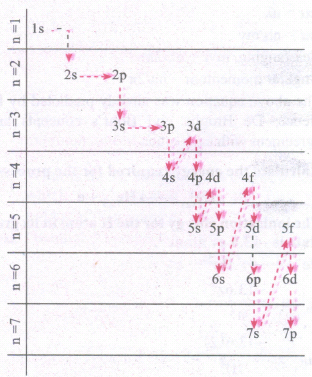
The word Aufbau in German means 'building up'. In the ground state of the atoms, the orbitals are filled in the order of their increasing energies. That is the electrons first occupy the lowest energy orbital available to them.
Once the lower energy orbitals are completely filled, then the electrons enter the next higher energy orbitals. The order of filling of various orbitals as per the Aufbau principle which is in accordance with (n + l) rule.
101.
(i) By treatment with catalyst like Pt or Fe.
(ii) By passing an electric discharge
(iii) By heating to 800°C or more.
(iv) By mixing with paramagnetic molecules like O2,NO,NO2·
(v) By mixing with nascent hydrogen or atomic hydrogen.
102.
Statement : "No two electrons in an atom can have the same set of values of all four quantum numbers"
Explanation : It means that, each electron must have unique values for the four quantum numbers (n, l, m and s).
For the lone electron present in hydrogen atom, the four quantum numbers are: n = 1; l = 0; m = 0 and s = +1/2. For the two electrons present in helium, one electron has the quantum numbers same as the electron of hydrogen atom, n = 1.
l = 0, m = 0 and s = +1/2. For other electron, the fourth quantum number is different i.e., n = 1, l = 0, m = 0 and s = -1/2.
As we know that the spin quantum number can have only two values +1/2 and - 1/2, only two electrons can be accommodated in a given orbital in accordance with pauli exclusion principle.
| Atom | e- | n | l | m | s |
| Helium | First | 1 | 0 | 0 | +1/2 |
| Second | 1 | 0 | 0 | +1/2 |
103.
ΔHf0 CO2 = -393.5 kJ mol-1
ΔHf0 CO = -111.31 kJ mol-1
ΔHf0 (H2O) = - 242 kJ mol-1
CO2(g) + H2(g) - CO(g) + H2O(g)
ΔHf0 = ?
ΔHf0 = Σ(ΔHf0)products-Σ(ΔHf0)reactions
ΔHf0 = [ΔHf0(CO) + ΔHf0(H2O)] - [ΔHf0(CO2) + ΔHf0(H2)]
ΔHf0 = [-111.31 + (-242)] - [-393.5 + (0)]
ΔHf0 = [-353.31] + 393.5
ΔHf0 = 40.19
ΔHf0 = +40.19 kJ mol-1.
104.
Electronic configuration of Fe3+ : 1s2 2s2 2p6 3s2 3p6 4s0 3d5
Electronic configuration of Ni2+ : 1s2 2s2 2p6 3s2 3p6 4s0 3d8
Fe3+ has stable 3d5 half filled configuration.
105.
n = 4 l = 0,1,2,3
4 sub shells s, p, d & f.
I = 0 m1 = 0 + one 4s orbital.
I = 1 m1 = -1, 0, + 1 \(\Rightarrow\) three 4p orbitals.
I = 2 m1 = -2,:1, 0, +1, +2 \(\Rightarrow\) five 4d orbitals.
I = 3 m1 = -3, -2, -1,0, +1, +2, +3 \(\Rightarrow\) seven 4f orbitals.
Over all 16 orbitals are possible.
106.
Heavy water is toxic when taken in large quantities. Heavy water is not radioactive. The deuterium in it is stable; it does not decay. Nobody will be in danger at all from radiation. It is heavier than plain water. D2O performs little different from H2O in chemical reactions. One has to drink a lot of D2O to kill him.
107.
\({ E }_{ n }=\frac { -13.6 }{ { n }_{ 2 } } ev{ \quad atom }^{ -1 }\)
n = 3 E3 = \(\frac { -13.6 }{ { 3 }^{ 2 } } =\frac { -13.6 }{ 9 } \)
= -1.51 ev atom-1
n = 4 E4 =\(\frac { -13.6 }{ { 4 }^{ 2 } } =\frac { -13.6 }{ 16 } \)
= -0.85 ev atom-1
\(\triangle \)E = (E4-E3) = (-0.85) - (-1.51) ev atom-1
= (-0.85 + 1.51)
= 0.66eV atom-1
(1eV = 1.6 x 10⁻¹⁹J)
\(\triangle \)E = 0.66 x 1.6 x 10-19J
\(\triangle \)E = 1.06 x 10⁻¹⁹J
hv = 1.06 x 10⁻¹⁹J
\(\frac { hv }{ \leftthreetimes } \) = 1.06 x 10⁻¹⁹J
\(\therefore\)\( \leftthreetimes\) = \(\frac { hc }{ 1.06\times { 10 }^{ -19 }J } \)
= \(\frac { 6.626\times { 10 }^{ -34 }JS\times 3\times { 10 }^{ 8 }{ ms }^{ -1 } }{ 1.06\times { 10 }^{ -19 }J } \)
\(\lambda=1.875\times10^{-6}m\)
108.
2NH3 + H2O + CO2 ⟶ (NH4)2 CO3
(NH4)2 CO3 + H2O + CO2 ⟶ 2NH4 HCO3
2NH4HCO3 + NaCl ⟶ NH4Cl + NaHCO3
2NaH CO3 ⟶ Na2 CO3 + CO2 + H2O.
109.
The solubility product of NaCl is lower than that of NaOH. The more soluble a substance is, the higher the Ksp value it has In aqueous solution NaOH gives OH- ions. It can be solvated by establishing H-bonds with water molecules. So it is more water soluble.
110.
Gases are very less denser. They have negligible intermolecular forces of attraction between the molecules. They are in continuous kinetic motion. So they won't settle at the bottom due to gravitational forces. The material that is most dense will sink to the bottom; the less denser will go up.
111.
a) KH, CaH2, ------ GaH3, GeH4, AsH3, H2Se, HBr
b) Trend in the formula:

c) First 2 members: KH & CaH2. KH is alkali hydride (Grey powder) CaH2 is an alkaline earth hydride.
KH reacts vigorously with water liberating H2 gas.
\(\mathrm{LiH}_{(\mathrm{s})}+\mathrm{H}_{2} \mathrm{O}_{(h)} \rightarrow \mathrm{Li}(\mathrm{OH})_{a q}+\mathrm{H}_{2}\)
CaH2 reacts with water liberating H2 gas
\(\mathrm{CaH}_{2}+2 \mathrm{H}_{2} \mathrm{O} \rightarrow \mathrm{Ca}(\mathrm{OH})_{2}+2 \mathrm{H}_{2}\)
112.
For ideal gases, a = 0. The value of 'a' is a measure of the attractive forces between the molecules. There will not be any intermolecular forces of attraction. So it cannot be liquefied.
113.
According to Avogadro's hypothesis: V \(\alpha\) n
\(\therefore \frac{V_{1}}{n_{1}}=\frac{V_{2}}{n_{2}}=\text { constant }\)
V1 & n2 are the volume and number of moles of a gas and V2 & n2 are a different set of values of volume and number of moles of the same gas at same temperature and pressure.

11th Standard Syllabus & Materials
11th Standard
TN 11th Tamil பீடு பெற நில் - செய்யுள் - காவடிச்சிந்து Important Questions And Answers Study Material - QB365 Set A
NEW11th Standard
TN 11th Tamil பீடு பெற நில் - உரைநடை - மலை இடப்பெயர்கள் : ஓர் ஆய்வு Important Questions And Answers Study Material - QB365 Set A
NEW11th Standard
TN 11th Tamil மாமழை போற்றுதும் - துணைப்பாடம் - யானை டாக்டர் Important Questions And Answers Study Material - QB365 Set A
NEW11th Standard
TN 11th Tamil மாமழை போற்றுதும் - செய்யுள் - ஐங்குறுநூறு Important Questions And Answers Study Material - QB365 Set A



Tamilnadu Stateboard 11th Standard Subjects

Maths

Commerce

Economics

Biology

Business Maths and Statistics

Accountancy

Computer Science

Physics
Chemistry
Maths
Biology
Economics
Physics
Chemistry

History
Business Maths and Statistics

Computer Science
Accountancy

Computer Applications
History
Computer Technology
Commerce
Computer Applications
Computer Technology

Tamil

English

French
Tamilnadu Stateboard Standards
