
 100% FREE ACCESS
11th Standard Syllabus & Materials
11th Standard
TN 11th Tamil இயற்கை வேளாண்மை,சுற்றுச்சூழல் -செய்யுள் - மனோன்மணீயம் Important Questions And Answers Study Material - QB365 Set A
NEW11th Standard
TN 11th Tamil என்னுயிர் என்பேன் -துணைப்பாடம் - இசைத்தமிழர் இருவர் Important Questions And Answers Study Material - QB365 Set A
NEW11th Standard
TN 11th Tamil மொழி கலை -செய்யுள் - ஒவ்வொரு புல்லையும் Important Questions And Answers Study Material - QB365 Set A
NEW11th Standard
TN 11th Tamil பீடு பெற நில் - இலக்கணம் - பகுபத உறுப்புகள் Important Questions And Answers Study Material - QB365 Set A
NEW11th Standard
TN 11th Tamil பீடு பெற நில் - துணைப்பாடம் - வாடிவாசல் Important Questions And Answers Study Material - QB365 Set A
NEW11th Standard
TN 11th Tamil பீடு பெற நில் - செய்யுள் - குறுந்தொகை Important Questions And Answers Study Material - QB365 Set A

Published on: 08/09/2018
FIVE MARK TEST
Download Tamil Nadu 11th Standard Chemistry question papers, model tests, one-mark questions, important questions, and public exam papers in PDF format. Free study materials and answer keys for TN State Board students.
Questions + Answers key
Take MCQ Chemistry Test
1.
\({ 2NH }_{ 3 }\left( g \right) +{ CO }_{ 2 }\left( g \right) \rightarrow \underset{Urea}{H_2N}-\overset { \underset { || }{ O } }{ C } -{ NH }_{ 2 }\left( aq \right) +{ H }_{ 2 }O(I)\)
In a process, 646 g of ammonia is allowed to react with 1.144 kg of CO2 to form urea.
(i) If the entire quantity of all the reactants is not consumed in the reaction which is the limiting reagent ?
(ii) Calculate the quantity of urea formed and unreacted quantity of the excess reagent. The balanced equation is
\(\overset { { 2NH }_{ 3 }+{ CO }_{ 2 } }{ \underset { { H }_{ 2 }NCON{ H }_{ 2 }+{ H }_{ 2 }O }{ \downarrow } } \)
2.
Calculate the percentage composition of the elements present in magnesium carbonate. How many kilogram of CO2 can be obtained by heating 1 kg of 90 % pure magnesium carbonate.
3.
When a mole of magnesium bromide is prepared from 1 mole of magnesium and 1 mele of liquid bromine, 524 kJ of energy is released.
The heat of sublimation of Mg meta) is 148 kJ mol-1, The heat of dissociation of bromine gas into atoms is 193 kJ mol-1. The heat of vapourisation of liquid bromine is 31 kJ mol-1. The ionisation energy of magnesium is 2187 kJ mol-1 and the electron affinity of bromine is - 662 kJ mol-1. Calculate the lattice energy of magnesium bromide.
4.
Using Slater's rule calculate the effective nuclear charge on a 3p electron in aluminium and chlorine. Explain how these results relate to the atomic radius of the two atoms.
5.
Calculate the heat of glucose and its calorific value from following data:
(i) C(graphite)+O2(g) ➝ CO2(g); ΔH= -395 KJ
(ii) H2(g)+\(\frac{1}{2}\)O2 ➝ H2O(l); ΔH= -269.4 KJ
(iii) C+6H2(g)+3O2(g) ➝ C6H12O6(s); ΔH= -1169.8 KJ
6.
From the following data,
CH4+2O2 ➝ CO2+2H2O ΔHo= -890 KJ mol-1
H2O(l) ➝ H2O(g) ΔHo= 44 KJ mol-1 at 298 K
Calculate the enthalpy of the reaction
CH4+2O2 ➝ CO2+2H2O ΔHo=?
7.
Calculate the lattice energy of CaCl2 from the given data
Ca(s)+Cl2(g) ➝ CaCl2(s) ΔHfo =-795 KJ mol-1
Sublimation : Ca(s) ➝ Ca(g) ΔH1o = +121 KJ mol-1
Ionisation: Ca(g) ➝ Ca2++2e- ΔH2o = +2422 KJ mol-1
Dissociation : Cl2(g) ➝ 2Cl(g) ΔH3o = +242.8 KJ mol-1
Electron affinity: Cl(g)+e- ➝ Cl-(g) ΔH4o = -795 KJ mol-1
8.
The boiling point of water at a pressure of 50 atm is 538 K. Compare the theoretical efficiencies of a steam engine operating between the boiling point of water at
(i) 1atm pressure
(ii) 50 atm pressure, assuming the temperature of the sink to be 350°C in each case.
9.
Calculate the entropy change of a process H2O(l) ➝ H2O(g) at 373K. Enthalpy of vaporization of water is 40850 J Mole-1.
10.
A 10 L cylinder consist of mixture of helium, oxygen, and nitrogen of masses 0.4 g, 1.6 g and 1.4 g at 27°C. Calculate the partial pressures of He, O and N and finally arrive at the total pressure. Assume the gases to behave ideally.
11.
The critical temperature of hydrogen gas is 33.2 °C and its critical pressure is 12.4 atm. Find out the values of a and b.
12.
A flammable hydrocarbon gas of particular volume is found to diffuse through a small hole in 1.5 minutes. Under the same conditions of temperature and pressure an equal volume of bromine vapour takes 4.73 min to diffuse through the same hole. Calculate the molar mass of the unknown gas and suggest what this gas might be, (Given that molar mass of bromine = 159.8 g/mole).
13.
For a gaseous mixture of 2.41 g of helium and 2.79 g of neon in an evacuated 1.04 dm3 container at 298 K calculate the partial pressure of each gas and hence find the total pressure of the mixture.
14.
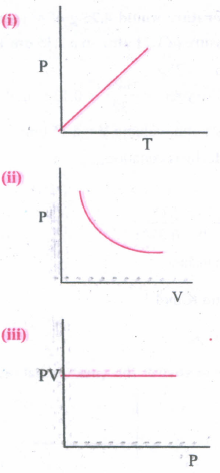
Use the graphs to answer the question below.
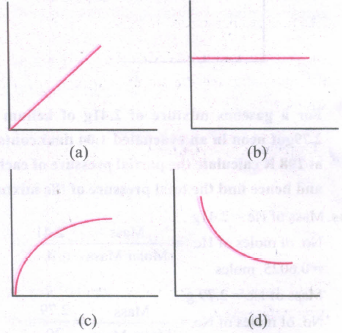
i) Which of the graphs is the best representation of pressure and temperature (measured in kelvin) for one mole of ideal gas
ii) Which of the graphs is the best representation of pressure and volume of one mole of an ideal gas.
iii) Which of the above graph represents PV vs P of one mole of an ideal gas?
15.
At what temperature would 4.25 g of oxygen gas O2 exert a pressure of 1.21 atm. in a 2.15 dm3 flask.
16.
Which of following flasks has higher pressure
(a) 5.00 L containing 4.15 g of Helium at 298 K
(b) 10.0 L containing 56.2 g Argon at 303 K
17.
Suppose a 375 mL sample of neon gas at 78°C is cooled to 22 °C at constant pressure. What will be the new volume of neon sample?
18.
For the equilibrium \({ PCl }_{ 5 }\rightleftharpoons { PCl }_{ 3(g) }+{ Cl }_{ 2(g) }\) at 298 K, K is 1.8 x 10⁻⁷. What is the ΔG0 for the reaction?
19.
Standard enthalpy change for combustion of methane is -990 kJ mol-1 and standard entropy change for the same combustion reaction is -342.98 JK-1 at 25°C calculate ΔG0 of the reaction.
20.
In the reaction N2(g) + O2(g) ⟶ 2NO(g), ΔH0 reaction is 179.9 KJ mol-1 and ΔS0reaction=78.09 JK-1mol-1. Calculate ΔG0reaction at 300 K.
21.
Calculate the change of entropy for the process, water (liq)to water (vapor, 373 K) involving ΔHvap = 40850J mol-1 at 373 K.
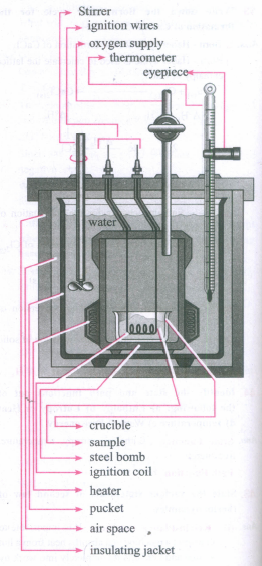
22.
The heat of combustion of ethyl alcohol is 34,600 cals. The heat of formation of CO2 and water are -96,200 and -68,000 calories respectively at constant pressure. What is the heat of formation of ethyl alcohol?
23.
250 J of work is done on the system and at the same time 100 J of heat is given out. What is the change in the internal energy?
24.
A sample of solid KClO3 (potassium chlorate) was heated in a test tube to obtain O2 according to the reaction
2KClO3 \(\longrightarrow \)2KCl + 3O2
The oxygen gas was collected by downward displacement of water at 295 K. The total pressure of the mixture is 772 mm of Hg. The vapour pressure of water is 26.7 mm of Hg at 300K. What is the partial pressure of the oxygen gas ?
25.
A mixture of He and O2 were used in the 'air' tanks of underwater divers for deep dives. For a particular dive 12 dm3 of O2 at 298 K, 1 atm. and 46 dm3 of He, at 298 K, 1 atm. were both pumped into a 5 dm3 tank. Calculate the partial pressure of each gas and the total pressure in the tank at 298K
26.
1 mole of an ideal gas is maintained at 4.1 atm and at a certain temperature absorbs 3710J heat and expands to 2 litres. Calculate the entropy change in expansion process.
27.
Calculate the entropy change in the system, and in the surroundings and the total entropy change in the universe when during a process 75J of heat flow out of the system at 55°C to the surrounding at 20°C.
28.
Calculate the maximum % efficiency of thermal engine operating between 110o and 25o.
29.
Calculate the standard free energy change \({ \Delta G }^{ o }\) of the following reaction and say whether it is feasible at 373 K or not.\(\frac{1}{2}H_{2(g)}+\frac{1}{2}I_{2(g)} \rightarrow HI_(g);\) \({ \Delta H }_{ r }^{ o }\) is + 25.95 kJ mol-1 standard entropies of HI(g) H2(g) and I2(g) are 206.3,140.6 and 118.7 Jk-1 mol-1.
30.
Will the reaction, I2(g)+H2S(g) ➝ 2HI(g)+S(s)
\({ \Delta G }_{ HI }^{ o }\)=1.8 kJ mol-1
\({ \Delta G }_{ H_2S }^{ o }\) = -33.8 kJ mol-1
31.
A helium filled balloon had a volume of 400 mL, when it is cooled to -120°C. what will be its volume if the balloon is warmed in an oven to 100°C assuming changes in pressure.
32.
In an experiment of verification of Charle's law, the following are the set of readings taken by a student
| Experiment | Volume (L) | Temperature (°C) |
| 1 | 1.54 | 20 |
| 2 | 1.65 | 40 |
| 3 | 1.95 | 100 |
| 4 | 2.07 | 120 |
What is the average value of the constant of proportionality?
33.
When the temperature of a gas increases from 0°C the volume of the gas increases by a factor of 1.25.what is the final temperature ?
34.
At sea level a balloon has volume of 785 x10-3dm3 What will be its volume, if it taken to a place where the pressure is 0052 atm. Less than the atmospheric pressure of 1 atm.
35.
A gas has a volume of 6.85 dm3 at a pressure of 0.650 atm. When pressure is Increased by 0.5 atm. what will be its volume?
36.
A tank of oxygen has a volume of 2.5 L at a pressure of 5.0 atm. What would be the volume of oxygen at 1.01 atm?
37.
Calculate AG0 for conversion of oxygen to ozone \(\frac { 3 }{ 2 } { O }_{ 2 }(g)\ \longrightarrow { O }_{ 3(g) }\) at 298 K, if Kp for this conversion is 2.47 x 10⁻²⁹ in standard pressure units.
38.
Show that the reaction \(CO+\frac { 1 }{ 2 } { O }_{ 2 }\longrightarrow { CO }_{ 2 }\) at 300K is spontaneous. The standard Gibbs free energies of formation of CO2 and CO are -394.4 and -137.2 KJ mole-1 respectively.
39.
Calculate the entropy change of a process possessing ΔHt = 2090 J mole-1.
40.
If the weather balloon at a pressure 0.0965 atm. at ground level has a volume of 10.0 m3 What will be the pressure at an altitude of 5300 m where its volume is 20.0 m3?
41.
Find the ratio of effusion rates of hydrogen and krypton gas.
42.
It takes 192 sec for an unknown gas to diffuse through a porous wall and 84 sec for N2 gas to effuse at the same temperature and pressure. What is the molar mass of the unknown gas?
43.
Solve
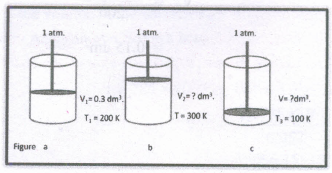
Effect of temperature on volume of the gas to verify Charles' law All the container a, b and c have same pressure of 1 atm. If T1, T2, and T3 are, respectively, at 200, 300 and 100 K, and V1 = 0.3 dm3, calculate V2 and V3.
44.
An inflated balloon has a volume of 275 mL, and contains 0.120 mole of air. As shown in fig a piece of dry ice weighing 1 g is placed in the balloon and its neck is tied. What is the volume of the balloon after dry ice (solid CO2) has vaporized? Assume pressure and temperature to remain constant.
45.
ΔH and ΔS for the reaction
Ag2O(s) ➝ 2Ag(s)+\(\frac{1}{2}O_{2(g)}\) are 30.56 kJ mol-1 and 66.0 Jk-1 mol-1 respectively. Calculate the temperature at which the free energy for this reaction will be zero. What will be the direction of reaction at this temperature and at temperature below this and why?
ΔH = 30.56 kJ mol-1 = 30560 J mol-1
ΔS = 66.0 JK-1 mol-1
ΔG = 0
46.
The standard heat of formation of H2O(l) from its elements and O2 is -290.83 kJ mol-1 and the standard entropy change for the same reaction is -330 JK-I at 25°C. Will the reaction be spontaneous at 25°C.
Given: \(\Delta{H^{o}}\)= -290.83 kJ mol-1
= -290830 J mol-1
\(\Delta{S^{o}}\) = -330 JK-1
T = 25°C = 298 K
47.
Calculate the standard entropy of formation \(\Delta { S }_{ f }^{ o }\) of CO2(g). Given the standard entropies of CO2(g), C(s), O2(g) as 218.8, 8.740 and 205.60 Jk-1 respectively.
48.
The heat of combustion of solid naphthalene (C10H10) at constant volume was -4984 kJ mol-1 at 298 K. Calculate the value of enthalpy change.
Given:
C10H8(s)+12O2(g) ➝ 10CO2(g)+4H2O(l)
\(\Delta U\)=-4984 kJ mol-1
\(\Delta U\)=-4984 kJ mol-1,R=8.314 JK-1 mol-1
T=298 K
49.
The entropy change in the conversion of water to ice at 272 k for the system is -22.88 Jk-1mol-1 and that of surrounding is + 24.85 Jk-1 mol-1, State whether the process is spontaneous or not?
50.
Calculate the entropy change during the melting of one mole of ice into water at 0°C and 1 atm pressure. Enthalpy of fusion of ice is 6008 J mol-1.
51.
Calculate the standard entropy change for the following reaction (Δsf0), given the standard entropies of CO2(g) , C(s) 'O2(g) as 213.6, 5.740, and 205 JK-1 respectively.
52.
Calculate the entropy change in the engine that receives 957.5 kJ of heat reversibly at 110°C temperature.
53.
If an automobile engine burns petrol at a temperature of 816° C and if the surrounding temperature is 21° C, calculate its maximum possible efficiency
54.
A gas mixture of 3.67 lit of ethylene and methane on complete combustion at 25°C and at 1 atm pressure produce 6.11 lit of carbon dioxide . Find out the amount of heat evolved in kJ, during this combustion. (ΔHc(CH4)= - 890 kJ mol-1 and (ΔHc(C2H4) = -1423 kJ mol-1
55.
When 1-pentyne (A) is treated with 4N alcoholic KOH at 175°C, it is converted slowly into an equilibrium mixture of 1.3% 1-pentyne(A) , 95.2% 2-pentyne(B) and 3.5% of 1,2 pentadiene (C) the equilibrium was maintained at 175°C, calculate ΔG0 for the following equilibria.
B \(\rightleftharpoons \)AGIO?
B \(\rightleftharpoons \)CG20?
56.
Calculate the enthalpy change for the reaction
Fe2O3 + 3CO ⟶ 2Fe + 3CO2 from the following data.
2Fe +\(\frac{3}{2}\)O2 ⟶ Fe2O3; ΔH = -741 kJ
C +\(\frac{1}{2}\)O2 ⟶ CO; ΔH = -137 kJ
C + O2 ⟶ CO2; ΔH = - 394.5 kJ
57.
Inside a certain automobile engine, the volume of air in a cylinder is 0.1475 dm3, when the pressure is 1.05 atm. When the gas is compressed, the pressure increased to 5.65 atm. at the same temperature. What is the volume of compressed air?
58.
If a scuba diver takes a breath at the surface filling his lungs with 5.82 dm3 of air what volume will the air in his lungs occupy when he dives to a depth where the pressure is 1.92 atm. (assume temperature is constant and the pressure at the surface is exactly)
59.
The Van der Waals' constants a = 2.095 lit2 atm mol-1 and b = 0.0189 lit mol-1 respectively. Calculate the inversion temperature.
60.
Van der Waals' constant for gas are a = 3.67 atm lit2 mo1-2 b = 0.0408 lit mol-1. Find the critical temperature and critical pressure of the gas.
61.
Van der Waals' constant for a gas (g) are a = 6.34 atm lit-2; and b = 52.6 ml mol-1. Find the critical temperature and critical pressure of the gas.
62.
75 ml of gas A effuses through a pin hole in 73 seconds the same volume of SO2 under identical conditions effuses in seconds. Calculate the molecular mass of A.
63.
When the first element of the periodic table is treated with dioxygen, it gives a compound whose solid state floats on its liquid state. This compound has an ability to act as an acid as well as a base. What products will be formed when this compound undergoes autoionisation ?
64.
Dihydrogen reacts with dioxygen (O2) to form water. Write the name and formula of the product when the isotope of hydrogen which has one proton and one neutron in its nucleus is treated with oxygen. Will the reactivity of both the isotopes be the same towards oxygen? Justify your answer.
65.
An element (A) which is used in metallurgy for the reduction of metal oxide to metal reacts with carbon monoxide and forms an industrial solvent (B). The industrially produced element (A) reacts with nitrogen to form compound (C). Identify A, B, and C.
66.
Compound A is an important peroxide which disproportionates to give oxygen and water. Compound A reacts with ferrous sulphate under the acidic condition to give compound B. Compound A reacts with KMnO4 in basic condition to form (C) and (D) along with water and CO2 What are A, B, C and D ? Write down the equations involved in their formation.
67.
Identify the compound (A) which is a universal solvent. Compound A reacts with chlorine gas to give B and C. Compound A dissolves in an ionic compound of silicon to give compound D. Identify A and write the equations involved in the formation of B, C, and D.
68.
An element (A) belonging to group number 1 and period number 3 react with dihydrogen to form anhydride (B). The element (A) reacts with the universal solvent to give a strong base (C). Identify A, B, and C.
69.
If a gas diffuses at the rate of one-half as fast as O2, find the molecular mass of the gas.
70.
A neon-dioxygen mixture contains 60.8 g dioxygen and 167.5 g neon. If pressure of the mixture of gases in the cylinder is 20 bar, what is the partial pressure of dioxygen and neon in the mixture?
71.
At 27°C temperature and 4 bar pressure CO is filled in 2 litre vessel. Find the pressure if it is filled in 4 litre vessel at 77 °C temperature.
72.
Find the pressure of neon gas having density 0.9 gm lit-1 at 350 K temperature.
73.
Find the moles of O2 gas having pressure 250 bar in 500 ml vessel at 350 k temperature.
74.
Find the pressure of 5 mole CI2 gas filled in a 2 litre vessel at 27 °C temperature.
75.
What is the equilibrium constant Keq for the following reaction at 400K.
2NOCI(g) \(\rightleftharpoons \) 2NO(g) + Cl2(g)
given that ΔHo = 77.2kJ mol-1 and ΔSo = 122JK-1mol-1
76.
For the reaction Ag2O(s) ⟶2Ag(s) + \(\frac{1}{2}\)O2(g) : ΔH =30.56 kJ mol-1 and &DeltaS = 6.66JK-1 mol-1 (at 1 atm). Calculate the temperature at which ΔG is equal to zero. Also predict the direction of the reaction (i) at this temperature and (ii) below this temperature.
77.
You are given normal boiling points and standard enthalpies of vaporisation. Calculate the entropy of vapourisation of liquids listed below.
| S.No | Liquid | Boiling points (0C) | ΔH (kJ mol-1) |
| 1 | Ethanol | 78.4 | +42.4 |
| 2 | Toluene | 110.6 | +35.2 |
78.
Calculate the standard heat of formation of propane, if its heat of combustion is -2220.2 kJ mol-1.. The heats of formation of CO2(g) and H2O(l) are -393.5 and -285.8 kJ mol-1 respectively
79.
Calculate the entropy change in the system, and surroundings, and the total entropy change in the universe during a process in which 245 J of heat flow out of the system at 77°C to the surrounding at 33°C.
80.
Calculate the work done when 2 moles of an ideal gas expands reversibly and isothermally from a volume of 500 ml to a volume of 2 L at 25°C and normal pressure.
81.
List the characteristics of Gibbs free energy
82.
Suggest and explain an indirect method to calculate lattice enthalpy of sodium chloride crystal
83.
Derive the relation between ΔH and ΔU for an ideal gas. Explain each term involved in the equation.
84.
Calculate the work involved in expansion and compression process.
85.
Explain how heat absorbed at constant volume is measured using bomb calorimeter with a neat diagram.
86.
List the characteristics of internal energy.
87.
Write down the Born-Haber cycle for the formation of CaCl2
88.
Identify the missing quantum numbers and the sub energy level
| n | 1 | m | Sub energy level |
| ? | ? | 0 | 4d |
| 3 | 1 | 0 | ? |
| ? | ? | ? | 5p |
| ? | ? | -2 | 3d |
89.
What is the de Broglie wave length of an electron, which is accelerated from the rest, through a potential difference of 100 V ?
90.
What is the de Broglie wavelength (in cm) of a 160 g cricket ball travelling at 140 Km hr -1.
91.
92.
Explain the important common features of Group 2 elements.
93.
Alkaline earth metal (A), belongs to 3rd period reacts with oxygen and nitrogen to form compound (B) and (C) respectively. It undergo metal displacement reaction with AgNO3 solution to form compound (D).
94.
Discuss briefly the similarities between beryllium and aluminium.
95.
State the trends in the variation of electronegativity in group and periods.
96.
What is screening effect? Briefly give the basis for pauling's scale of electronegativity.
97.
Explain the following, give appropriate reasons.
(i) Ionisation potential of N is greater than that of O.
(ii) First ionisation potential of C-atom is greater than that of B atom, where as the reverse is true is for second ionisation potential.
(iii) The electron affinity values of Be, Mg and noble gases are zero and those of N (0.02 eV) and P (0.80 eV) are very low.
(iv) The formation of F-(g) from F(g) is exothermic while that of O2-(g) from O (g) is endothermic.
98.
By using paulings method calculate the ionic radii of K+ and CI- ions in the potassium chloride crystal. Given that dk+-cl-=3.14 Å.
99.
Compare the structures of H2O and H2O2 .
100.
An isotope of hydrogen (A) reacts with diatomic molecule of element which occupies group number 16 and period number 2 to give compound (B) is used as a moderator in nuclear reaction. (A) adds on to a compound ( C), which has the molecular formula C3H6 to give (D). Identify A, B, C and D.
101.
A group-1 metal (A) which is present in common salt reacts with (B) to give compound (C) in which hydrogen is present in –1 oxidation state. (B) on reaction with a gas (C) to give universal solvent (D). The compound (D) on reacts with (A) to give (E), a strong base. Identify A, B, C, D and E. Explain the reactions.
102.
Derive the values of critical constants in terms of van der Waals constants.
103.
Write the Van der Waals equation for a real gas. Explain the correction term for pressure and volume.
104.
Why the first ionisation enthalpy of sodium is lower than that of magnesium while its second ionisation enthalpy is higher than that of magnesium.
105.
Explain the diagonal relationship.
106.
Explain the periodic trend of ionisation potential.
107.
Explain the pauling method for the determination of ionic radius.
108.
Calculate the total number of angular nodes and radial nodes present in 3d and 4f orbitals.
109.
Critical temperature of H2O, NH3, and CO2 are 647.4, 405.5 and 304.2 K, respectively. When we start cooling from a temperature of 700 K which will liquefy first and which will liquefy finally?
110.
An athlete in a kinesiology research study has his lung volume of 7.05 dm3 during a deep inhalation. At this volume, the lungs contain 0.312 mole of air. During exhalation, the volume of his lung decreases to 2.35 dm3. How many moles of air does the athlete exhale during exhalation? (assume pressure and temperature remain constant).
111.
Inside a certain automobile engine, the volume of air in a cylinder is 0.375 dm3, when the pressure is 1.05 atm. When the gas is compressed to a volume of 0.125 dm3 at the same temperature, what is the pressure of the compressed air?
112.
Freon-12, the compound widely used in the refrigerator system as coolant causes depletion of ozone layer. Now it has been replaced by eco friendly compounds. Consider 1.5 dm3 sample of gaseous Freon at a pressure of 0.3 atm. If the pressure is changed to 1.2 atm. at a constant temperature, what will be the volume of the gas increased or decreased?
113.
For a chemical reaction the values of ΔH and ΔS at 300K are -10 KJ mole-1 and -20 J deg-1 mole-1 respectively. What is the value of ΔG of the reaction? Calculate the ΔG of a reaction at 600K assuming ΔH and ΔS values are constant. Predict the nature of the reaction.
114.
Calculate the entropy change when 1 mole of ethanol is evaporated at 351 K The molar heat of vaporisation of ethanol is 39.84 kJ mol-1.
115.
A small bubble rises from the bottom of a lake where the temperature and pressure are 8° C and 6.4 atm. to the water surface, where the temperature is 25°C and pressure is 1 atm. Calculate the final volume in (mL) of the bubble, if its initial volume is 2.1 mL.
116.
Find out the value of equilibrium constant for the following reaction at 298K; 2NH3(g)+ CO2(g) \(\rightleftharpoons \) NH2CONH2(aq) + H2O(l) Standard Gibbs energy change, \(\Delta { G }_{ r }^{ 0 }\) at the given temperature is -13.6 kJ mol-1.
117.
For the reaction at 298 K: 2A +B ⟶ C. ΔH = 400 J mol-1; ΔS = 0.2 JK-1 mol-1 Determine the temperature at which the reaction would be spontaneous.
118.
The standard enthalpies of formation of SO2 and SO3 are -297 kJ mol-1 and -396 kJ mol-1 respectively. Calculate the standard enthalpy of reaction for the reaction: SO2 + \(\frac{1}{2}\)O2⟶SO3
119.
At 33K, N2O4 is fifty percent dissociated. Calculate the standard free energy change at this temperature and at one atmosphere
120.
Calculate the enthalpy of hydrogenation of ethylene from the following data. Bond energies of C - H, C - C , C = C and H - H are 414, 347, 618 and 435 kJ mol-1
121.
Cyanamide (NH2CN) is completely burnt in excess oxygen in a bomb calorimeter, ΔU was found to be -742.4 kJ mol-1 calculate the enthalpy change of the reaction at 298K. NH2CN(S) +\(\frac{3}{2}\)O2(g)⟶ N2(g)+ CO2(g)+ H2O(i) ΔH= ?
122.
30.4 kJ is required to melt one mole of sodium chloride. The entropy change during melting is 28.4 JK-1 mol-1. Calculate the melting point of sodium chloride.
123.
1 mole of an ideal gas, maintained at 4.1 atm and at a certain temperature, absorbs heat 3710 J and expands to 2 litres. Calculate the entropy change in expansion process.
124.
In a constant volume calorimeter:3.5g of a gas with molecular weight 28 was burnt in excess oxygen at 298 K. The temperature of the calorimeter was found to increase from 298 K to 298.45 K due to the combustion process. Given that the calorimeter constant is 2.5 kJ K-1. Calculate the enthalpy of combustion of the gas in kJ mol-1
125.
Show that if the measurement of the uncertainty in the location of the particle is equal to its de Broglie wavelength, the minimum uncertainty in its velocity is equal to its velocity 1/4\(\pi\) of its velocity (V).
126.
Suppose that the uncertainty in determining the position of an electron in an orbit is 0.6 \(\mathring{A}\) . What is the uncertainty in its momentum
127.
Protons can be accelerated in particle accelerators. Calculate the wavelength (in Å) of such accelerated proton moving at 2.85 x 10⁸ ms-1 (the mass of proton is 1.673 x 10⁻²⁷ Kg).
128.
The Li2+ ion is a hydrogen like ion that can be described by the Bohr model. Calculate the Bohr radius of the third orbit and calculate the energy of an electron in 4th orbit.
129.
Calculate the energy required for the process.
\({ He }_{ (g) }^{ + }\longrightarrow { He }_{ (g) }^{ 2+ }+{ e }^{ - }\)
The ionisation energy for the H atom in its ground state is -13.6 ev atom-1
130.
A combustible gas is stored in a metal tank at a pressure of 2.98 atm at 25°C. The tank can withstand a maximum pressure of 12 atm after which it will explode. The building in which the tank has been stored catches fire. Now predict whether the tank will blow up first or start melting? (Melting point of the metal = 1100 K).
131.
It takes 192 sec for an unknown gas to diffuse through a porous wall and 84 sec for N2 gas to effuse at the same temperature and pressure. What is the molar mass of the unknown gas ?
132.
Hydrochloric acid is treated with a metal to produce hydrogen gas. Suppose a student carries out this reaction and collects a volume of 154.4 x 10⁻³ dm3 of a gas at a pressure of 742 mm of Hg at a temperature of 298 K. What mass of hydrogen gas (in mg) did the student collect ?
133.
A small bubble rises from the bottom of a lake where the temperature and pressure are 6°C and 4 atm. to the water surface, where the temperature is 25°C and pressure is 1 atm. Calculate the final volume in (mL) of the bubble, if its initial volume is 1.5 mL.
134.
An ion with mass number 37 possesses unit negative charge. If the ion contains 11.1% more neutrons than electrons, Find the symbol of the ion.
135.
A sample of gas has a volume of 8.5 dm3 at an unknown temperature. When the sample is submerged in ice water at 0 °C, its volume gets reduced to 6.37 dm3. What is its initial temperature ?
136.
A sample of gas at 15°C at 1 atm. has a volume of 2.58 dm3. When the temperature is raised to 38°C at 1 atm does the volume of the gas increase? If so, calculate the final volume.
137.
Explain preparation of hydrogen using electrolysis.
138.
Justify the position of hydrogen in the periodic table?
139.
Explain the following observation
Aerated water bottles are kept under water during summer
140.
Calculate the uncertainty in the position of an electron, if the uncertainty in its velocity is 5.7 x 10⁵ ms-1.
141.
A tank contains a mixture of 52.5 g of Oxygen and 65.1 g of CO2 at 300 K the total pressure in the tanks is 9.21 atm. calculate the partial pressure (in atm.) of each gas in the mixture.
142.
A sample of gas has a volume of 3.8 dm3 at an unknown temperature. When the sample is submerged in ice water at 0 °C, its volume gets reduced to 2.27 dm3. What is its initial temperature?
143.
Argon is an inert gas used in light bulbs to retard the vaporization of the tungsten filament. A certain light bulb containing argon at 1.2 atm and 18°C is heated to 85°C at constant volume. Calculate its final pressure in atm.
144.
Sulphur hexafluoride is a colourless, odourless gas; calculate the pressure exerted by 1.82 moles of the gas in a steel vessel of volume 5.43 dm3 at 69.5°C, assuming ideal gas behaviour.
145.
Of two samples of nitrogen gas, sample A contains 1.5 moles of nitrogen in a vessel of volume of 37.6 dm3 at 298K, and the sample B is in a vessel of volume 16.5 dm3 at 298K. Calculate the number of moles in sample B.
146.
Explain whether a gas approaches ideal behavior or deviates from ideal behaviour if
it is compressed to a smaller volume at constant temperature.
1.
(i) The entire quantity of ammonia is consumed in the reaction. So ammonia is the Iimiting reagent. Some quantity of CO2 remains unreacted, so CO2 is the excess reagent.
(ii) Quantity of urea formed = number of moles of urea formed x molar mass of urea
= 19 moles x 60 g mol-1
= 1140 g = 1.14 kg
Excess reagent leftover at the end of the reaction is carbon dioxide.
Amount of carbon dioxide leftover
= number of moles of CO2 left over x molar mass of CO2
= 7 moles x 44 g mol-1
= 308 g
| Reactants | Products | |||
| NH3 | CO2 | Urea | H2O | |
| Stoichiometric coefficients | 2 | 1 | 1 | 1 |
| Number of moles of reactants allowed to react \(N=\frac { Mass }{ Molar\quad mass } \) | \(\frac { 646 }{ 17 } =38\) moles | \(\frac { 1144 }{ 44 } =26\)moles | - | - |
| Actual number of moles consumed during reaction Ratio (2:1) | 38 moles | 19 moles | - | - |
| No.of moles of product thus formed | - | - | 19 moles | 19 moles |
| No.of moles of reactant left at the end of the reaction | - | 7 moles | - | - |
2.
The balanced chemical equation is
\(\mathrm{MgCO}_{3} \stackrel{\Delta}{\longrightarrow} \mathrm{MgO}+\mathrm{CO}_{2}\)
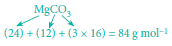
Molar mass of MgCO3 is 84 g mol–1.
84 g MgCO3 contain 24 g of Magnesium.
∴ 100 g of MgCO3 contain
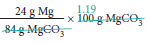
= 28.57 g Mg.
i.e. percentage of magnesium
= 28.57 %.
84 g MgCO3 contain 12 g of carbon
∴ 100 g MgCO3 contain
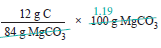
= 14.29 g of carbon.
∴ Percentage of carbon
= 14.29 %.
84 g MgCO3 contain 48 g of oxygen
∴ 100 g MgCO3 contains
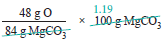
= 57.14 g of oxygen.
∴ Percentage of oxygen
= 57.14 %.
As per the stoichiometric equation,
84 g of 100 % pure MgCO3 on heating gives 44 g of CO2.
∴ 1000 g of 90 % pure MgCO3 gives
\(\frac{\text { wt. of } \mathrm{MgCO}_{3}}{84 \mathrm{~g}} \frac{\text { % Purities }}{100 \%} \frac{\text { wt.of } \mathrm{CO}_{2}}{44 \mathrm{~g}}\)
\(x=44 \times \frac{100}{84} \times \frac{90}{100}\)
= 471.43 g CO2
= 0.471 kg CO2
3.
Given:
Mg(s)+Br2(I) ⟶ MgBr2(s) ΔHf0 = -524 KJ mol-1
Sublimation:
Mg(s) ⟶ Mg(g), ΔH10 = +148 KJ mol-1
Ionisation:
Mg(g) ⟶ Mg2+(g)+2e- , ΔH20 =2187 KJ mol-1
Vapourisation:
Br2(I) ⟶ Br2(g), ΔH30 = +31 KJ mol-1
Dissociation:
Br2(g) ⟶ 2Br(g), ΔH40 = +193 KJ mol-1
Electron affinity:
Br(g) + e- ⟶ Br-(g), ΔH50 = -331 KJ mol-1
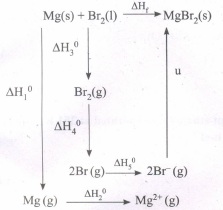
ΔHf = ΔH1 + ΔH2 + ΔH3 + ΔH4 + 2ΔH5 + u
-524 = 148 + 2187 + 31 + 193 + (2 x -331) + u
-524 = 1897 + u
u = -524 - 1897
u = -2421 kJ mol-1.
4.
Electronic Configuration of Aluminium
\(\underbrace { { Al }^{ 13 }{ 1s }^{ 2 } }_{ (n-2) } \underbrace { 2s^{ 2 }{ 2p }^{ 2 } }_{ (n-1) } \underbrace { { 3s }^{ 2 }{ 3p }^{ 1 } }_{ n } \)
| Group | no.of electrons |
Contribution of each electron to'S' value |
Contribution of a particular group |
| n (n-1) (n-2) |
2 8 2 |
0.35 0.85 1 |
0.70 6.80 2.00 |
| 9.50 |
∴ Effective nuclear charge = Z - S = 13 - 9.5
(Zeff)Al =3.5
Electronic Configuration of chlorine
\(\underbrace { { 1s }^{ 2 } }_{ (n-2) } \underbrace { 2s^{ 2 }{ 2p }^{ 2 } }_{ (n-1) } \underbrace { { 3s }^{ 2 }{ 3p }^{ 5 } }_{ n } \)
| Group | no.of electrons |
Contribution of each electron to'S' value |
Contribution of a particular group |
| n (n-1) (n-2) |
6 8 2 |
0.35 0.85 1 |
2.1 6.8 2 |
| S= | 10.9 |
∴ Effective nuclear charge = Z - S = 17 - 10.9
(Zeff)cl = 6.1
(Zeff)cl > (Zeff)Al and hence rcl
5.
The required equation is
C6H12O6(s)+6O2(g) ➝ 6CO2(g)+6H2O(l)
(i) C(graphite)+O2(g) ➝ CO2(g); ΔH= -395.0 KJ
(ii) H2(g)+\(\frac{1}{2}\)O2(g) ➝ H2O(l); ΔH= -269.4 KJ
(iii) 6C(graphite)+6H2(g)+3O2(g) ➝ C6H12O6(s); ΔH= -1169.8 KJ
Multiply equation (i) and (ii) by 6 and add them up
(iv) 6C(graphite)+6H2(g)+9O2(g) ➝ 6CO2(g)+6H2O(l) ; ΔH= -3984.6 KJ
Subtracting equation (iii) from (iv)
C6H12O6(s)+6O2(g) ➝ 6CO2(g)+6H2O(l) ΔH= -2816.6 KJ
∴ Enthalpy of combustion of glucose = -2816.6 KJ.
6.
CH4+2O2 ➝ CO2(g)+2H2O(l) ΔHo= -890 KJ mol-1
H2O(l) ➝ H2O(g) ΔHo= 44 KJ mol-1 at 298 K
ΔHo for CH4+2O2(g) ➝ CO2(g)+2H2O(g)
=-890+44=-846 KJ mol-1
7.
Ca(s) + Cl2(g) \(\rightarrow \) CaCl2(s) ΔHfo = -795 KJ mol-1
ΔHfo = ΔH1o + ΔH2o + ΔH3o + ΔH4o + ΔH5o
ΔH1o for Ca(s) \(\rightarrow \) Ca(g)=121 KJmol-1
ΔH2o for Ca(g) \(\rightarrow \) Ca2+(g) +2e- = 2422 KJmol-1
ΔH3o for Cl2(g) \(\rightarrow \) 2Cl(g) = +242.8 KJmol-1
ΔH4o for 2Cl+2e- \(\rightarrow \)2Cl- = 2 x -355 KJmol-1
ΔHfo = -795KJ mol-1
ΔHfo = ΔH1o + ΔH2o+ ΔH3o + ΔH4o + ΔH5o
ΔHfo = 121 + 2422 + 242.8[ 2 x 355] +ΔH5o
-795 = 2785.8 - 710 + ΔH5o
ΔH5o = 2870 KJ mol-1
\(\therefore\) Lattice enthalpy of CaCl2 = 2870 KJ mol-1
8.
(i) T1= 265 + 273 = 538 K
T2 = 100 + 273 = 373 K
\(\eta =\left( \frac { { T }_{ 1 }-{ T }_{ 2 } }{ { T }_{ 1 } } \right) \times 100\)
\(=\left( \frac { 538-373 }{ 538 } \right) \times 100\)
\(=\frac { 165 }{ 538 } \times 100\)
\(\eta =42.75%\)%
(ii) T1 = 265 + 273 = 538 K
T2 = 35 + 273 = 308 K
\(\eta =\left( \frac { { T }_{ 1 }-{ T }_{ 2 } }{ { T }_{ 1 } } \right) \times 100\)
\( =\left( \frac { 538-308 }{ 538 } \right) \times 100\)
\(=\frac { 230 }{ 538 } \times 100\)
\(\eta =42.75%\)%.
9.
\(\Delta S_{vap}=\frac{\Delta H_{vap}}{T_{vap}}\)
=\(\frac{40850 J mole^{-1}}{373 K}\)
=109.51 JK-1 mol-1
10.
Mass of He = 0.4 g; V = 10 Litres
Mass of O = 1.6 g; T = 27oC + 273 = 300K
Mass of N = 1.4g
R = 0.0821 dm3 atm K-1 mol-1
Sol:
Calculate of no.of moles:
\(\left[ No.of\ moles=\frac { mass }{ molecular\ mass } \right] \)
No.of moles of He (nHe) = \(\frac { 0.4 }{ 4 } =0.1\)
No.of moles O2 (\({ n }_{ { o }_{ 2 } }\)) = \(\frac { 1.6 }{ 32 } =0.05\)
No. of moles of N2 (\({ n }_{ { N }_{ 2 } }\)) =\(\frac { 1.4 }{ 28 } =0.05\)
Total no.of moles (n) = nHe + \({ n }_{ { o }_{ 2 } }\) + \({ n }_{ { N }_{ 2 } }\)
= 0.1 + 0.05 + 0.05
n = 0.2
Calculate of mole fraction:
Mole fraction of He (XHe) = \(\frac { 0.1 }{ 0.2 } =0.5\)
Mole fraction of O2 (\({ X }_{ { o }_{ 2 } }\)) = \(\frac { 0.05 }{ 0.2 } =0.25\)
Mole fraction of N2 ( \({ X }_{ { N }_{ 2 } }\)) = \(\frac { 0.05 }{ 0.2 } =0.25\)
Calculate of Total pressure of an ideal gas:
PV = nRT
\(P=\frac { nRT }{ V } \)
\(=\frac { 0.2\times 0.082\times 300 }{ 10 } =0.4926\)
P = 0.4926 atm
Calculation of Partial pressure:
Partial pressure of He (PHe) = 0.5 x 0.4926
= 0.2463 atm
[\(\therefore\) Partial pressure = mole fraction x Total pressure]
Partial pressure of O2 (\({ P }_{ { o }_{ 2 } }\)) = 0.25 x 0.4926 = 0.1231 atm
Partial pressure of N2 (\({ P }_{ { N }_{ 2 } }\)) = 0.25 x 0.4926 = 0.1231 atm
Calculation of Total pressure in the cylinder:
\(\therefore\) Total pressure PTotal = PHe + \({ P }_{ { o }_{ 2 } }\) + \({ P }_{ { N }_{ 2 } }\)
= 0.2463 + 0.1231 + 0.1231
= 0.4925
PTotal = 0.4925 atm
11.
Given:
Tc = 33.2oC + 273 = 306.2 K
PC = 12.4 atm, R = 0.082 atm lit K-1 mol-1
Sol:
\({ T }_{ C }=\frac { 8a }{ 27Rb }\)...(1)
\({ P }_{ C }=\frac { a }{ { 27 }b^{ 2 } } \)...(2)
(1) + (2)
\(\frac { { T }_{ C } }{ { P }_{ C } } =\frac { 8a }{ 27Rb } \times \frac { { 27 }b^{ 2 } }{ a } =\frac { 8b }{ R } \)
\(\therefore \frac { 306.2 }{ 12.4 } =\frac { 8\times b }{ 0.082 } \)
\(b=\frac { 306.2\times 0.082 }{ 12.4\times 8 } =0.253\)
b = 0.253 lit mol-1
Sub 'b' in (1)
\({ T }_{ C }=\frac { 8a }{ 27Rb } ;306.2=\frac { 8\times a }{ 27\times 0.082\times 0.253 } \)
\(a=\frac { 306.2\times 27\times 0.082\times 0.253 }{ 8 } =21.439\)
a = 21.439 atm lit2 mol-1
12.
t1 = 1.5 minutes (gas)hydro carbon
t2 = 4.73 minutes (gas)Bromine
\(\frac { { \gamma }_{ Hydrocarbon } }{ { \gamma }_{ Bromine } } =\frac { { t }_{ Bromine } }{ { t }_{ Hydrocarbon } } \)
( \(\therefore\) Volume is constant)
\(=\frac { 4.73minutes }{ 1.5minutes } \)
=3.15
\(\frac { { \gamma }_{ Hydrocarbon } }{ { \gamma }_{ Bromine } } =\sqrt { \frac { { m }_{ Bromine } }{ { m }_{ Hydrocarbo } } } \)
\(3.15=\sqrt { \frac { 159.8{ gmol }^{ -1 } }{ { m }_{ Hydrocarbon } } } \)
= 3.15
Squaring on both sides and rearranging,
\({ m }_{ Hydrocarbon }=\frac { 159.8{ mol }^{ -1 } }{ { \left( 3.15 \right) }^{ 2 } } \)
mhydrocarbon = 16.1 g mol-1
n(12) + (2n + 2) 1 = 16
12n + 2n + 2 = 16
14n = 16 - 2
14n = 14
n = 1
\(\therefore\) The hydrocarbon is C1 H2(1)+2 = CH4
13.
Mass of He = 2.41g
No. of moles of He =\(\frac { Mass }{ MolarMass } \) =\(\frac { 2.41 }{ 4 } \)
= 0.6025 moles
Mass of Ne = 2.79 g
No. of moles of Ne = \(\frac { Mass }{ MolarMass } =\frac { 2.79 }{ 20 } \)
= 0.1395 moles
Volume of the Total no. of moles of the mixture
= 0.6025 + 0.1395 = 0.7420 moles
Container V = 1.04 dm3
Temperature T = 298 K
Pressure P = \(\frac { 1 }{ RT } \)RT
According to ideal gas equation PV = nRT
P=\(\frac { 0.7420x0.0821x298 }{ 1.04 } \)= 17.45 atm
Partial pressure P = mole fraction x Total pressure
=\(\frac { nA }{ nA+nB } \) xp
Partial Pressure of Helium = PHc= \(\frac { 0.6025 }{ 0.7420 } x 17.45\)
According to Dalton's law of partial pressure
= 3.280 atm.
p = p1 + P2 + P3
Ptotal = PHe + PNe = 14.169 + 3.280 = 17.449 atm
14.
15.
Mass of oxygen = 4.25 g
No. of moles of oxygen = \(\frac { 4.25 }{ 32 } =0.1328\) moles
Pressure P = 1.21 atm, volume V = 2.15 dm3
According to ideal gas equation
PV = nRT
\(T=\frac { PV }{ nR } =\frac { 1.21\times 2.15 }{ 0.1328\times 0.0821 } \)
\(\because\) R is the gas constant
R = 0.0821 L atm K mol-1
\(=\frac { 2.6015 }{ 0.0109 } =238\quad K\)
16.
(a) 5.076 atm
(b) 3.495 atm
17.
Volume of the neon gas V1 = 375 ml
of a temperature T1 = 78°C + 273
= 351 K
At a temperature of T2 = 22°C + 273
= 295 K
The volume of neon gas V2 = ?
According to Charles law
\(\frac { { V }_{ 1 } }{ { T }_{ 1 } } =\frac { { V }_{ 2 } }{ { T }_{ 2 } } \)
\({ V }_{ 2 }=\frac { { V }_{ 1 }{ T }_{ 2 } }{ { T }_{ 1 } } \)
\({ V }_{ 2 }=\frac { 375\times 295 }{ 351 } =315.17\quad ml\)
\(\therefore\) Volume of neon gas at a temperature of 22°C = 315.17 ml
18.
Given:
R=8.314 JK-1mol-1
T=278K
K=1.8 x 10⁻⁷
ΔG0=-2.303 RT log K
ΔG0=-2.303 x 8.314 x log(1.8 x 10⁻⁷)
ΔG0=-2.303 x 8.314 x 298 x (-6.745)
ΔG0=38484 J mol-1
ΔG0=38.484 KJ mol-1.
19.
Given:
ΔH0=-990 kJ mol-1=-990000 J mol-1
ΔS0=-342.98 JK-1; T=250C=298K
ΔG0=ΔH0-TΔS0
=-990000-298(-342.98)
=-990000+102208.04
=-887791.96 mol-1
ΔG0=-887.791 kJ mol-1
20.
Given: ΔH0 reaction=179.9 KJ mol-1=179900 J mol-1, ΔS0reaction=78.09 JK-1 mol-1, Temperature, T=300K, T=250C=298 K
ΔG0=ΔH0-TΔS0
=179900-300(78.09)J mol-1
=179900-23,427 J mol-1
=156473 J mol-1
ΔS0reaction=156.473 KJ mol-1
21.
\({ \triangle S }_{ vap }=\frac { { \triangle H }_{ vap } }{ { T }_{ b }(K) } =\frac { 40850J/mol }{ 373K } \)=109.517 JK-1mol-1
22.
Given: ΔHf0, CO2=-96200 cal; ΔHf0, H2O=-68000 cal, ΔHC0, C2H5OH=34,600 cal
C2H5OH(I) + 3O2(g) ⟶ 2CO2(g) + 3H2O(I)
\({ \triangle H }^{ 0 }={ \sum { H } }_{ Products }^{ 0 }-{ \sum { H } }_{ Reactants }^{ 0 } \)
=(-2 x 96200) + (-3 x 68000)-34600
=-192400-204000 -34600=-431000
ΔH0=-431000 cal
23.
w=250 J
q =100 J
[Work done on the system, w > 0 Heat given out of the system, q < 0]
ΔU=q+w
=(-100)+(+250)=50
ΔU=+50J
24.
2KCIO(s) \(\longrightarrow\) 2KCI(s) + 3O2(g)
Ptotal = 772 mm Hg
\({ P }_{ { H }_{ 2 }O }\) = 26.7 mm Hg
Ptotal = \({ P }_{ { O }_{ 2 } }+{ P }_{ { H }_{ 2 }O }\)
\(\therefore { P }_{ { O }_{ 2 } }={ P }_{ total }-{ P }_{ { H }_{ 2 }O }\)
P1 = 26.7 mm Hg, T2 = 295 K
T1 = 300k, P2 = ?
\(\frac { { P }_{ 1 } }{ { T }_{ 1 } } =\frac { { P }_{ 2 } }{ { T }_{ 2 } } \)
\(\Rightarrow { P }_{ 2 }=\left( \frac { { P }_{ 1 } }{ { T }_{ 1 } } \right) { T }_{ 2 }=\frac { 26.7mm\ Hg }{ 300K } \times 295K\)
P2 = 26.26 mm Hg
\(\therefore { P }_{ { O }_{ 2 } }\)= 772 - 26.26 = 745.74 mm Hg.
25.
Vo2 = 12 dm3
VHe = 46 dm3
Vtotal = 5 dm3
\(\left.\begin{array}{c}
T=298 \mathrm{~K} \\
\mathrm{P}=1 \mathrm{~atm}
\end{array}\right\} \text { Constant }\)
PO2 = X02 x Ptotal
\(
\mathrm{X}_{\mathrm{O}_{2}}=\frac{\mathrm{n}_{\mathrm{O}_{2}}}{\mathrm{n}_{\mathrm{O}_{2}}+\mathrm{n}_{\mathrm{He}}}
\)
\(\mathrm{n}_{\mathrm{o} 2}=0.54 \mathrm{~mol}
\)
\(=\frac{0.54}{0.54+2.05}
\)
\(=\frac{0.54}{2.59}=0.21\)
.jpg)
nHe = 2.05mol
Ptotal x Vtotal = 1 atm x 22.4 l
\(\therefore { P }_{ total }=\frac { 1atm\times 22.4l }{ 5l } \)
Ptotal = 4.48 atm
= 0.94 atm
PHe = XHe x Ptotal
\({ X }_{ He }=\frac { { n }_{ He } }{ { n }_{ o2 }+{ n }_{ He } } =\frac { 2.05 }{ 0.54+2.05 } \)
\({ X }_{ He }=\frac { 2.05 }{ 2.59 } =0.79\)
\(\therefore\) PHe = 0.79 x 4.48 atm
PHe = 3.54 atm.
26.
For 1 mole of an ideal gas,
PV=RT
P=4.1 atm
V=2lt.
PV=RT
T=\(\frac{PV}{R}=\frac{4.1atm\times2lit\times1mole}{0.082 lit atm K^{-1}mol^{-1}}\)
=100 K
\(\Delta S=\frac{q}{T}\)
\(\Delta S=\frac{3710J}{100K}=37.1 JK^{-1}\)
ΔS of expansion = 37.1 JK-1.
27.
Tsystem=273+55=328 K
Tsurroundings=20+273=293 K
ΔSUniv=ΔStotal=ΔSsystem+ΔSsurroundings
\(\Delta S_{system}=\frac{q_{system}}{T_{system}}=\frac{-75J}{328K}=-0.2287 JK^{-1}\)
\(\Delta S_{surroundings}=\frac{q_{Surroundings}}{T_{Surroundings}}=\frac{+75J}{293K}=0.260 JK^{-1}\)
ΔSUniv=ΔStotal=[-0.2287+0.26]
=0.0313 JK-1.
28.
% Efficiency = \([\frac{T_1-T_2}{T_1}]\times100\)
T1=110+273=383 K.
T2=25+273=298 K.
% Efficiency = \([\frac{383-298}{383}]\times100\)
=22%.
29.
Given: \({ S }_{ { I }_{ 2 } }^{ o }=118.7\quad J{ K }^{ -1 }{ mol }^{ -1 };{ S }_{ { HI } }^{ o }=206.3\quad J{ K }^{ -1 }{ mol }^{ -1 };{ S }_{ { { H }_{ 2 } } }^{ o }=140.6\quad J{ K }^{ -1 }{ mol }^{ -1 }\)
Formula : \({ \Delta S }^{ O }={ S }_{ HI }^{ o }-\frac { 1 }{ 2 } ({ S }_{ { H }_{ 2 } }^{ o }+{ S }_{ { I }_{ 2 } }^{ o })\)
ΔGo=ΔHo-TΔSo
\(\Delta H_{f}^{o}\)=+25.955 kJ mol-1
ΔSo=\(\Sigma S_{Products}^{o}-\Sigma _{Reactants}^{o}\)
=206.3-\(\frac{1}{2}\)(140.6+118.7)
=206.3-129.65
ΔSo=76.65 kJ-1mol-1
ΔG=ΔH-TΔS
=25.95-(373x76.65x10-3)
=25.95-28.59
=-2.640 kJ-1 mol-1
When ΔG is -ve.The reaction is spontaneous.
30.
\({ \Delta G }_{ reaction}^{ o }={\Sigma \Delta G }_{ products }^{ o }-{ \Sigma\Delta G }_{ reactants }^{ o }\)
=2(1.8)-(-33.8)
=3704 kJ mol-1
\({ \Delta G }_{ reaction }^{ o }\)=+37.4 kJ mol-1
Since \({ \Delta G }^{ o }\) is positive, the reaction will not proceed spontaneously in the forward direction.
31.
Volume of the gas in the balloon V1 = 400 ml
temperature T1 = -120 °C + 273
= 153 K
If the balloon is warmed T2 = 100° C + 273
to a temperature = 373 K
Then the volume of the gas V2 = ?
According to charles law \(\frac { { V }_{ 1 } }{ { T }_{ 1 } } =\frac { { V }_{ 2 } }{ { T }_{ 2 } } \)
\({ V }_{ 2 }=\frac { { V }_{ 2 } }{ { T }_{ 1 } } \times { T }_{ 2 }\)
\(=\frac { 400 }{ 153 } \times 373=975\quad ml\)
\(\therefore\) Volume of helium gas in the balloon at a temperature of 100°C = 975 ml
32.
According to charles law
\(\frac { { V }_{ 1 } }{ { T }_{ 1 } } =\frac { 1.54 }{ 293 } \)
= 0.0052
T1 = 20 C + 273 = 293 K
T2 = 40°C
\(\frac { { V }_{ 2 } }{ { T }_{ 2 } } =\frac { 1.65 }{ 40+273 } =\frac { 1.65 }{ 313 } =0.0052\)
T3 = 100°C + 273 = 373 K
\(\frac { { V }_{ 3 } }{ { T }_{ 3 } } =\frac { 1.95 }{ 373K } =0.0052\)
T4 = 120°C+273 = 393 K
\(\frac { { V }_{ 4 } }{ { T }_{ 4 } } =\frac { 2.07 }{ 393 } =0.0052\)
The average value of constant of proportionality is 0.0052.
33.
Initial temperature T1 of the gas = 0°C = 0 + 273
= 273°C
Let the Initial volume of the gas V1 = x ml
The final volume V2 of the gas = 1.25 \(\times\) xml
According to Charles' law
\(\frac { { V }_{ 1 } }{ { T }_{ 1 } } =\frac { { V }_{ 2 } }{ { T }_{ 2 } } \)
\(\frac { x }{ 273 } =\frac { 1.25\times x }{ { T }_{ 2 } } \)
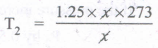
= 341.25 K
The final temperature = 341.25 K
34.
At sea level pressure P1 = 1 atm
Volume occupied at sea level V1 = 785 \(\times\) 10-3 dm3
If the pressure P2 = 0.052 atm
the volume of the balloon V2 = ?
According to Boyle's law
P1 V1 = P2 V2
1 \(\times\) 785 \(\times\) 10-3 = 0.052 \(\times\) V2
\({ V }_{ 2 }=\frac { 1\times 785\times { 10 }^{ -3 } }{ 0.052 } \)
= 15096.15 \(\times\) 10-3 dm3
35.
Volume of gas V 1 = 6.85 dm3
at a pressure P1 = 0.650 atm
If the pressure increased
P2 by 0.5 atm = P1 + 0.5
= 0.650 + 0.5
= 1.15 atm
Volume of the gas V2 = ?
According to Boyle's law
P1 V1 = P2 V2,
6.85 \(\times\) 0.650 = V2 \(\times\) 1.15
V2 = \(\frac { 6.85\times 0.650 }{ 1.15 } \)
\(=\frac { 4.4525 }{ 1.15 } \)
= 3.871 dm3
36.
Volume of oxygen V1 = 2.5 L
at a pressure P1 = 5.0 atm
At pressure P2 = 1.01 atm
Volume of oxygen V2 = ?
According to Boyle's law
P1 V1 = P2 V2
5 \(\times\) 25 = V2 \(\times\) 1.01
\({ V }_{ 2 }=\frac { 12.5 }{ 1.01 } =12.37\quad L\)
Volume of oxygen at a pressure of 1.01 atm
= 12.37 l
37.
ΔG0 = 2.303 RT log Kp
where
R = 8.314 JK-1 mol-1;
Kp = 2.47 x 10⁻²⁹;
T=298K
ΔG0 = -2.303 (8.314 JK-1 mol-1) (298K)log(2.47 x 10⁻²⁹)
ΔG0 = 16300 J mol-1
ΔG0 = 16.3 kJ mol-1
38.
\(CO+\frac { 1 }{ 2 } { O }_{ 2 }\longrightarrow { CO }_{ 2 }\)
\({ \triangle }G_{ (reaction) }^{ 0 }={ \sum { G } }_{ f(products) }^{ 0 }-{ \sum { G } }_{ f(reactants) }^{ 0 }\)
\({ \triangle G }_{ (reaction) }^{ 0 }=\left[ { G }_{ { CO }_{ 2 } }^{ 0 } \right] -\left[ { G }_{ CO }^{ 0 }+\frac { 1 }{ 2 } { G }_{ { O }_{ 2 } }^{ 0 } \right] \)
\({ \triangle G }_{ (reaction) }^{ 0 }\) =-394.4+[137.2+0]
\({ \triangle G }_{ (reaction) }^{ 0 }\) =-257.2 kJ mol-1
\({ \triangle G }_{ (reaction) }^{ 0 }\) of a reaction at a given temperature is negative hence the reaction is spontaneous.
39.
ΔHt = 2090 Jmol-1
Tt = 13+273 = 286K
ΔSt = \(\frac { { \triangle H }_{ t } }{ { T }_{ t } } \)
ΔSt = \(\frac { 2090 }{ 286 } \)
ΔSt = 7.307 JK-1mol-1
40.
Pressure of a gas at ground level P1 = 0.965 atm
Volume of the gas at ground level V1 = 10.0 m3
Volume of the gas at an altitude of 5300m V2 = 20.0 m3
Pressure of the gas at an altitude of 5300 P2 = ?
According to Boyle's law = T1 V1 = P2 V2
0.0965 \(\times\) 10 = P2 \(\times\) 20.0
\({ P }_{ 2 }=\frac { 0.0965\times 10.0 }{ 20.0 } \)
= 0.04825 atm
Pressure of the gas at an altitude of 5300m
P2 = 0.04825 atm
41.
According to Graham's law of diffusion
\(\frac { { r }_{ H_{ 2 } } }{ { r }_{ K_{ r } } } =\sqrt { \frac { { M }_{ Kr } }{ { M }_{ { H }_{ 2 } } } } \)
\(\frac { { r }_{ { H }_{ 2 } } }{ { r }_{ { K }_{ r } } } =\sqrt { 42 } \)
\(\frac { { r }_{ { H }_{ 2 } } }{ { r }_{ Kr } } =6.480\)
\({ r }_{ { H }_{ 2 } }=6.480\quad { r }_{ Kr }\)
1 : 6480 is ratio of H2 : Kr
42.
Molar mass of N2 = 28 g/ mole
rate of diffusion = 192 sec
of unknown gas rate of diffusion of \({ r }_{ N_{ 2 } }\) (nitrogen gas) = 84 sec
According to Graham's law or
\(\frac { { r }_{ unknown } }{ { r }_{ { N }_{ 2 } } } =\sqrt { \frac { { M }_{ { N }_{ 2 } } }{ { M }_{ unknown } } } \)
Molecular mass of unknown gas
\({ M }_{ unknown }=\frac { { M }_{ N_{ 2 } }\times { \left( { V }_{ { N }_{ 2 } } \right) }^{ 2 } }{ { \left( { { r }_{ unknown } } \right) }^{ 2 } } \)
\({ M }_{ unknown }=\frac { 28\times 84\times 84 }{ 192\times 192 } \)
\(=\frac { 197568 }{ 36864 } =5.35\quad g/mole\)
43.
0.15 dm2
44.
Given data V1 = 275 ml n1 = 0.120 moles
V2 = ?
\({ n }_{ 1 }=\frac { mass }{ molecular\ mass } =\frac { 1 }{ 44 } \)
Assuming pressure and temperature are constant According to Avogadro's hypothesis,
n2 = 0.227 moles
\(\frac { { V }_{ 1 } }{ { n }_{ 1 } } =\frac { { V }_{ 2 } }{ { n }_{ 2 } } \)
\({ V }_{ 2 }=\frac { { V }_{ 1 }{ n }_{ 2 } }{ { n }_{ 1 } } \)
\({ V }_{ 2 }=\frac { 275\times 0.0227 }{ 0.120 } \)
V2 = 52 moles
The volume of the balloon after dry ice has vaporized is V1 + V2 = 275 + 52 = 327 ml.
45.
ΔG = ΔH - TΔS
T = \(\frac{\Delta H-\Delta G}{\Delta S}\)=\(\frac{30560-0}{66}\)=463
T = 463K.
At 463 K, the reaction is at equilibrium
At T < 463 K, ΔG will have positive value hence backward reaction is favoured.
46.

= -290830 - 298 (-330)
= -290830 + 98340 = -192490
\(\Delta{G^{o}}\)=-192490 J mol-1
Since \(\Delta{G^{o}}\) is negative, the reaction is spontaneous.
47.
C+O2 ➝ CO2 \(\Delta { S }_{ f }^{ o }\)=?
\(\Delta { S }_{ f }^{ o }\), CO2 = \({ \Sigma S }_{ Compound }^{ o }-{ \Sigma S }_{ elements }^{ o }\)
=218.8(8.74+205.60)
\(\Delta { S }_{ f }^{ o }\), CO2 =4.46 Jk-1
48.
\(\Delta n\)=10-12=-2 mol
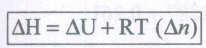
=-4984x103J+8.314 JK-1 mol-1x298kx(-2)mol.
=-4984000 J-4955.144J=-4988955.144J
\(\Delta H\)=-4988.955 kJ
49.
\(\Delta{S}_{univ}=\Delta{S}_{sys}+\Delta{S}_{surr}\)
=-22.88+(+24.85)
=1.97 Jk-1mol-1
\(\therefore \underline { \Delta } { S }_{ Univ }>0\) at 272K
∴ The process of freezing of water is spontaneous
50.
ΔHfusion = 6008 J mol-1
Tf=00C = 273K
\({ H }_{ 2 }O_{ (S) }\quad \overset { 273K }{ \longrightarrow } \quad { H }_{ 2 }O_{ (I) }\)
ΔS(fusion) = \(\frac { \triangle H_{ fusion } }{ { T }_{ f } } \)
ΔS(fusion) = \(\frac { 6008 }{ 273 } \)
ΔS(fusion) = 22.007 JK-1 mole-1
51.
C(g) + O2(g) ⟶ CO2(g)
ΔSr0 = \({ \sum { S } }_{ (Products) }^{ 0 }-{ \sum { S } }_{ (reactants) }^{ 0 }\)
ΔSr0 = \(\left\{ { S }_{ CO2 }^{ 0 } \right\} -\left\{ { S }_{ C }^{ 0 }+{ S }_{ O2 }^{ 0 } \right\} \)
ΔSr0 = 213.6 - [5.74+205]
ΔSr0 = 213.6 - [210.74]
ΔSr0 = 2.86 JK-1
52.
q = 957.7 kJ
T = 110+273 = 383 K
ΔS= \(\frac { { q }_{ rev } }{ T } \)
ΔS = \(\frac { 957.7 }{ 383 } \)
ΔS =2.5 kJ K-1
53.
% Efficiency =\(\left[ \frac { { T }_{ 1 }-{ T }_{ 2 } }{ { T }_{ 1 } } \right] \times 100\)
Here
T1 = 816+273=1089 K;
T2 = 21+273 = 294 K
% Efficiency= \(\left( \frac { 1089-294 }{ 1089 } \right) \times 100\)
% Efficiency = 73%
54.
ΔHc(CH4)= - 890 kJ mol-1
ΔHc(C2H4) = -1423 kJ mol-1
ΔHc=-203.87 kJ mol-1
Let the mixture contain x lit of CH4 and (3.67 - x)
lit of ethylene
CH4+2O2\(\rightarrow \)2CO2+2H2O
XLit
C2H4+3O2\(\rightarrow \)2CO2+2H2O
(3.67-X)Lit 2(3.67-X)Lit
Volume of Carbondioxide formed
=x + 2 (3.67 - x) = 6.11 lit
X+7.34-2X=6.11
7.34-X=6.11
X=1.23Lit
Given mixture contains 1.23 lit of methane and 2.44 lit of ethylene, hence
\(\triangle { H }_{ C }=\left[ \frac { \triangle { H }_{ C }\left( { CH }_{ 4 } \right) }{ 22.4Lit } \times \left( X \right) lit \right] +\left[ \frac { \triangle { H }_{ C }\left( { C }_{ 2 }{ H }_{ 4 } \right) }{ 22.4lit } \times \left( 3.67-X \right) lit \right] \)
\(\triangle { H }_{ C }=\left[ \frac { -890KJ{ mol }^{ -1 } }{ 22.4Lit } \times 1.23lit \right] +\left[ \frac { -1423 }{ 22.4lit } \times \left( 3.67-1.23 \right) lit \right] \)
ΔHc =[-48.87kJ mol-1]+[-155kJ mol-1]
ΔHc =-203.87kJ mol-1 .
55.
T=1750 C=175+273=448K
Concentration of l-pentyne [A] = 1.3%
Concentration of2-pentyne [B] = 95.2%
Concentration of 1, 2-pentadiene [C] = 3.5%
At equilibrium
B\(\rightleftharpoons \)A
95.2%1.3%\(\Rightarrow \)
\({ K }_{ 1 }=\frac { 1.3 }{ 95.2 } =0.0136\)
B\(\rightleftharpoons \)C
95.2%3.5%\(\Rightarrow \)
\({ K }_{ 2}=\frac { 3.5 }{ 95.2 } =0.0367\)
\(\Rightarrow \)\(\Delta { G }_{ 1 }^{ 0 }\) =-2.303RT log K1
\(\Delta { G }_{ 1 }^{ 0 }\)=-2.303X8.314X448Xlog0.0136
\(\Delta { G }_{ 1 }^{ 0 }\) =+16010J
\(\Delta { G }_{ 1 }^{ 0 }\)=+16 kJ
\(\Rightarrow \)\(\Delta { G }_{ 2 }^{ 0 }\)=-2.303X8.314X448Xlog0.0367
\(\Delta { G }_{ 2 }^{ 0 }\) =+12312J
\(\Delta { G }_{ 2 }^{ 0 }\)=+12.312 kJ.
56.
ΔHf(Fe2O3)= -741 kJ mol-1
ΔHf(CO)= -137 kJ mol-1
ΔHf(CO2)= -394.5 kJ mol-1
Fe2O3 + 3CO ⟶ 2Fe + 3CO2 ΔHr=?
ΔHr=Σ(ΔHf)products - Σ(ΔHf)reactants
ΔHr=[2ΔHf=(Fe)+3ΔHf(CO2)]-[ΔHf(Fe2O3)+3ΔHf(CO)]
ΔHr=[0 + 3 (-394.5)] - [-741 +3 (-137)]
ΔHr=[-1183.5] - [-1152]
ΔHr=-1183.5 + 1152
ΔHr=-31.5 kJ mol-1
57.
Given data P1 = 1.05 atm V1 = 0.475 dm3
P2 = 5.65 atm V2 = ?
P1V1 = P2V2
\({ V }_{ 2 }=\frac { { P }_{ 1 }V_{ 1 } }{ { P }_{ 2 } } \)
\({ V }_{ 2 }=\frac { 1.05\ atm\times 0.475{ dm }^{ 3 } }{ 5.65\ atm } \)
V2 = 0.088 dm3
58.
Given data P1 = 1 atm V1 = 5.82 dm3
P1 = 1.92 atm V2 = ?
According to Boyles law,
P1V1 = P2V2
\({ V }_{ 2 }=\frac { { P }_{ 1 }{ V }_{ 1 } }{ { P }_{ 2 } } \)
\({ V }_{ 2 }=\frac { 1\ atm\times 5.82\ { dm }^{ 3 } }{ 1.92\ atm } \)
V2 = 3.031 dm2
59.
a = 2.095 lit2 atm mol-1; R = 0.0821 dm3 atm lit K-1 mol-1
b = 0.0189 lit mol-1
\({ T }_{ i }=\frac { 2a }{ Rb } \)
\(=\frac { 2\times 2.095 }{ 0.0821\times 0.0189 } =2700.28\quad K\)
Ti = 2700.28 K
60.
a = 3.67 atm lit2 mol-2
b = 0.0408 lit mol-1
R = 0.0821 atm lit K-1 mol-1
(i) \({ T }_{ c }=\frac { 8a }{ 27Rb } \)
\(=\frac { 8\times 3.67 }{ 27\times 0.082\times 0.0408 } =324.7\quad K\)
Tc = 324.7 K
(ii) \({ P }_{ c }=\frac { a }{ 27{ b }^{ 2 } } \)
\(=\frac { 3.67 }{ 27\times { (0.0408) }^{ 2 } } =81.6\)
Pc = 81.6 atm.
61.
a = 6.34 atm lit-2; b = 52.6 ml mol-1
b = 0.056 lit mol-1
\({ T }_{ c }=\frac { 8a }{ 27Rb } \)
\(=\frac { 8\times 6.34 }{ 27\times 0.0821\times 0.0526 } =434.997\simeq 435\quad K\)
TC = 162 °C
\({ P }_{ C }=\frac { a }{ { 27b }^{ 2 } } =\frac { 6.34 }{ 27\times { (0.0526) }^{ 2 } } =84.87\)
Pc=\(\frac { a }{ 27{ b }^{ 2 } } =\frac { 6.34 }{ 27\times { (0.0526) }^{ 2 } } =84.87\)
Pc = 84.87 atm.
62.
Time taken for effusion of gas A = 73 seconds
Time taken for effusion of SO2 gas = 75 seconds
Volume of gases (A & SO2) taken = 75 ml each.
Molecular mass of SO2 =
\(\frac { Effusion\ rate\ of\ { SO }_{ 2 } }{ Effusion\ rate\ of\ A } =\sqrt { \frac { { M }_{ A } }{ { M }_{ { SO }_{ 2 } } } } \)
\(\frac { 75/75 }{ 75/73 } =\sqrt { \frac { { M }_{ A } }{ { M }_{ { SO }_{ 2 } } } } ;\frac { 1 }{ 1.027 } =\sqrt { \frac { { M }_{ A } }{ 64 } } \)
\({ (0.9737) }^{ 2 }=\frac { { M }_{ A } }{ 64 } ;{ M }_{ A }=60.67\)
\(\therefore\) Molecular mass of A is 60.67.
63.
The first element of the periodic table is hydrogen.
2H2 + O2 ➝ 2H2O
The compound formed is water.
Auto - ionization or auto-protolysis of water proceeds as follows
\(\underset { Acid }{ { H }_{ 2 }O(l) } +\underset { Base }{ { H }_{ 2 }O(l) } \longleftrightarrow \underset { Conjugate\quad Acid }{ { H }_{ 3 }O } +(aq)+\underset { Conjugate\quad Acid }{ OH-(aq) } \)
64.
2H2 + O2 ➝ 2H2O
The isotope of hydrogen which has one proton and one neutron in its nucleus is Deuterium.
2D2 + O2 ➝ 2D2O
The product is heavy water (Deuterium oxide). H2O and D2O have same chemical properties but the
reaction velocity of D2O is slightly less due to the difference in the mass number of the isotopes known as isotopic effect. Deuterium is heavier than protium so reacts slowly.
65.
(i) The element (A) is hydrogen reacts with carbon monoxide to form methanol (B).
CO + 2H2 \(\overset{Cu}{\rightarrow}\) CH3OH
(A) (B)
(ii) Hydrogen reacts with nitrogen to form ammonia (C).
\({ N }_{ 2 }+3{ H }_{ 2 }\quad \overset { 380-{ 450 }^{ 0 }C }{ \underset { 200/atm\quad 1le }{ \rightleftharpoons } } 2\underset { (C) }{ { NH }_{ 2 } } \)
| A | H2 | Hydrogen |
| B | CH3OH | Methanol |
| C | NH3 | Ammonia |
66.
(i) A important peroxide is hydrogen peroxide (A).
(ii) H2O2 disproportionates to form oxygen and water.
\(\underset { (A) }{ { H }_{ 2 }{ O }_{ 2 } } \quad \longrightarrow { H }_{ 2 }O+\frac { 1 }{ 2 } { O }_{ 2 }\)
(iii) H2O2 reacts with FeSO4 in acidic condition to form ferric sulphate (B).
2FeSO4 + H2SO4 + H2O2 ➝ Fe2(SO4)3 + 2H2O
(A) (B)
(iv) H2O2 reacts with KMnO4 in basic condition and form Manganese dioxide (C) and potassium hydroxide (D).
2KMnO4 + 3H2O2 ➝ 2MnO2 + 2KOH + 2H2O + 3O2
(A) (C) (D)
| A | H2O2 | Hydrogen peroxide |
| B | Fe2(SO4)3 | Ferric sulphate |
| C | MnO2 | Manganese dioxide |
| D | KOH | Potassium hydroxide |
67.
(i) The universal solvent is water (A).
(ii) Water reacts with chlorine gas to form Hydrochloric acid (B) and Hypochlorous acid (C).
Cl2 + H2O ➝ HCl + HOCl
(A) (B) (C)
(iii) Water reacts with silicon tetrachloride (SiCI4) to give silicon dioxide (D).
SiCl4 + 2H2O ➝ SiO2 + 4HCl
(A) (D) (B)
| A | H2O | Water |
| B | HCl | Hydro chloric acid |
| C | HOCl | Hypo chlorous acid |
| D | SiO2 | Silicon dioxide |
68.
(i) An element (A) belonging to group number 1 and period number 3 is sodium (A).
(ii) Sodium reacts with hydrogen to form sodium hydride (B)
2Na + H2 ➝ 2NaH
(A) (B) (C)
(iii) Sodium reacts with water to form sodium hydroxide (C).
2Na + 2H2O ➝ 2NaOH + H2
(A) (C)
| A | Na | Sodium |
| B | NaH | Sodium hydride |
| C | NaOH | Sodium hydroxide |
69.
Applying Graham's law of Diffusion,
\(\frac { { r }_{ 1 } }{ { r }_{ 2 } } =\sqrt { \frac { { M }_{ 2 } }{ { M }_{ 1 } } } ;\frac { 1/2 }{ 1 } =\sqrt { \frac { 32 }{ { M }_{ 1 } } } \)
Squaring both sides of the equation,
\({ \left( \frac { 1 }{ 2 } \right) }^{ 2 }=\frac { 32 }{ { M }_{ 1 } } ;\frac { 1 }{ 4 } =\frac { 32 }{ { M }_{ 1 } } \)
\(\therefore\) M1 = 128
Thus the molecular mass of the unknown gas is 128.
70.
Mass of neon = 167.5
Mass of dioxygen = 60.8 g
Pressure = 20 bar
No. of moles of dioxygen = \(\frac { 60.8\ g }{ 32\ g\ mol } =1.9\ mol\)
No. of moles of neon = \(\frac { 167.5\ g }{ 20\ g\ mol } =8.375\ mol\)
Mole fraction of dioxygen \(=\frac { 1.9 }{ 1.9+8.375 } =\frac { 1.9 }{ 10.275 } =0.185\)
Mole fraction of neon = \(\frac { 8.375 }{ 1.9+8.375 } =\frac { 8.375 }{ 10.275 } =0.815\)
Partial pressure of gas = Mole fraction \(\times\) x Total pressure
Partial pressure of dioxygen = 0.185 \(\times\) 20 = 3.7 bar
Partial pressure of neon = 0.815 \(\times\) 20 = 16.3 bar.
71.
P1 = 4 bar; P2 = ?
V1 = 2 litre; V2 = 4 litre
T1= 27 + 273 = 300 K
T2 = 77 + 273 = 350 K
\(\frac { { P }_{ 1 }{ V }_{ 1 } }{ { T }_{ 1 } } =\frac { { P }_{ 2 }{ V }_{ 2 } }{ { T }_{ 2 } } \)
\({ P }_{ 2 }=\frac { { P }_{ 1 }{ V }_{ 1 } }{ { T }_{ 1 } } \times \frac { T_{ 2 } }{ V_{ 2 } } =\frac { 4\times 2\times 350 }{ 300\times 4 } =2.33\ bar\)
The pressure of CO gas will be 2.33 bar.
72.
Density (d) = 0.9 gm lit-1
T = 350 K
Mass of neon (M) = 20 gm mol-1
\(P=\frac { dRT }{ M } \quad \left( \because n=\frac { d }{ M } \right) \)
\(=\frac { 0.9\times 8.314\times 10^{ -2 }\times 350 }{ 20 } =1.309\quad bar\)
Pressure of neon = 1.309 bar
73.
P = 250 bar; T = 350 K; V = 500 ml = 0.5 litre
\(P=\frac { nRT }{ V } [\because PV=nRT]\)
\(=\frac { 250\times 0.5 }{ 8.314\times { 10 }^{ -2 }\times 350 } =4.296\quad mol\)
\(\therefore\) n = 4.296 mol.
74.
n = 5; V = 2 Iitre;T= 27 + 273 = 300 K
\(P=\frac { nRT }{ V } [\because PV=nRT]\)
\(P=\frac { 5\times 8.314\times 300 }{ 2 } =62.355\quad bar\)
\(\therefore\) The pressure of CI2 gas will be 62.355 bar.
75.
Given
T = 400K;\(\triangle { H }^{ 0 }\) = 77.2 kJ mol-1 = 77200 J mol-1
\(\triangle { S }^{ 0 }\)=122 JK-1 mol-1
\(\triangle { G }^{ 0 }\) = -2.303 RT log keq
log keq =\(\frac { \triangle { G }^{ 0 } }{ 2.303RT } \)
log keq = \(\frac { \left( \triangle H^{ 0 }-T\triangle S^{ 0 } \right) }{ 2.303RT } \)
log keq = -\(\left( \frac { 77200-400\times 122 }{ 2.303\times 8.314\times 400 } \right) \)
log keq = \(-\left( \frac { 28400 }{ 7659 } \right)\)
log keq =-3.7080
Keg =antilog(-3.7080)
Keg =1.95x10⁻⁴
76.
ΔH =30.56 kJ mol-1
= 30560 J mol-1
ΔS=6.66 \(\times\) 10-3 kJK-1 mol-1
T=? at which ΔG=0
ΔG=ΔH-TΔS
0=ΔH-TΔS
T=\(\frac { \Delta H }{ \Delta S } \)
T=\(\frac { 30.56kJ\quad mol^{ -1 } }{ 6.66\times { 10 }^{ -3 }kJK^{ -1 }mol^{ -1 } } \)
T = 4589K
(i) At 4589K; ΔG= 0 the reaction is in equilibrium.
(ii) at temperature below 4598 K, ΔH>TΔS
ΔG=ΔH- TΔS > 0, the reaction in the forward direction, is non-spontaneous. In other words the reaction occurs in the backward direction.
77.
For ethanol:
Given:
Tb =78.4°C = (78.4 + 273)
=351.4 K
\(\triangle \)HV(ethanol) =+ 42.4 kJ mol-1
ΔSV =\(\frac { \triangle { H }_{ V } }{ { T }_{ b } } \)
ΔSV =\(\frac { +42.4KJ{ mol }^{ -1 } }{ 351.4k } \)
ΔSV =\(\frac { +42400J{ mol }^{ -1 } }{ 351.4k } \)
ΔSV =+120.66JK-1mol-1
For Toluene:
Given:
Tb =110.6°C = (110.6 + 273)
=383.6 K
\(\triangle \)HV (toluene)=+35.2KJ mol-1
ΔSV =\(\frac { \triangle Hv }{ { T }_{ b } } \)
ΔSV =\(\frac { +35200J{ mol }^{ -1 } }{ 383.6k } \)
ΔSV =+91.76JK-1mol-1
78.
C3H8+5O2\(\rightarrow \)3CO2+4H2O
\(\triangle { H }_{ C }^{ 0 }=-2220.2KJ\quad mo{ l }^{ -1 }\)....(1)
C+O 2\(\rightarrow \)3CO2
\(\triangle { H }_{F}^{0 }=-393.5KJ\quad mo{ l }^{ -1 }\)....(2)
\({ H }_{ 2 }+\frac { 1 }{ 2 } { O }_{ 2 }\rightarrow { H }_{ 2 }O\)
\(\triangle { H }_{F}^{0 }=-285.8KJ\quad mo{ l }^{ -1 }\)...(3)
3C+4H2\(\rightarrow \)C3H8
\(\triangle { H }_{ C }^{ 0 }\)=?
(2) X3 \(\Rightarrow \)3C+3O2 \(\rightarrow \)3CO2
\(\triangle { H }_{F}^{0 }= \) -1180.5 KJ ....(4)
(3)X4\(\Rightarrow \) 4H2 +2O2 \(\rightarrow \)4H2O
\(\triangle { H }_{F}^{0 }= \) -1143.2KJ ....(5)
(4)+(5)-(1)\(\Rightarrow \) 3C+3O2+4H2+2O2+3CO2 +4H2O\(\rightarrow \)3CO2+4H2O+C3H8+5O2
\(\triangle { H }_{F}^{0 }= \) -1180.5-1143.2-(-2220.2)KJ
3C+4H2\(\rightarrow \)C3H8
\(\triangle { H }_{F}^{0 }= \) -103.5KJ
Standard heat of formation of propane is
\(\triangle { H }_{ R }^{ 0 }\left( { C }_{ 3 }{ H }_{ 8 } \right) =-103.5KJ\)
79.
Tsys=77°C = (77 + 273) = 350 K
Tsurr=33°C = (33 + 273) = 306 K
q=245 J
ΔSsys=\(\frac{q}{T_{sys}}=\frac{-245}{350}=-0.7JK^{-1}\)
ΔSsurr=\(\frac{q}{T_{sys}}=\frac{+245}{350}=0.8JK^{-1}\)
ΔSuniv=ΔSsys+ΔSsurr
ΔSuniv=-0.7 JK-1+ 0.8 JK-1
ΔSuniv=0.1 JK-1.
80.
n = 2 moles
Vi=500 ml = 0.5 L
Vf = 2 L
T=250C = 298 K
w=-2.303 nRTlog\((\frac{V_f}{V_i})\)
w=-2.303 \(\times\) 2 \(\times\) 8.314 \(\times\) 298 \(\times\) log\((\frac{2}{0.5})\)
w -2.303 \(\times\) 2 \(\times\) 8.314 \(\times\) 298 \(\times\) log(4)
w=-2.303 \(\times\) 2 \(\times\) 8.314 \(\times\) 298 \(\times\) 0.6021
w=-6871 J
w=-6.871 KJ.
81.
(i) Free energy is defined as G = H - TS. 'G' is a state function.
(ii) G- Extensive property; ΔG - intensive property. When mass remains constant between initial and final states of system.
(iii) 'G' has a single value for the thermodynamic state of the system.
(iv) G and ΔG values correspond to the system only.
| Process | Spontaneous | Equilibrium | Non-Spontaneous |
| ΔG | -Ve | Zero | +Ve |
(v) Gibbs free energy and the net work done by the system:
For any system at constant pressure and temperature
ΔG = ΔH - TΔS .....(1)
We know that,
ΔH = ΔU + PΔV
ΔG =ΔU + PΔV-TΔS
from first law of thermodynamics
ΔU = q +w
from second law of thermodynamics
Δ S=\(\frac{q}{T}\) Δ G=q+w+PΔ V-T\((\frac{q}{T}) \)
Δ G = w+PΔV
-ΔG = -w - PΔV ......(2)
But -PΔV represents the work done due to expansion against a constant external pressure.
82.
Let us use the Born - Haber cycle for determining the lattice enthalpy of NaCl as follows:
Since the reaction is carried out with reactants in elemental forms and products in their standard states, at 1 bar, the overall enthalpy change of the reaction is also the enthalpy of formation for NaCl. Also, the formation of NaC1 can be considered in 5 steps. The sum of the enthalpy changes of these steps is equal .to the enthalpy change for the overall reaction from which the lattice enthalpy of NaCl is calculated.
Let us calculate the lattice energy of sodium chloride using Born-Haber cycle
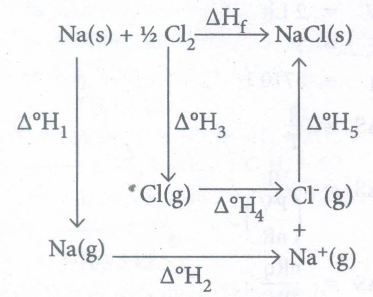
Δ°Hf = heat of formation of sodium chloride
= - 411.3 kJ mol-1
Δ°H1= heat of sublimation ofNa(S) = 108.7 kJ mol-1
Δ°H2 = ionisation energy ofNa(S) = 495.0 kJ mol-1
Δ°H3= dissociation energy ofCI2(S) = 244 kJ mol-1
Δ°H4= Electron affinity ofCl(S) = - 349.0 kJ mol-1
Δ°Hf = Δ°H1+Δ°H2+1/2Δ°H3+Δ°H4+Δ°H5
Δ°H5=(Δ°Hf )-( Δ°H1+Δ°H2+1/2Δ°H3+Δ°H4)
⇒Δ°H5 = (-411.3)-(108.7+495.0+ 122-349)
Δ°H5= (-411.3)-(376.7)
∴ Δ°H5 = -788 kJ mol-1
This negative sign in lattice energy indicates that the energy is released when sodium is formed from its constituent gaseous ions Na+ and Cl-
83.
When the system at constant pressure undergoes changes from an initial state with H1, U1 and, V1 to a final state with H2, U2 and V2 the change in enthalpy ΔH, can be calculated as follows:
H = U+PV
In the initial state
H1 = U1 +PV1 ........(1)
In the final state
H2 = U2 +PV2 ........(2)
change in enthalpy is (2) - (1)
(H2 - H1) = (U2 - U1) + P(V2 - V1)
ΔH = ΔU+PΔV
As per first law of thermodynamics,
ΔV = q+w
Equation (3) becomes
ΔH = q+w+PΔV
w = -PΔV
ΔH = qp-PΔV+PΔV
ΔH = qp....(4)
qp - is the heat absorbed at constant pressure and is p considered as heat content. Consider a closed system of gases which are chemically reacting to form gaseous products at constant temperature and pressure with Vi and Vf as the total volumes of the reactant and product gases respectively, and n i and nf as the number of moles of gaseous reactants and products, then,
For reactants (initial state) :
PVi = ni RT ...(5)
For products (final state) :
PVf = nfRT .........(6)
(6) - (5)
P(Vf - Vi) = (nf - ni) RT
PΔV = Δn(g) RT ...........(7)
Substituting in (7) in (3)
ΔH = ΔV +Δn(g) RT ........(8)
84.
(i) For understanding pressure-volume work, let us consider a cylinder which contains 'n' moles of an ideal gas fitted with a frictionless piston of cross-sectional area A. The total volume of the gas inside is Vi and pressure of the gas inside is Pint.
(ii) If the external pressure Pext is greater than Pint the piston moves inward till the pressure inside becomes equal to Pext. Let this change be achieved in a single step and the final volume be Vf
(iii) In this case, the work is done on the system (+w). It can be calculated as follows w=-FΔx (1)
(iv) where dx is the distance moved by the piston during the compression and F is the force acting on the gas.
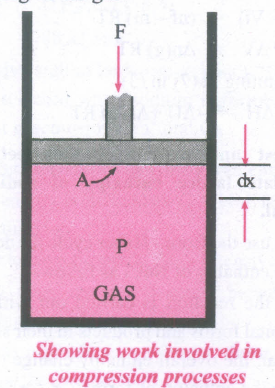
F = PextA (2)
Substituting (2) in (1)
w = - Pext. A. Δx
A.Δx change in volume = Vf - Vi
w = - Pext. ( Vf - Vi) (3)
w = - Pext. (-ΔV) (4)
=Pext.ΔV
(vi) Since work is done on the system, it is a positive quantity.
(vii) If the pressure is not constant, but changes during the process such that it is always infinitesimally greater than the pressure of the gas, then, at each stage of compression, the volume decreases by an infinitesimal amount, dV. In such a case we can calculate the work done on the gas by the relation,
\({ w }_{ rev }=\int _{ { V }_{ i } }^{ { V }_{ f } }{ { P }_{ int }dV } \)
(vii) In a compression process, Pext the external pressure is always greater than the pressure of the system.
i.e Pext= (Pint+ dP).
(viii) In an expansion process, the external pressure is always less than the pressure of the system
i.e. Pext= (Pint - dP).
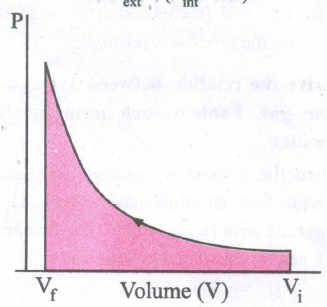
(ix) When pressure is not constant and changes in infinitesimally small steps (reversible conditions) during compression from Vi to Vf the P - V plot looks like in image Work done on the gas is represented by the shaded area. In general case we can write,
(x) Pext= (Pint + dP). Such processes are called reversible processes. For a compression process work can be related to internal pressure of the system under reversible conditions by writing equation
\({ w }_{ rev }=\int _{ { V }_{ i } }^{ { V }_{ f } }{ { P }_{ int }dV } \)
For a given system with an ideal gas
PintV= nRT
\({ P }_{ int }=\frac { nRT }{ V } \)
\({ W }_{ rev }=\int _{ { V }_{ i } }^{ { V }_{ f } }{ \frac { nRT }{ V } } dV\)
\({ W }_{ rev }=-nRT\quad \int _{ { V }_{ i } }^{ { V }_{ f } }{ \left( \frac { dV }{ V } \right) } \)
\({ W }_{ rev }=-nRT\quad ln\quad \left( \frac { { V }_{ f } }{ { V }_{ i } } \right) \)
\({ W }_{ rev }=-2.303\quad nRT\quad log\left( \frac { { V }_{ f } }{ { V }_{ i } } \right) \)
(xi) If Vf > Vi (expansion), the sign of work done by the process is negative.
(xii) IfVf < Vi(compression) the sign of work done on the process is positive.
85.
(i) Heat evolved at constant volume, is measured in a bomb calorimeter.
(ii) Apparatus setup: The inner vessel (the bomb) and its cover are made of strong steel. The cover is fitted tightly to the vessel by means of metal lid and screws.
(iii) Experiment: A weighed amount of the substance is taken in a platinum cup connected with electrical wires for striking an arc instantly to kindle combustion. The bomb is then tightly closed and pressurized with excess oxygen. The bomb is immersed in water, in the inner volume of the calorimeter. A stirrer is placed in the space between the wall of the calorimeter and the bomb, so that water can be stirred, uniformly. The reaction is started by striking the substance through electrical heating.
(iv) Calculation: A known amount of combustible substance is burnt in oxygen in the bomb. Heat evolved during the reaction is absorbed by the calorimeter as well as the water in which the bomb is immersed. The change in temperature is measured using a Beckman thermometer. Since the bomb is sealed its volume does not change and hence the heat measurements is equal to the heat of combustion at a constant volume (ΔU)c
The amount of heat produced in the reaction (ΔU)c is equal to the sum of the heat absorbed by the calorimeter and water.
Heat absorbed by the calorimeter q1 = k.ΔT
where k is a calorimeter constant equal to mc Cc (mc is mass of the calorimeter and Cc is heat capacity of calorimeter)
Heat absorbed by the water q2 = mw Cw ΔT
where mw is molar mass of water
Cw is molar heat capacity of water (4,184 kJ K-1mol-1)
Therefore ΔUc = q1 + q2
=k.ΔT + m w Cw ΔT
=(k+m w Cw) ΔT
Calorimeter constant can be determined by burning a know.n mass of standard sample (benzoic acid) for which the heat of combustion is known (-3227 kJmol-1)
The enthalpy of combustion at constant pressure of the substance is calculated from the equation (7.17)
\(\Delta { H }_{ C(pressure) }^{ 0 }=\Delta { U }_{ C(vol) }^{ o }+\Delta { n }_{ g }RT\)
86.
Characteristics of internal energy (U) :
87.
Born - Haber cycle for the formation of CaCl2
Born - Haber cycle is used to calculate the lattice enthalpy of CaCl2
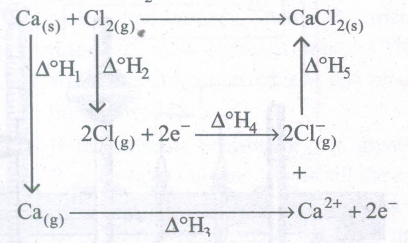
ΔoH1 - Enthalpy change for the sublimation of Ca(s) to Ca(g)
ΔoH2 - Enthalpy change for dissociation of Cl2(g) to 2Cl(g)
ΔoH3 - Ionisation energy for Ca(g) to Ca2+(g)
ΔoH4 - Electron affinity for the conversion of 2Cl(g) to 2Cl-(g)
ΔoH5 - Lattice enthalpy for the formation of solid CaCl2·
ΔoHf =ΔoH1+ΔoH2+ΔoH3+ΔoH4+ΔoH5
88.
| n | 1 | m | Sub energy level |
| 4 | 2 | 0 | 4d |
| 3 | 1 | 0 | 3p |
| 5 | 1 | any one value -1,0,+1 | 5p |
| 3 | 2 | -2 | 3d |
89.
Potential difference = 100V
= 100 x 1.6 x 10-19J
\(\lambda=\frac{h}{\sqrt{2mev}}\)
\(=\frac { 6.626\times { 10 }^{ -34 }Kg{ m }^{ 2 }{ s }^{ -1 } }{ \sqrt { 2\times 9.1\times { 10 }^{ -31 }Kg\times 100\times 1.6\times { 10 }^{ -19 }J } } \)
\(\lambda=1.22\times10^{-10}m\)
90.
m 160 g = 160 x 10-3 kg
\(v=140 km hr^{-1}=\frac{104\times10^{3}}{60\times60}ms^{-1}\)
\(v=38.88ms^{-1}\)
\(\lambda=\frac{h}{mv}\)
\(=\frac{6.626\times^{-34}Kgm^{2}s^{-1}}{160\times10^{-3}Kg\times38.88ms^{-1}}\)
\(\lambda=1.065\times10^{-34}m\)
91.
92.
1. This group contains Be, Mg, Ca, Sr, Ba & Ra.
2. Except Be all these elements are called as alkaline earth metals because their oxides and hydroxides are alkaline in nature.
3. Beryllium is the rare element and Radium is the rarest (10% rocks) ; Their Occurrence: Be- Beryl; Mg - carnallite; Dolomite Ca - Fluorapatite; Sr - Celestite Ba - Barytes.
4. Radium is radioactive.
5. The general electronic configuration is :
[Noble gas] ns2 eg. Be - [He] 2s2
6. On moving down the group the radii increase. Their atomic radii are smaller than alkali metals.
7. They exhibit +2 oxidation state.
8. The ionisation enthalpies are less than p - block elements due to large size. Down the group the ionisation enthalpy decreases.
9. The IE1 of group 2 elements are greater than group 1 elements.
10. The IE2 values are higher than that of alkali metals.
11. They are less electro Positive elements than alkali metals.
12. The hydration enthalpy decreases with increase in ionic radii.
13. MgCl2 form MgCI2 .6H2O and CaCl2 form CaCl2.6H2O
14. The electronegativity value decreases down the group.
15. With concentrated HCl They impart flame colour. Ca - Brick Red ; Sr - Crimson red and Barium - Apple Green.
16. All form metallic halides at elevated temperatures. M + X2 + MX2
17. All elements except Beryllium combine with hydrogen to form hydrides of formula MH2.
93.
(i) Alkaline earth metal (A) belonging to 3rd period is magnesium.
(ii) So A is Magnesium. Magnesium reacts with oxygen and nitrogen as follows.
\(2Mg+O_2⟶\underset{(B)}{2MgO}\)
\(3Mg+N_2⟶\underset{(C)}{Mg_3N_2}\)
So B is Magnesium oxide and C is magnesium nitride.
(iii) Magnesium undergoes metal displacement reaction with AgNO3 as follow to give D as follows :
\(Mg+2AgNO_3⟶\underset{D}{Mg(NO_3)_2}+2Ag\)
So D is Magnesium nitrate.
Result :
| Compound or Element | Symbol or Formula | Name |
|---|---|---|
| A | Mg | Magnesium |
| B | MgO | Magnesium oxide |
| C | Mg3N2 | Magnesium nitride |
| D | Mg(NO3)2 | Magnesium nitrate |
94.
| S.No | Properties |
|---|---|
| 1 | Beryllium chloride forms a dimeric structure like aluminium chloride with chloride bridges. Beryllium chloride also forms polymeric chain structure In addition to dimer. Both are soluble in organic solvents and are strong lewis acids. |
| 2 | Beryllium hydroxide dissolves in excess of alkali and gives beryllate ion and [Be(OH)2]2- and hydrogen as aluminium hydroxide which gives aluminate ion, [Al(OH)4]- |
| 3 | Beryllium and aluminum ions have strong tendency to form complexes, \(BeF_4^{2-} AIFt{_6^{3-}}\) |
| 4 | Both beryllium and aluminium hydroxides are amphoteric in nature. |
| 5 | Carbides of beryllium (Be2C) like aluminum carbide (Al4C3) give methane on hydrolysis |
| 6 | Both beryllium and aluminium are rendered passive by nitric acid. |
95.
(i) Variation of Electronegativity in a period: The electronegativity generally increases across a period from left to right. The atomic radius decreases in a period, as the attraction between the valence electron and the nucleus increases. Hence the tendency to attract shared pair of electrons increases. Therefore, electronegativity also increases in a period.
(ii) Variation of Electronegativity in a group: The electronegativity generally decreases down a group. As we move down a group the atomic radius increases and the nuclear attractive force on the valence electron decreases. Hence, the electronegativity decreases.
96.
Screening effect: The repulsive force between the inner shell electrons and the valence electrons leads to a decrease in the electrostatic attractive forces acting on the valence electrons by the nucleus. Thus, the inner shell electrons act as a shield between the nucleus and the valence electrons. This effect is called shielding effect.
Pauling's scale: Pauling, he assigned arbitrary value of electronegativities for hydrogen and fluorine as 2.2 and 4.0 respectively. Based on this the electronegativity values for other elements can be calculated using the following expression.
\(({ X }_{ A }-{ X }_{ B })=0.182\sqrt { E_{ AB } } -({ E }_{ AA }*{ E }_{ BB })^{ 1/2 }\)
Where EAB' EAA and EBB are the bond dissociation energies of AB, A2 and B2 molecules respectively. The electronegativity of any given element is not a constant and its value depends on the element to which it is covalently bound. The electronegativity values play an important role in predicting the nature of the bond.
97.
(i) Electron configuration of nitrogen
(Z = 7) 1s2 2s2 2p3.
Electron configuration of oxygen
(2= 8) 1s2 2s2 2p4.
Nitrogen has a half filled electronic configuration which is much more stable than an incomplete p-orbital of oxygen which would need to give up one of it's electrons to attain the stability of nitrogen. Hence nitrogen would require more ionization energy to remove an electron from it's outer shell than oxygen.
(ii) Electron configuration of carbon
(Z = 6) 1s22s22p2.
Electron configuration of Boron
(Z = 5) Is22s22p1
The size of a carbon atom is smaller than boron So the valence electron of carbon has greater nuclear charge than that of boron. Hence the first I.E of carbon is greater than that of boron. However, the second ionization enthalpy of boron is higher than that of carbon. This is because after losing electron, Boron has a fully filled orbital (2s2) than carbon (2p1). Fully filled orbitals have more stability than partially filled orbitals so greater amount of energy will be needed to remove an electron from boron. So in this case, the second I.E of boron is higher than that of carbon.
(iii) The electron affinities of Be, Mg and noble gases are almost zero because both Be (Z = 4; 1s22s2) and Mg (Z = 12; Is22s22p63s2) are having s orbital fully filled in their valence shell. Fully filled orbitals are most stable due to symmetry. Therefore, these elements would be having least tendency to accept electron. Hence, Be and Mg would be having zero electron affinity. Whereas N (Z = 7; 1s22s22px12py12pz1 and P (Z = 15) Is2 2s2 2p6 3s2 3p3 is having half filled 2p-subshell. Half filled sub shells are most stable due to symmetry (Hund's rule). Thus, nitrogen and phosphorous are having least tendency to accept electron. Hence, have low electron affinity.
(iv) Fluorine is highly electro negative in nature therefore as it gains the electron its octet become stable and releases the energy so exothermic. while in oxygen the addition of first electron is exothermic in nature but addition of second electron experiences high repulsive force. So needs extra external energy to enter outer shell, hence endothermic in nature.
98.
r(K+)+r(Cl-) = d(K+-Cl-) = 3.14 Å.
The effective nuclear charge for K+ and CI- can be calculated as follows.
K+ = (1s2) (2s22p6) (3s23p6)
inner shell (n-1)th shell nth shell
Z*(K-) = Z-S
= 19 - [(0.35 x 7) + (0.85 x 8) + (1 x 2)]
= 19 - 11.25 = 7.75
Z*(Cl-) = 17- [(0.35 x 7) + (0.85 x 8) + (1 x 2)]
= 17-11.25 = 5.75
∴ \(\frac { r({ K }^{ + }) }{ r(Cl^{ - }) } =\frac { Z*(Cl^{ - }) }{ Z*(K^{ + }) } =\frac { 5.75 }{ 7.75 } \)=0.74
∴ r(K+) = 0.74 r(Cl-)
Substitute (2) in (1)
0.74 r(Cl-) + r(Cl-) = 3.14 Å.
1.74 r(Cl-) = 3.14 Å
r(Cl-) = \(\frac { 3.14\overset { 0 }{ A } }{ 1.74 } \)=1.81.Å.
99.
| H2O | H2O2 | |
|---|---|---|
| Hybridisation of oxygen |
SP3 | Sp3 (each 0 - atom) |
| Structure | .jpg) |
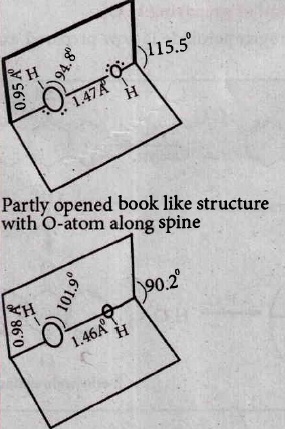 |
100.
The element which occupies group number (16) and period number (2) is oxygen. (B) is D2O which is used as a moderator in nuclear reactions.
So (A) must be deuterium, which is an isotope of hydrogen
\(2\underset { (A) }{ { D }_{ 2 } } +{ O }_{ 2 }\rightarrow 2\underset { (B) }{ { D }_{ 2 }O } \)
So (B) is D2O
(A) adds to (C) as follows :
\(3 \mathrm{D}_{2}+\mathrm{C}_{3} \mathrm{H}_{6} \rightarrow \mathrm{CH}_{3}-\mathrm{CH}-\mathrm{CH}_{2}\)
So (D) is 1,2 - dideutero propane.
| A | D2 | Deuterium |
| B | D2O | Heavy water or deuterium oxide |
| C | CH3-CH = CH2 | Propene |
| D | CH3 - CHD - CH2D | Propane deuteride |
101.
The group metal - 1 which is present in common salt is sodium.
So (A) is sodium
Sodium reacts with hydrogen (B) to give, sodium hydride (C). In sodium hydride the hydrogen is present in -1 oxidation state.
\(2\underset { (A) }{ Na } +\underset { (B) }{ { H }_{ 2 } } \rightarrow 2\underset { (C) }{ NaH } \)
So (B) hydrogen and (C) is sodium hydride
H2 reacts with oxygen gas (D) to give an universal solvent, water (E) follows:
\(2\underset { (B) }{ { H }_{ 2 } } +{ O }_{ 2 }\rightarrow 2\underset { (D) }{ { H }_{ 2 }O } \)
So (E) is water. Water is the universal solvent
Water (E) reacts with sodium (A) follow to give (F), which is a strong base.
\(2\underset { (E) }{ { H }_{ 2 }O } +\underset { (A) }{ 2Na } \rightarrow 2\underset { (F) }{ NaOH } +{ { H }_{ 2 } } \)
So (F) is sodium hydroxide.
| Element / Compound | Symbol / Formula | Name |
| A | Na | Sodium |
| B | H2 | Hydrogen |
| C | NaH | Sodium hydride |
| D | H2O | Water |
| E | NaOH | Sodium hydroxide |
102.
The van der Waals equation for n moles is
\(\left( P+\frac { { an }^{ 2 } }{ { v }^{ 2 } } \right) \left( v-nb \right) =nRT\) ....(1)
For 1 mole
\(\left( P+\frac { { a }^{ 2 } }{ { v }^{ 2 } } \right) \left( v-b \right) =RT\) ...(2)
From the equation we can derive the values of critical constants Pc, Vc and Tc, in terms of a and b, the van der Waals constants, On expanding the above equation
\(pv+\frac { a }{ v } -pb-\frac { ab }{ { v }^{ 2 } } -RT=0\) ...(3)
Multiply equation (3) by V2 / P
\(\frac { { v }^{ 2 } }{ p } \left( Pv+\frac { a }{ v } -pb-\frac { ab }{ { v }^{ 2 } } -RT \right) =0\)
\({ v }^{ 3 }+\frac { av }{ p } +-{ bv }^{ 2 }-\frac { ab }{ { v }^{ 2 } } -\frac { { RTV }^{ 2 } }{ p } \) ...(4)
When the above equation is rearranged in powers of Y.
\({ v }^{ 3 }-\left[ \frac { RT }{ P } +b \right] { v }^{ 2 }+\left[ \frac { a }{ p } \right] v-\left[ \frac { ab }{ p } \right] =0\) ...(5)
The equation (5) is a cubic equation in V. On solving this equation,
we will get three solutions. At the critical point all these three solutions of V are equal to the critical volume VC. The pressure and temperature becomes Pc and Tc respectively
i.e., V = Vc
V - Vc = 0
(V - VC)3 = 0
V3 - 3VCV2 + 3Vc2V - Vc3 = 0 .....(6)
As equation (5) is identical with equation (6), we can equate the coefficients of V2, V and constant terms in (5) and (6).
\(-3{ v }_{ c }{ v }^{ 2 }=-\left[ \frac { { RT }_{ c } }{ { p }_{ c } } +b \right] { v }^{ 2 }\)
\(3{ v }_{ c }=\frac { { RT }_{ c } }{ { p }_{ c } } +b\) .....(7)
\(3{ v }_{ c }^{ 2 }=\frac { a }{ { p }_{ c } } \) ......(8)
\(3{ v }_{ c }^{ 2 }=\frac { ab }{ { p }_{ c } } \) ...(9)
Divide equation (9) by equation (8)
\(\frac { { v }_{ c }^{ 3 } }{ 3{ v }_{ c }^{ 2 } } =\frac { ab/{ p }_{ c } }{ a/{ p }_{ c } } \)
\(\frac { { V }_{ c } }{ 3 } =b\)
i.e. Vc = 3b .....(10)
when equation (10) is substituted in (8)
\(3{ v }_{ c }^{ 2 }=\frac { a }{ { p }_{ c } } \)
\({ p }_{ c }=\frac { a }{ 3{ v }_{ c }^{ 2 } } =\frac { a }{ 3\left( { 3b }^{ 2 } \right) } =\frac { a }{ { 3\times 9b }^{ 2 } } =\frac { a }{ { 27 }b^{ 2 } } \)
\({ p }_{ c }=\frac { a }{ { 27 }b^{ 2 } } \) ...(11)
substituting the values of Vc and Pc in equation (7),
\(3vc=b+\frac { { RT }_{ c } }{ p } \)
\(3\left( 3b \right) =b+\frac { { RT }_{ c } }{ \left( \frac { a }{ { 27b }^{ 2 } } \right) } \)
\(9b-b=\left( \frac { { RT }_{ c } }{ a } \right) 27{ b }^{ 2 }\)
\(8b=\frac { { t }_{ c }R{ 27b }^{ 2 } }{ a } \)
\(\therefore { T }_{ c }=\frac { 8ab }{ 27R{ b }^{ 2 } } =\frac { 8a }{ 27Rb } \)
\({ T }_{ c }=\frac { { 8 }_{ a } }{ 27Rb } \) ......(12)
The critical constants can be calculated using the values of van der Waals constant of a gas and vice versa.
\(a=3{ V }_{ C }^{ 2 }{ P }_{ C }\quad and\quad b=\frac { { V }_{ C } }{ 3 } \)
103.
The van der equation for a real gas is
\(\left( P+{{{am}^{2}}\over{{V}^{2}}} \right)(V-nb)=nRT\)
Pressure, Correction:
The pressure of a gas is directly proportional to the force created by the bombardment of molecules on the walls of the container. The speed of a molecule moving towards the wall of the container is reduced by the attractive forces exerted by its neighbours. Hence, the measured gas pressure is lower than the ideal pressure of the gas. Hence, van der Waals introduced a correction term to this effect.
Van der Waals found out the forces of attraction experienced by a molecule near the wall are directly proportional to the square of the density of the gas.
\(P^{\prime} \propto \rho^{2} ; \quad \rho=\frac{n}{v}\)
where n is the number of moles of gas and
V is the volume of the container
\( \Rightarrow p^{\prime} \alpha \frac{n^{2}}{V^{2}} \)
\(\Rightarrow p^{\prime}=a \frac{n^{2}}{V^{2}}\)
where a is proportionality constant and depends on the nature of gas
Therefore \(P_{\text {ideal }}=P+\frac{\operatorname{an}^{2}}{V^{2}}\)
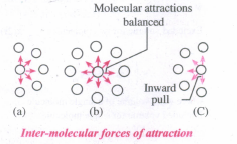
Volume Correction
As every individual molecule of a gas occupies a certain volume, the actual volume is less than the volume of the container,
V. Van der Waals introduced a correction factor V' to this effect. Let us calculate the correction term by considering gas molecules as spheres.
V = excluded volume
Excluded volume for two molecules
\(=\frac{4}{3} \pi(2 r)^{3}=8\left(\frac{4}{3} \pi r^{3}\right)=8 V_{m}\)
Where Vm it a volume of a single molecule
Excluded volume for single molecule = \(\frac{8 \mathrm{~V}_{\mathrm{m}}}{2}=4 \mathrm{~V}_{\mathrm{m}}\)
Excluded volume for n molecule = n(4Vm) = nb
Where b is van der waals constant which is equal to 4Vm
\( \Rightarrow V^{\prime}=n b \)
\(V_{\text {ideal }}=V-n b\)
Replacing the corrected pressure and volume in the ideal gas equation PV = nRT we get the Van der Waals equation of state for real gases as below,
\(\left(p+\frac{a^{2}}{V^{2}}\right)(V-n b)=n R T\)
The constants a and b are van der Waals constants and their values vary with the nature of the gas. It is an approximate formula for the non-ideal gas.
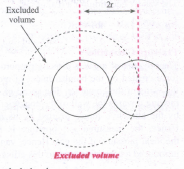
104.
The electronic configuration of Sodium (Z = 11) Is22s22p63s1.
Magnesium (Z = 12) 1s22s22p63s2
Magnesium atom has a smaller radius and higher nuclear charge than a sodium atom, thus more energy will be required to remove the electron from the same orbital (3s), making the first ionisation energy of magnesium higher than that of sodium.
However, the second ionization enthalpy of sodium is higher than that of magnesium. This is because after losing 1 electron, sodium attains the stable noble gas configuration of neon (1s22s22p6). On the other hand, magnesium, after losing 1 electron still has one electron in the 3s-orbital(1s22s22p63s1). In order to attain the stable noble gas configuration, Thus, the energy required to remove the second electron in case of sodium is much higher than that required in case of magnesium. Hence, the second ionization enthalpy of sodium is higher than that of magnesium.
105.
On moving diagonally across the periodic table, the second and third period elements show certain similarities. It is quite pronounced in the following pair of elements.

The similarity in properties existing between the diagonally placed elements is called diagonal relationship.
106.
Variation along a period: Ionisation energy usually increases along a period. This is due to increase of nuclear charge and decrease in size as we move from left to right in a period.
Periodic variation in group: Ionisation energy decreases down a group. As we move down a group, the valence electron occupies new shells, the distance between the nucleus and the valence electron increases. So, the nuclear forces of attraction on valence electron decreases and hence ionisation energy also decreases down a group.
107.
(i) Ionic radius of uni-univalent crystal can be calculated using Pauling's method from the inter ionic distance between the nuclei of the cation and anion.
(ii) Pauling assumed that ions present in a crystal lattice are perfect spheres, and they are in contact with each other therefore,
d=rC+ + rA- ...(1)
Where d is the distance between the centre of the nucleus of cation C+ and anion A-and rC+, rA- are the radius of the cation and anion respectively.
(iii) Pauling also assumed that the radius of the ion having noble gas electronic configuration is inversely proportional to. the effective nuclear charge.
\({ r }_{ C }^{ + }\alpha \frac { 1 }{ ({ Z }_{ eff }){ C }^{ + } } \) ....(2) and
\({ r }_{ A }^{ - }\alpha \frac { 1 }{ ({ Z }_{ eff }){ A }^{ - } } \)...(3)
Where Zeff is the effective nuclear charge and Zeff= Z - S
Dividing the equation 1 by 3
\(\frac { { r }_{ C }^{ + } }{ { r }_{ A }^{ - } } =\frac { ({ Z }_{ eff }){ A }^{ - } }{ ({ Z }_{ eff }){ C }^{ + } } \) ...(4)
On solving equation and (1) and (4) the values of rC+ and rA- can be obtained.
108.
| Orbital | n | l | Radial node n - l -1 | Angular node l | Total node n - 1 |
| 3d | 3 | 2 | 0 | 2 | 2 |
| 4f | 4 | 3 | 0 | 3 | 3 |
109.
Critical temperature of a gas is defined as the temperature above which it cannot be liquefied even at high pressures.
\(\therefore \) When cooling starts from 700 K, H2O will liquefy first, then followed by ammonia and finally carbon dioxide will liquefy.
110.
V1 = 7.05 dm3 V2 = 2.35 dm3
n1 = 0.312 mol n2 = ?
' P ' and ' T ' are constant
\(\frac { { V }_{ 1 } }{ n_{ 1 } } =\frac { { V }_{ 2 } }{ { n }_{ 2 } } \)
n2 = \(\left( \frac { { n }_{ 2 } }{ { V }_{ 1 } } \right) \times { V }_{ 2 }\)
\(\mathrm{n}_{2}=\frac{0.312 \mathrm{~mol}}{7.05 \mathrm{\not dm}^{3}} \times 2.35 \mathrm{\not dm}^{3}\)
n2 = 0.104 mol
Number of moles exhaled = 0.312 - 0.104 = 0.208 moles
111.
V1 = 0.375 dm3 V2 = 0.125
P1 = 1.05 atm P2 = ?
' T '- Constant
P1V1 = P2V2
\(\therefore \) P2 = \(\frac { { P }_{ 1 }{ V }_{ 1 } }{ { V }_{ 2 } } =\frac { 1.05\times 0.375 }{ 0.125 } \) = 3.15 atm
112.
Volume of freon (V1) = 1. 5 dm3
Pressure (P1) = 0. 3atm
' T ' is constant
P2 = 1.2 atm
V2 = ?
\(\therefore \) P1V1 = P2V2
V2 = \(\frac { { P }_{ 1 }{ V }_{ 1 } }{ { P }_{ 2 } } \)
= 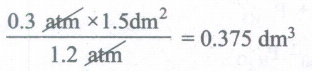
\(\therefore \) Volume decreased from 1.5 dm3 to 0.375 dm3
113.
ΔH = -10 KJ mol-1 = - 10000 J mol-1
ΔS = -20 JK-1 mol-1
T = 300 K
ΔG = ?
ΔG = ΔH - TΔS
ΔG = -10 KJ mol-1 - 300 k x (-20 x 10-3 )kJ K-1 mol-1
ΔG = (-10 + 6) KJ mol-1
ΔG = -4 KJ mol-1
At 600 K
ΔG = -10 KJ mol-1 - 600 K x (-20 x 10-3) KJ K-1 mol-1
ΔG = (-10 + 12) KJ mol-1
ΔG = + 2 KJ mol-1
The value of ΔG is negative at 300K and the reaction is spontaneous, but at 600K the value ΔG becomes positive and the reaction is non spontaneous.
114.
Tb = 351 K
ΔHvap = 39840 Jmol-1
ΔSV = ?
ΔSv = \(\frac { { \triangle H }_{ vap } }{ { T }_{ b } } \)
ΔSv = \(\frac { 39840 }{ 351 } \)
ΔSv = 113.5 JK-1 mol-1
115.
T1 = 8°C + 273 = 281 K
P1 = 6.4 atm V1 = 2.1 ml
T2 = 25°C + 273 = 298 K
P2 = 1 atm V2 = ?
\(\frac{\mathrm{P}_{1} \mathrm{~V}_{1}}{\mathrm{~T}_{1}}=\frac{\mathrm{P}_{2} \mathrm{~V}_{2}}{\mathrm{~T}_{2}} \Rightarrow \mathrm{V}_{2}=\left(\frac{\mathrm{P}_{1} \mathrm{~V}_{1}}{\mathrm{~T}_{1}}\right) \times \frac{\mathrm{T}_{2}}{\mathrm{P}_{2}}\)
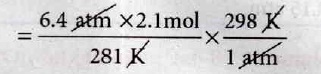
= 14.25 ml
116.
T=298K
\(\Delta { G }_{ r }^{ 0 }\)=- 13.6 kJ mol-1
=-13600 J mol-1
ΔG0=- 2.303 RT log Keq
log Keq=\(\frac { 13.6kJmol^{ -1 } }{ 2.303\times 8.314\times { 10 }^{ -3 }JK^{ -1 }mol^{ -1 }\times 298K } \)
log Keq = 2.38
Keq = antilog (2.38)
Keq = 239.88.
117.
T =298 K
ΔH 400 J mol-1 = 400 J mol-1
ΔS= 0.2 J K-1 mol-1
ΔG =ΔH-TΔS
if T =2000 K
ΔG = 400 - (0.2 \(\times\) 2000) = 0
if T > 2000 K
ΔG will be negative.
The reaction would be spontaneous only beyond 2000K.
118.
\(\Delta { H }_{ f }^{ 0 }\)(SO2) = - 297 kJ mol-1
\(\Delta { H }_{ f }^{ 0 }\)(SO3) = - 396 kJ mol-1
SO2 + \(\frac{1}{2}\)O2⟶SO3 \(\Delta { H }_{ r}^{ 0 }\)=?
\(\Delta { H }_{ r}^{ 0 }\)=\((\Delta { H }_{ f }^{ 0 })\)compound-Σ(ΔHf)elements
\(\Delta { H }_{ r}^{ 0 }\)=\(\Delta { H }_{ f }^{ 0 }\)(SO3)-(\(\Delta { H }_{ f }^{ 0 }\)(SO2) +\(\frac{1}{2}\)\((\Delta { H }_{ f }^{ 0 })\)(O2))
\(\Delta { H }_{ r}^{ 0 }\)=- 396 kJ mol-1 - (-297 kJ mol-1 + 0)
\(\Delta { H }_{ r}^{ 0 }\)=-396 kJ mol-1 + 297
\(\Delta { H }_{ r}^{ 0 }\)=-99 kJ mol-1
119.
T= 33K
N2O4 \(\rightleftharpoons \) 2NO2
Initial concentration 100%
Concentration dissociated 50%
Concentration remaining at equilibrium 50% 100%
Keq=\(\frac{100}{50}=2\)
ΔGo=-2.303 RT log Keq
ΔGo=-2.303 x 8.314 x 33 x log 2
ΔGo=-190.18 J mol-1
120.
EC-H=414 kJ mol-1
EC-C=347 kJ mol-1
EC=C=618 kJ mol-1
EH-H=435 kJ mol-1
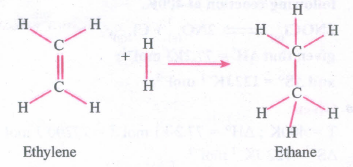
ΔHr= Σ(Bond energy)r -Σ(Bond energy)p
ΔHr= (EC=C + 4EC-H + EH-H) - (EC-C + 6EC-H)
ΔHr= (618 + (4 \(\times\) 414) + 435) - (347 +(6 \(\times\) 414))
ΔHr= 2709 - 2831
ΔHr= -122 kJ mol-1
121.
T = 298K ; ΔU= - 742.4 kJ mol-1
ΔH=?
ΔH=ΔU+ΔngRT
ΔH=ΔU+(np-nr)RT
ΔH=-742.4 +\((2-\frac{3}{2})\)\(\times\)8.314 \(\times\) 10-3 \(\times\) 298
=-742.4 + (0.5 \(\times\) 8.314 \(\times\)10-3 \(\times\)298)
=-742.4 + 1.24
=-741.16 kJ mol-1
122.
ΔHf (NaCl)=30.4 kJ = 30400 J mol-1
ΔSf (NaCl)=28.4 JK-1mol-1
Tf=?
ΔSf =\(\frac { \Delta { H }_{ f } }{ { T }_{ f } } \)
Tf=\(\frac { \Delta { H }_{ f } }{ \Delta { S }_{ f } } \)
Tf=\(\frac { 30400J{ mol }^{ -1 } }{ 28.4J{ K }^{ -1 }mol^{ -1 } } \)
Tf=1070.4K
123.
n = 1mole
P = 4.1 atm
V= 2 L
T=?
q=3710 J
ΔS=\(\frac{q}{T}\)
ΔS=\(\frac { q }{ \left( \frac { PV }{ nR } \right) } \)
ΔS=\(\frac{nRq}{PV}\)
ΔS=\(\frac { 1\times 0.082\quad lit\quad atm{ K }^{ -1 }\times 3710J }{ 4.1\quad atm\times 2\quad lit } \)
ΔS=37.10JK-1
124.
Ti = 298 K
Tf = 298.45 K
k = 2.5 kJK-1
m =3.5g
Mm = 28
heat evolved= kΔT
=k (Tf - Ti)
=2.5 KJ K-1 (298.45 - 298)K
=1.125kJ
ΔHc=\(\frac{1.125}{3.5}\times\)28KJmol-1
ΔHc = 9 kJ mol-1
125.
\(\triangle x=?\)
\(\triangle v=?\)
\(\triangle x.\triangle p\ge\frac{h}{4\pi}\)
\(\lambda (m\triangle v)\ge\frac{h}{4\pi}\)
\(\triangle v\ge\frac{h}{4\pi(m\lambda)}\)
\(\triangle \ge\frac{h}{4\pi\times m \times\frac{h}{mv}}\) \(\left[ \because \lambda-={{h}\over{mv}} \right]\)
\(\triangle v \ge \frac{v}{4\pi}\)
therefore, minimum uncertainty in velocity \(=\frac{v}{4\pi}\)
126.
\(\triangle\)x = 0.6\(\mathring{A}\) = 0.6 x 10⁻¹⁰m
\(\triangle p\) = ?
\(\triangle x.\triangle p\ge\frac{h}{4\pi}\)
\(\triangle x.\triangle p\ge5.28\times10^{-35}kgm^{2}s^{-1}\)
\((0.6 \times10^{-10}) \triangle p \ge5.28\times10^{-35}\)
\(\Rightarrow \triangle \ge \frac{5.28\times10^{-35}kgm^{2}s^{-1}}{0.6510^{-1}m}\)
\(\triangle p \ge8.8\times10^{-25}kgms^{-1}\)
127.
v = 2.85 x 10⁸ ms-1
mp = 1.673 x 10⁻²⁷Kg
\(\lambda=\frac{h}{mv}\)
\(=\frac{6.626\times10^{-34}kgm^{2}s^{-1}}{1.673\times10^{-27}kg\times\times2.85\times10^{8}ms^{-1}}\)
\(\lambda=1.389\times10^{-15}\Rightarrow\lambda=1.389\times10^{-15}A\) \([\because \mathring{A}={10}^{-10}m]\)
128.
\({ r_{n} }=\frac{(0.529)n^2}{z}\mathring{A}\ \ { E_{n} }=\frac{-13.6(z)^2}{(n)^2}ev atom^{-1}\)
for Li2+ z = 3
Bohr radius for the third orbit (r3)
= \(\frac { (0.529){ (3) }^{ 2 } }{ 3 } \)
= 0.529\(\times\)3
=1.587 \(\mathring{A}\)
Energy of an electron in the fourth orbit
\(({E}_{6})=\frac { -13.6{ (3) }^{ 2 } }{ { (4) }^{ 2 } } \)
=-7.65eV atom-1
129.
\({ He }^{ + }\longrightarrow { He }^{ 2+ }+{ e }^{ - }\)
\({ E }_{ n }=\frac{-13.6(2)^2}{n^2}\)
\({ E }_{ 1 }=\frac{-13.6(2)^2}{(1)^2}=-54.4\)
\({ E }_{ \infty }=\frac{-13.6(2)^2}{(\infty)^2}=0\)
\(\therefore\) Required Energy for the given process
= E\(\infty\) - EI = 0 - (- 54.4) = 56.4 ev.
130.
Pressure of the gas in the tank at its melting point
T1 = 298 K; P1 = 2.98 atm; T2 = 1100 K; P2 = ?
\(\frac { { P }_{ 1 } }{ { T }_{ 1 } } =\frac { { P }_{ 2 } }{ { T }_{ 2 } } \)
\(\Rightarrow \quad { P }_{ 2 }=\frac { { P }_{ 1 } }{ { T }_{ 1 } } \times { T }_{ 2 }\)
\({ P }_{ 2 }=\frac { 2.98\quad atm }{ 298\ K } \times 1100\ K=11\ atm\)
At 1100 K the pressure of the gas inside the tank will become 11 atm. Given that tank can withstand a maximum pressure of 12 atm, the tank will start melting first.
131.
\(\frac { { \gamma }_{ unknown } }{ \gamma { N }_{ 2 } } =\frac { { t }_{ { N }_{ 2 } } }{ { t }_{ unknown } } =\sqrt { \frac { { m }_{ { N }_{ 2 } } }{ { m }_{ unknown } } } \)
\(\frac { 84\quad sec }{ 192\quad sec } =\sqrt { \frac { 14g\quad { mol }^{ -1 } }{ { m }_{ unknown } } } =\frac { 14g\quad { mol }^{ -1 } }{ { m }_{ unknown } } \)
\({ m }_{ unknown }=28 g { mol }^{ -1 }\times { \left( \frac { 192\quad sec }{ 84\quad sec } \right) }^{ 2 }\)
munknown = 146 g mol-1 .
132.
Given,
V = 154.4 \(\times\) 10-3 dm3,
P = 742 mm of Hg
T = 298 K m = ?
\(n=\frac { PV }{ RT } =\frac { 742mm\ Hg\times 154.4\times { 10 }^{ -3 }L }{ 62mm\ Hg\ L{ K }^{ -1 }{ mol }^{ -1 }\times 298K } \)
\(n=\frac { Mass }{ Molar\ Mass } \)
mass = n \(\times\) Molar mass
= 0.006 \(\times\) 2.016
= 0.0121 g = 12.1 mg.
133.
T1 = 6°C + 273 = 279 K
P1 = 4 atm V1 = 1.5 ml
T2 = 25°C + 273 = 298 K
P2 = 1 atm V2= ?
\(\frac { { P }_{ 1 }{ V }_{ 1 } }{ { T }_{ 1 } } =\frac { { P }_{ 2 }{ V }_{ 2 } }{ { T }_{ 2 } } \)

V2 = 6.41 ml.
134.
| Atom | Uni- negative ion | |
| number of electron | x-I | x |
| number of protons | x-1 | x-1 |
| number of neutrons | y | y |
Given that, y = x + 11.1% of x
\(=\left(x+\frac{11.1}{100} x\right)=x+0.111 x\)
Y = 1.111 x
mass number = 37
number of protons + number of neutrons = 37
(x -1) + 1.111x = 37
x+1.111x = 38
2.111x = 38
\(x=\frac{38}{2.11}\)
x = 18.009
x 18 (whole number)
ஃ Atomic number = x- 1 = 18 - 1 = 17
Mass number = 37
Symbol of the ion \({ _{ 17 }^{ 37 }{ Cl } }^{ - }\)
135.
V1 = 8.5 dm3 V2 = 6.37 dm3
T1 = ? T2 = 0o C = 273 K
\(\frac { { V }_{ 1 } }{ { T }_{ 1 } } =\frac { { V }_{ 2 } }{ { T }_{ 2 } } \)
\({ V }_{ 1 }\times \left( \frac { { T }_{ 2 } }{ { V }_{ 2 } } \right) ={ T }_{ 1 }\)
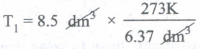
T1 = 364.28 K
136.
T1 = 15oC + 273 T2= 38 + 273
T1 = 288 K T2 = 311 K
V1 = 2.58 dm3 V2 = ?
(P = 1 atm constant)
\(\frac { { V }_{ 1 } }{ { T }_{ 1 } } =\frac { { V }_{ 2 } }{ { T }_{ 2 } } \)
\({ V }_{ 2 }=\left( \frac { { V }_{ 1 } }{ { T }_{ 1 } } \right) \times { T }_{ 2 }\)
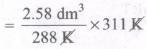
V2 = 2.78 dm3 i.e. volume increased from 2.58 dm3 to 2.78 dm3.
137.
High purity hydrogen (> 99.9%) is obtained by the electrolysis of water containing traces of acid or alkali or the electrolysis of aqueous solution of sodium hydroxide or potassium hydroxide using a nickel anode and iron cathode. However, this process is not economical for large-scale production.
At anode: 2OH- ➝ H2O + 1/2O2 + 2e-
At cathode: 2H2O + 2e- ➝ 2OH- + H2
Overall reaction: H2O ➝ H2 + 1/2O2
138.
(i) Hydrogen has the electronic configuration of 1s1 which resembles with ns1 general valence shell configuration of alkali metals and shows similarity with them as follows:
1. It forms unipositive ion (H+) like alkali metals (Na+,K+,Cs+)
2. It forms halides (HX), oxides (H2O), peroxides (H2O2) and sulphides (H2S) like alkali metals (NaX, Na2O, Na2O2, Na2S)
3. It also acts as a reducing agent.
4. lt is an electro positive element
However, unlike alkali metals which have ionization energy ranging from 377 to 520 kJ mol-1, the hydrogen has 1.314 kJ mol-1 which is much higher than alkali metals.
Like the formation of halides (X -) from halogens, hydrogen also has a tendency to gain one electron to form hydride ion(H+) whose electronic configuration is similar to the noble gas, helium. However, the electron affinity of hydrogen is much less than that of halogen atoms. Hence, the tendency of hydrogen to form hydride ion is low compared to that of halogens to form the halide ions as evident from the following reactions:
\(
1 / 2 \mathrm{H}_{2}+\mathrm{e}^{-} \rightarrow \mathrm{H}^{-} \Delta \mathrm{H}=+36 \mathrm{kcal} \mathrm{mol}^{-1}
\)
\(1 / 2 \mathrm{Br}_{2}+\mathrm{e}^{-} \rightarrow \mathrm{Br}^{-} \Delta \mathrm{H}=-55 \mathrm{kcal} \mathrm{mol}^{-1}\)
Since, hydrogen has similarities with alkali metals as well as the halogens; it is difficult to find the right position in the periodic table. However, in most of its compounds hydrogen exists in +1 oxidation state. Therefore, it is reasonable to place the hydrogen in group 1 along with alkali metals as shown in the latest periodic table published by IUPAC.
139.
Aerated water bottle contains excess dissolved oxygen/CO2 bottled at high pressure. During summer due to high Temperature, O2/CO2 escapes from the solution increasing the Pressure inside the bottle which may cause bursting of the bottle. To maintain low T, it is kept under water
140.
Given \(\triangle\)v = 5.7 x 10⁵ ms-1. \(\triangle\)x = ?
According to Heisenbergs uncertainty principle \(\Delta x \cdot \Delta p \geq \frac{\mathrm{h}}{4 \pi}\)
\(
\frac{\mathrm{h}}{4 \pi}=\frac{6.626 \times 10^{-34}}{4 \times 3.14} \mathrm{kgm}^{2} \mathrm{~s}^{-1}=5.28 \times 10^{-35}
\)
\(\Delta x \cdot \Delta \mathrm{p} \geq 5.28 \times 10^{-35}
\)
\(\Delta x . \mathrm{m} \Delta \mathrm{v} \geq 5.28 \times 10^{-35}
\)
\(\Rightarrow \Delta x \geq \frac{5.28 \times 10^{-35} \mathrm{kgm}^{2} \mathrm{~s}^{-1}}{9.1 \times 10^{-31} \mathrm{~kg} \times 5.7 \times 10^{5} \mathrm{~ms}^{-1}} \Rightarrow \Delta x \geq 1.017 \times 10^{-10} \mathrm{~m}\)
141.
No. of moles of Oxygen =\(\frac { Mass }{ Molar Mass }\) =\(\frac { 52.5}{ 32 }\)
= 1.640 moles
No. of moles of CO2 = \(\frac { Mass }{ Molar Mass }\)=\(\frac { 65.1 }{ 44} \)
= 1.480 moles
Partial pressure = Mole fraction x Total Pressure
\(\therefore \mathrm{P}_{\mathrm{o}_{2}}=\left(\frac{1.641}{1.641+1.480}\right) 9.21=\frac{1.641}{3.121} \times 9.21\)
= 4.842 atm.
\(\mathrm{P}_{\mathrm{CO}_{2}}=\left(\frac{1.480}{1.641+1.480}\right) 9.21=\frac{1.480 \times 9.21}{3.121}\)
= 4.367 atm.
142.
V1 = 3.8 dm3 T2 = 0oC = 273 K
T1 = ? V2 = 2.27 dm3
\(\frac { { V }_{ 1 } }{ { T }_{ 1 } } =\frac { { V }_{ 2 } }{ { T }_{ 2 } } { T }_{ 1 }=\left( \frac { { T }_{ 2 } }{ { V }_{ 2 } } \right) \times { V }_{ 1 }\)
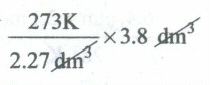
T1 = 457K
143.
Given data P1 = 1.2 atm
T1 = 18° C
T1 = 18 + 273 = 291 K
P2 = ?
T2 = 85° C
= 85 + 273 = 358 K
\(\frac { { P }_{ 1 } }{ { T }_{ 1 } } =\frac { { P }_{ 2 } }{ { T }_{ 2 } } \)
\({ P }_{ 2 }=\frac { { P }_{ 1 }{ T }_{ 2 } }{ { T }_{ 1 } } =\frac { 1.2\times 358 }{ 291 } \)
P2 = 1.48 atm
144.
n =1.82 mole
V = 5.43 dm3
T = 69.5 + 273 = 342.5
P = ?
PV = nRT
\(P=\frac { nRT }{ V } \)

P = 9.425 atm.
145.
nA = 1.5 mol nB = ?
VA= 37.6 dm3 VB = 16.5 dm3
(T = 298 K constant)
\(\frac { { V }_{ A } }{ { n }_{ A } } =\frac { { V }_{ B } }{ { n }_{ B } } \)
\({ n }_{ A }=\left( \frac { { n }_{ A } }{ { V }_{ A } } \right) { V }_{ B }\)

= 0.66 mol.
146.
The gas deviates from ideal gas behaviour and will be a real gas only. In the compressed state, the inter molecular forces will be very high as the molecules are very close.

11th Standard Syllabus & Materials
11th Standard
TN 11th Tamil பீடு பெற நில் - செய்யுள் - காவடிச்சிந்து Important Questions And Answers Study Material - QB365 Set A
NEW11th Standard
TN 11th Tamil பீடு பெற நில் - உரைநடை - மலை இடப்பெயர்கள் : ஓர் ஆய்வு Important Questions And Answers Study Material - QB365 Set A
NEW11th Standard
TN 11th Tamil மாமழை போற்றுதும் - துணைப்பாடம் - யானை டாக்டர் Important Questions And Answers Study Material - QB365 Set A
NEW11th Standard
TN 11th Tamil மாமழை போற்றுதும் - செய்யுள் - ஐங்குறுநூறு Important Questions And Answers Study Material - QB365 Set A



Tamilnadu Stateboard 11th Standard Subjects

Maths

Commerce

Economics

Biology

Business Maths and Statistics

Accountancy

Computer Science

Physics
Chemistry
Maths
Biology
Economics
Physics
Chemistry

History
Business Maths and Statistics

Computer Science
Accountancy

Computer Applications
History
Computer Technology
Commerce
Computer Applications
Computer Technology

Tamil

English

French
Tamilnadu Stateboard Standards
