
 100% FREE ACCESS
11th Standard Syllabus & Materials
11th Standard
TN 11th Tamil இயற்கை வேளாண்மை,சுற்றுச்சூழல் -செய்யுள் - மனோன்மணீயம் Important Questions And Answers Study Material - QB365 Set A
NEW11th Standard
TN 11th Tamil என்னுயிர் என்பேன் -துணைப்பாடம் - இசைத்தமிழர் இருவர் Important Questions And Answers Study Material - QB365 Set A
NEW11th Standard
TN 11th Tamil மொழி கலை -செய்யுள் - ஒவ்வொரு புல்லையும் Important Questions And Answers Study Material - QB365 Set A
NEW11th Standard
TN 11th Tamil பீடு பெற நில் - இலக்கணம் - பகுபத உறுப்புகள் Important Questions And Answers Study Material - QB365 Set A
NEW11th Standard
TN 11th Tamil பீடு பெற நில் - துணைப்பாடம் - வாடிவாசல் Important Questions And Answers Study Material - QB365 Set A
NEW11th Standard
TN 11th Tamil பீடு பெற நில் - செய்யுள் - குறுந்தொகை Important Questions And Answers Study Material - QB365 Set A

Published on: 05/09/2018
UNIT TEST 2
Download Tamil Nadu 11th Standard Chemistry question papers, model tests, one-mark questions, important questions, and public exam papers in PDF format. Free study materials and answer keys for TN State Board students.
Questions + Answers key
Take MCQ Chemistry Test
1.
Which of the following does not represent the mathematical expression for the Heisenberg uncertainty principle?
\(\triangle x.\triangle p\ge \frac { h }{ 4\pi } \)
\(\triangle x.\triangle v\ge \frac { h }{ 4\pi m } \)
\(\triangle E.\triangle t\ge \frac { h }{ 4\pi } \)
\(\triangle E.\triangle x\ge \frac { h }{ 4\pi } \)
2.
Time independent Schrodinger wave equation is ______________
\(\overset { \wedge }{ H } \psi =E\psi \)
\({ \triangledown }^{ 2 }\psi +\frac { 8{ \pi }^{ 2 }m }{ { h }^{ 2 } } (E+V)\psi =0\)
\(\frac { { \partial }^{ 2 }\psi }{ { \partial x }^{ 2 } } +\frac { { \partial }^{ 2 }\psi }{ { \partial y }^{ 2 } } +\frac { { \partial }^{ 2 }\psi }{ { \partial z }^{ 2 } } +\frac { { 2m } }{ { h }^{ 2 } } (E-V)\Psi =0\)
All of these
3.
A macroscopic particle of mass 100 g and moving at a velocity of 100 cm S-1 will have a de Broglie wavelength of ___________
6.6 x 10⁻²⁹ cm
6.6 x 10⁻³⁰ cm
6.6 x 10⁻³¹ cm
6.6 x 10⁻³² cm
4.
Consider the following sets of quantum numbers:
| n | l | m | s | |
| (i) | 3 | 0 | 0 | +\(\frac { 1 }{ 2 } \) |
| (ii) | 2 | 2 | 1 | -\(\frac { 1 }{ 2 } \) |
| (iii) | 4 | 3 | -2 | +\(\frac { 1 }{ 2 } \) |
| (iv) | 1 | 0 | -1 | +\(\frac { 1 }{ 2 } \) |
| (v) | 3 | 4 | 3 | -\(\frac { 1 }{ 2 } \) |
Which of the following sets of quantum number is not possible?
(i), (ii), (iii) and (iv)
(ii), (iv) and (v)
(i) and (iii).
(ii), (iii) and (iv)
5.
If n = 6, the correct sequence for filling of electrons will be __________
ns \(\rightarrow\) (n-2)f \(\rightarrow\) (n - 1)d \(\rightarrow\) np
ns \(\rightarrow\) (n - 1) d \(\rightarrow\) (n - 2) f \(\rightarrow\) np
ns \(\rightarrow\) (n-2)f \(\rightarrow\)np \(\rightarrow\) (n-1)d
none of these are correct
6.
The total number of orbitals associated with the principal quantum number n = 3 is _________
9
8
5
7
7.
What is the maximum numbers of electrons that can be associated with the following set of quantum numbers? n = 3, I = 1 and m =-1
4
6
2
10
8.
The maximum number of electrons in a sub shell is given by the expression _____________
2n2
2l + 1
4l + 2
none of these
9.
Two electrons occupying the same orbital are distinguished by ___________
azimuthal quantum number
spin quantum number
magnetic quantum number
orbital quantum number
10.
Based on equation E = \(-2.178\times { 10 }^{ -18 }J\left( \frac { { Z }^{ 2 } }{ { n }^{ 2 } } \right) \)certain conclusions are written. Which of them is not correct?
Equation can be used to calculate the change in energy when the electron changes orbit
For n = 1, the electron has a more negative energy than it does for n = 6 which means that the electron is more loosely bound in the smallest allowed orbit
The negative sign in equation simply means that the energy of electron bound to the nucleus is lower than it would be if the electrons were at the infinite distance from the nucleus.
Larger the value of n, the larger is the orbit radius.
11.
The electronic configuration of Eu (Atomic no. 63) Gd (Atomic no. 64) and Tb (Atomic no. 65) are ____________
[Xe] 4f6 5d1 6s2, [Xe] 4f7 5d1 6s2 and [Xe] 4f8 5d1 6s2
[Xe] 4f7 , 6s2, [Xe] 4f7 5d1 6s2 and [Xe] 4f9 6s2
[Xe] 4f7 6s2, [Xe] 4f8 6s2 and [Xe] 4f8 5d1 6s2
[Xe] 4f6 5d1 6s2, [Xe] 4f7 5d1 6s2 and [Xe] 4f9 6s2
12.
Splitting of spectral lines in an electric field is called _____________
Zeeman effect
Shielding effect
Compton effect
Stark effect
13.
The energies E1and E2 of two radiations are 25 eV and 50 eV respectively. The relation between their wavelengths ie \(\lambda \)1 and\(\lambda \)2 will be ___________
\(\frac { { \lambda }_{ 1 } }{ { \lambda }_{ 2 } } =1\)
\({ \lambda }_{ 1 }=2{ \lambda }_{ 2 }\)
\({ \lambda }_{ 1 }=\sqrt { 25\times 50{ \lambda }_{ 2 } } \)
\(2{ \lambda }_{ 1 }={ \lambda }_{ 2 }\)
14.
The energy of light of wavelength 45 nm is _____________.
6.67 x 10¹⁵J
6.67 x 10¹¹J
4.42 x 10⁻¹⁸J
4.42 x 10⁻¹⁵J
15.
Calculate the total number of angular nodes and radial nodes present in 3d and 4f orbitals.
16.
How many unpaired electrons are present in the ground state of Fe3+ (z = 26), Mn2+(z = 25) and argon (z = 18)?
17.
Show that if the measurement of the uncertainty in the location of the particle is equal to its de Broglie wavelength, the minimum uncertainty in its velocity is equal to its velocity 1/4\(\pi\) of its velocity (V).
18.
Suppose that the uncertainty in determining the position of an electron in an orbit is 0.6 \(\mathring{A}\). What is the uncertainty in its momentum
19.
Protons can be accelerated in particle accelerators. Calculate the wavelength (in Å) of such accelerated proton moving at 2.85 x 10⁸ ms-1 (the mass of proton is 1.673 x 10⁻²⁷ kg).
20.
The Li2+ ion is a hydrogen like ion that can be described by the Bohr model. Calculate the Bohr radius of the third orbit and calculate the energy of an electron in 4th orbit.
21.
Calculate the energy required for the process.
\({ He }_{ (g) }^{ + }\longrightarrow { He }_{ (g) }^{ 2+ }+{ e }^{ - }\)
The ionisation energy for the H atom in its ground state is -13.6 eV atom-1
22.
Calculate the uncertainty in position of an electron, if Δv = 0.1% and \(\upsilon \) = 2.2 x 10⁶ ms-1.
23.
Give the electronic configuration of Mn2+ and Cr3+
24.
For each of the following, give the sub level designation, the allowable m values and the number of orbitals
(i) n = 4, l = 2
(ii) n = 5, l = 3
(iii) n = 7, l = 0
25.
Explain briefly the time independent Schrodinger wave equation?
26.
Using s, p, d notations, describe the orbital with the following quantum numbers.
(i) n = 1, l = 0
(ii) n = 3, l = 1
(iii) n = 4, l = 2
(iv) n = 4, l = 3
27.
What is shape of the orbital with
(i) n = 2 and = 0
(ii) n = 2 and 1 = 1?
28.
Complete the table given below
| S.No | Symbol | Mass No. | Atomic No | Proton | Neutron | Electrons |
| 1. | Zn2+ | 64 | 30 | - | - | - |
| 2. | Cl- | 35 | - | - | 18 | 18 |
| 3. | Ar | - | - | 18 | 22 | 1 |
29.
Identify the missing quantum numbers and the sub energy level
| n | 1 | m | Sub energy level |
| ? | ? | 0 | 4d |
| 3 | 1 | 0 | ? |
| ? | ? | ? | 5p |
| ? | ? | -2 | 3d |
30.
What is the de Broglie wavelength (in cm) of a 160 g cricket ball travelling at 140 km hr -1.
31.
Describe the Aufbau principle
32.
Define orbital? What are the n and l values for 3px and 4dx2-y2 electron?
33.
State and explain pauli exclusion principle.
34.
How many orbitals are possible in the 4th energy level? (n = 4)
35.
Calculate the uncertainty in the position of an electron, if the uncertainty in its velocity is 5.7 x 10⁵ ms-1.
36.
Chromium (Z = - 24) and copper (Z = 29), should have the configuration.
Cr = 1s2 2s2 2p6 3s2 3p6 3d4 4s2
Cu = 1s2 2s2 2p6 3s2 3p6 3d9 4s2
But their actual configuration are Cr = 1s2 2s2 2p6 3s2 3p6 3d5 4s1 and
Cu = 1s2 2s2 2p6 3s2 3p6 3d10 4s1 Explain the reason.
37.
How many neutrons and protons are there in the Following nuclei?
\(_{ 6 }^{ 13 }{ C }\),\(_{ 2 }^{ 18 }{ O }\).\(_{ 12}^{ 24}{ Mg }\),\(_{26 }^{ 56}{ Fe }\),\(_{ 88}^{ 38}{ Sr }\)
38.
The quantum mechanical treatment of the hydrogen atom gives the energy value:
\({ E }_{ n }=\frac { -13.6 }{ { n }_{ 2 } } ev{ \ atom }^{ -1 }\)
(i) use this expression to find ΔE between n = 3 and n = 4
(ii) Calculate the wavelength corresponding to the above transition.
39.
Consider the following electronic arrangements for the d5 configuration.
(a)
| \(\upharpoonleft \downharpoonright \) | \(\upharpoonleft \downharpoonright \) | \(\upharpoonleft \) |
(b)
| \(\upharpoonleft \) | \(\upharpoonleft \) | \(\upharpoonleft \) | \(\upharpoonleft \downharpoonright \) |
(c)
| \(\upharpoonleft \) | \(\upharpoonleft \) | \(\upharpoonleft \) | \(\upharpoonleft \) | \(\upharpoonleft \) |
which of these represents the ground state
40.
Which quantum numbers reveal information about the shape, energy, orientation and size of orbitals?
41.
How many radial nodes for 2s, 4p, 5d and 4f orbitals exhibit? How many angular nodes?
42.
How many orbitals are possible for n = 4?
1.
(d)
\(\triangle E.\triangle x\ge \frac { h }{ 4\pi } \)
2.
(a)
\(\overset { \wedge }{ H } \psi =E\psi \)
3.
(c)
6.6 x 10⁻³¹ cm
4.
(b)
(ii), (iv) and (v)
5.
(a)
ns \(\rightarrow\) (n-2)f \(\rightarrow\) (n - 1)d \(\rightarrow\) np
6.
(a)
9
7.
(c)
2
8.
(c)
4l + 2
9.
(b)
spin quantum number
10.
(b)
For n = 1, the electron has a more negative energy than it does for n = 6 which means that the electron is more loosely bound in the smallest allowed orbit
11.
(b)
[Xe] 4f7 , 6s2, [Xe] 4f7 5d1 6s2 and [Xe] 4f9 6s2
12.
(d)
Stark effect
13.
(b)
\({ \lambda }_{ 1 }=2{ \lambda }_{ 2 }\)
14.
(c)
4.42 x 10⁻¹⁸J
15.
| Orbital | n | l | Radial node n - l -1 | Angular node l | Total node n - 1 |
| 3d | 3 | 2 | 0 | 2 | 2 |
| 4f | 4 | 3 | 0 | 3 | 3 |
16.
Electronic configuration of Fe3+ 1s22s22p63s23p63d64s2
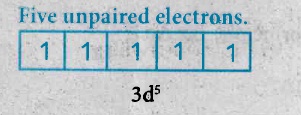
Electronic configuration of mn2+ is 1s2 2s2 2p6 3s2 3p6 4s2 3d5
Five unpaired electrons
Electronic configuration of Ar is 1s2 2s2 2p6 3s2 3p6
no unpaired electrons.
17.
\(\triangle x=?\)
\(\triangle v=?\)
\(\triangle x.\triangle p\ge\frac{h}{4\pi}\)
\(\lambda (m\triangle v)\ge\frac{h}{4\pi}\)
\(\triangle v\ge\frac{h}{4\pi(m\lambda)}\)
\(\triangle \ge\frac{h}{4\pi\times m \times\frac{h}{mv}}\) \(\left[ \because \lambda-={{h}\over{mv}} \right]\)
\(\triangle v \ge \frac{v}{4\pi}\)
therefore, minimum uncertainty in velocity \(=\frac{v}{4\pi}\)
18.
\(\triangle\)x = 0.6\(\mathring{A}\) = 0.6 x 10⁻¹⁰m
\(\triangle p\) = ?
\(\triangle x.\triangle p\ge\frac{h}{4\pi}\)
\(\triangle x.\triangle p\ge5.28\times10^{-35}kgm^{2}s^{-1}\)
\((0.6 \times10^{-10}) \triangle p \ge5.28\times10^{-35}\)
\(\Rightarrow \triangle \ge \frac{5.28\times10^{-35}kgm^{2}s^{-1}}{0.6510^{-1}m}\)
\(\triangle p \ge8.8\times10^{-25}kgms^{-1}\)
19.
v = 2.85 x 10⁸ ms-1
mp = 1.673 x 10⁻²⁷ kg
\(\lambda=\frac{h}{mv}\)
\(=\frac{6.626\times10^{-34}kgm^{2}s^{-1}}{1.673\times10^{-27}kg\times\times2.85\times10^{8}ms^{-1}}\)
\(\lambda=1.389\times10^{-15}\Rightarrow\lambda=1.389\times10^{-15}A\) \([\because \mathring{A}={10}^{-10}m]\)
20.
\({ r_{n} }=\frac{(0.529)n^2}{z}\mathring{A}\ \ { E_{n} }=\frac{-13.6(z)^2}{(n)^2}ev atom^{-1}\)
for Li2+ z = 3
Bohr radius for the third orbit (r3)
= \(\frac { (0.529){ (3) }^{ 2 } }{ 3 } \)
= 0.529\(\times\)3
=1.587 \(\mathring{A}\)
Energy of an electron in the fourth orbit
\(({E}_{6})=\frac { -13.6{ (3) }^{ 2 } }{ { (4) }^{ 2 } } \)
=-7.65eV atom-1
21.
\({ He }^{ + }\longrightarrow { He }^{ 2+ }+{ e }^{ - }\)
\({ E }_{ n }=\frac{-13.6(2)^2}{n^2}\)
\({ E }_{ 1 }=\frac{-13.6(2)^2}{(1)^2}=-54.4\)
\({ E }_{ \infty }=\frac{-13.6(2)^2}{(\infty)^2}=0\)
\(\therefore\) Required Energy for the given process
= E\(\infty\) - EI = 0 - (- 54.4) = 56.4 eV.
22.
\(\triangle x.\triangle p\ge \frac { h }{ 4\pi } \)
\(\triangle x.\triangle p\ge 5.28 \times{ 10 }^{ -35 }Kg{ m }^{ 2 }{ s }^{ -1 }\)
\(\triangle x.(m\triangle v)\ge 5.28 \times{ 10 }^{ -35 }Kg{ m }^{ 2 }{ s }^{ -1 }\)
Given \(\triangle\)v = 0.1%
v = 2.2 x 10⁶ ms-1
m = 9.1 x 10⁻³¹Kg
\(\triangle\)v = \(\frac{0.1}{100}\times2.2\times{10}^{6}ms^{-1}\)
= \(2.2\times{10}^{6}ms^{-1}\)
\(\therefore \triangle x\ge \frac { { 5.28\times 10 }^{ -35 }{ Kgm }^{ 2 }{ s }^{ -1 } }{ 9.1\times { 10 }^{ -31 }Kg\times 2.2\times { 10 }^{ 3 }m{ s }^{ -1 } } \)
\(\\ \triangle x\ge 2.64\times { 10 }^{ -8 }m\)
23.
i) 25Mn - 1s2, 2S2, 2p6, 3s2, 3p6, 4s2, 3d5
23Mn2+ - 1s2, 2S2, 2p6, 3s2, 3p6, 3d5
ii) 24Cr - 1s2, 2S2,2p6, 3s2, 3p6, 4s1, 3d3
21Cr3+ - 1s2, 2S2,2p6, 3s2, 3p6, 3d3
24.
| n | 1 | Sub Energy | m1values | Number of orbitals |
| 4 | 2 | 4d | -2,-1,0,+1,+2 | Five 4d orbitals |
| 5 | 3 | 5f | -3,-2,-1,0,+1,+2,+3, | Seven 5f orbitals |
| 7 | 0 | 7s | 0 | one 7s orbitals |
25.
Erwin Schrodinger expressed the wave nature of electron in terms of a differential equation. This equation determines the change of wave function in space depending on the field of force in which the electron moves. The time independent Schrodinger equation can be expressed as,
\(\overset { \wedge }{ H } \psi =E\psi \) .........(1)
Where \(\overset { \wedge }{ H } \) is called Hamiltonian operator, \(\psi \) is the wave function and is a function of position coordinates of the particle and is denoted as \(\psi \) (x, y, z) E is the energy of the system
\(\overset { \wedge }{ H } =\left[ \frac { { -h }^{ 2 } }{ 8{ \pi }^{ 2 } } \left( \frac { { \partial }^{ 2 }\psi }{ { \partial x }^{ 2 } } +\frac { { \partial }^{ 2 }\psi }{ { \partial y }^{ 2 } } +\frac { { \partial }^{ 2 }\psi }{ { \partial z }^{ 2 } } \right) +V \right] \)
can be written as
\(\left[ \frac { { -h }^{ 2 } }{ 8{ \pi }^{ 2 }m } \left( \frac { { \partial }^{ 2 }\psi }{ { \partial x }^{ 2 } } +\frac { { \partial }^{ 2 }\psi }{ { \partial y }^{ 2 } } +\frac { { \partial }^{ 2 }\psi }{ { \partial z }^{ 2 } } \right) +V\Psi \right] =E\Psi \)
Multiply by \(\frac { 8{ \pi }^{ 2 }m}{ { -h }^{ 2 } } \)and rearranging
\(\frac { { \partial }^{ 2 }\psi }{ { \partial x }^{ 2 } } +\frac { { \partial }^{ 2 }\psi }{ { \partial y }^{ 2 } } +\frac { { \partial }^{ 2 }\psi }{ { \partial z }^{ 2 } } +\frac { 8{ \pi }^{ 2 }m }{ { -h }^{ 2 } } (E-V)\Psi =0\) ........(2)
The above Schrodinger wave equation does not contain time as a variable and is referred to as time independent Schrodinger wave equation. This equation can be solved only for certain values of E, the total energy. i.e. the energy of the system is quantised. The permitted total energy values are called eigenvalues and corresponding wave functions represent the atomic orbitals.
26.
| S.No | n | l | Subshell notation |
| (i) | 1 | 0 | 1s |
| (ii) | 3 | 1 | 3p |
| (iii) | 4 | 2 | 4d |
| (iv) | 4 | 3 | 4f |
27.
(i) n= 2 and 1 =0. The orbital is 2s. Its shape is symmetrically spherical.
(ii) n = 2 and 1 = 1. The orbital is 2p. Its shape is dumbbell.
28.
(i) \({ _{ 30 }^{ 64 }{ Zn } }^{ 2+ }\)
No. of protons = 30
No. of electrons = 30 - 2 = 28
No. of neutrons = 64 - 30 = 34
(ii) 35Cl-
Atomic number = Mass number - No. of neutrons
= 35 - 18 = 17
Atomic number = No. of protons = 17
(iii) Ar
Mass number = No. of protons + No. of neutrons
= 18 + 22 = 40
Atomic number = No. of protons = 18
No. of electrons = No. of protons = 18.
29.
| n | 1 | m | Sub energy level |
| 4 | 2 | 0 | 4d |
| 3 | 1 | 0 | 3p |
| 5 | 1 | any one value -1,0,+1 | 5p |
| 3 | 2 | -2 | 3d |
30.
m = 160 g = 160 x 10-3 kg
\(v=140 km hr^{-1}=\frac{104\times10^{3}}{60\times60}ms^{-1}\)
\(v=38.88ms^{-1}\)
\(\lambda=\frac{h}{mv}\)
\(=\frac{6.626\times^{-34}Kgm^{2}s^{-1}}{160\times10^{-3}Kg\times38.88ms^{-1}}\)
\(\lambda=1.065\times10^{-34}m\)
31.
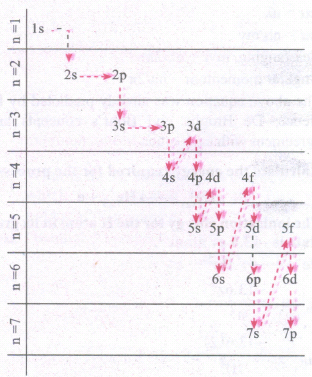
The word Aufbau in German means 'building up'. In the ground state of the atoms, the orbitals are filled in the order of their increasing energies. That is the electrons first occupy the lowest energy orbital available to them.
Once the lower energy orbitals are completely filled, then the electrons enter the next higher energy orbitals. The order of filling of various orbitals as per the Aufbau principle which is in accordance with the (n + l) rule.
32.
The solution to Schrodinger equation gives the permitted total energy values called eigen values and the corresponding wave function represent atomic orbitals.
| Orbital | n | l |
| 3px | 3 | 1 |
| 4dx2-y2 | 4 | 2 |
33.
Statement : "No two electrons in an atom can have the same set of values of all four quantum numbers"
Explanation : It means that, each electron must have unique values for the four quantum numbers (n, l, m and s).
For the lone electron present in hydrogen atom, the four quantum numbers are: n = 1; l = 0; m = 0 and s = +1/2. For the two electrons present in helium, one electron has the quantum numbers same as the electron of hydrogen atom, n = 1.
l = 0, m = 0 and s = +1/2. For other electron, the fourth quantum number is different i.e., n = 1, l = 0, m = 0 and s = -1/2.
As we know that the spin quantum number can have only two values +1/2 and - 1/2, only two electrons can be accommodated in a given orbital in accordance with Pauli exclusion principle.
| Atom | e- | n | l | m | s |
| Helium | First | 1 | 0 | 0 | +1/2 |
| Second | 1 | 0 | 0 | +1/2 |
34.
n = 4 l = 0,1,2,3
4 sub shells s, p, d & f.
I = 0 m1 = 0 + one 4s orbital.
I = 1 m1 = -1, 0, + 1 \(\Rightarrow\) three 4p orbitals.
I = 2 m1 = -2,:1, 0, +1, +2 \(\Rightarrow\) five 4d orbitals.
I = 3 m1 = -3, -2, -1,0, +1, +2, +3 \(\Rightarrow\) seven 4f orbitals.
Over all 16 orbitals are possible.
35.
Given \(\triangle\)v = 5.7 x 10⁵ ms-1. \(\triangle\)x = ?
According to Heisenbergs uncertainty principle \(\Delta x \cdot \Delta p \geq \frac{\mathrm{h}}{4 \pi}\)
\(
\frac{\mathrm{h}}{4 \pi}=\frac{6.626 \times 10^{-34}}{4 \times 3.14} \mathrm{kgm}^{2} \mathrm{~s}^{-1}=5.28 \times 10^{-35}
\)
\(\Delta x \cdot \Delta \mathrm{p} \geq 5.28 \times 10^{-35}
\)
\(\Delta x . \mathrm{m} \Delta \mathrm{v} \geq 5.28 \times 10^{-35}
\)
\(\Rightarrow \Delta x \geq \frac{5.28 \times 10^{-35} \mathrm{kgm}^{2} \mathrm{~s}^{-1}}{9.1 \times 10^{-31} \mathrm{~kg} \times 5.7 \times 10^{5} \mathrm{~ms}^{-1}} \Rightarrow \Delta x \geq 1.017 \times 10^{-10} \mathrm{~m}\)
36.
The reasons are:
(i) Symmetrical distribution: 3d5(half-filled) and 3d10 (completely filled) one more symmetrical and hence more stable.
(ii) Exchange energy: Electrons with parallel spins in degenerate orbitals tend to exchange their positions. As a result, energy is released. This energy is called exchange energy. Greater the exchange energy, greater is the stability.
37.
| Nucleus | Atomic Number (Z) | Mass Number (A) | Number of protons =Z | Number of Neutrons =A-Z |
| \(_{ 6 }^{ 13 }{ C }\) | 6 | 13 | 6 | 13 - 6 = 7 |
| \(_{ 2 }^{ 18 }{ O }\) | 8 | 16 | 8 | 16 - 8 = 8 |
| \(_{ 12}^{ 24}{ Mg }\) | 12 | 24 | 12 | 24 - 12 = 12 |
| \(_{26 }^{ 56}{ Fe }\) | 26 | 56 | 26 | 56 - 26 = 30 |
| \(_{ 88}^{ 38}{ Sr }\) | 38 | 88 | 38 | 88 - 38 = 50 |
38.
\({ E }_{ n }=\frac { -13.6 }{ { n }_{ 2 } } ev{ \quad atom }^{ -1 }\)
n = 3 E3 = \(\frac { -13.6 }{ { 3 }^{ 2 } } =\frac { -13.6 }{ 9 } \)
= -1.51 ev atom-1
n = 4 E4 =\(\frac { -13.6 }{ { 4 }^{ 2 } } =\frac { -13.6 }{ 16 } \)
= -0.85 ev atom-1
\(\triangle \)E = (E4-E3) = (-0.85) - (-1.51) ev atom-1
= (-0.85 + 1.51)
= 0.66 eV atom-1
(1eV = 1.6 x 10⁻¹⁹J)
\(\triangle \)E = 0.66 x 1.6 x 10-19J
\(\triangle \)E = 1.06 x 10⁻¹⁹J
hv = 1.06 x 10⁻¹⁹J
\(\frac { hv }{ \leftthreetimes } \) = 1.06 x 10⁻¹⁹J
\(\therefore\)\( \leftthreetimes\) = \(\frac { hc }{ 1.06\times { 10 }^{ -19 }J } \)
= \(\frac { 6.626\times { 10 }^{ -34 }JS\times 3\times { 10 }^{ 8 }{ ms }^{ -1 } }{ 1.06\times { 10 }^{ -19 }J } \)
\(\lambda=1.875\times10^{-6}m\)
39.
(i) ground state :
| \(\upharpoonleft \) | \(\upharpoonleft \) | \(\upharpoonleft \) | \(\upharpoonleft \) | \(\upharpoonleft \) |
This type of electronic configuration have ten possible arrangements (i.e. Half filled configuration is More).
40.
a) Principal quantum number defines energy and size of an orbital.
b) Azimuthal quantum number defines shape of an orbital
c) Magnetic quantum number defines spatial orientation (direction) of an orbital.
41.
| Orbital | n | 1 | Radial node n-1-1 | Angular node 1 |
| 2s | 2 | 0 | 1 | 0 |
| 4p | 4 | 1 | 2 | 1 |
| 5d | 5 | 2 | 2 | 2 |
| 4f | 4 | 3 | 0 | 3 |
42.
| n | l | m | orbitals | Total number of orbitals |
| 0 | 0 | 1 | (1- 4s +3 - 4p orbital +5 - 4d orbital +7 - 4f orbital) =16 |
|
| 4 | 1 | -1 0 +1 |
3 | |
| 2 |
-2 |
5 | ||
| 3 |
-3 |
7 |

11th Standard Syllabus & Materials
11th Standard
TN 11th Tamil பீடு பெற நில் - செய்யுள் - காவடிச்சிந்து Important Questions And Answers Study Material - QB365 Set A
NEW11th Standard
TN 11th Tamil பீடு பெற நில் - உரைநடை - மலை இடப்பெயர்கள் : ஓர் ஆய்வு Important Questions And Answers Study Material - QB365 Set A
NEW11th Standard
TN 11th Tamil மாமழை போற்றுதும் - துணைப்பாடம் - யானை டாக்டர் Important Questions And Answers Study Material - QB365 Set A
NEW11th Standard
TN 11th Tamil மாமழை போற்றுதும் - செய்யுள் - ஐங்குறுநூறு Important Questions And Answers Study Material - QB365 Set A



Tamilnadu Stateboard 11th Standard Subjects

Maths

Commerce

Economics

Biology

Business Maths and Statistics

Accountancy

Computer Science

Physics
Chemistry
Maths
Biology
Economics
Physics
Chemistry

History
Business Maths and Statistics

Computer Science
Accountancy

Computer Applications
History
Computer Technology
Commerce
Computer Applications
Computer Technology

Tamil

English

French
Tamilnadu Stateboard Standards
