
 100% FREE ACCESS
11th Standard Syllabus & Materials
11th Standard
TN 11th Tamil இயற்கை வேளாண்மை,சுற்றுச்சூழல் -செய்யுள் - மனோன்மணீயம் Important Questions And Answers Study Material - QB365 Set A
NEW11th Standard
TN 11th Tamil என்னுயிர் என்பேன் -துணைப்பாடம் - இசைத்தமிழர் இருவர் Important Questions And Answers Study Material - QB365 Set A
NEW11th Standard
TN 11th Tamil மொழி கலை -செய்யுள் - ஒவ்வொரு புல்லையும் Important Questions And Answers Study Material - QB365 Set A
NEW11th Standard
TN 11th Tamil பீடு பெற நில் - இலக்கணம் - பகுபத உறுப்புகள் Important Questions And Answers Study Material - QB365 Set A
NEW11th Standard
TN 11th Tamil பீடு பெற நில் - துணைப்பாடம் - வாடிவாசல் Important Questions And Answers Study Material - QB365 Set A
NEW11th Standard
TN 11th Tamil பீடு பெற நில் - செய்யுள் - குறுந்தொகை Important Questions And Answers Study Material - QB365 Set A

Published on: 18/02/2019
11th Public Exam March 2019 Model Question
Download Tamil Nadu 11th Standard Chemistry question papers, model tests, one-mark questions, important questions, and public exam papers in PDF format. Free study materials and answer keys for TN State Board students.
Questions + Answers key
Take MCQ Chemistry Test
1.
The oxidation of SO2 and O2 to SO3 is an exothermic reaction. The yield of SO3 will be maximum if ____________
Temperature and pressure both are increased
Temperature decreased, pressure increased
Temperature increased, pressure constant
Temperature and pressure both decreased
2.
Hunsdiecker reaction is used to prepare alkyl chloride and alkyl bromide starting from
diazonium salt
silver salts of carboxylic acid
sodium salt of carboxylic acid
alcohol
3.
Which among the following molecule obeys octet rule?
NO
NO2
N2O3
ClO2
4.
The number of axial hydrogen atoms in chair form of cyclohexane is ______________
3
6
12
2
5.
6.
Which of the following species is not electrophilic in nature ?
Cl+
BH3
H3O+
+NO2
7.
A sample of 0.5g of an organic compound was treated according to Kjeldahl’s method. The ammonia evolved was absorbed in 50mL of 0.5M H2SO4. The remaining acid after neutralisation by ammonia consumed 80mL of 0.5 MNaOH, The percentage of nitrogen in the organic compound is __________
14%
28%
42%
56%
8.
Normality of 1.25M sulphuric acid is ___________
1.25 N
3.75 N
2.5 N
2.25 N
9.
The number of molecules in 40 g of sodium hydroxide is __________
6.023\(\times\)10-23
3.0115\(\times\)1023
6.023\(\times\)1023
2 x 6.023\(\times\)1023
10.
The oxidation state of alkali metal is _______
+2
+1
+3
0
11.
The work done by the liberated gas when 55.85 g of iron (molar mass 55.85 g mol-1) reacts with hydrochloric acid in an open beaker at 25°C _____________
- 2.48 kJ
-2.22 kJ
+2.22 kJ
+ 2.48 kJ
12.
Which is the correct sequence of solubility of carbonates of alkaline earth metals ?
BaCO3 > SrCO3 > CaCO3 > MgCO3
MgCO3 > CaCO3 > SrCO3 > BaCO3
CaCO3 > BaCO3 > SrCO3 > BaCO3
BaCO3 > CaCO3 > SrCO3 > MgCO3
13.
The value of the gas constant R is ____________
0.082 dm3 atm.
0.987 cal mol-1K-1
8.3 J mol-1 K-1
8 erg mol-1 K-1
14.
Two electrons occupying the same orbital are distinguished by ___________
azimuthal quantum number
spin quantum number
magnetic quantum number
orbital quantum number
15.
Ionic hydrides are formed by _____________
halogens
halogens
inert gases
group one elements
16.
Write a note on principle involved in chromatography and explain thin layer chromatography.
17.
Give a detailed account on the different mechanisms followed in elimination reaction.
18.
Discuss the similarities between beryllium and aluminium.
19.
Explain paper chromatography.
20.
The observed depression in freezing point of water for a particular solution is 0.093o C. Calculate the concentration of the solution in molality. Given that molal depression constant for water is 1.86 K Kg mol-1.
21.
The equilibrium constant at 298 K for a reaction is 100.
A + B \(\rightleftharpoons \) C + D
If the initial concentration of all the four species is 1 M, the equilibrium concentration of D (in mol lit-1) will be
22.
(a) How is H2O2 prepared ?
(b) Explain about the structure of H2O2
23.
Calculate the total pressure in a mixture of 8 g of oxygen and 4 g of hydrogen confined in a vessel of 1 dm3 at 27° C. [R = 0.083 bar dm3 K-1 mol-1.]
24.
List the characteristics of Gibbs free energy
25.
Explain displacement reaction ? Explain its two types with an example for each.
26.
Explain the periodic trend of ionisation potential.
27.
Among anthracene and cyclopentadiene which is aromatic? Give reason for your answer.
28.
Suggest and explain the method suitable to purify the organic compounds depending on their boiling points.
29.
Ethane burns completely in air to give CO2, while in a limited supply of air gives CO. The same gases are found in automobile exhaust. Both CO and CO2 are atmospheric pollutants
i) What is the danger associated with these gases
ii) How do the pollutants affect the human body ?
30.
Dissolved oxygen in water is responsible for aquatic life. What processes are responsible for the reduction in dissolved oxygen in water ?
31.
Calculate the amount of water produced by the combustion of 32 g of methane.
32.
Mention the condition for Adiabatic, isothermal, isobaric, isochoric and cyclic process.
33.
What are transfermium elements?
34.
Which of the following gases would you expect to deviate from ideal behaviour under conditions of low temperature F2, Cl2 or Br2? Explain.
35.
Complete the following chemical reactions and classify them into
(a) hydrolysis (b) redox (c) hydration reactions.
(1) KMnO4 + H2O2 ➝
(2) CrCl3 + H2O ➝
(3) CaO + H2O ➝
36.
How does the effect of the process C2 \(\rightarrow\) C2+ + e- affect the bond order ?
37.
How does the addition reaction affect the hybridisation of the substrale ? Give example.
38.
Explain the mechanism of SN1 reaction by highlighting the stereochemistry behind it
39.
What are the anomalies of the long form of periodic table?
40.
Give an expression for the rate of diffusion of a gas and to its molecular weight
41.
The stabilisation of a half filled d - orbital is more pronounced than that of the p-orbital why?
1.
(b)
Temperature decreased, pressure increased
2.
(b)
silver salts of carboxylic acid
3.
(c)
N2O3
4.
(b)
6
5.
(c)
6.
(c)
H3O+
7.
(b)
28%
8.
(c)
2.5 N
9.
(c)
6.023\(\times\)1023
10.
(b)
+1
11.
(a)
- 2.48 kJ
12.
(b)
MgCO3 > CaCO3 > SrCO3 > BaCO3
13.
(c)
8.3 J mol-1 K-1
14.
(b)
spin quantum number
15.
(d)
group one elements
16.
(i) The principle behind chromatography is selective distribution of the mixture of organic substances between two phases - a stationary phase and a moving phase. The stationary phase can be a solid or liquid, while the moving phase is a liquid or a gas. When the stationary phase is a solid, the moving phase is a liquid or a gas. If the stationary phase is solid, the basis is adsorption, and when it is a liquid, the basis is partition. So the chromatography is dened as a technique for the separation of a mixture brought about by differential movement of the individual compound through porous medium under the influence of moving solvent.
(ii) Thin layer chromatography : This method is an another type of adsorption chromatography with this method it is possible to separate even minute quantities of mixtures. A sheet of a glass is coated with a thin layer of adsorbent
(cellulose, silica gel or alumina). This sheet of glass' is called chromoplate or thin layer chromatography plate. After drying the plate, a drop of the mixture is placed just above one edge and the plate is then placed in a closed jar
containing eluent (solvent). The eluent is drawn "up the adsorbent layer by capillary action. The components of the mixture move up along with the eluent to different distances depending upon their degree of adsorption of each component of the mixture. It is expressed in terms of its retention factor (ie) Rf value
\({ R }_{ f }=\frac { Distance\ moved\ by\ the\ substance\ from\ base\ line(x) }{ Distance\ moved\ by\ the\ solvent\ from\ base\ line(y) } \)
The spots of colored compounds are visible on TLC plate due to their original color. The colorless compounds are viewed under uv light or in another method using iodine crystals or by using appropriate reagent.
17.
Elimination reactions may proceed through two different mechanisms namely E1 and E2
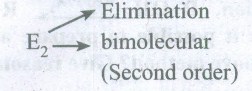
(i) The rate of E2 reaction depends on the concentration of alkyl halide and base Rate = k [alkyl halide] [base]
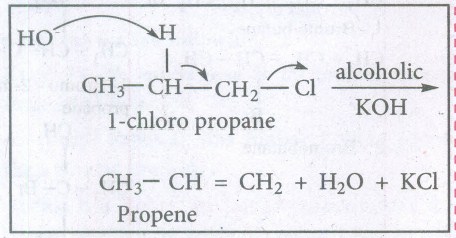
(ii) It is therefore, a second order reaction. Generally primary alkyl halide undergoes this reaction in the presence of alcoholic KOH. It is a one step process in which the abstraction of the proton from the . p carbon and expulsion of halide from the a carbon occur simultaneously. The mechanism is shown below.
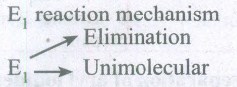
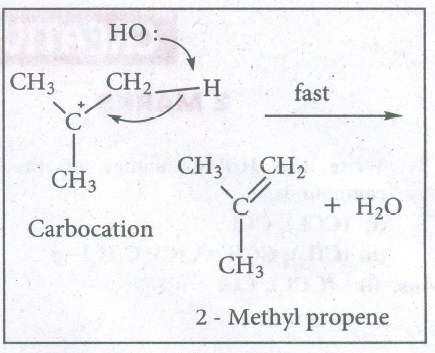
(iii) Generally, tertiary alkyl halide which undergoes elimination reaction by this mechanism in the presence of alcoholic KOH. It follows first order kinetics. Let us. consider the following elimination reaction.
Step - 1: Heterolytic fission to yield a carbocation
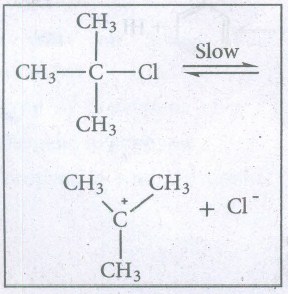
Step - 2 Elimination of a proton from the \(\beta\)- carbon to produce an alkene.
18.
| S.No | Properties |
|---|---|
| 1 | Beryllium chloride forms a dimeric structure like aluminium chloride with chloride bridges. Beryllitrm chloride also forms polymeric chain structure ln addition to dinner. Both are soluble in organic solvents and are strong lewis acids. |
| 2 | Beryllium hydroxide dissolves in excess of alkali and gives beryllate ion [Be(OH)2]2- as aluminium hydroxide which gives aluminate ion, [Al(OH)4]- |
| 3 | Beryllium arid aluminum ions have strong tendency to form complexes,  |
| 4 | Both beryllium and aluminium hydroxides are amphoteric in nature. |
| 5 | Carbides of beryllium (Be2C) like aluminum carbide (Al4C3) give methane on hydrolysis |
| 6 | Both beryllium and aluminium are rendered passive by nitric acid |
19.
Partition Chromatography:
Paper chromatography (PC) is an example of partition chromatography. The same procedure is followed as in thin layer chromatography except that a strip of paper acts as an adsorbent is method involves continues differential portioning of components of a mixture between stationary and mobile phase. In paper chromatography, a special quality paper known as chromatography paper is used. This paper act as a stationary phase.
A strip of chromatographic paper spotted at the base with the solution of the mixture is suspended in a suitable solvent which act as the mobile phase solvent rises up and flows over the spot. The paper selectively retains different components according to their different partition in the two phases where a chromatogram is developed. The spots of the separated colored compounds are visible at different heights from the position of initial spots on the chromatogram. The spots of the separated colorless compounds may be observed either under ultraviolent light or by the use of an appropriate spray reagent.
20.
\(\Delta T_f=0.093^oC=0.093K\)
m = ?
Kf = 1.86K Kg mol-1
\(\Delta T_f=K_f.m\)
\(\therefore m={\Delta T_f\over K_f}\)
\(={0.093K\over 1.86\ K\ Kg\ mol^{-1}}\)
= 0.05 mol Kg-1
= 0.05 m.
21.
Given data:
[A] = [B] = [C]= [D] =1 M
Kc = 100
[D]eq = ?
Solution:
Let x be the no moles of reactants reacted
| A | B | C | D | |
|---|---|---|---|---|
| Initial concentration | 1 | 1 | 1 | 1 |
| At equilibrium (as per reaction stoichiometry) |
1-x | 1-x | 1-x | 1-x |
\(K_c={[C][D]\over [A][B]}\)
\(100={(1+x)(1+x)\over (1-x)(1-x)}\)
\(\sqrt{100}=\sqrt{{(1+x)(1+x)\over (1-x)(1-x)}}\)
\(10={1+x\over 1-x}\)
10(1 - x) = 1 + x
10 - 10x - 1 - x = 0
9 - 11x = 0
11x = 9
\(x={9\over 11}=0.818\)
[D]eq = 1+x = 1 + 0.818 = 1.818M.
22.
(a) Hydrogen peroxide can be made by adding a metal peroxide to dilute acid.
BaO2(s) + H2SO4(aq) ⟶ BaSO4(S) + H2O2(aq)
(b) Structure of H2O2
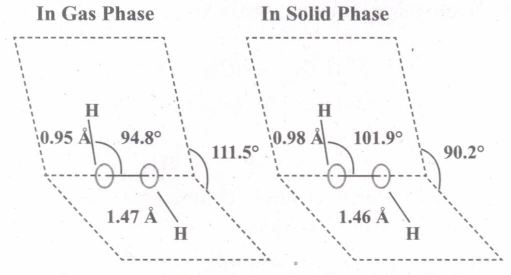
(i) H2O2 has a non-polar structure. The molecular dimensions in the gas phase and solid phase differ as shown in the figure.
(ii) Both in gas phase and solid phase, the H2O2 molecule adopt a skew configuration due to repulsive interaction of the -OH bonds with lone pairs of electrons on each oxygen atom.
(iii) Indeed, it is the smallest molecule known to show hindrance rotation about a single bond. In solid phase, the dihedral angle is sensitive and hydrogen bonding decreasing from 111.5° in the gas phase to 90.2°, in the solid phase.
(iv) Structurally, H2O2 is represented by the dihydroxyl formula in which the two O-H groups do not lie in the same plane. In the solid phase of molecule, the dihedral angle reduces to 90.2° due to hydrogen bonding and the O-O-H angle expands from 94.8° to 101.9°.
(v) One way of explaining the shape of hydrogen peroxide is that the hydrogen atoms would lie on the pages of a partly opened book, and the oxygen atoms along the spin.
23.
Molar mass of O2, = 32 g mol-1
∴ 8 g of O2=\(\frac{8}{32}\)mol = 0.25 mol
molar mass of H2 = 2 g mol-1
∴ 4 g of H2=\(\frac{4}{42}\)mol = 2 mol
Total number of mol (n) = 0.25 + 2 = 2.25
Volume (V) = 1 dm3; Temperature (T) = 27° C = 300K
R = 0.083 bar dm3K-1mol-1
PV = nRT (or) \(P=\frac{nRT}{V}\)
(or) \(P=\frac{(2.25 mol)(0.083 bar dm^{3}K^{-1}mol^{-1})(300 K)}{1 dm^{3}}\)
= 56.025 bar
24.
(i) Free energy is defined as G = H - TS. 'G' is a state function.
(ii) G- Extensive property; ΔG - intensive property. When mass remains constant between initial and final states of system.
(iii) 'G' has a single value for the thermodynamic state of the system.
(iv) G and ΔG values correspond to the system only.
| Process | Spontaneous | Equilibrium | Non-Spontaneous |
| ΔG | -Ve | Zero | +Ve |
(v) Gibbs free energy and the net work done by the system:
For any system at constant pressure and temperature
ΔG = ΔH - TΔS .....(1)
We know that,
ΔH = ΔU + PΔV
ΔG =ΔU + PΔV-TΔS
from first law of thermodynamics
ΔU = q +w
from second law of thermodynamics
Δ S=\(\frac{q}{T}\) Δ G=q+w+PΔ V-T\((\frac{q}{T}) \)
Δ G = w+PΔV
-ΔG = -w - PΔV ......(2)
But -PΔV represents the work done due to expansion against a constant external pressure.
25.
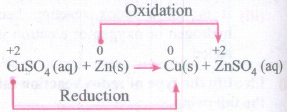
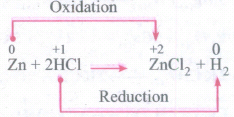
Displacement reaction: Redox reactions in which an ion (or an atom) in a compound is replaced by an ion (or atom) of another element are called displacement reactions. They are further classified into
(i) metal displacement reactions
(ii) non-metal displacement reactions.
(i) Metal displacement reactions :
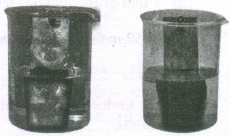
Place a zinc metal strip in an aqueous copper sulphate solution taken in a beaker. Observe the solution, the intensity of the blue colour of the solution slowly reduced and finally disappeared.
The zinc metal strip became coated with brownish metallic copper. This is due to the following metal displacement reaction.
(ii) Non-metal displacement:
26.
Variation along a period: Ionisation energy usually increases along a period. This is due to increase of nuclear charge and decrease in size as we move from left to right in a period.
Periodic variation in group: Ionisation energy decreases down a group. As we move down a group, the valence electron occupies new shells, the distance between the nucleus and the valence electron increases. So, the nuclear forces of attraction on valence electron decreases and hence ionisation energy also decreases down a group.
27.
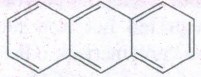
Among anthracene and cyclopentadiene - anthracene is aromatic in nature.
| Anthracene | Cyclopentadiene | |
|---|---|---|
 |
 |
|
| 1. | Planar structure | Planar structure |
| 2. | Contains 14 delocalised \(\pi\) electrons (4n + 2 = 14\(\pi\)e-) | Contains 4 non-delocalised \(\pi\) electrons |
| 3. | Hence aromatic | Hence non-aromatic |
28.
This method is to purify liquids from non-volatile impurities, and used for separating the constituents of a liquid mixture which differ in their boiling points.
There are various methods of distillation depending upon the difference in the boiling points of the constituents. The methods are
(i) simple distillation
(ii) fractional distillation and
(iii) steam distillation.
The process of distillation involves the impure liquid when boiled gives out vapour and the vapour so formed is collected and condensed to give back the pure liquid in the receiver. is method is called simple distillation. Liquids with large difference in boiling point (about 40K) and do not decompose under ordinary pressure can be purified by simply distillation Eg. The mixture of C6H5NO2 (b.p 484K) & C6H6(354K) and mixture of diethyl ether (b.p 308K) and ethyl alcohol (b.p 351K)
29.
(i) (a) Carbon Monoxide:
Carbon monoxide is a poisonous gas produced as a result of incomplete combustion of coal are firewood. It is released into the air mainly by automobile exhaust. It binds with haemoglobin and form carboxy haemoglobin which impairs normal oxygen transport by blood and hence the oxygen carrying capacity of blood is reduced. This oxygen deficiency results in headache, dizziness, tension, Loss of consciousness, blurring of eye sight and cardiac arrest.
(b) Carbon dioxide:
Carbon dioxide is released into the atmosphere mainly by the process of respiration, burning of fossil fuels, forest fire, decomposition of limestone in cement industry etc.Green plants can convert CO2 gas in the atmosphere into carbohydrate and oxygen through a process called photosynthesis. The increased CO2 level in the atmosphere is responsible for global warming. It causes headache and nausea.
ii) a) Carbon Monoxide :
It binds with haemoglobin and form carbory haemoglobin which impairs normal oxygen transport by blood and hence the oxygen carrying capacity of blood is reduced. This oxygen deficiency results in headache, dizziness, tension, Loss of consciousness, blurring of eye sight and cardiac arrest.
b) Carbon dioxide :
It causes headache and nausea.
30.
a) The growth of algae in extreme abundance covers the water surface and reduces the oxygen concentration in water. Thus, bloom-infested water inhibits the growth of other living organisms in the water body. This process in which the nutrient rich water bodies support a dense plant population, kills animal life by depriving it of orygen and results in loss of biodiversity is known as eutrophication.
b) Chemicals from industries
c) Toxic pesticides
d) Detergents and oil floats
e) Acids from mine drianage and salts from various sources.
31.
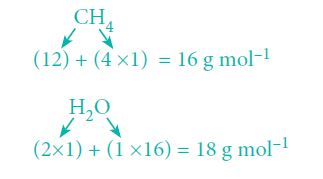
CH4(g) + 2O2 \(\rightarrow\) CO2 + 2H2O
16g (2x18)g
As per stoichiometric equation,
16 g of methane produces 36 g of H2O
\(\therefore\) 32 g of methane will produce = \(\frac { 36 }{ 16 } \times 32=72\) g of water.
32.
| Process | Condition |
|---|---|
| Adiabatic | q=0 |
| Isothermal | dT=0 |
| Isobaric | dP=0 |
| Isochoric | dV=0 |
| Cyclic | dE=0, dH=0, dP=0, dV=0 |
33.
The elements beyond fermium are called as transfermium elements.
34.
The larger the size of the molecule, the greater will be Van der Waals' attraction. Therefore greater the deviation from ideal behaviour. So bromine will deviate more from ideal behaviour because it has bigger atoms.
35.
(i) 2KMnO4 + 3H2O2 ➝ 2MnO2 + 2KOH + 2H2O + 3O2 (Redox reaction)
(ii) CrCl3 + 6H2O ➝ [Cr Cl2 (H2O)CI. 2H2O [Hydration reaction]
(iii) CaO + H2O ➝ Ca(OH)2 (Hydration reaction)
36.
\(C^+_2:(\sigma_{1s})^2(\sigma^*_{1s})^2(\sigma_{2s})^2(\sigma^*_{2s})^2 (\pi_2p_x)^2=(\pi_2p_y)^1\)
Bond order = \({1\over2}(8-4)=2\)
\(C^+_2:(\sigma_{1s})^2(\sigma^*_{1s})^2(\sigma_{2s})^2(\sigma^*_{2s})^2 (\pi_2p_x)^2=(\pi_2p_y)^1\)
Bond order = \({1\over2}(7-4)=1.5\)
\(\therefore\)The Bond order decreases by 1.5 during the process.
37.
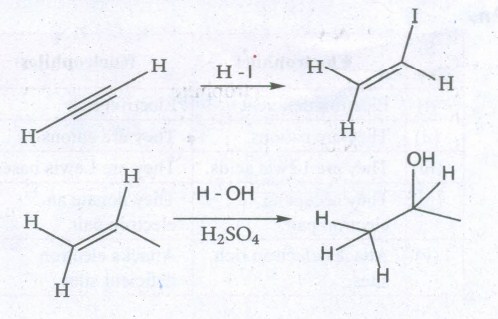
During the addition reaction the hydridisation of the substrate changes (from sp2 ⟶ sp3 in the addition reaction of alkenes or sp ⟶ sp2 in the addition reaction of alkynes) as only one bond breaks and two new bonds are formed.
38.
The rate of the following SN1 reaction depends upon the concentration of alkyl halide (RX) and is independent of the concentration of the nucleophile (OH-).
Hence Rate of the reaction = k [alkyl halide]
SN1 reaction mechanism by taking a reaction between tertiary butyl bromide with aqueous KOH.
\({ CH }_{ 3 }-\overset { \underset { | }{ { CH }_{ 3 } } }{ \underset { \overset { | }{ { CH }_{ 3 } } }{ C } } -Br\overset { { OH }^{ - }(aq) }{ \underset { -Br }{ \longrightarrow } } { CH }_{ 3 }-\overset { \underset { | }{ { CH }_{ 3 } } }{ \underset { \overset { | }{ { CH }_{ 3 } } }{ C } } -OH\)
Tert-Butyl bromide Tert-Butyl alcohol
This reaction takes place in two steps as shown below
Step-1 Formation of carbocation :
The polar C - Br bond breaks forming a carbocation and bromide ion. is step is slow and hence it is the rate determining step
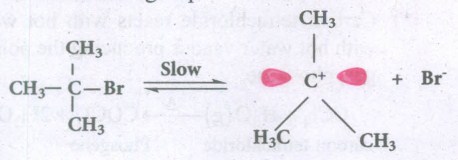
The carbocation has 2 equivalent lobes of the vacant 2p orbital, so it can react equally rapidly from either face
Ste - 2
The nucleophile immediately reacts with the carbocation. This step is fast and hence does not affect the rate of the reactions.
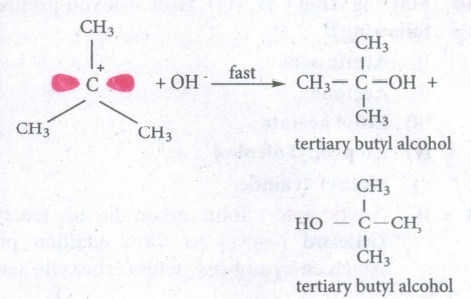
As shown above, the nucleophilic reagent OH- can attack carbocation from both the sides.
39.
The long form of periodic table need clarification about the following:
(i) Position of hydrogen is not defined till now.
(ii) Lanthanides and actinides still find place in the bottom of the table
40.
rate of diffusion \(\propto \frac{1}{\sqrt{M}}\)
41.
Energy electrons symmetry
This is due to the symmetrical distribution and exchange energy of given d- electrons. Symmetry leads to stability.
Exchange energy:
If two or more electrons with the same spin are present in degenerate orbitals, there is a possibility for exchanging their positions. During exchange process, the energy is released and the released energy is called exchange energy. If more number of exchanges are possible, more exchange energy in released. More number of exchanges are possible only in case of half filled and fully filled configurations.
For example, in chromium the electronic configuration is [Ar]3d5 4s1. The 3d orbital is half filled and there are ten possible exchanges as shown in figure. On the other hand only six exchanges are possible for [Ar]3d4 4s2 configuration. Hence, exchange energy for the half filled configuration is more. This increases the stability of half filled 3d orbitals.
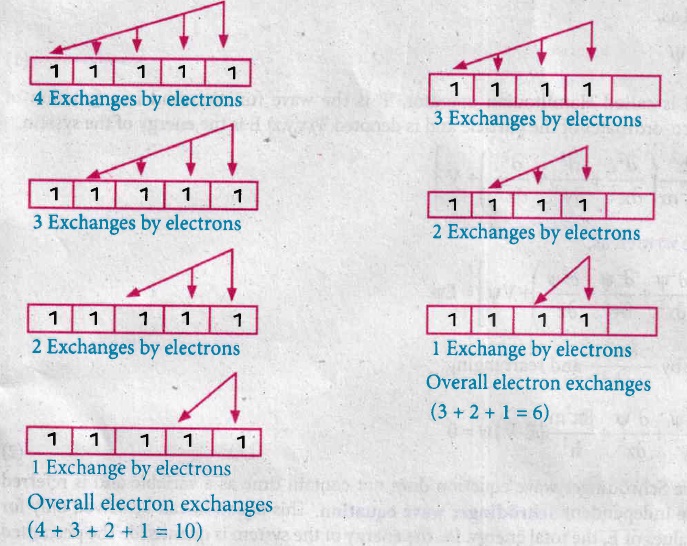
The exchange energy is the basis for Hund's rule, which allows maximum multiplicity, that is electron pairing is possible only when all the degenerate orbitals contain one electron each.

11th Standard Syllabus & Materials
11th Standard
TN 11th Tamil பீடு பெற நில் - செய்யுள் - காவடிச்சிந்து Important Questions And Answers Study Material - QB365 Set A
NEW11th Standard
TN 11th Tamil பீடு பெற நில் - உரைநடை - மலை இடப்பெயர்கள் : ஓர் ஆய்வு Important Questions And Answers Study Material - QB365 Set A
NEW11th Standard
TN 11th Tamil மாமழை போற்றுதும் - துணைப்பாடம் - யானை டாக்டர் Important Questions And Answers Study Material - QB365 Set A
NEW11th Standard
TN 11th Tamil மாமழை போற்றுதும் - செய்யுள் - ஐங்குறுநூறு Important Questions And Answers Study Material - QB365 Set A



Tamilnadu Stateboard 11th Standard Subjects

Maths

Commerce

Economics

Biology

Business Maths and Statistics

Accountancy

Computer Science

Physics
Chemistry
Maths
Biology
Economics
Physics
Chemistry

History
Business Maths and Statistics

Computer Science
Accountancy

Computer Applications
History
Computer Technology
Commerce
Computer Applications
Computer Technology

Tamil

English

French
Tamilnadu Stateboard Standards
