
 100% FREE ACCESS
11th Standard Syllabus & Materials
11th Standard
TN 11th Tamil இயற்கை வேளாண்மை,சுற்றுச்சூழல் -செய்யுள் - மனோன்மணீயம் Important Questions And Answers Study Material - QB365 Set A
NEW11th Standard
TN 11th Tamil என்னுயிர் என்பேன் -துணைப்பாடம் - இசைத்தமிழர் இருவர் Important Questions And Answers Study Material - QB365 Set A
NEW11th Standard
TN 11th Tamil மொழி கலை -செய்யுள் - ஒவ்வொரு புல்லையும் Important Questions And Answers Study Material - QB365 Set A
NEW11th Standard
TN 11th Tamil பீடு பெற நில் - இலக்கணம் - பகுபத உறுப்புகள் Important Questions And Answers Study Material - QB365 Set A
NEW11th Standard
TN 11th Tamil பீடு பெற நில் - துணைப்பாடம் - வாடிவாசல் Important Questions And Answers Study Material - QB365 Set A
NEW11th Standard
TN 11th Tamil பீடு பெற நில் - செய்யுள் - குறுந்தொகை Important Questions And Answers Study Material - QB365 Set A

Published on: 18/02/2019
+1 First Revision Test 2019
Download Tamil Nadu 11th Standard Chemistry question papers, model tests, one-mark questions, important questions, and public exam papers in PDF format. Free study materials and answer keys for TN State Board students.
Questions + Answers key
Take MCQ Chemistry Test
1.
For the reaction \({ CH }_{ 4\left( g \right) }+2O_{ 2\left( g \right) }\rightleftharpoons { CO }_{ 2\left( g \right) }+2{ H }_{ 2 }O_{ \left( l \right) }\) \(\Delta H\) = -170.8 KJ mol-1 which of the following statement is not true?
At equilibrium, the concentration of CO2(g) and H20(l) are not equal
The equilibrium constant for the reaction is given by \({ K }_{ p }=\cfrac { \left[ { CO }_{ 2 } \right] }{ \left[ { CH }_{ 4 } \right] \left[ { O }_{ 2 } \right] } \)
Addition of CH4(g) or 02(g) at equilibrium will cause a shift to the right
The reaction is exothermic.
2.
Identify the correct order of the diatomic species arranged in their increasing order of bond order.
\({ He }_{ 2 }^{ + }<{ O }_{ 2 }^{ - }
\(<{ C }_{ 2 }^{ 2- }<{ He }_{ 2 }^{ + }<{ O }_{ 2 }^{ - }
\(<{ O }_{ 2 }^{ - }
\(NO<{ { O }_{ 2 }^{ - }
3.
In SN1, the rate of the reaction depends on the ______________.
nucleophile
medium
concentration of the substrate
none of the above
4.
In E1, reaction, the intermediate formed is ___________
Carbanion
Carbocation
Carbon free radical
Carbene
5.
Hyper Conjugation is also known as ___________.
no bond resonance
Baker - nathan effect
both (a)and (b)
none of these
6.
Lassaigne’s test for the detection of nitrogen fails in ______________
H2N – CO– NH.NH2.HCl
NH2 – NH2. HCl
C6H5 – NH – NH2. HCl
C6H5 CONH2
7.
The Henry's law constant for the solubility of Nitrogen gas in water at 350 K is 8 x 10⁴ atm. The mole fraction of nitrogen in air is 0.5. The number of moles of Nitrogen from air dissolved in 10 moles of water at 350K and 4 atm pressure is ____________
4 x 10⁻⁴
4 x 10⁴
2 x 10⁻²
2.5 x 10⁻⁴
8.
In the reaction 2AuCl3 + 3SnCl2 \(\rightarrow\) 2Au + 3SnCl4 which is an oxidising agent?
AuCl3
Au
SnCl2
Both AuCl3 and SnCl2
9.
In the modern periodic table, the period indicates the value of____
atomic number
mass number
principal quantum number
azimuthal quantum number
10.
ΔS is expected to be maximum for the reaction ____________
Ca(S)+ 1/2O2(g) ⟶ CaO(S)
C(S) + O2(g) ⟶ CO2(g)
N2(g) + O2(g) ⟶ 2NO(g)
CaCO3(S) ⟶ CaO(S) + CO2(g)
11.
The name 'Blue John' is given to which of the following compounds ?
CaH2
CaF2
Ca2(PO4)2
CaO
12.
What is the maximum numbers of electrons that can be associated with the following set of quantum numbers? n = 3, I = 1 and m =-1
4
6
2
= 10
13.
The value of the gas constant R is ____________
0.082 dm3 atm.
0.987 cal mol-1K-1
8.3 J mol-1 K-1
8 erg mol-1 K-1
14.
Zeolite used to soften hardness of water is hydrated _____________
Sodium aluminium silicate
Calcium aluminium silicate
Zinc aluminium borate
Lithium aluminium hydride
15.
Complete the following reactions:
(i) \(({ CH }_{ 3 }COO)_{ 2 }pb+Na_{ 2 }S\rightarrow ?\)
(ii) \({ Na }_{ 2 }[(Fe(CN)_{ 5 }NO]+{ Na }_{ 2 }S\rightarrow ?\)
(iii) \(NaCNS+FeCI_{ 3 }\rightarrow ?\)
(iv) \(Na_{ 2 }S+AgNO_{ 3 }\rightarrow ?\)
(v) \(BaCI_{ 2 }+{ Na }_{ 2 }{ SO }_{ 4 }\rightarrow ?\)
(vi) \({ Na }_{ 4 }[Fe(CN)_{ 6 }]+{ FeCI }_{ 3 }\rightarrow ?\)
16.
Write a short note on the following.
(i) Aromatisation
(ii) Pyrolysis
17.
On the basis of chemical reactions involved, explain how do CFC’s cause depletion of ozone layer in stratosphere ?
18.
Mention the standards prescribed by BIS for quality of drinking water.
19.
Which alkyl halide from the following pair is
i) chiral
ii) undergoes faster SN2 reaction?
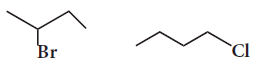
20.
0.24 g of a gas dissolves in 1 L of water at 1.5 atm pressure. Calculate the amount of dissolved gas when the pressure is raised to 6.0 atm at constant temperature.
21.
For a gaseous homogeneous reaction at equilibrium, number of moles of products are greater than the number of moles of reactants. Is KC is larger or smaller than KP.
22.
How much volume of carbon dioxide is produced when 50 g of calcium carbonate is heated completely under standard conditions ?
23.
(a) Under what condition, the heat evolved or absorbed in a reaction is equal to its free energy change?
(b) Calculate the entropy change for the following reversible process.
\(H_2 O \rightleftharpoons H_2O_{I} \) Δfus H is 6 kJ mol-1
24.
Given the formula of the species that will be isoelectronic with the following atoms or ions
(i) Ar
(ii) F-
(iii) K+
(iv) S-2
25.
When the driver of an automobile applies brake, the passengers are pushed toward the front of the car but a helium balloon is pushed toward back of the car. Upon forward acceleration the passengers are pushed toward the front of the car. Why?
26.
What are isotopes? Write the names of isotopes of hydrogen.
27.
Why \(\sigma\) bond is stronger than \(\pi\) bond ?
28.
Classify the following reactions in one of the reaction type studied in this unit.
(i) \(C{ H }_{ 3 }C{ H }_{ 2 }Br+H\overset { - }{ S } \longrightarrow C{ H }_{ 3 }C{ H }_{ 2 }SH+Br\)
(ii) \({ \left( C{ H }_{ 3 } \right) }_{ 2 }C=C{ H }_{ 2 }+HCl\longrightarrow { \left( C{ H }_{ 3 } \right) }_{ 2 }CCl-C{ H }_{ 3 }\)
(iii) \(C{ H }_{ 3 }-C{ H }_{ 2 }Br+H\overset { - }{ O } \longrightarrow C{ H }_{ 2 }=C{ H }_{ 2 }+{ H }_{ 2 }O+Br\)
(iv) \({ \left( { CH }_{ 3 } \right) }_{ 3 }C-C{ H }_{ 2 }OH+HB\longrightarrow { \left( C{ H }_{ 3 } \right) }_{ 2 }CBr-C{ H }_{ 2 }-C{ H }_{ 3 }+{ H }_{ 2 }O\)
29.
How much volume of chlorine is required to prepare 89.6 L of HCI gas at STP?
30.
Account for the difference in size of Na +(95 pm) and Mg+2(65pm) both of which have the same noble gas configuration
31.
State Dalton's law of partial pressure.
32.
Consider the following electronic arrangements for the d5 configuration.
(a)
| \(\upharpoonleft \downharpoonright \) | \(\upharpoonleft \downharpoonright \) | \(\upharpoonleft \) |
(b)
| \(\upharpoonleft \) | \(\upharpoonleft \) | \(\upharpoonleft \) | \(\upharpoonleft \downharpoonright \) |
(c)
| \(\upharpoonleft \) | \(\upharpoonleft \) | \(\upharpoonleft \) | \(\upharpoonleft \) | \(\upharpoonleft \) |
which of these represents the ground state
33.
How would you estimate the percentage of phospherous us in an organic compound?
34.
Answer the following.
(i) Predict the major product formed when HCI is added to iso-butylene,
(ii) What happens when CH3-Br is treated with KCN?
(iii) Identify the chiral molecule in the following pair.
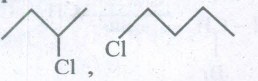
(iv) Arrange the compounds in the order of I reactivity towards SN2 displacement. 2-Bromo-2-methylbutane, I-Bromopentane, 2-Bromo pentane.
35.
Discuss the similarities between beryllium and aluminium.
36.
Explain varions types of constitutional isomerism (structural isomerism) in organic compounds
37.
28 g of Nitrogen and 6 g of hydrogen were mixed in a 1 litre closed container. At equilibrium 17 g NH3 was produced. Calculate the weight of nitrogen, hydrogen at equilibrium.
38.
A compound on analysis gave the following percentage composition: C = 24.47%, H = 4.07 %, CI = 71.65%. Find out its empirical formula.
39.
Which of following flasks has higher pressure
(a) 5.00 L containing 4.15 g of Helium at 298 K
(b) 10.0 L containing 56.2 g Argon at 303 K
40.
Bond angle of water is reduced from 109.28° to 104.5°. Explain.
41.
Write down the Born-Haber cycle for the formation of CaCl2
42.
Explain the following, give appropriate reasons.
(i) Ionisation potential of N is greater than that of O.
(ii) First ionisation potential of C-atom is greater than that of B atom, where as the reverse is true is for second ionisation potential.
(iii) The electron affinity values of Be, Mg and noble gases are zero and those of N (0.02 eV) and P (0.80 eV) are very low.
(iv) The formation of F-(g) from F(g) is exothermic while that of O2-(g) from O (g) is endothermic.
43.
Assertion (A) : Excessive use of chlorinated pesticide causes soil and water pollution.
Reason (R) : Such pesticides are non-biodegradable.
i) Both (A) and R are correct and (R) is the correct explanation of (A)
ii) Both (A) and R are correct and (R) is not the correct explanation of (A)
iii) Both (A) and R are not correct
iv) (A) is correct but( R) is not correct
Both (A) and R are correct and (R) is the correct explanation of (A)
Both (A) and R are correct and (R) is not the correct explanation of (A)
Both (A) and R are not correct
(A) is correct but( R) is not correct
1.
(b)
The equilibrium constant for the reaction is given by \({ K }_{ p }=\cfrac { \left[ { CO }_{ 2 } \right] }{ \left[ { CH }_{ 4 } \right] \left[ { O }_{ 2 } \right] } \)
2.
(a)
\({ He }_{ 2 }^{ + }<{ O }_{ 2 }^{ - }
3.
(c)
concentration of the substrate
4.
(b)
Carbocation
5.
(c)
both (a)and (b)
6.
(c)
C6H5 – NH – NH2. HCl
7.
(d)
2.5 x 10⁻⁴
8.
(a)
AuCl3
9.
(c)
principal quantum number
10.
(d)
CaCO3(S) ⟶ CaO(S) + CO2(g)
11.
(b)
CaF2
12.
(c)
2
13.
(c)
8.3 J mol-1 K-1
14.
(a)
Sodium aluminium silicate
15.
| (i) | \(({ CH }_{ 3 }COO)_{ 2 }pb+Na_{ 2 }S\rightarrow ?\) Lead acetate |
\(PbS\downarrow +2CH_{ 3 }COONa\) Lead Sulphide |
| (ii) | \({ Na }_{ 2 }[(Fe(CN)_{ 5 }NO]+{ Na }_{ 2 }S\rightarrow ?\) Sod.nitro prusside |
\({ Na }_{ 4 }[(Fe(CN)_{ 5 }NOS]\) |
| (iii) | \(NaCNS+FeCI_{ 3 }\rightarrow ?\) | Fe(CNS)3+3NaCI Ferric sulpho cyanide |
| (iv) | \(Na_{ 2 }S+AgNO_{ 3 }\rightarrow ?\) Sodium sulphide silver Nitrate |
\(Ag_{ 2 }S\downarrow +NaNO_{ 3 }\) Silver sulphide |
| (v) | \(BaCI_{ 2 }+{ Na }_{ 2 }{ SO }_{ 4 }\rightarrow ?\) Barium chloride soddium sulphate |
BaSO4+2NaCI Barium sulphate |
| (vi) | \({ Na }_{ 4 }[Fe(CN)_{ 6 }]+{ FeCI }_{ 3 }\rightarrow ?\) Sod. Ferrocyanide Ferric chloride |
\({ Fe }_{ 4 }[Fe(CN)_{ 6 }]_{ 3 }+12NaCI\) Ferric Ferro cyanide |
16.
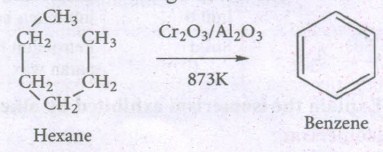
(i) Aromatisation:
Alkanes with six to ten carbon atoms are converted into homologous of benzene at high temperature and in the presence of catalyst. This process is known as aromatization. It occurs by simultaneous cyclisation followed by dehydrogenation of alkanes n-Hexane passed over Cr2O3 supported on alumina at 873 K gives benzene.
(ii) Pyrolysis:
Pyrolysis is dened as the thermal decomposition of organic compound into smaller fragments in the absence of air through the application of heat. 'Pyro' means 'fire' and 'lysis' means 'separating'. Pyrolysis of alkanes also named as cracking.
In the absence of air, when alkane vapours are passed through red-hot metal it breaks down into simpler hydrocarbons.
1) CH3-CH2-CH3
\(\downarrow 773K\)
\({ CH }_{ 3 }-CH={ CH }_{ 2 }+{ CH }_{ 2 }={ CH }_{ 2 }+{ H }_{ 2 }+{ CH }_{ 4 }\)
2) 2CH3-CH3 \(\overset { 773K }{ \longrightarrow } \) CH2 = CH2 + 2CH4
The products depends upon the nature of alkane, temperature, pressure and presence or absence of catalyst. The ease of cracking in alkanes increases with increase in molecular weight and branching in alkanes. Cracking plays an, important role in petroleum industry.
17.
The chloro fluoro derivatives of methane and ethane are referred by trade name Freons. These Chloro Fluoro Carbon compounds are stable, non-toxic, noncorrosive and noninflammable, easily liquefiable and are used in refrigerators, air- conditioners and ln the production of plastic foams. CFC's are the exhaust of supersonic air craft's and jumbo jets in the upper atmosphere. They slowly pass from troposphere to stratosphere. ,They stay for very longer period of 50 - 100 years. In the presence of uv radiation, CFC's break up into chlorine free radical
CF2Cl2 \(\xrightarrow{hv}\) CF2 CI +Cl.
CFCl3 \(\xrightarrow{hv}\)CFCI2+ Cl
Clo+O3 ⟶ C10+O2
Cloo+O ⟶ CI+O2
Chlorine radical is regenerated in the. course of reaction. Due to this continuous attack of Cl0 thinning of ozone layer takes place which leads to formation of ozone hole. It is estimated that for every reactive chlorine atom generated in the stratosphere 1,00,000 molecules of ozone are depleted.
18.
Standard characteristics of drinking water.
| S.No | Characteristics | Desirable limit |
|---|---|---|
| I | Physico-chemical Characteristics | |
| i) | pH | 6.5 to 8.5 |
| ii) | Total Dissolved Solids (TDS) | 500ppm |
| iii) | Total Hardness (as CaCO3) | 300 ppm |
| iv) | Nitrate | 45ppm |
| v) | Chloride | 250ppm |
| vi) | Sulphate | 200ppm |
| vii) | Fluoride | 1 ppm |
| II | Biological Characteristics | |
| i) | Escherichia Coli (E.Coil) | Not at all |
| ii) | Coliforms | Not to exceed 10 (In 100 ml water sample) |
19.
i) chiral molecule:
The chiral molecule is 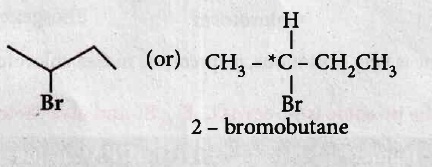
ii) SN2 reaction:
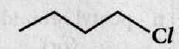 undergoes SN2 reaction faster as it is a primary alkyl halide.
\( \text { (or) } \mathrm{CH}_3-\mathrm{CH}_2-\mathrm{CH}_2-\mathrm{CH}_2-\mathrm{Cl}\\ 1 - chlorobutane\)
20.
Psolute = KH Xsolute in solution
At pressure 1.5 atm,
p1 = KH x1 ------(1)
At pressure 6.0 atm,
p2 = KH x2 -----(2)
Dividing equation (1) by (2)
From equation p1/p2 = x1/x2
1.5/6.0 = 0.24/x2
Therefore x2 = 0.24 x 6.0/1.5 = 0.96 g/L.
21.
\(\Delta n_{g}=\sum n p_{(g)}-\sum n R_{(g)}\)
As \(\Delta n_{p}(g)\) is greater \(\Delta n_{g}=+v e\)
\( \therefore K_{p}=K_{c}(R T)^{+v e} \)
\(\therefore K_{p}>K_{c} \)
So K is smaller than Kp.
22.
The balanced chemical equation is,
\({ CaCO }_{ 3 }\left( s \right) \overset { \triangle }{ \longrightarrow } { CaO }_{ (s) }+{ CO }_{ 2 }(g)\)
As per the stoichiometric equation,
1 mole (100g) CaC03 on heating produces 1 mole CO2
.png)
At STP, 1 mole of CO2 occupies a volume of 22.7 liters
At STP, 50 g of CaCO3 on heating produces,
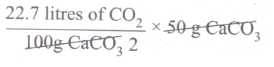
= 11.35 liters of CO2
23.
H2O \(\rightleftharpoons\) H2O(1) \(\triangle_{fus}\) H is 6 kJ mol-1
(a) ΔG=ΔH-TΔS
When the reaction is carried out at 0°K
or ΔS=0
ΔG=ΔH
(b) \(H_2O_{s} \rightleftharpoons H_2O{_{(I)}}\)
\(\Delta_{fus}H= 6\) kJ mol-1
= 6000 kJ mol-1
\(\Delta_{fus}H= 6\) kJ mol-1
= 6000 J mol-1
24.
Iso electronic species are those which have the same number of electrons.
(i) Ar has 18 electrons. Therefore, the species p-3, S-2, Cl-, K+, Ca+2 are isoelectronic with Ar.
(ii) F- has 10 electrons. Therefore the species, N-3, 0-2, Ne, Na+, Mg+2 are isoelectronic with F-
(iii) K+ has 18 electrons. Therefore, the species p-3, S-2, CI-, Ar, Ca+2are isoelectronic with K+
(iv) Sr+2has 36 electrons. Therefore Br-, Kr, Rb+ etc are isoelectronic with Sr+2
25.
The passenger in a moving bus falls in the forward direction, when brakes are applied suddenly is in accordance with Newton's first law of motion.
When breaks are applied, the automobile comes to rest but the passenger due to inertia of motion tend to continue to move in forward direction hence fall forward.
The movement of helium balloon in the opposite direction is due to the difference in the density of surrounding air. When the car stops suddenly, the air moves forward due to inertia of motion.
As a result the air in the front of the car is more dense that at the rear of the car creating more pressure on the front side of the balloon. This causes the balloon move towards the rear of the car where air is less dense.
The body is at rest but the car is forward motion, due to inertia the passengers are pushed toward the front of the car on forward acceleration.
26.
Elements having same atomic number but different mass numbers are called isotopes. These are variant, of an element which differ in neutron numbers, which contain equal number of protons. They differ in relative atomic mass but not in chemical properties.
The isotopes of hydrogen are:
1. Protium \(\left(\mathrm{H}^{1} \text { or } \mathrm{H}\right)\) [Predominant form]
2. Deuterium (or) Heavy hydrogen \(\left({ }_{1} \mathrm{H}^{2} \text { or }{ }_{1} \mathrm{D}^{2}\right)\)
3. Tritium \(\left({ }_{1} \mathrm{H}^{3} \text { or }{ }_{1} \mathrm{T}^{3}\right)\)
27.
\(\sigma\) - bond is formed by the head on overlap of atomic orbital and \(\pi\) - bond is formed by the side-ways overlap.
The head on overlap of sigma bonds accounts for its higher stability, thereby makes it a stronger bond.
28.
(i) Nucleophilic substitution reaction - Br is substituted by H\(\overset { - }{ s } \)
(ii) Electrophilic addition reaction - HCI is added to the C = C bond.
(iii) β-elimination reaction - Hand Br are eliminated from successive carbon atoms.
(iv) Nucleophilic substitution reaction with rearrangement -\(\overset { - }{ O } \)H us substituted by Br.
29.
\(\underset { (1\times 22.4L) }{ { H }_{ { 2 }_{ (g) } } } +\underset { (1\times 22.4L) }{ Cl_{ { 2 }_{ (g) } } } \rightarrow \underset { (2\times 22.4L) }{ 2HCl_{ _{ (g) } } } \)
2 x 22.4 L of HCI is produced by 22.4 L of Cl2.
\(\therefore\) 89.6 L of HCl will be produced by
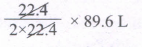
= 44.8 L of chlorine.
30.
The nuclear charge in Mg+2 is more than Na+ and therefore electrons are drawn more closely, and hence size decreases
31.
"The total pressure of a mixture of non-reacting gases is the sum of partial pressures of the gases present in the mixture"
32.
(i) ground state :
| \(\upharpoonleft \) | \(\upharpoonleft \) | \(\upharpoonleft \) | \(\upharpoonleft \) | \(\upharpoonleft \) |
This type of electronic configuration have ten possible arrangement (i.e. Half filled configuration is More).
33.
A known mass of the organic compound (w) containing phosphorus is heated with fuming HNO3 in a sealed tube where C is converted into CO2 and H to H20. Phosphorus present in organic compound is oxidized to phosphoric acid which is precipitated, as ammonium phosphomolybdate by heating with cone. HNO3 and then adding ammonium molybdate.
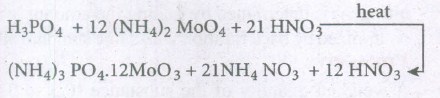
The precipitate of ammonium phosphomolybdate thus formed is filtered washed, dried and weighed. In an alternative method, the phosphoric acid is precipitated as magnesium-ammonium phosphate by adding magnesia mixture (a mixture containing MgCI2, NH4CI and ammonia) This ppt is washed, dried and ignited to get magnesium pyrophosphate which is washed, dried a weighed. The following are
the reaction that takes place. By knowing the mass of the organic compound and the mass of ammonium phosphomolybdate or magnesium pyrophosphate formed, the percentage of P is calculated.
Mass of organic compound is wg
Weight of ammonium phosphomolybdate = xg
Weight of magnesium pyrophosphate = yg
Mole mass of (NH4)3PO4.l2Mo03 is 877g
[3 x(14 + 4) + 31 +4(16)] + 12 (96+3x16)
Molar mass of Mg3P2O7 is 222 g
(2x24) + (31x2) + (7x16)
1877g of (NH4)3PO4.12Mo O3contains 31g of P
xg of(NH4)3PO4.12 MoO3 in w g of organic
compound contains \(\left( \frac { 32 }{ 1877 } \times \frac { x }{ w } \right) \)of phosphorous
Percentage of phosphorous = \(\left( \frac { 32 }{ 1877 } \times \frac { x }{ w } \times 100 \right) \)
(or)
227 of Mg2P2O7 contains 62 g of P
Y g of of Mg2P2O7 in w g of organic compound contains \(\left( \frac { 62 }{ 222 } \times \frac { y }{ w } \right) \)of P.
Percentage Phosphorous= \(\left( \frac { 62 }{ 222 } \times \frac { y }{ w } \times 100 \right) \)
34.
Reaction between iso-butylene and HCI are as follows:
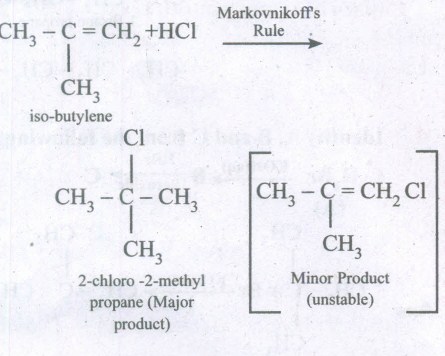
(ii) When CH3- Br is treated with KCN, methyl cyanide is formed.
\(\underset { Methyl\\ Bromide }{ { CH }_{ 3 } } -Br+\underset { Potcyanide }{ KCN } \longrightarrow \underset { Methyl\\ Cyanide }{ { CH }_{ 3 } } -CN+\underset { Pot\\ Bromide }{ KBr } \)
(iii) 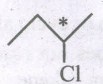 is a chiral molecule, as four atoms attached to *C - atom are different
(iv) 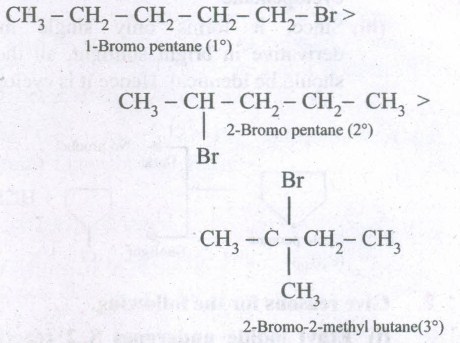
This order is due to steric reasons, the order of reactivity in SN2 follows the order: 1°>2°> s 3°.
35.
| S.No | Properties |
|---|---|
| 1 | Beryllium chloride forms a dimeric structure like aluminium chloride with chloride bridges. Beryllitrm chloride also forms polymeric chain structure ln addition to dinner. Both are soluble in organic solvents and are strong lewis acids. |
| 2 | Beryllium hydroxide dissolves in excess of alkali and gives beryllate ion [Be(OH)2]2- as aluminium hydroxide which gives aluminate ion, [Al(OH)4]- |
| 3 | Beryllium arid aluminum ions have strong tendency to form complexes,  |
| 4 | Both beryllium and aluminium hydroxides are amphoteric in nature. |
| 5 | Carbides of beryllium (Be2C) like aluminum carbide (Al4C3) give methane on hydrolysis |
| 6 | Both beryllium and aluminium are rendered passive by nitric acid |
36.
This type of isomers have same molecular formula. but differ in their bonding sequence. Structural or constitutional isomerism is further classfied into following types.
(a) Chain or nuclear or skeletal isomerism: These isomers differ in the way in which the carbon atoms are bonded to each other in a carbon chain or in other words isomers have similar molecular formula but differ in the nature of the carbon skeleton (ie. Straight or branched)
\({ CH }_{ 3 }-{ CH }_{ 2 }-{ CH }_{ 2 }-CH_{ 2 }-{ CH }_{ 3 }\)
n-Pentane
\(\underset { \underset { CH_{ 3 } }{ | } }{ { CH }_{ 3 }-{ CH }-{ CH }_{ 2 }-{ CH }_{ 3 } } \)
Isopentane 2-methyl butane
(b) Position isomerism:
If different compounds belonging to same homologous series with the same molecular formula and carbon skeleton, but differ in the position of substituent or functional group or an unsaturated linkage are said to exhibit position isomerism.
CH3-CH2-CH2-CH = CH2
Pent-1ene and
CH3-CH2-CH = CH-CH3
pent-2-ene
(c) Functional isomerism: Different compounds having same molecular formula but different functional groups are said to exhibit functional isomerism.
CH3-CH2.CHO
Propanal
(aldehyde group)
\(\overset { \overset { O }{ || } }{ { CH }_{ 3 }-{ CH }-{ CH }_{ 2 }-{ CH }_{ 3 } } \)
Propanone
(Keto group)
(a) Metamerism:This type of isomerism is a special kind of structural isomerism arises due to different alkyl groups attached to . the either side ofthe same functional group and having same molecular formula.
CH3 - O - C3H7
Methyl propyl ether
1-methoxypropane
C2H5-OC2H5
diethyl ether
ethoxyethane
(b) Tautomerism : It is a special type of functional isomerism in which a single compound exists in two readily inter convertible structures that differ markedly in the relative position of atleast one atomic nucleus, generally hydrogen. The two different structures are known as tautomers. There are slveral types of tautomerism and the two important types are dyad and triad systems.
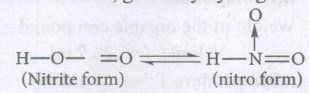
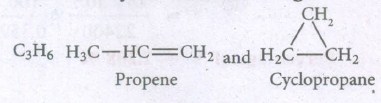
(c) Ring chain isomerism: In this type of isomerism, compounds having same molecular formula but differ in terms of bonding of carbon atom to form open chain and cyclic structures for eg:
37.
Given \(m_{N_2}\) = 28 g \(m_{H_2}\) = 6g
V = 1 L
\((n_{N_2})_{initial}={28\over 28}=1\ mol\)
\((n_{H_2})_{initial}={6\over 2}=3\ mol\)
N2(g) + 3H2(g) ⇌ 2 NH3(g)
| N2(g) | H2(g) | NH3(g) | |
| Initial concentration | 1 | 3 | - |
| Reacted | 0.5 | 1.5 | - |
| Equilibrium concentration | 0.5 | 1.5 | 1 |
\([NH_3]=({17\over 17})=1\ mol=1\ mol\)
Weight of N2 = (no. of moles of N2) × molar mass of N2
= 0.5 x 28 = 14 g
Weight of H2 = (no. of moles of H2) × molar mass of H2
= 1.5 x 2 = 3 g
38.
| Element | Percentage | Atomic mass | Relative No. of atoms | Simple ratio of atoms | Simplest whole number ratio |
|---|---|---|---|---|---|
| C | 24.47% | 12 | \(\frac{24.27}{12}=2.02\) | \(\frac{2.02}{2.02}=1\) | 1 |
| H | 4.07% | 1 | \(\frac{4.07}{1}=4.07\) | \(\frac{4.07}{2.02}=2.01\) | 2 |
| Cl | 71.65% | 35.45 | \(\frac{71.65}{35.45}=2.02\) | \(\frac{2.02}{2.02}=1\) | 1 |
\(\therefore\) The empirical formula = CH2Cl
39.
(a) 5.076 atm
(b) 3.495 atm
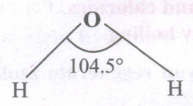
40.
(i) Water molecule undergoes Sp3 hybridization.
(ii) The O - atom in H2O molecule contains two bonding pairs and two lone pairs of electrons.
(iii) The overall arrangement for four electron pairs is tetrahedral but the Ip-Ip repulsions being greater than Ip - bp rep in H2O.
(iv) The HOH angle is reduced to 104.5° than 109°28'.
(v) The molecule has a bent shape.
41.
Born - Haber cycle for the formation of CaCl2
Born - Haber cycle is used to calculate the lattice enthalpy of CaCl2
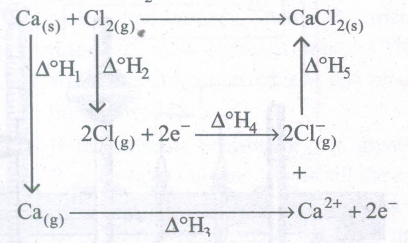
ΔoH1 - Enthalpy change for the sublimation of Ca(s) to Ca(g)
ΔoH2 - Enthalpy change for dissociation of Cl2(g) to 2Cl(g)
ΔoH3 - Ionisation energy for Ca(g) to Ca2+(g)
ΔoH4 - Electron affinity for the conversion of 2Cl(g) to 2Cl-(g)
ΔoH5 - Lattice enthalpy for the formation of solid CaCl2·
ΔoHf =ΔoH1+ΔoH2+ΔoH3+ΔoH4+ΔoH5
42.
(i) Electron configuration of nitrogen
(Z = 7) 1s2 2s2 2p3.
Electron configuration of oxygen
(2= 8) 1s2 2s2 2p4.
Nitrogen has a half filled electronic configuration which is much more stable than an incomplete p-orbital of oxygen which would need to give up one of it's electrons to attain the stability of nitrogen. Hence nitrogen would require more ionization energy to remove an electron from it's outer shell than oxygen.
(ii) Electron configuration of carbon
(Z = 6) 1s22s22p2.
Electron configuration of Boron
(Z = 5) Is22s22p1
The size of a carbon atom is smaller than boron So the valence electron of carbon has greater nuclear charge than that of boron. Hence the first I.E of carbon is greater than that of boron. However, the second ionization enthalpy of boron is higher than that of carbon. This is because after losing electron, Boron has a fully filled orbital (2s2) than carbon (2p1). Fully filled orbitals have more stability than partially filled orbitals so greater amount of energy will be needed to remove an electron from boron. So in this case, the second I.E of boron is higher than that of carbon.
(iii) The electron affinities of Be, Mg and noble gases are almost zero because both Be (Z = 4; 1s22s2) and Mg (Z = 12; Is22s22p63s2) are having s orbital fully filled in their valence shell. Fully filled orbitals are most stable due to symmetry. Therefore, these elements would be having least tendency to accept electron. Hence, Be and Mg would be having zero electron affinity. Whereas N (Z = 7; 1s22s22px12py12pz1 and P (Z = 15) Is2 2s2 2p6 3s2 3p3 is having half filled 2p-subshell. Half filled sub shells are most stable due to symmetry (Hund's rule). Thus, nitrogen and phosphorous are having least tendency to accept electron. Hence, have low electron affinity.
(iv) Fluorine is highly electro negative in nature therefore as it gains the electron its octet become stable and releases the energy so exothermic. while in oxygen the addition of first electron is exothermic in nature but addition of second electron experiences high repulsive force. So needs extra external energy to enter outer shell, hence endothermic in nature.
43.
i) Both (A) and R are correct and (R) is the correct explanation of (A)

11th Standard Syllabus & Materials
11th Standard
TN 11th Tamil பீடு பெற நில் - செய்யுள் - காவடிச்சிந்து Important Questions And Answers Study Material - QB365 Set A
NEW11th Standard
TN 11th Tamil பீடு பெற நில் - உரைநடை - மலை இடப்பெயர்கள் : ஓர் ஆய்வு Important Questions And Answers Study Material - QB365 Set A
NEW11th Standard
TN 11th Tamil மாமழை போற்றுதும் - துணைப்பாடம் - யானை டாக்டர் Important Questions And Answers Study Material - QB365 Set A
NEW11th Standard
TN 11th Tamil மாமழை போற்றுதும் - செய்யுள் - ஐங்குறுநூறு Important Questions And Answers Study Material - QB365 Set A



Tamilnadu Stateboard 11th Standard Subjects

Maths

Commerce

Economics

Biology

Business Maths and Statistics

Accountancy

Computer Science

Physics
Chemistry
Maths
Biology
Economics
Physics
Chemistry

History
Business Maths and Statistics

Computer Science
Accountancy

Computer Applications
History
Computer Technology
Commerce
Computer Applications
Computer Technology

Tamil

English

French
Tamilnadu Stateboard Standards
