
 100% FREE ACCESS
11th Standard Syllabus & Materials
11th Standard
TN 11th Tamil இயற்கை வேளாண்மை,சுற்றுச்சூழல் -செய்யுள் - மனோன்மணீயம் Important Questions And Answers Study Material - QB365 Set A
NEW11th Standard
TN 11th Tamil என்னுயிர் என்பேன் -துணைப்பாடம் - இசைத்தமிழர் இருவர் Important Questions And Answers Study Material - QB365 Set A
NEW11th Standard
TN 11th Tamil மொழி கலை -செய்யுள் - ஒவ்வொரு புல்லையும் Important Questions And Answers Study Material - QB365 Set A
NEW11th Standard
TN 11th Tamil பீடு பெற நில் - இலக்கணம் - பகுபத உறுப்புகள் Important Questions And Answers Study Material - QB365 Set A
NEW11th Standard
TN 11th Tamil பீடு பெற நில் - துணைப்பாடம் - வாடிவாசல் Important Questions And Answers Study Material - QB365 Set A
NEW11th Standard
TN 11th Tamil பீடு பெற நில் - செய்யுள் - குறுந்தொகை Important Questions And Answers Study Material - QB365 Set A

Published on: 25/06/2021
QB365 provides detailed and simple solution for every
Creative Questions in class 11 Chemistry Subject. It will
helps to get more idea about question pattern in every Creative questions with solution.
Download Tamil Nadu 11th Standard Chemistry question papers, model tests, one-mark questions, important questions, and public exam papers in PDF format. Free study materials and answer keys for TN State Board students.
Questions + Answers key
Take MCQ Chemistry Test1.
Explain the different types of substitution reactions or displacement reactions.
2.
Discuss the reason behind the classification of inductive effect into +I and -I effect.
3.
Distinguish between electrophiles and nucleophiles
4.
While writing the resonance structures, what are the rules to be followed ?
5.
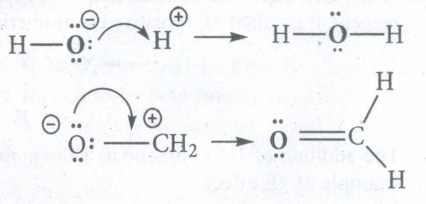
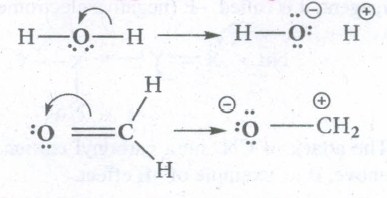
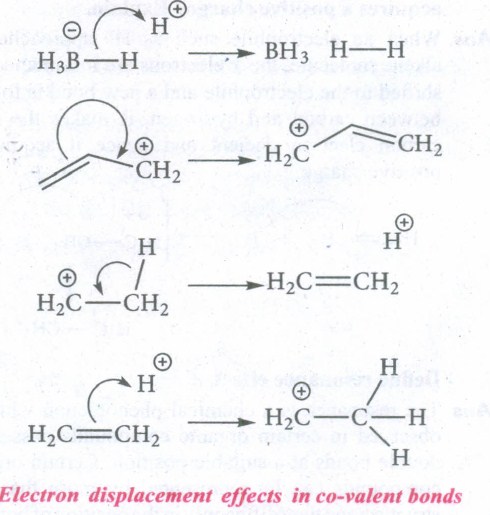
Illustrate with examples, the three types of electron movement in organic reaction.
1.
In this reaction an atom or a group of atoms attached to a carbon atom is replaced by a new atom or a group of atoms. Based on the nature of the attacking reagent, this reactions can be classied as
i) Nucleophilic substitution
ii) Electrophilic substitution
iii) Free radical substitution
(i) Nucleophilic substitution:
This reaction can be represented as
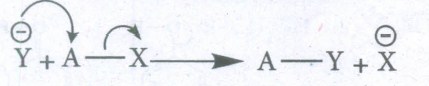
Here Y- is the incoming nucleophile or and attacking species and x- is the leaving group.
Example: Hydrolysis of alkyl halides
\(C{ H }_{ 3 }\overset { aqueous\quad OH }{ \longrightarrow } C{ H }_{ 3 }OH+Br\)
Aliphatic nucleophilic substitution reactions take places either by SN1 or SN2 mechanism.
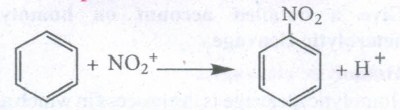
(ii) Electrophilic substitution:

Here Y+ is an electrophile
Example: Nitration of Benzene
(iii) Free radical substitution:
\(A-X+{ Y }^{ . }\longrightarrow A-Y+\overset { . }{ X } \)
\(C{ H }_{ 4 }+\overset { . }{ C } l\longrightarrow \overset { . }{ C } { H }_{ 3 }+HCl\)
Aliphatic electrophilic substitution
A general aliphatic electrophilic substitution is represented as
\(R-X+{ E }^{ \oplus }\longrightarrow R-E+{ X }^{ \oplus }\)
\({ R }_{ 2 }NH+N\overset { + }{ O } \longrightarrow { R }_{ 2 }N-NO+{ H }^{ + }\)
2.
The inductive effect represents the ability of a particular atom or a group to either withdraw or donate electron density to the attached carbon. Based on this ability the substituents are classied as +I groups and -I groups. Their ability to release or withdraw the electron through sigma covalent bond is called +I effect and -I effect respectively.
Higher the electronegativity of the substitutent, greater is the -I effect. The order of the -I effect of some groups are given below.
NH3+ > NO2 > CN > SO3H > CHO
Highly electropositive atoms and atoms are groups which carry a negative charge are electron donating or +I groups.
Example: Alkali metals, alkyl groups such as methyl, ethyl, negatively charged groups such as CH3O-, C2H5O-, COO- etc
Lesser the electronegativity of the elements, greater is the +I effect. The relative order of +I effect of some alkyl groups is given below
-C(CH3)3> - CH(CH3)2 > - CH2CH3 > - CH3
3.
| S.No | Electrophiles | Nucleophiles |
| (i) | Electron deficient | Electron rich |
| (ii) | They are cations. | They are anions |
| (iii) | They are Lewis acids | They are Lewis bases |
| (iv) | They accept an electron pair | They donate an electron pair. |
| (v) | Attacks electron rich sites. | Attacks electron deficient sites. |
| (vi) | They posses an empty orbital to house the lone pair from the nucleophiles. |
They possess a minimum of one lone pair of electron. |
| (vii) | Eg: NO2+, R+, etc | Eg: CN-, RCOO-, etc |
4.
(i) The arrangement of atoms must be identical or almost same in every resonance structure.
(ii) The energy content of all the canomical forms must be almost same.
(iii) Each canocial form must have the same number of unpaired electrons.
5.
There are three types of electron movement viz.,
1. lone pair becomes a bonding pair.
2. bonding pair becomes a lone pair
3. a bond breaks and becomes another bond
Type 1: A lone pair to a bonding pair
Type 2: A bonding pair to a lone pair
Type 3: A bonding pair to an another bonding pair

11th Standard Syllabus & Materials
11th Standard
TN 11th Tamil பீடு பெற நில் - செய்யுள் - காவடிச்சிந்து Important Questions And Answers Study Material - QB365 Set A
NEW11th Standard
TN 11th Tamil பீடு பெற நில் - உரைநடை - மலை இடப்பெயர்கள் : ஓர் ஆய்வு Important Questions And Answers Study Material - QB365 Set A
NEW11th Standard
TN 11th Tamil மாமழை போற்றுதும் - துணைப்பாடம் - யானை டாக்டர் Important Questions And Answers Study Material - QB365 Set A
NEW11th Standard
TN 11th Tamil மாமழை போற்றுதும் - செய்யுள் - ஐங்குறுநூறு Important Questions And Answers Study Material - QB365 Set A



Tamilnadu Stateboard 11th Standard Subjects

Maths

Commerce

Economics

Biology

Business Maths and Statistics

Accountancy

Computer Science

Physics
Chemistry
Maths
Biology
Economics
Physics
Chemistry

History
Business Maths and Statistics

Computer Science
Accountancy

Computer Applications
History
Computer Technology
Commerce
Computer Applications
Computer Technology

Tamil

English

French
Tamilnadu Stateboard Standards



