
 100% FREE ACCESS
11th Standard Syllabus & Materials
11th Standard
TN 11th Tamil இயற்கை வேளாண்மை,சுற்றுச்சூழல் -செய்யுள் - மனோன்மணீயம் Important Questions And Answers Study Material - QB365 Set A
NEW11th Standard
TN 11th Tamil என்னுயிர் என்பேன் -துணைப்பாடம் - இசைத்தமிழர் இருவர் Important Questions And Answers Study Material - QB365 Set A
NEW11th Standard
TN 11th Tamil மொழி கலை -செய்யுள் - ஒவ்வொரு புல்லையும் Important Questions And Answers Study Material - QB365 Set A
NEW11th Standard
TN 11th Tamil பீடு பெற நில் - இலக்கணம் - பகுபத உறுப்புகள் Important Questions And Answers Study Material - QB365 Set A
NEW11th Standard
TN 11th Tamil பீடு பெற நில் - துணைப்பாடம் - வாடிவாசல் Important Questions And Answers Study Material - QB365 Set A
NEW11th Standard
TN 11th Tamil பீடு பெற நில் - செய்யுள் - குறுந்தொகை Important Questions And Answers Study Material - QB365 Set A

Published on: 13/05/2022
QB365 provides detailed and simple solution for every
Creative Questions in class 11 Chemistry Subject. It will
helps to get more idea about question pattern in every Creative questions with solution.
Download Tamil Nadu 11th Standard Chemistry question papers, model tests, one-mark questions, important questions, and public exam papers in PDF format. Free study materials and answer keys for TN State Board students.
Questions + Answers key
Take MCQ Chemistry Test1.
Explain the types of addition reactions ?
2.
How does hyper conjugation effect explain the stability of alkenes ?
3.
How does inductive effect influence the reactivity and acidity of carboxylic acids ?
4.
Explain electron movement in organic reactions.
5.
How is resonance useful in explaining the acidity of phenol ?
1.
Addition reactions are classified into three types. They are,
(i) Electrophilic addition reaction
(ii) Nucleophilic addition reaction
(iii) Free radical addition reaction
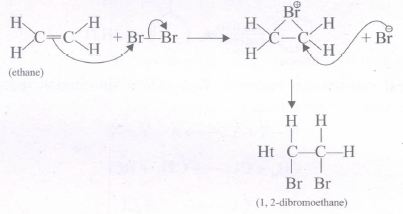
(i) Electrophilic addition reaction: An electrophilic addition reaction can be described as an addition reaction in which a reactant with multiple bonds as in a double or triple bond undergoes has its n bond broken and two new a bond are formed.
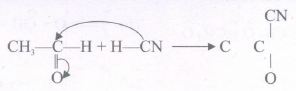
(il) Nucleophilic addition reaction: A nucleophilic addition reaction is an addition reaction where a chemical compound with an electron deficient or electrophilic double or triple bond, a n bond, reacts with a nucleophilic which is an electron rich reactant with the disappearance of the double bond and creation of two new single or a bonds.
(iii) Free radical addition reaction: It is an addition reaction in organic chemistry involving free radicals. The addition may occur between a radical and a non radical or between two radicals.
\({ CH }_{ 2 }={ CH }_{ 2 }+H-Br\overset { Benzoyl\quad peroxide }{ \longrightarrow } { CH }_{ 3 }-{ CH }_{ 2 }-Br\)
2.
(i) The relative stability of various classes of carbonium ions may be explained by the number of no bond resonance structures that can be written for them.
(ii) Such structures are arrived by shifting the bonding electrons from an adjacent C-H bond to the electron deficient carbon.
(iii) In this way, the positive charge originally on carbon is dispersed to the hydrogen. This manner of electron release by assuming no bond character in the adjacent C-H bond is called hyper conjugation or Baker- Nathan effect.
(iv) The greater the hyper conjugation, the greater will be the stability of the compound. The increasing order of stability can be shown as:
\({ CH }_{ 3 }-CH=CH-{ CH }_{ 3 }<{ CH }_{ 3 }-\underset { \overset { | }{ { CH }_{ 3 } } }{ C } =CH-{ CH }_{ 3 }<{ CH }_{ 3 }-\underset { \overset { | }{ { CH }_{ 3 } } }{ C } =\underset { \overset { | }{ { CH }_{ 3 } } }{ C } -{ CH }_{ 3 }\)
(v) Alkyl group increases in the C=C double bond carbon, hyper conjugation increases and stability of that organic compound also increases.
3.
1) Reactivity:
(i) When a highly electronegative atom such as halogen is attached to a carbon then it makes the C-X bond polar.
(ii) In such cases the -I effect of halogen facilitates the attack of an incoming nucleophile at the polarized carbon and hence increases the reactivity.
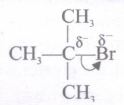
(iii) If a -I group is attacher neared to a carbonyl carbon, it decreases the availability of electron density on the carbonyl carbon and hence increases the rate of the nucleophilic addition reaction.
(2) Acidity of carboxylic acid:
(i) When a halogen atom is attached to the carbon which is neared to the carboxylic acid group, its -I effect withdraws the bonded electrons towards itself and makes the ionization of H+ easy.
(ii) The acidity of various chloro acetic acid is in the following order.
CI3C-COOH > Cl2CHCOOH > CICH2COOH
The strength of the acid increases with increase in the -effect of the group attached to the carboxyl group.
(iii) Similarly the following order of acidity in the carboxylic acids is due to the +1 effect of alkyl group.
(CH3)3FCOOH < (CH3)2CHCOOH < CH3COOH
4.
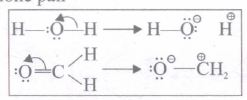
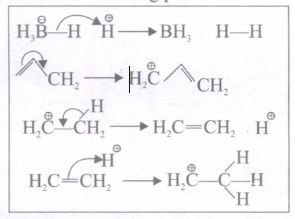
All organic reactions can be understood by following the electron movements.
(i) Lone pair becomes a bonding pair.
(ii) Bonding pair becomes a lone pair.
(iii) A bond breaks and becomes another bond.
The electron movement depends on the nature of the substrate, reagent and the prevailing conditions.
Type 1.A lone pair to a bonding pair
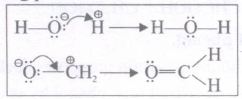
Type 2. A bonding pair to a lone pair
Type 3. A bonding pair to an another bonding pair
5.
(i) Resonance is useful in explaining certain properties such as acidic of phenol.
(ii) The phenoxide ion is more stabilized than phenol by resonance effect.
(iii) The resonance favours ionisation of phenol to form H+ and shows acidity

Phenoxide ion resonance structures
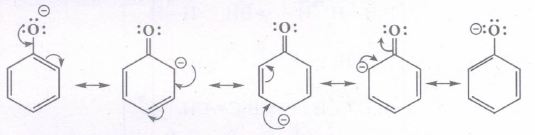
(iv) The above structures shows that there is a charge separation in the resonance structure of phenol which needs energy whereas there is no such hybrid structures in the case of phenoxide ion. This increases stability accounts for the acidic character of phenol.

11th Standard Syllabus & Materials
11th Standard
TN 11th Tamil பீடு பெற நில் - செய்யுள் - காவடிச்சிந்து Important Questions And Answers Study Material - QB365 Set A
NEW11th Standard
TN 11th Tamil பீடு பெற நில் - உரைநடை - மலை இடப்பெயர்கள் : ஓர் ஆய்வு Important Questions And Answers Study Material - QB365 Set A
NEW11th Standard
TN 11th Tamil மாமழை போற்றுதும் - துணைப்பாடம் - யானை டாக்டர் Important Questions And Answers Study Material - QB365 Set A
NEW11th Standard
TN 11th Tamil மாமழை போற்றுதும் - செய்யுள் - ஐங்குறுநூறு Important Questions And Answers Study Material - QB365 Set A



Tamilnadu Stateboard 11th Standard Subjects

Maths

Commerce

Economics

Biology

Business Maths and Statistics

Accountancy

Computer Science

Physics
Chemistry
Maths
Biology
Economics
Physics
Chemistry

History
Business Maths and Statistics

Computer Science
Accountancy

Computer Applications
History
Computer Technology
Commerce
Computer Applications
Computer Technology

Tamil

English

French
Tamilnadu Stateboard Standards



