
 100% FREE ACCESS
11th Standard Syllabus & Materials
11th Standard
TN 11th Tamil இயற்கை வேளாண்மை,சுற்றுச்சூழல் -செய்யுள் - மனோன்மணீயம் Important Questions And Answers Study Material - QB365 Set A
NEW11th Standard
TN 11th Tamil என்னுயிர் என்பேன் -துணைப்பாடம் - இசைத்தமிழர் இருவர் Important Questions And Answers Study Material - QB365 Set A
NEW11th Standard
TN 11th Tamil மொழி கலை -செய்யுள் - ஒவ்வொரு புல்லையும் Important Questions And Answers Study Material - QB365 Set A
NEW11th Standard
TN 11th Tamil பீடு பெற நில் - இலக்கணம் - பகுபத உறுப்புகள் Important Questions And Answers Study Material - QB365 Set A
NEW11th Standard
TN 11th Tamil பீடு பெற நில் - துணைப்பாடம் - வாடிவாசல் Important Questions And Answers Study Material - QB365 Set A
NEW11th Standard
TN 11th Tamil பீடு பெற நில் - செய்யுள் - குறுந்தொகை Important Questions And Answers Study Material - QB365 Set A

Published on: 13/05/2022
QB365 provides detailed and simple solution for every
Creative Questions in class 11 Chemistry Subject. It will
helps to get more idea about question pattern in every Creative questions with solution.
Download Tamil Nadu 11th Standard Chemistry question papers, model tests, one-mark questions, important questions, and public exam papers in PDF format. Free study materials and answer keys for TN State Board students.
Questions + Answers key
Take MCQ Chemistry Test1.
Complete the reactions and identify the products.
(i)
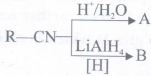
(ii)
\({ CH }_{ 3 }-\underset { \overset { | }{ Cl } }{ C } H-{ CH }_{ 3 }\overset { { H }^{ + }/{ K }_{ 2 }{ Cr }_{ 2 }{ O }_{ 7 } }{ \longrightarrow } A\overset { (O)) }{ \longrightarrow } B\)
2.
An organic compound (A) of a molecular formula C2H4 which is a simple alkene. A reacts with dil H2SO4 to give B. A again reacts with Cl2 to give C. Identify A,B and C and write the equations.
3.
An organic compound (A) has a molecular formula C2H60 it is one of the primary alcohol. A reacts with acidified potassium dichromate to give B. B on further undergoes to oxidation reaction to give C. C on reacts with SOCl2 to give D which is chlorinated product. Identify A,B,C and D, explain with equation.
4.
For the following bond cleavages use curved-arrows to show the electron flow and classify each as homolytic or heterolytic fission. Identify reactive intermediate produced as free radical, carbocation and carbanion ?
(a) \({ CH }_{ 3 }O-O{ CH }_{ 3 }\longrightarrow { CH }_{ 3 }\overset { \bullet }{ O } +{ CH }_{ 3 }\overset { \bullet }{ O } \)
(b)
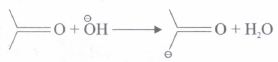
(c)
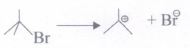
(d)
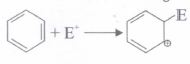
5.
Explain the types of substitution reaction ?
1.
(a)
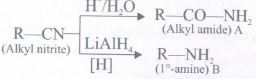
(b)
\(\underset { (isopropyl\quad alcohol) }{ { CH }_{ 3 }COOH } \overset { { H }^{ + }/{ K }_{ 2 }{ Cr }_{ 2 }{ O }_{ 7 } }{ \longrightarrow } { CH }_{ 3 }-\underset { \overset { || }{ O } }{ C } -{ CH }_{ 3 }\overset { (O) }{ \longrightarrow } \underset { (Acentic\quad acid) }{ { CH }_{ 3 }COOH } \)
2.
(i) C2H4 is CH2=CH2 is a simple alkene. A is ethylene.
(ii) Ethylene (A) reacts with dil H2SO4 to give ethanol (B)
\(\underset { Ethylene\\ \quad \quad \quad (A) }{ { CH }_{ 2 }{ CH }_{ 2 } } \overset { dil{ H }_{ 2 }{ SO }_{ 4 } }{ \longrightarrow } \underset { ethanol\\ \quad \quad (B) }{ { CH }_{ 3 }-{ CH }_{ 2 }-OH } \)
(iii) Ethylene (A) reacts with Cl2 to give 1,2 dichloro ethane (C)
\(\underset { (Ethylene)\\ \quad \quad \quad (A) }{ { CH }_{ 2 }={ CH }_{ 2 } } \overset { { cl }_{ 2 } }{ \longrightarrow } \underset { (1,2-dicholoro\quad ethene) }{ \underset { \overset { | }{ Cl } }{ { CH }_{ 2 } } -\underset { \overset { | }{ Cl } }{ { CH }_{ 2 } } } \)
| A | Ethylene | CH2=CH2 |
| B | Ethanol | CH3-CH2-OH |
| C | 1,2-dichloroethane | \(\underset { \overset { | }{ Cl } }{ C } { H }_{ 2 }-\underset { \overset { | }{ Cl } }{ C } { H }_{ 2 }\) |
3.
(i) C2H60 is CH3-CH2-OH which is a primary alcohol (A)
(ii) CH3-CH2-OH (A) reacts with H+/K2Cr2O7 to give acetaldehyde (B)
\(\underset { Acetaldhyde\\ (B) }{ { CH }_{ 3 }CHO } \overset { (o) }{ \longrightarrow } \underset { Acetic\quad acid\\ (c) }{ { CH }_{ 3 }COOH } \)
(iii) CH3CHO (B) which on further oxidation to give acetic acid (C).
\(\underset { Acetic\quad acid\\ (c) }{ { CH }_{ 3 }COOH } \overset { (O) }{ \longrightarrow } \underset { Acetyl\quad chloride\\ (D) }{ { CH }_{ 3 }COCl+{ SO }_{ 2 }+HCl } \)
| A | CH3-CH2-OH | Ethanol |
| B | CH3CHO | Acetaldehyde |
| C | CH3COOH | Acetic acid |
| D | CH3COCl | Acetyl chloride |
4.
(a)

(b)
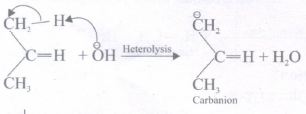
(c)
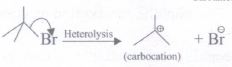
(d)
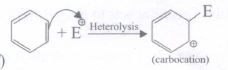
5.
Substitution reactions are classified into three types. They are,
(i) Nucleophilic substitution reaction.
(ii) Electrophilic substitution reaction.
(iii) Free radical substitution reaction.
(i) Nucleophilic substitution reaction: A nucleophilic substitution reaction in organic chemistry is a type of reaction where a nucleophilic gets attached to the positive charged atoms or molecules of the other substance. A good example of a nucleophilic substitution reaction is the hydrolysis of alkyl bromide, under the basic conditions where in the nucleophile is nothing but the base \(\overset { \ominus }{ O } H\), whereas the leaving group is the BrӨ. The reaction for the following is as give below.
\(\underset { (mentyl\quad bromide) }{ { CH }_{ 3 }Br } \overset { aq.\overset { \ominus }{ O } H }{ \longrightarrow } \underset { (methanol) }{ { CH }_{ 3 }OH } +{ Br }^{ \ominus }\)
(ii) Electrophilic substitution reaction: The electrophilic substitution reaction involves the electrophiles. The electrophilic reactions occur mostly with the aromatic compounds. This types of substitution reaction are basically defined as those chemical reactions where the electrophile replaces the functional group in a compound but not the hydrogen atom, sometimes hydrogen atom can be also replaced by electrophiles. For example:
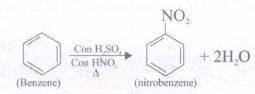
(iii) Free radical substitution reaction: Free radical substitution reaction involving free radicals are a reactive intermediate
\(A-X+\overset { \bullet }{ Y } \longrightarrow A-Y+\overset { \bullet }{ X } \)
\({ CH }_{ 4 }+\overset { \bullet }{ C } l\longrightarrow \overset { \bullet }{ C } { H }_{ 3 }+HCl\)
\(\overset { \bullet }{ C } { H }_{ 3 }+\overset { \bullet }{ C } l\longrightarrow { CH }_{ 3 }Cl\)

11th Standard Syllabus & Materials
11th Standard
TN 11th Tamil பீடு பெற நில் - செய்யுள் - காவடிச்சிந்து Important Questions And Answers Study Material - QB365 Set A
NEW11th Standard
TN 11th Tamil பீடு பெற நில் - உரைநடை - மலை இடப்பெயர்கள் : ஓர் ஆய்வு Important Questions And Answers Study Material - QB365 Set A
NEW11th Standard
TN 11th Tamil மாமழை போற்றுதும் - துணைப்பாடம் - யானை டாக்டர் Important Questions And Answers Study Material - QB365 Set A
NEW11th Standard
TN 11th Tamil மாமழை போற்றுதும் - செய்யுள் - ஐங்குறுநூறு Important Questions And Answers Study Material - QB365 Set A



Tamilnadu Stateboard 11th Standard Subjects

Maths

Commerce

Economics

Biology

Business Maths and Statistics

Accountancy

Computer Science

Physics
Chemistry
Maths
Biology
Economics
Physics
Chemistry

History
Business Maths and Statistics

Computer Science
Accountancy

Computer Applications
History
Computer Technology
Commerce
Computer Applications
Computer Technology

Tamil

English

French
Tamilnadu Stateboard Standards



