
 100% FREE ACCESS
11th Standard Syllabus & Materials
11th Standard
TN 11th Tamil இயற்கை வேளாண்மை,சுற்றுச்சூழல் -செய்யுள் - மனோன்மணீயம் Important Questions And Answers Study Material - QB365 Set A
NEW11th Standard
TN 11th Tamil என்னுயிர் என்பேன் -துணைப்பாடம் - இசைத்தமிழர் இருவர் Important Questions And Answers Study Material - QB365 Set A
NEW11th Standard
TN 11th Tamil மொழி கலை -செய்யுள் - ஒவ்வொரு புல்லையும் Important Questions And Answers Study Material - QB365 Set A
NEW11th Standard
TN 11th Tamil பீடு பெற நில் - இலக்கணம் - பகுபத உறுப்புகள் Important Questions And Answers Study Material - QB365 Set A
NEW11th Standard
TN 11th Tamil பீடு பெற நில் - துணைப்பாடம் - வாடிவாசல் Important Questions And Answers Study Material - QB365 Set A
NEW11th Standard
TN 11th Tamil பீடு பெற நில் - செய்யுள் - குறுந்தொகை Important Questions And Answers Study Material - QB365 Set A

Published on: 13/05/2022
QB365 provides detailed and simple solution for every Book back Questions in class 11 Chemistry Subject. It will helps to get more idea about question pattern in every book back questions with solution.
latest Book back QuestionsDownload Tamil Nadu 11th Standard Chemistry question papers, model tests, one-mark questions, important questions, and public exam papers in PDF format. Free study materials and answer keys for TN State Board students.
Questions + Answers key
Take MCQ Chemistry Test1.
What are degradable and nondegradable pollutants ?
2.
What is a pi bond ?
3.
If there is no change in concentration, why is the equilibrium state considered dynamic?
4.
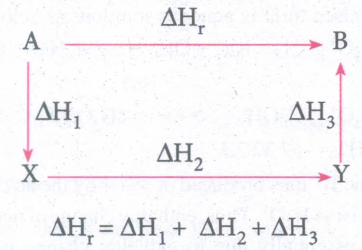
Define Hess's law of constant heat summation.
5.
How many orbitals are possible for n = 4?
6.
Give the mathematical expression that relates gas volume and moles.
7.
What do you understand by the term mole?
8.
Is the definition given below for ionisation enthalpy correct?
"Ionisation enthalpy is defined as the energy required to remove the most loosely bound electron from the valence shell of an atom."
9.
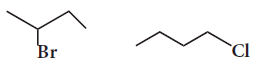
Which alkyl halide from the following pair is
i) chiral
ii) undergoes faster SN2 reaction?
10.
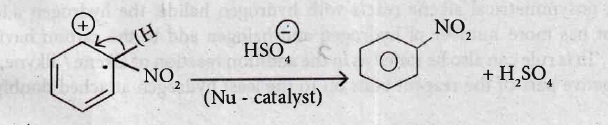
Describe the mechanism of Nitration of benzene.
11.
What are electrophiles and nucleophiles ? Give suitable examples for each.
12.
Substantiate lithium fluoride has the lowest solubility among group one metal fluorides.
13.
Predict which of the following hydrides is a gas on a solid
(a) HCl
(b) NaH
Give your reason.
14.
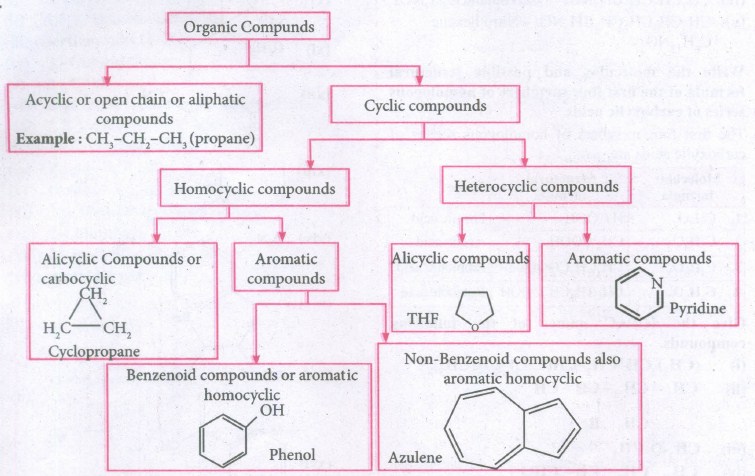
Describe the classification of organic compounds based on their structure.
1.
i. Bio-degradable pollutants :
The pollutants which can be easily decomposed by the natural biological processes are called bio-degradable pollutants.
Examples: plant wastes, animal wastes, etc.
ii. Non bio-degradable pollutants :
The pollutants which cannot be decomposed by the natural biological processes are called Non bio-degradable pollutants.
Examples : metal wastes (mainly Hg and Pb), D.D.T, plastics, nuclear wastes, etc., These pollutants are harmful to living organisms even in low concentration. As they are not degraded naturally,it is difficult to eliminate them from our environment.
2.
When two atomic orbitals overlaps sideways, the resultant covalent bond is called a pi (\(\pi\)) bond.
3.
This condition is not static and is dynamic, because both the forward and reverse reactions are still occurring with the same rate. No macroscopic change is observed.
4.
The enthalpy change of a reaction either at constant volume or constant pressure is the same whether it takes place in a single or multiple steps provided the initial and final states are same.
5.
| n | l | m | orbitals | Total number of orbitals |
| 0 | 0 | 1 | (1- 4s +3 - 4p orbital +5 - 4d orbital +7 - 4f orbital) =16 |
|
| 4 | 1 | -1 0 +1 |
3 | |
| 2 |
-2 |
5 | ||
| 3 |
-3 |
7 |
6.
According to Avogadro's hypothesis: V \(\alpha\) n
\(\therefore \frac{V_{1}}{n_{1}}=\frac{V_{2}}{n_{2}}=\text { constant }\)
V1 & n2 are the volume and number of moles of a gas and V2 & n2 are a different set of values of volume and number of moles of the same gas at same temperature and pressure.
7.
One mole is the amount of substance of a system, which contains as many elementary particles as there are atoms in 12 g of carbon-12 isotope.
8.
No the above definition is incorrect. The correct definition is Ionization energy is defined as the minimum amount of energy required to remove the most loosely bound electron from the valence shell of the isolated neutral gaseous atom in its ground state.
9.
i) chiral molecule:
The chiral molecule is 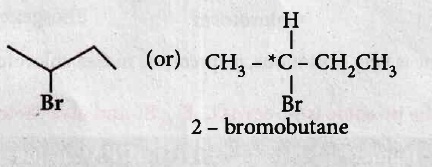
ii) SN2 reaction:
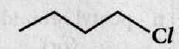 undergoes SN2 reaction faster as it is a primary alkyl halide.
\( \text { (or) } \mathrm{CH}_3-\mathrm{CH}_2-\mathrm{CH}_2-\mathrm{CH}_2-\mathrm{Cl}\\ 1 - chlorobutane\)
10.
Benzene undergoes nitration reaction becasuse it is an elecron - rich system due to delocalised \(\pi\) electron. So it is easily attacked by electrophiles and gives substituted products.

Mechanism:
Step - I : Formafion of the electrophile:

Step - II : Formation of carbocation intermediate:
The electrophile attacks the aromatic ring to form a carbocation intermediate which is stabilised by resonance.

Step - III: Formation of nitro benzene:
The electrophile attacks the artomatic ring to fo
11.
a) Electrophiles:
Electrophiles are reagents that are attracted towards negative charge or electron rich center. They are either positively charged ions or electron deficient neutral molecules. All Lewis acids act as electrophiles.
Neutral molecules like SnCl4 can also act as an electrophile, as it has vacant d-orbitals which can accommodate the electrons from others.
| Types | Examples | Electron deficiententity |
| Neutral electrophiles | Carbon dioxide (CO2), dichlorocarbene (CCl2) |
C |
| Aluminium chloride (AlCl3), boron trifluoride (BF3) and ferric chloride (FeCI3) | Metal (M) | |
| Positively charged electrophiles | Carbocations(R+) | C+ |
| Proton (H+) | H+ | |
| Alkyl halides (RX) | X+ | |
| Oxonium ion (H3O+) and nitrosonium ion (NO+) | O+ | |
| Nitronium ion (+NO2) | N+ |
b) Nucleophiles:
Nucleophiles are reagents that has high affinity for electro positive centers. They possess an atom has an unshared pair of electrons, and hence it is in search for an electro positive centre where it can have an opportunity to share its elections to form a covalent bond, and gets stabilised.
They are usually negatively charged ions or electron rich neutral molecules (contains one or more lone pair of electrons). AII Lewis bases act as nucleophiles.
| Types | Examples | Electron rich site |
| Neutral molecules having unshared pair of electron | Ammonia (NH3) and amines (RNH2) | N: |
| Water (H2O), alcohols(ROH) and ethers (R - O- R) |
:O: | |
| Hydrogen sulphide (H2S) and thiols (RSH) |
:S: | |
| Negatively, charged nucleophiles | Chlorides (Cl-), bromides (Br-) and iodides (I-) |
X- |
| Hydroxide ( HO-), alkoxide (RO-) and Carboxlate ions (RCOO-) |
O- | |
| Cyanide (CN-) | N- |
12.
The lattice energy of LiF is higher due to the smaller size of Li+ and F-. So LiF has lower solubility.
13.
a) HCl is a gas. It is an electron rich covalent hydride. It is a covalent molecule with strong covalent bond. However the forces between the molecules are not as strong.
b) NaH is a solid. It is an ionic hydride of group I sodium metal. It is an insoluble hydride
14.

11th Standard Syllabus & Materials
11th Standard
TN 11th Tamil பீடு பெற நில் - செய்யுள் - காவடிச்சிந்து Important Questions And Answers Study Material - QB365 Set A
NEW11th Standard
TN 11th Tamil பீடு பெற நில் - உரைநடை - மலை இடப்பெயர்கள் : ஓர் ஆய்வு Important Questions And Answers Study Material - QB365 Set A
NEW11th Standard
TN 11th Tamil மாமழை போற்றுதும் - துணைப்பாடம் - யானை டாக்டர் Important Questions And Answers Study Material - QB365 Set A
NEW11th Standard
TN 11th Tamil மாமழை போற்றுதும் - செய்யுள் - ஐங்குறுநூறு Important Questions And Answers Study Material - QB365 Set A



Tamilnadu Stateboard 11th Standard Subjects

Maths

Commerce

Economics

Biology

Business Maths and Statistics

Accountancy

Computer Science

Physics
Chemistry
Maths
Biology
Economics
Physics
Chemistry

History
Business Maths and Statistics

Computer Science
Accountancy

Computer Applications
History
Computer Technology
Commerce
Computer Applications
Computer Technology

Tamil

English

French
Tamilnadu Stateboard Standards



