
 100% FREE ACCESS
11th Standard Syllabus & Materials
11th Standard
TN 11th Tamil இயற்கை வேளாண்மை,சுற்றுச்சூழல் -செய்யுள் - மனோன்மணீயம் Important Questions And Answers Study Material - QB365 Set A
NEW11th Standard
TN 11th Tamil என்னுயிர் என்பேன் -துணைப்பாடம் - இசைத்தமிழர் இருவர் Important Questions And Answers Study Material - QB365 Set A
NEW11th Standard
TN 11th Tamil மொழி கலை -செய்யுள் - ஒவ்வொரு புல்லையும் Important Questions And Answers Study Material - QB365 Set A
NEW11th Standard
TN 11th Tamil பீடு பெற நில் - இலக்கணம் - பகுபத உறுப்புகள் Important Questions And Answers Study Material - QB365 Set A
NEW11th Standard
TN 11th Tamil பீடு பெற நில் - துணைப்பாடம் - வாடிவாசல் Important Questions And Answers Study Material - QB365 Set A
NEW11th Standard
TN 11th Tamil பீடு பெற நில் - செய்யுள் - குறுந்தொகை Important Questions And Answers Study Material - QB365 Set A

Published on: 08/06/2021
QB365 provides detailed and simple solution for every Book back Questions in class 11 Chemistry Subject. It will helps to get more idea about question pattern in every book back questions with solution.
Download Tamil Nadu 11th Standard Chemistry question papers, model tests, one-mark questions, important questions, and public exam papers in PDF format. Free study materials and answer keys for TN State Board students.
Questions + Answers key
Take MCQ Chemistry Test1.
What is green chemistry ?
2.
Explain the preparation of the following compounds
i) DDT
ii) Chloroform
iii) Biphenyl
iv) Chloropicrin
v) Freon-12
3.
Complete the following :
i) 2 – butyne \(\overset { Lindlar\quad Catalyst }{ \longrightarrow } \)
ii) CH2 = CH2 \(\overset { { I }_{ 2 } }{ \longrightarrow } \)
iii) \(\underset { \overset { | }{ Br } }{ { CH }_{ 2 } } -\underset { \overset { | }{ Br } }{ { CH }_{ 2 } } \overset { Zn/{ C }_{ 2 }{ H }_{ 5 }OH }{ \longrightarrow } \)
iv) \({ CaC }_{ 2 }\overset { { H }_{ 2 }O }{ \longrightarrow } \)
4.
State the third law of thermodynamics.
5.
How would you explain the fact that the second ionisation potential is always higher than first ionisation potential?
6.
The ammonia evolved form 0.20 g of an organic compound by kjeldahl method neutralised 15ml of N/20 sulphare acid solution. Calculate the percentage of Nitrogen.
7.
An atom of an element contains 35 electrons and 45 neutrons. Deduce
(i) the number of protons
(ii) the electronic configuration for the element
(iii) All the four quantum numbers for the last electron
8.
Why do astronauts have to wear protective suits when they are on the surface of moon?
9.
NH3 has exceptionally high melting point and boiling point as compared to those of the hydrides of the remaining elements of group 15. Explain.
10.
Explain electromeric effect.
11.
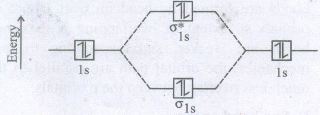
Hydrogen gas is diatomic where as inert gases are monoatomic – explain on the basis of MO theory.
12.
Which solution has the lower freening point ? 10 g of methanol (CH3OH) in 100 g of water (or) 20 g of ethanol (C2H5OH) in 200 g of water.
13.
State Le-Chatelier principle.
14.
How is plaster of paris prepared ?
15.
Which contains the greatest number of moles of oxygen atoms
i) 1 mol of ethanol
ii) 1 mol of formic acid
iii) 1 mol of H2O
1.
(i) Green chemistry is a chemical philosophy encouraging the design of products and Processes that reduce or eliminate the use and generation of hazardous substances.
(ii) For this, scientist are trying to develop methods to produce eco-friendly compounds. This can be best understood by considering the following example in which styrene is produced both by traditional and greener routes. To avoid carcinogenic benzene, greener route is to start with cheaper and environmentally safer xylenes.
(iii) Green chemistry means science of environmentally favourable chemical synthesis.
2.
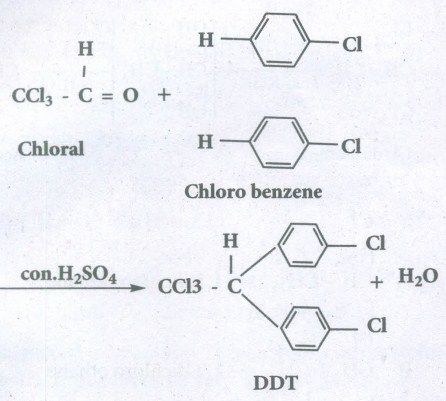
i) DDT: DDT can be prepared by heating a mixture of chlorobenzene with chloral (Trichloro acetaldehyde) in the presence of con. H2SO4,
ii) Chloroform :The reaction of methane with excess of chlorine in the presence of sunlight will give carbon tetrachloride as the major product.
\(\underset { Methane }{ { CH }_{ 4 }+4C{ l }_{ 2 }\overset { h\gamma }{ \longrightarrow } } +\underset { Carbon \ tetrachloride }{ 4HCl } \)
iii) Bipheenyl :
\(\underset { Chlorobenzene }{ { C }_{ 6 }{ H }_{ 5 }Cl } +2Na+Cl-{ C }_{ 6 }{ H }_{ 5 }\overset { Ether }{ \longrightarrow } \underset { Biphenyl }{ { C }_{ 6 }{ H }_{ 5 }-{ C }_{ 6 }{ H }_{ 5 }+2NaCl } \)
iv) Chloropicrin : Chloroform reacts with nitric acid to form chloropicrin.(Trichloro nitro methane)
\(\underset { Chloroform }{ { CH }_{ 3 }+HN{ O }_{ 3 }\overset { \triangle }{ \longrightarrow } } \underset { Chloropicrin }{ C{ Cl }_{ 3 }N{ O }_{ 2 }+{ H }_{ 2 }O } \)
v) Freon-12 :Freon - 12 is prepared by the action of hydrogen fluoride on carbon tetrachloride in . the presence of catalylic amount of antimony pentachloride. is is called swartz reaction
\(\underset { Carbontetrachloridew }{ { CCl }_{ 3 }+2HF\overset { SbC{ l }_{ 5 } }{ \longrightarrow } } \underset { Freon-12 }{ 2HC{ l }+CCl_{ 2 }F_{ 2 } } \)
3.
(i) CH3 - C\(\equiv \)C - CH3 + H2 \(\overset { Lindlas }{ \underset { Catalyst }{ \longrightarrow } } \)CH3 - CH = CH - CH3
2 - Butyne 2 - Butene
Lindlar catalyst consist of pd deposited on CaCO3 and then poisoned by lead on sulphur.
(ii) CH2 = CH2 \(\overset { { I }_{ 2 } }{ \longrightarrow } \)\(\left[ \underset { \underset { I }{ | } }{ { CH }_{ 2 } } -\underset { \overset { | }{ I } }{ { CH }_{ 2 } } \right] \)\(\overset { { I }_{ 2 } }{ \longrightarrow } \) CH2 = CH2
ethene
(iii) \(\underset { \overset { | }{ \underset { 1,2- }{ Br } } }{ { CH }_{ 2 } } -\underset { \overset { | }{ \underset { Dibromoethane }{ Br } } }{ { CH }_{ 2 } } \overset { Zn/{ C }_{ 2 }{ H }_{ 5 }OH }{ \longrightarrow } \underset { \overset { | }{ Br } }{ { CH }_{ 2 } } -\underset { \underset { ethene }{ \overset { \downarrow }{ { CH }_{ 2 }={ CH }_{ 2 }+Zn{ Br }_{ 2 } } } }{ CH.ZnBr } \)
(iv) CaC2 \(\overset { { H }_{ 2 }O }{ \rightarrow } \)CH \(\equiv \) CH + Ca(OH)2
Calcium Carbride Ethyne
4.
(i) The third law of thermodynamics states that the entropy of pure crystalline substance at absolute zero is zero.
(ii) It can also be stated as it is impossible to lower the temperature of an object to absolute zero in a finite number of steps
(iii) Mathematically, \(\lim _{ T\rightarrow 0 }{ S=0 } \) for a perfectly ordered crystalline state.
5.
The total number of electrons are less in the cation than the neutral atom while the nuclear charge remains the same. Therefore the effective nuclear charge of the cation is higher than the corresponding neutral atom. Thus the successive ionisation energies, always increase in the following order
IE1 < IE2 < IE3 < .....
6.
w = 0.2 g ,N = 1/20 N, v = 15 ml
\(\mathrm{V}=15 \mathrm{ml} \% \mathrm{~N}=\frac{1.4 \mathrm{NV}}{\mathrm{W}}=\frac{1.4 \times 1 / 20^{\times 15}}{0.2}=5.25 \%\)
7.
(i) no. of electrons: 35 (given)
no. of protons : 35
(ii) Electronic configuration
1s2 2S2 2p6 3s2 3p6 4s2 3d10 4p5
(iii) Last electron:
| \(\downharpoonleft\upharpoonright\) | \(\upharpoonleft\downharpoonright\) | \(\upharpoonleft\) |
4Px 4Py 4pz
last electron present in 4Py orbital y
n = 4, l = 1 m1 = either + 1 or -1 and s = -1/2
8.
Astronauts must wear space suits filled with air, whenever they leave a spacecraft and are exposed to the environment of space.
Dangers experienced on moon's space :
1. In space there is no air to breathe and no air pressure.
2. Space is extremely cold and filled with dangerous radiations.
3. If they do not wear space suits, there may be bleeding due to high body pressure.
4. The space suits prevent astronauts from impacts of small bits of space dust.
5. There is no atmosphere on the moon and there are dangers from micro-meteorite impacts.
6. The astronauts are protected from these dangers on wearing space suits.
9.
(i) Due to small size of Nitrogen atom.
(ii) Due to polar nature of N-H bond.
(iii) Due to intermolecular H-bonding which is stronger than London forces present in other hydrides. Other hydrides lack H-bonding
10.
Electromeric is a temporary effect which operates in unsaturated compounds (containing >C = C <, > C = O, etc...) in the presence of an attacking reagent.
Let us consider two different compounds
(i) Compounds containing carbonyl group (> C = O) and
(ii) Unsaturated compounds such as alkenes (> C = C <).
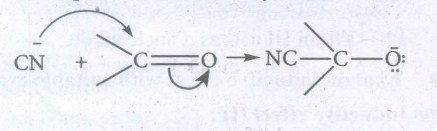
When a nucleophile approaches the carbonyl compound, the \(\pi\) electrons between C and O is instantaneously shifted to the more electronegative oxygen. This makes the carbon electron deficient and thus facilitating the formation of a new bond between the incoming nucleophile and the carbonyl carbon atom.
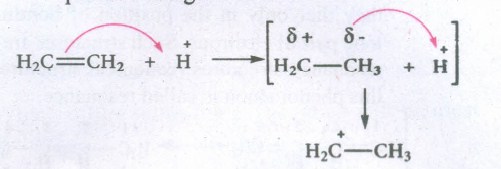
On the other hand When an electrophile such as H+ approaches an alkene molecule, the π electrons are instantaneously shified to the electrophile and a new bond is formed between carbon and hydrogen. is makes the other carbon electron decient and hence it acquires a positive charge.
The electromeric effect, is denoted as E effect. Like the inductive effect, the electromeric effect is also classified as +E and -E based on the direction in which the pair of electron is transfered to form a new bond with the attacking agent.
When the π electron is transfer red towards the attacking reagent, it is called + E (positive electromeric) effect.
The addition of H+ to alkene as shown above is an example of +E effect.
When the π electron is transfered away from the attacking reagent, it is called, -E (negativc electromeric) effect.
The attack of CN- on a carbonyl carbon, as shown above, is an example of -E effect.
11.
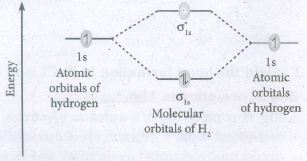
H2 molecule :
Electronic configuration of H atom 1s1
Electronic configuration of H2 molecule \(\sigma^{2}_{1s}\)
Bond order = \({N_b-N_a\over2}={2-0\over2}=1\)
Molecule has no unpaired electrons hence it is diamagnetic
Helium molecule (i.e) He2 :
The electronic econfiguration of He atom is 1 s2
.'. Electronic configuration of He2 molecule is \((\sigma_{1s})^2(\sigma^*_{1s})^2\)
Bond order = \({N_b-N_a\over2}={2-2\over2}\)
= 0
He, cannot exist. Similarly all the inert gases, X2 cannot orist as their bond order = 0.
12.
\(\Delta T_f=K_f\ m\)
ie \(\Delta T_f\alpha\ m\)
\(m_{CH_3-OH}={({10\over 32})\over 0.1}=3.125\ m\)
\(m_{C_2H_5-OH}={({20\over 46})\over 0.2}=2.174\ m\)
\(\therefore\) depression in freezing point is more in methanol solution and it will have lower freezing point.
13.
If a system at equilibrium is disturbed, then the system shifts itself in a direction that nullifies the effect of that disturbance.
14.
Calcium Sulphate (plaster of paris), CaSO4. 1/2H2O :
It is a hemihydrate of calcium sulphate. It is obtained when gypsum, CaSO4 .2H2O,is heated to 393 K
2(CaSO4.2H2O) ⟶ 2CaSO4,H2O + 3H2O
Above 393 K, no water of crystallisation is left and anhydrous calcium sulphate, CaSO4 is formed. This is a known 'dead burnt plaster'.
It has a remarkable property of setting with water. On mixing with an adequate quantity of water it forms a plastic mass that gets into hard solid in 5 to 15 minutes.
15.
| Compound | Given No. of moles | No. of oxygen atoms |
|---|---|---|
| Ethanol - C2H5OH | 1 | 1\(\times\)6.022\(\times\)1023 |
| Formic acid - HCOOH | 1 | 2\(\times\)6.022\(\times\)1023 |
| Water - H2O | 1 | 1\(\times\)6.022\(\times\)1023 |
| Formic acid | ||

11th Standard Syllabus & Materials
11th Standard
TN 11th Tamil பீடு பெற நில் - செய்யுள் - காவடிச்சிந்து Important Questions And Answers Study Material - QB365 Set A
NEW11th Standard
TN 11th Tamil பீடு பெற நில் - உரைநடை - மலை இடப்பெயர்கள் : ஓர் ஆய்வு Important Questions And Answers Study Material - QB365 Set A
NEW11th Standard
TN 11th Tamil மாமழை போற்றுதும் - துணைப்பாடம் - யானை டாக்டர் Important Questions And Answers Study Material - QB365 Set A
NEW11th Standard
TN 11th Tamil மாமழை போற்றுதும் - செய்யுள் - ஐங்குறுநூறு Important Questions And Answers Study Material - QB365 Set A



Tamilnadu Stateboard 11th Standard Subjects

Maths

Commerce

Economics

Biology

Business Maths and Statistics

Accountancy

Computer Science

Physics
Chemistry
Maths
Biology
Economics
Physics
Chemistry

History
Business Maths and Statistics

Computer Science
Accountancy

Computer Applications
History
Computer Technology
Commerce
Computer Applications
Computer Technology

Tamil

English

French
Tamilnadu Stateboard Standards



