
 100% FREE ACCESS
11th Standard Syllabus & Materials
11th Standard
TN 11th Tamil இயற்கை வேளாண்மை,சுற்றுச்சூழல் -செய்யுள் - மனோன்மணீயம் Important Questions And Answers Study Material - QB365 Set A
NEW11th Standard
TN 11th Tamil என்னுயிர் என்பேன் -துணைப்பாடம் - இசைத்தமிழர் இருவர் Important Questions And Answers Study Material - QB365 Set A
NEW11th Standard
TN 11th Tamil மொழி கலை -செய்யுள் - ஒவ்வொரு புல்லையும் Important Questions And Answers Study Material - QB365 Set A
NEW11th Standard
TN 11th Tamil பீடு பெற நில் - இலக்கணம் - பகுபத உறுப்புகள் Important Questions And Answers Study Material - QB365 Set A
NEW11th Standard
TN 11th Tamil பீடு பெற நில் - துணைப்பாடம் - வாடிவாசல் Important Questions And Answers Study Material - QB365 Set A
NEW11th Standard
TN 11th Tamil பீடு பெற நில் - செய்யுள் - குறுந்தொகை Important Questions And Answers Study Material - QB365 Set A

Published on: 08/06/2021
QB365 provides detailed and simple solution for every Book back Questions in class 11 Chemistry Subject. It will helps to get more idea about question pattern in every book back questions with solution.
Download Tamil Nadu 11th Standard Chemistry question papers, model tests, one-mark questions, important questions, and public exam papers in PDF format. Free study materials and answer keys for TN State Board students.
Questions + Answers key
Take MCQ Chemistry Test1.
Two isomers (A) and (B) have the same molecular formula C2H4Cl2. Compound (A) reacts with aqueous KOH gives compound (C) of molecular formula C2H4O. Compound (B) reacts with aqueous KOH gives compound(D) of molecular formula C2H6O2. Identify (A), (B), (C) and (D).
2.
0.40 g of an iodo-substituted organic compound gave 0.235 g of AgI by carius method. Calculate the percentage of iodine in the compound. (Ag = 108, I = 127)
3.
Vapour pressure of a pure liquid A is 10.0 torr at 27°C. The vapour pressure is lowered to 9.0 torr on dissolving one gram of B in 20 g of A. If the molar mass of A is 200 then calculate the molar mass of B.
4.
5.
State the various statements of second law of thermodynamics.
6.
What is the difference between molecular mass and molar mass ? Calculate the molecular mass and molar mass for carbon monoxide.
7.
What is water-gas shift reaction?
8.
Justify that the fifth period of the periodic table should have 18 elements on the basis of quantum numbers.
9.
Give suitable explanation for the following facts about gases.
Gases don't settle at the bottom of a container.
10.
Give the systematic names for the following
Milk of magnesia
11.
Explain how oxygen deficiency is caused by carbon monoxide in our blood ? Give its effect
12.
Describe the Aufbau principle
1.
\(\overset { \underset { | }{ Cl } }{ \underset { \overset { | }{ Cl } }{ CH } } -{ CH }_{ 3 }\quad (A)\) 1, 1,-dichloro ethane
\(\underset { \overset { | }{ Cl } }{ { CH }_{ 2 } } -\underset { \overset { | }{ Cl } }{ { CH }_{ 2 } } \) (B) 1, 2, dichloro ethane
\(\overset { \underset { | }{ Cl } }{ \underset { \overset { | }{ Cl } }{ CH } } -{ CH }_{ 3 }\underset { aq\quad KOH }{ \longrightarrow } \left[ \overset { \underset { | }{ OH } }{ \underset { \overset { | }{ OH } }{ CH } } -{ CH }_{ 3 } \right] \underset { -{ H }_{ 2 }) }{ \longrightarrow } { CH }_{ 3 }CHO\)
(A) (C)
1, 1, dichloro ethane Acetaldhyde
\(A \ \ \overset { \underset { | }{ Cl } }{ \underset { \overset { | }{ Cl } }{ CH } } -{ CH }_{ 3 }\) -1,1 dichloro ethane
B \(\underset { \overset { | }{ Cl } }{ { CH }_{ 2 } } -\underset { \overset { | }{ Cl } }{ { CH }_{ 2 } } \)-1, 2 dichloro ethane
C CH3CHO -Acetaldehyde
D \(\underset { \overset { | }{ OH } }{ { CH }_{ 2 } } -\underset { \overset { | }{ OH } }{ { CH }_{ 2 } } \)-Ethyleneglycol
2.
(w) = 0.33 g
(c) = 0.397 g
\(\% I=\frac{127}{235} \times \frac{c}{w} \times 100=\frac{127}{235} \times \frac{0.235}{0.40} \times 100=31.75 \%\)
3.
\(P_A^o\) = 10 torr, Psolution = 9 torr
WA = 20 g WB = 1 g
MA = 200 g mol-1 MB = ?
\({\Delta P\over P_A^o}={W_B\times M_A\over M_B\times W_A}\)
\({10-9\over 10}={1\times 200\over M_B\times 20}\)
\(M_B={200\over 20}\times 10=100\ g\ mol^{-1}\)
4.
5.
(i) Kelvin-Planck statement: It is impossible to construct a machine that absorbs heat from a hot source and converts it completely into work by a cyclic process without transferring a part of heat to a cold sink.
(ii) Clausius statement: It is impossible to transfer heat from a cold reservoir to a hot reservoir without doing some work.
(iii) Entropy statement: The entropy of an isolated system increases during a spontaneous process
6.
1) The unit of molecular mass is atomic mass unit [amu]. The unit of molar mass is gram per mole.
2) Molecular mass is the mass of one molecule while molar mass is the mass of one mole of molecules (6.022 x 10²³)
(i) Molecular mass of CO2 = 1(C) + 2(0) = 12 + 32 = 44 amu
or 7.304 x 10⁻²³ g
(ii) Molar mass of CO2 = 44 g mol-1.
7.
The carbon monoxide of the water gas can be converted to carbon dioxide by mixing the gas mixture with more steam at 400oC and passed over a shift converter containing iron/copper catalyst. This reaction is called as water-gas shift reaction.
CO + H2O ➝ CO2 + H2
8.
(i) According to aufbau's principle 5th period has nine orbital (one 5s, five 4d and three 6p) to be filled.
(ii) Nine orbitals can accommodate a maximum of 18 electrons. Hence fifth period of the periodic table should has 18 elements from rubidium (2 = 37) to Xenon (Z = 54).
9.
Gases are very less denser. They have negligible intermolecular forces of attraction between the molecules. They are in continuous kinetic motion. So they won't settle at the bottom due to gravitational forces. The material that is most dense will sink to the bottom; the less denser will go up.
10.
Mg (OH)2 ; Magnesium hydroxide.
11.
It binds with haemoglobin and form carboxy haemoglobin which impairs normal oxygen transport by blood and hence the oxygen carrying capacity of blood is reduced. This oxygen deficiency results in headache, dizziness, tension, Loss of consciousness, blurring of eye sight and cardiac arrest.
12.
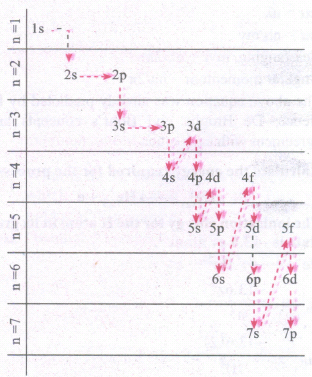
The word Aufbau in German means 'building up'. In the ground state of the atoms, the orbitals are filled in the order of their increasing energies. That is the electrons first occupy the lowest energy orbital available to them.
Once the lower energy orbitals are completely filled, then the electrons enter the next higher energy orbitals. The order of filling of various orbitals as per the Aufbau principle which is in accordance with (n + l) rule.

11th Standard Syllabus & Materials
11th Standard
TN 11th Tamil பீடு பெற நில் - செய்யுள் - காவடிச்சிந்து Important Questions And Answers Study Material - QB365 Set A
NEW11th Standard
TN 11th Tamil பீடு பெற நில் - உரைநடை - மலை இடப்பெயர்கள் : ஓர் ஆய்வு Important Questions And Answers Study Material - QB365 Set A
NEW11th Standard
TN 11th Tamil மாமழை போற்றுதும் - துணைப்பாடம் - யானை டாக்டர் Important Questions And Answers Study Material - QB365 Set A
NEW11th Standard
TN 11th Tamil மாமழை போற்றுதும் - செய்யுள் - ஐங்குறுநூறு Important Questions And Answers Study Material - QB365 Set A



Tamilnadu Stateboard 11th Standard Subjects

Maths

Commerce

Economics

Biology

Business Maths and Statistics

Accountancy

Computer Science

Physics
Chemistry
Maths
Biology
Economics
Physics
Chemistry

History
Business Maths and Statistics

Computer Science
Accountancy

Computer Applications
History
Computer Technology
Commerce
Computer Applications
Computer Technology

Tamil

English

French
Tamilnadu Stateboard Standards



