
 100% FREE ACCESS
11th Standard Syllabus & Materials
11th Standard
TN 11th Tamil இயற்கை வேளாண்மை,சுற்றுச்சூழல் -செய்யுள் - மனோன்மணீயம் Important Questions And Answers Study Material - QB365 Set A
NEW11th Standard
TN 11th Tamil என்னுயிர் என்பேன் -துணைப்பாடம் - இசைத்தமிழர் இருவர் Important Questions And Answers Study Material - QB365 Set A
NEW11th Standard
TN 11th Tamil மொழி கலை -செய்யுள் - ஒவ்வொரு புல்லையும் Important Questions And Answers Study Material - QB365 Set A
NEW11th Standard
TN 11th Tamil பீடு பெற நில் - இலக்கணம் - பகுபத உறுப்புகள் Important Questions And Answers Study Material - QB365 Set A
NEW11th Standard
TN 11th Tamil பீடு பெற நில் - துணைப்பாடம் - வாடிவாசல் Important Questions And Answers Study Material - QB365 Set A
NEW11th Standard
TN 11th Tamil பீடு பெற நில் - செய்யுள் - குறுந்தொகை Important Questions And Answers Study Material - QB365 Set A

Published on: 13/05/2022
QB365 provides detailed and simple solution for every Book back Questions in class 11 Chemistry Subject. It will helps to get more idea about question pattern in every book back questions with solution.
latest Book back QuestionsDownload Tamil Nadu 11th Standard Chemistry question papers, model tests, one-mark questions, important questions, and public exam papers in PDF format. Free study materials and answer keys for TN State Board students.
Questions + Answers key
Take MCQ Chemistry Test1.
How is acid rain formed ? Explain its effect
2.
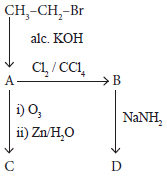
Identify the compound A, B, C and D in the following series of reactions
3.
Henry’s law constant for solubility of methane in benzene is 4.2 x 10⁻⁵ mm Hg at a particular constant temperature At this temperature.
Calculate the solubility of methane at
i) 750 mm Hg
ii) 840 mm Hg
4.
Calculate the enthalpy change for the reaction
Fe2O3 + 3CO ⟶ 2Fe + 3CO2 from the following data.
2Fe +\(\frac{3}{2}\)O2 ⟶ Fe2O3; ΔH = -741 kJ
C +\(\frac{1}{2}\)O2 ⟶ CO; ΔH = -137 kJ
C + O2 ⟶ CO2; ΔH = - 394.5 kJ
5.
What is the de Broglie wave length of an electron, which is accelerated from the rest, through a potential difference of 100 V ?
6.
A Compound on analysis gave Na = 14.31% S = 9.97% H = 6.22% and 0 = 69.5%.
Calculate the molecular formula of the compound if all the hydrogen in the compound is present in combination with oxygen as a water of crystallization. (molecular mass of the compound is 322).
7.
8.
What is screening effect? Briefly give the basis for pauling's scale of electronegativity.
9.
A group-1 metal (A) which is present in common salt reacts with (B) to give compound (C) in which hydrogen is present in –1 oxidation state. (B) on reaction with a gas (C) to give universal solvent (D). The compound (D) on reacts with (A) to give (E), a strong base. Identify A, B, C, D and E. Explain the reactions.
10.
Write the Van der Waals equation for a real gas. Explain the correction term for pressure and volume.
11.
1 mol of CH4, 1 mole of CS2 and 2 mol of H2S are 2 mol of H2 are mixed in a 500 ml flask. The equilibrium constant for the reaction KC = 4 x 10⁻² mol2 lit–2. In which direction will the reaction proceed to reach equilibrium ?
1.
Rain water normally has a pH of 5.6 due to dissolution of atmospheric CO2 into it. Oxides of sulphur and nitrogen in the atmosphere may be absorbed by droplets of frater that make up clouds and get chemically converted into sulphuric acid and nitric acid respectively as a results of pH of rain water drops below the level 5.6, hence it is called acid rain. Acid rain is a by-product of a variety of sulphur and nitrogen oxides in the atmosphere. Burning of fossil fuels (coal and oil) in power stations, furnaces and petrol, diesel in motor engines produce sulphur dioxide and nitrogen oxides The main contributors of acid rain are SO2 and NO2.They are converted into sulphuric acid and nitric acid respectively by the reaction with oxygen and water.
2SO2 + O2 + 2H2O ⟶ 2H2SO4
4NO2 + O2 + 2H2O ⟶ 4HNO3
Harmful effects of acid rain
Some harmful effects are discussed below :
(i) Acid rain causes extensive damage to buildings and structural materials of marbles. This attack on marble is termed as Stone leprosy.
CaCO3 + H2SO4 ⟶ CaSO4 + H2O +CO2 ↑
(ii) Acid rain affects plants and animal life in aquatic ecosystem.
(iii) It is harmful for agriculture, trees and plants as it dissolves and removes the nutrients needed for their growth.
(iv) It corrodes water pipes resulting in the leaching of heavy metals such as iron, lead and copper into the drinking water which have toxic effects.
(v) It causes respiratory ailment in humans and animals.
2.
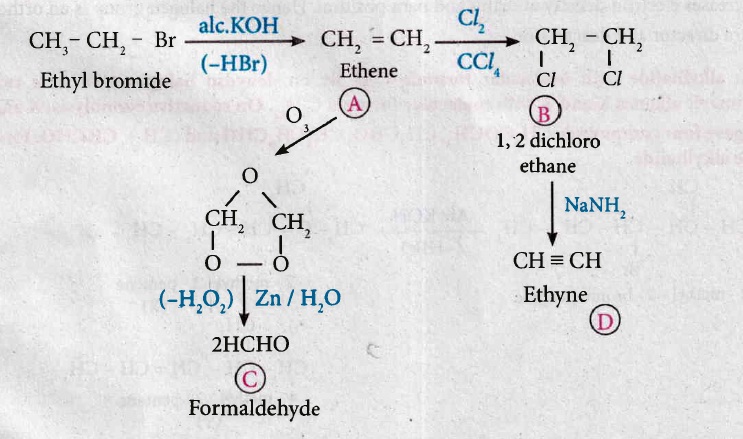
| compound | Structural formula | Name |
| A | CH2 = CH2 | Ethene |
| B | 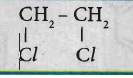 |
1,2 - dichloroethane |
| C | HCHO | Methanal |
| D | \(\mathrm{CH} \equiv \mathrm{CH}\) | Ethyne |
3.
(kH)bonzene = 4.2 x 10⁻⁵ mm Hg
Solubility of methane = ?
P = 750mm Hg
P = 840 mm Hg
According to Henrys Law,
P = KH . xin solution.
750 mm Hg = 4.2 x 10⁻⁵ mm Hg . xin solution
\(\Rightarrow X_{insolution}={750\over 4.2\times 10^{-5}}\)
i.e, solubility = 178.5 x 10⁵
similarly at P = 840 mm Hg
solubility = \({840\over 4.2\times 10^{-5}}\)
= 200 x 10-5.
4.
ΔHf(Fe2O3)= -741 kJ mol-1
ΔHf(CO)= -137 kJ mol-1
ΔHf(CO2)= -394.5 kJ mol-1
Fe2O3 + 3CO ⟶ 2Fe + 3CO2 ΔHr=?
ΔHr=Σ(ΔHf)products - Σ(ΔHf)reactants
ΔHr=[2ΔHf=(Fe)+3ΔHf(CO2)]-[ΔHf(Fe2O3)+3ΔHf(CO)]
ΔHr=[0 + 3 (-394.5)] - [-741 +3 (-137)]
ΔHr=[-1183.5] - [-1152]
ΔHr=-1183.5 + 1152
ΔHr=-31.5 kJ mol-1
5.
Potential difference = 100V
= 100 x 1.6 x 10-19J
\(\lambda=\frac{h}{\sqrt{2mev}}\)
\(=\frac { 6.626\times { 10 }^{ -34 }Kg{ m }^{ 2 }{ s }^{ -1 } }{ \sqrt { 2\times 9.1\times { 10 }^{ -31 }Kg\times 100\times 1.6\times { 10 }^{ -19 }J } } \)
\(\lambda=1.22\times10^{-10}m\)
6.
| Element | % | Relative number of atoms | Simple Ratio |
| Na | 14.31 | \(\frac { 14.31 }{ 23 } =0.62\) | \(\frac { 0.62 }{ 0.31 } =2\) |
| S | 9.97 | \(\frac { 9.97 }{ 32 } =0.31\) | \(\frac { 0.31 }{ 0.31 } =1\) |
| H | 6.22 | \(\frac { 6.22 }{ 1 } =6.22\) | \(\frac { 6.22 }{ 0.31 } =20\) |
| O | 69.5 | \(\frac { 69.5 }{ 16 } =4.34\) | \(\frac { 4.34 }{ 0.31 } =14\) |
Empirical formula = Na2 SH20 O14
\(\left[ \begin{matrix} { Na }_{ 2 }{ SH }_{ 20 }{ O }_{ 14 } \\ =(2\times 23)+(1\times 32)+(20\times 1)+14(16) \\ =46+32+20+234 \\ =322 \end{matrix} \right] \)
n = \(\frac { molar\quad mass }{ caluclated\quad empirical\quad formula\quad mass } =\frac { 322 }{ 322 } =1\)
Molecular formula = Na2 SH20O14
Since all the hydrogen in the compound are present as water
\(\therefore \) The molecular formula is Na2 SO4 10H2O.
7.
8.
Screening effect: The repulsive force between the inner shell electrons and the valence electrons leads to a decrease in the electrostatic attractive forces acting on the valence electrons by the nucleus. Thus, the inner shell electrons act as a shield between the nucleus and the valence electrons. This effect is called shielding effect.
Pauling's scale: Pauling, he assigned arbitrary value of electronegativities for hydrogen and fluorine as 2.2 and 4.0 respectively. Based on this the electronegativity values for other elements can be calculated using the following expression.
\(({ X }_{ A }-{ X }_{ B })=0.182\sqrt { E_{ AB } } -({ E }_{ AA }*{ E }_{ BB })^{ 1/2 }\)
Where EAB' EAA and EBB are the bond dissociation energies of AB, A2 and B2 molecules respectively. The electronegativity of any given element is not a constant and its value depends on the element to which it is covalently bound. The electronegativity values play an important role in predicting the nature of the bond.
9.
The group metal - 1 which is present in common salt is sodium.
So (A) is sodium
Sodium reacts with hydrogen (B) to give, sodium hydride (C). In sodium hydride the hydrogen is present in -1 oxidation state.
\(2\underset { (A) }{ Na } +\underset { (B) }{ { H }_{ 2 } } \rightarrow 2\underset { (C) }{ NaH } \)
So (B) hydrogen and (C) is sodium hydride
H2 reacts with oxygen gas (D) to give an universal solvent, water (E) follows:
\(2\underset { (B) }{ { H }_{ 2 } } +{ O }_{ 2 }\rightarrow 2\underset { (D) }{ { H }_{ 2 }O } \)
So (E) is water. Water is the universal solvent
Water (E) reacts with sodium (A) follow to give (F), which is a strong base.
\(2\underset { (E) }{ { H }_{ 2 }O } +\underset { (A) }{ 2Na } \rightarrow 2\underset { (F) }{ NaOH } +{ { H }_{ 2 } } \)
So (F) is sodium hydroxide.
| Element / Compound | Symbol / Formula | Name |
| A | Na | Sodium |
| B | H2 | Hydrogen |
| C | NaH | Sodium hydride |
| D | H2O | Water |
| E | NaOH | Sodium hydroxide |
10.
The van der equation for a real gas is
\(\left( P+{{{am}^{2}}\over{{V}^{2}}} \right)(V-nb)=nRT\)
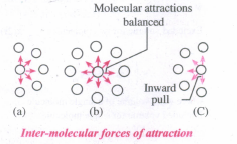
Pressure, Correction:
The pressure of a gas is directly proportional to the force created by the bombardment of molecules on the walls of the container. The speed of a molecule moving towards the wall of the container is reduced by the attractive forces exerted by its neighbours. Hence, the measured gas pressure is lower than the ideal pressure of the gas. Hence, van der Waals introduced a correction term to this effect.
Van der Waals found out the forces of attraction experienced by a molecule near the wall are directly proportional to the square of the density of the gas.
\(P^{\prime} \propto \rho^{2} ; \quad \rho=\frac{n}{v}\)
where n is the number of moles of gas and
V is the volume of the container
\( \Rightarrow p^{\prime} \alpha \frac{n^{2}}{V^{2}} \)
\(\Rightarrow p^{\prime}=a \frac{n^{2}}{V^{2}}\)
where a is proportionality constant and depends on the nature of gas
Therefore \(P_{\text {ideal }}=P+\frac{\operatorname{an}^{2}}{V^{2}}\)
Volume Correction
As every individual molecule of a gas occupies a certain volume, the actual volume is less than the volume of the container,
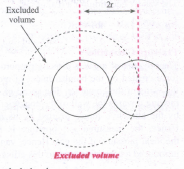
V. Van der Waals introduced a correction factor V' to this effect. Let us calculate the correction term by considering gas molecules as spheres.
V = excluded volume
Excluded volume for two molecules
\(=\frac{4}{3} \pi(2 r)^{3}=8\left(\frac{4}{3} \pi r^{3}\right)=8 V_{m}\)
Where Vm it a volume of a single molecule
Excluded volume for single molecule = \(\frac{8 \mathrm{~V}_{\mathrm{m}}}{2}=4 \mathrm{~V}_{\mathrm{m}}\)
Excluded volume for n molecule = n(4Vm) = nb
Where b is van der waals constant which is equal to 4Vm
\( \Rightarrow V^{\prime}=n b \)
\(V_{\text {ideal }}=V-n b\)
Replacing the corrected pressure and volume in the ideal gas equation PV = nRT we get the Van der Waals equation of state for real gases as below,
\(\left(p+\frac{a^{2}}{V^{2}}\right)(V-n b)=n R T\)
The constants a and b are van der Waals constants and their values vary with the nature of the gas. It is an approximate formula for the non-ideal gas.
11.
CH4(g) + 2H2S(g) ⇌ CS2(g) + 4H2(g)
KC = 4 x 10⁻² mol lit–2
Volume = 500 ml = 1/2 L
\(\left[\mathrm{CH}_{4}\right]_{\text {in }}=\frac{2 \mathrm{~mol}}{1 / 2 \mathrm{~L}} \)
= 2 mol L-1
\(\left[\mathrm{CS}_{2}\right]_{\text {in }}=\frac{1 \mathrm{~mol}}{1 / 2 \mathrm{~L}}\)
= 2 mol L-1
\( {\left[\mathrm{H}_{2} \mathrm{~S}\right]_{\text {in }}=\frac{2 \mathrm{~mol}}{1 / 2 \mathrm{~L}}=4 \mathrm{~mol} \mathrm{~L}^{-1} \quad\left[\mathrm{H}_{2}\right]=\frac{2 \mathrm{~mol}}{1 / 2 \mathrm{~L}}=4 \mathrm{~mol} \mathrm{~L}^{-1}} \)
\(\mathrm{Q}=\frac{\left[\mathrm{CS}_{2}\right]\left[\mathrm{H}_{2}\right]^{4}}{\left[\mathrm{CH}_{4}\right]\left[\mathrm{H}_{2} \mathrm{~S}\right]^{2}}=\frac{2 \times(4)^{4}}{(2) \times(4)^{2}}=16 \)
Q > Kc
\(\therefore \) The reaction will proceed in the reverse direction to reach the equilibrium.

11th Standard Syllabus & Materials
11th Standard
TN 11th Tamil பீடு பெற நில் - செய்யுள் - காவடிச்சிந்து Important Questions And Answers Study Material - QB365 Set A
NEW11th Standard
TN 11th Tamil பீடு பெற நில் - உரைநடை - மலை இடப்பெயர்கள் : ஓர் ஆய்வு Important Questions And Answers Study Material - QB365 Set A
NEW11th Standard
TN 11th Tamil மாமழை போற்றுதும் - துணைப்பாடம் - யானை டாக்டர் Important Questions And Answers Study Material - QB365 Set A
NEW11th Standard
TN 11th Tamil மாமழை போற்றுதும் - செய்யுள் - ஐங்குறுநூறு Important Questions And Answers Study Material - QB365 Set A



Tamilnadu Stateboard 11th Standard Subjects

Maths

Commerce

Economics

Biology

Business Maths and Statistics

Accountancy

Computer Science

Physics
Chemistry
Maths
Biology
Economics
Physics
Chemistry

History
Business Maths and Statistics

Computer Science
Accountancy

Computer Applications
History
Computer Technology
Commerce
Computer Applications
Computer Technology

Tamil

English

French
Tamilnadu Stateboard Standards



