
 100% FREE ACCESS
11th Standard Syllabus & Materials
11th Standard
TN 11th Tamil இயற்கை வேளாண்மை,சுற்றுச்சூழல் -செய்யுள் - மனோன்மணீயம் Important Questions And Answers Study Material - QB365 Set A
NEW11th Standard
TN 11th Tamil என்னுயிர் என்பேன் -துணைப்பாடம் - இசைத்தமிழர் இருவர் Important Questions And Answers Study Material - QB365 Set A
NEW11th Standard
TN 11th Tamil மொழி கலை -செய்யுள் - ஒவ்வொரு புல்லையும் Important Questions And Answers Study Material - QB365 Set A
NEW11th Standard
TN 11th Tamil பீடு பெற நில் - இலக்கணம் - பகுபத உறுப்புகள் Important Questions And Answers Study Material - QB365 Set A
NEW11th Standard
TN 11th Tamil பீடு பெற நில் - துணைப்பாடம் - வாடிவாசல் Important Questions And Answers Study Material - QB365 Set A
NEW11th Standard
TN 11th Tamil பீடு பெற நில் - செய்யுள் - குறுந்தொகை Important Questions And Answers Study Material - QB365 Set A

Published on: 08/06/2021
QB365 provides detailed and simple solution for every Book back Questions in class 11 Chemistry Subject. It will helps to get more idea about question pattern in every book back questions with solution.
Download Tamil Nadu 11th Standard Chemistry question papers, model tests, one-mark questions, important questions, and public exam papers in PDF format. Free study materials and answer keys for TN State Board students.
Questions + Answers key
Take MCQ Chemistry Test1.
How is acid rain formed ? Explain its effect
2.
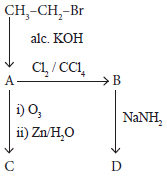
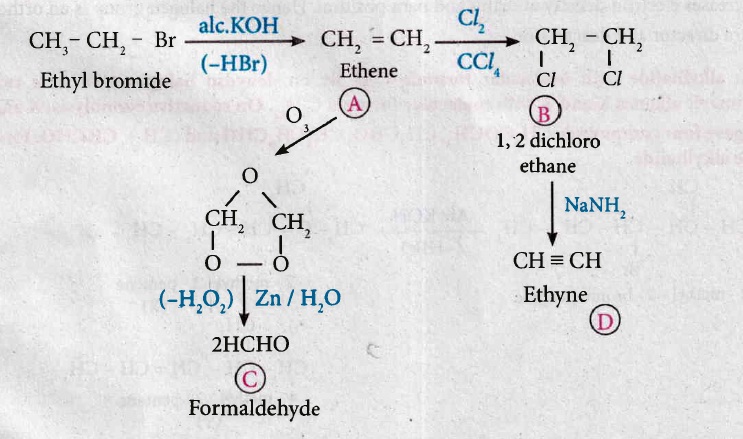
Identify the compound A, B, C and D in the following series of reactions
3.
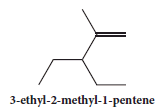
Give the structure for the following compound.
3- ethyl - 2 methyl -1-pentene
4.
Henry’s law constant for solubility of methane in benzene is 4.2 x 10⁻⁵ mm Hg at a particular constant temperature At this temperature.
Calculate the solubility of methane at
i) 750 mm Hg
ii) 840 mm Hg
5.
A sealed container was filled with 1 mol of A2 (g), 1 mol B2 (g) at 800 K and total pressure 1.00 bar. Calculate the amounts of the components in the mixture at equilibrium given that K = 1 for the reaction
A2 (g) + B2 (g) ⇌ 2AB (g)
6.
Calculate the percentage composition of the elements present in magnesium carbonate. How many kilogram of CO2 can be obtained by heating 1 kg of 90 % pure magnesium carbonate.
7.
When 1-pentyne (A) is treated with 4N alcoholic KOH at 175°C, it is converted slowly into an equilibrium mixture of 1.3% 1-pentyne(A) , 95.2% 2-pentyne(B) and 3.5% of 1,2 pentadiene (C) the equilibrium was maintained at 175°C, calculate ΔG0 for the following equilibria.
B \(\rightleftharpoons \)AGIO?
B \(\rightleftharpoons \)CG20?
8.
What is the de Broglie wave length of an electron, which is accelerated from the rest, through a potential difference of 100 V ?
9.
10.
Derive the values of critical constants in terms of van der Waals constants.
11.
Why the first ionisation enthalpy of sodium is lower than that of magnesium while its second ionisation enthalpy is higher than that of magnesium.
12.
Explain preparation of hydrogen using electrolysis.
1.
Rain water normally has a pH of 5.6 due to dissolution of atmospheric CO2 into it. Oxides of sulphur and nitrogen in the atmosphere may be absorbed by droplets of frater that make up clouds and get chemically converted into sulphuric acid and nitric acid respectively as a results of pH of rain water drops below the level 5.6, hence it is called acid rain. Acid rain is a by-product of a variety of sulphur and nitrogen oxides in the atmosphere. Burning of fossil fuels (coal and oil) in power stations, furnaces and petrol, diesel in motor engines produce sulphur dioxide and nitrogen oxides The main contributors of acid rain are SO2 and NO2.They are converted into sulphuric acid and nitric acid respectively by the reaction with oxygen and water.
2SO2 + O2 + 2H2O ⟶ 2H2SO4
4NO2 + O2 + 2H2O ⟶ 4HNO3
Harmful effects of acid rain
Some harmful effects are discussed below :
(i) Acid rain causes extensive damage to buildings and structural materials of marbles. This attack on marble is termed as Stone leprosy.
CaCO3 + H2SO4 ⟶ CaSO4 + H2O +CO2 ↑
(ii) Acid rain affects plants and animal life in aquatic ecosystem.
(iii) It is harmful for agriculture, trees and plants as it dissolves and removes the nutrients needed for their growth.
(iv) It corrodes water pipes resulting in the leaching of heavy metals such as iron, lead and copper into the drinking water which have toxic effects.
(v) It causes respiratory ailment in humans and animals.
2.
| compound | Structural formula | Name |
| A | CH2 = CH2 | Ethene |
| B | 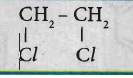 |
1,2 - dichloroethane |
| C | HCHO | Methanal |
| D | \(\mathrm{CH} \equiv \mathrm{CH}\) | Ethyne |
3.
4.
(kH)bonzene = 4.2 x 10⁻⁵ mm Hg
Solubility of methane = ?
P = 750mm Hg
P = 840 mm Hg
According to Henrys Law,
P = KH . xin solution.
750 mm Hg = 4.2 x 10⁻⁵ mm Hg . xin solution
\(\Rightarrow X_{insolution}={750\over 4.2\times 10^{-5}}\)
i.e, solubility = 178.5 x 10⁵
similarly at P = 840 mm Hg
solubility = \({840\over 4.2\times 10^{-5}}\)
= 200 x 10-5.
5.
A2(g) + B2(g) ⇌ 2AB(g)
| A2 | B2 | AB | |
| Initial Concentration | 1 | 1 | - |
| No.of moles reacted | x | x | - |
| No.of moles at equilibrium | 1 - x | 1 - x | 2x |
Total no. of moles = 1 – x + 1 – x + 2x = 2
\(K_p={(P_{AB})^2\over (P_{A_2})(P_{B_2})}={({2x\over 2}\times p)^2\over ({(1-x)\over 2}\times p)({1-x\over 2}\times p)}\)
\(K_p={4x^2\over (1-x)^2}\)
Given that Kp = 1; \({4x^2\over (1-x)^2}=1\)
\(\Rightarrow \) 4x2 = (1 - x)2
\(\Rightarrow \) 4x2 = 1 + x2 - 2x
3x2 + 2x - 1 = 0
\(X={-2\pm\sqrt{4-4\times 3\times -1}\over 2(3)}\)
\(X={-2\pm\sqrt{4+12}\over 6}\)
\(={-2\pm\sqrt{16}\over 6}\)
\(={-2+4\over 6};{-2-4\over 6}\)
\(={2\over 6};{-6\over 6}\)
X = 0.33 ; -1 (not possible)
\(\therefore\) [A2]eq = 1 - x = 1 - 0.33 = 0.67
[B2]eq = 1 - x = 1 - 0.33 = 0.67
[AB]eq = 2X = 2 x 0.33 = 0.66.
6.
The balanced chemical equation is
\(\mathrm{MgCO}_{3} \stackrel{\Delta}{\longrightarrow} \mathrm{MgO}+\mathrm{CO}_{2}\)
Molar mass of MgCO3 is 84 g mol–1.
84 g MgCO3 contain 24 g of Magnesium.
∴ 100 g of MgCO3 contain
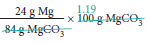
= 28.57 g Mg.
i.e. percentage of magnesium
= 28.57 %.
84 g MgCO3 contain 12 g of carbon
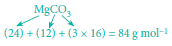
∴ 100 g MgCO3 contain
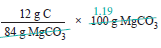
= 14.29 g of carbon.
∴ Percentage of carbon
= 14.29 %.
84 g MgCO3 contain 48 g of oxygen
∴ 100 g MgCO3 contains
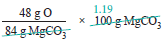
= 57.14 g of oxygen.
∴ Percentage of oxygen
= 57.14 %.
As per the stoichiometric equation,
84 g of 100 % pure MgCO3 on heating gives 44 g of CO2.
∴ 1000 g of 90 % pure MgCO3 gives
\(\frac{\text { wt. of } \mathrm{MgCO}_{3}}{84 \mathrm{~g}} \frac{\text { % Purities }}{100 \%} \frac{\text { wt.of } \mathrm{CO}_{2}}{44 \mathrm{~g}}\)
\(x=44 \times \frac{100}{84} \times \frac{90}{100}\)
= 471.43 g CO2
= 0.471 kg CO2
7.
T=1750 C=175+273=448K
Concentration of l-pentyne [A] = 1.3%
Concentration of2-pentyne [B] = 95.2%
Concentration of 1, 2-pentadiene [C] = 3.5%
At equilibrium
B\(\rightleftharpoons \)A
95.2%1.3%\(\Rightarrow \)
\({ K }_{ 1 }=\frac { 1.3 }{ 95.2 } =0.0136\)
B\(\rightleftharpoons \)C
95.2%3.5%\(\Rightarrow \)
\({ K }_{ 2}=\frac { 3.5 }{ 95.2 } =0.0367\)
\(\Rightarrow \)\(\Delta { G }_{ 1 }^{ 0 }\) =-2.303RT log K1
\(\Delta { G }_{ 1 }^{ 0 }\)=-2.303X8.314X448Xlog0.0136
\(\Delta { G }_{ 1 }^{ 0 }\) =+16010J
\(\Delta { G }_{ 1 }^{ 0 }\)=+16 kJ
\(\Rightarrow \)\(\Delta { G }_{ 2 }^{ 0 }\)=-2.303X8.314X448Xlog0.0367
\(\Delta { G }_{ 2 }^{ 0 }\) =+12312J
\(\Delta { G }_{ 2 }^{ 0 }\)=+12.312 kJ.
8.
Potential difference = 100V
= 100 x 1.6 x 10-19J
\(\lambda=\frac{h}{\sqrt{2mev}}\)
\(=\frac { 6.626\times { 10 }^{ -34 }Kg{ m }^{ 2 }{ s }^{ -1 } }{ \sqrt { 2\times 9.1\times { 10 }^{ -31 }Kg\times 100\times 1.6\times { 10 }^{ -19 }J } } \)
\(\lambda=1.22\times10^{-10}m\)
9.
10.
The van der Waals equation for n moles is
\(\left( P+\frac { { an }^{ 2 } }{ { v }^{ 2 } } \right) \left( v-nb \right) =nRT\) ....(1)
For 1 mole
\(\left( P+\frac { { a }^{ 2 } }{ { v }^{ 2 } } \right) \left( v-b \right) =RT\) ...(2)
From the equation we can derive the values of critical constants Pc, Vc and Tc, in terms of a and b, the van der Waals constants, On expanding the above equation
\(pv+\frac { a }{ v } -pb-\frac { ab }{ { v }^{ 2 } } -RT=0\) ...(3)
Multiply equation (3) by V2 / P
\(\frac { { v }^{ 2 } }{ p } \left( Pv+\frac { a }{ v } -pb-\frac { ab }{ { v }^{ 2 } } -RT \right) =0\)
\({ v }^{ 3 }+\frac { av }{ p } +-{ bv }^{ 2 }-\frac { ab }{ { v }^{ 2 } } -\frac { { RTV }^{ 2 } }{ p } \) ...(4)
When the above equation is rearranged in powers of Y.
\({ v }^{ 3 }-\left[ \frac { RT }{ P } +b \right] { v }^{ 2 }+\left[ \frac { a }{ p } \right] v-\left[ \frac { ab }{ p } \right] =0\) ...(5)
The equation (5) is a cubic equation in V. On solving this equation,
we will get three solutions. At the critical point all these three solutions of V are equal to the critical volume VC. The pressure and temperature becomes Pc and Tc respectively
i.e., V = Vc
V - Vc = 0
(V - VC)3 = 0
V3 - 3VCV2 + 3Vc2V - Vc3 = 0 .....(6)
As equation (5) is identical with equation (6), we can equate the coefficients of V2, V and constant terms in (5) and (6).
\(-3{ v }_{ c }{ v }^{ 2 }=-\left[ \frac { { RT }_{ c } }{ { p }_{ c } } +b \right] { v }^{ 2 }\)
\(3{ v }_{ c }=\frac { { RT }_{ c } }{ { p }_{ c } } +b\) .....(7)
\(3{ v }_{ c }^{ 2 }=\frac { a }{ { p }_{ c } } \) ......(8)
\(3{ v }_{ c }^{ 2 }=\frac { ab }{ { p }_{ c } } \) ...(9)
Divide equation (9) by equation (8)
\(\frac { { v }_{ c }^{ 3 } }{ 3{ v }_{ c }^{ 2 } } =\frac { ab/{ p }_{ c } }{ a/{ p }_{ c } } \)
\(\frac { { V }_{ c } }{ 3 } =b\)
i.e. Vc = 3b .....(10)
when equation (10) is substituted in (8)
\(3{ v }_{ c }^{ 2 }=\frac { a }{ { p }_{ c } } \)
\({ p }_{ c }=\frac { a }{ 3{ v }_{ c }^{ 2 } } =\frac { a }{ 3\left( { 3b }^{ 2 } \right) } =\frac { a }{ { 3\times 9b }^{ 2 } } =\frac { a }{ { 27 }b^{ 2 } } \)
\({ p }_{ c }=\frac { a }{ { 27 }b^{ 2 } } \) ...(11)
substituting the values of Vc and Pc in equation (7),
\(3vc=b+\frac { { RT }_{ c } }{ p } \)
\(3\left( 3b \right) =b+\frac { { RT }_{ c } }{ \left( \frac { a }{ { 27b }^{ 2 } } \right) } \)
\(9b-b=\left( \frac { { RT }_{ c } }{ a } \right) 27{ b }^{ 2 }\)
\(8b=\frac { { t }_{ c }R{ 27b }^{ 2 } }{ a } \)
\(\therefore { T }_{ c }=\frac { 8ab }{ 27R{ b }^{ 2 } } =\frac { 8a }{ 27Rb } \)
\({ T }_{ c }=\frac { { 8 }_{ a } }{ 27Rb } \) ......(12)
The critical constants can be calculated using the values of van der Waals constant of a gas and vice versa.
\(a=3{ V }_{ C }^{ 2 }{ P }_{ C }\quad and\quad b=\frac { { V }_{ C } }{ 3 } \)
11.
The electronic configuration of Sodium (Z = 11) Is22s22p63s1.
Magnesium (Z = 12) 1s22s22p63s2
Magnesium atom has a smaller radius and higher nuclear charge than a sodium atom, thus more energy will be required to remove the electron from the same orbital (3s), making the first ionisation energy of magnesium higher than that of sodium.
However, the second ionization enthalpy of sodium is higher than that of magnesium. This is because after losing 1 electron, sodium attains the stable noble gas configuration of neon (1s22s22p6). On the other hand, magnesium, after losing 1 electron still has one electron in the 3s-orbital(1s22s22p63s1). In order to attain the stable noble gas configuration, Thus, the energy required to remove the second electron in case of sodium is much higher than that required in case of magnesium. Hence, the second ionization enthalpy of sodium is higher than that of magnesium.
12.
High purity hydrogen (> 99.9%) is obtained by the electrolysis of water containing traces of acid or alkali or the electrolysis of aqueous solution of sodium hydroxide or potassium hydroxide using a nickel anode and iron cathode. However, this process is not economical for large-scale production.
At anode: 2OH- ➝ H2O + 1/2O2 + 2e-
At cathode: 2H2O + 2e- ➝ 2OH- + H2
Overall reaction: H2O ➝ H2 + 1/2O2

11th Standard Syllabus & Materials
11th Standard
TN 11th Tamil பீடு பெற நில் - செய்யுள் - காவடிச்சிந்து Important Questions And Answers Study Material - QB365 Set A
NEW11th Standard
TN 11th Tamil பீடு பெற நில் - உரைநடை - மலை இடப்பெயர்கள் : ஓர் ஆய்வு Important Questions And Answers Study Material - QB365 Set A
NEW11th Standard
TN 11th Tamil மாமழை போற்றுதும் - துணைப்பாடம் - யானை டாக்டர் Important Questions And Answers Study Material - QB365 Set A
NEW11th Standard
TN 11th Tamil மாமழை போற்றுதும் - செய்யுள் - ஐங்குறுநூறு Important Questions And Answers Study Material - QB365 Set A



Tamilnadu Stateboard 11th Standard Subjects

Maths

Commerce

Economics

Biology

Business Maths and Statistics

Accountancy

Computer Science

Physics
Chemistry
Maths
Biology
Economics
Physics
Chemistry

History
Business Maths and Statistics

Computer Science
Accountancy

Computer Applications
History
Computer Technology
Commerce
Computer Applications
Computer Technology

Tamil

English

French
Tamilnadu Stateboard Standards



