
 100% FREE ACCESS
11th Standard Syllabus & Materials
11th Standard
TN 11th Tamil இயற்கை வேளாண்மை,சுற்றுச்சூழல் -செய்யுள் - மனோன்மணீயம் Important Questions And Answers Study Material - QB365 Set A
NEW11th Standard
TN 11th Tamil என்னுயிர் என்பேன் -துணைப்பாடம் - இசைத்தமிழர் இருவர் Important Questions And Answers Study Material - QB365 Set A
NEW11th Standard
TN 11th Tamil மொழி கலை -செய்யுள் - ஒவ்வொரு புல்லையும் Important Questions And Answers Study Material - QB365 Set A
NEW11th Standard
TN 11th Tamil பீடு பெற நில் - இலக்கணம் - பகுபத உறுப்புகள் Important Questions And Answers Study Material - QB365 Set A
NEW11th Standard
TN 11th Tamil பீடு பெற நில் - துணைப்பாடம் - வாடிவாசல் Important Questions And Answers Study Material - QB365 Set A
NEW11th Standard
TN 11th Tamil பீடு பெற நில் - செய்யுள் - குறுந்தொகை Important Questions And Answers Study Material - QB365 Set A

Published on: 13/05/2022
QB365 provides detailed and simple solution for every Book back Questions in class 11 Chemistry Subject. It will helps to get more idea about question pattern in every book back questions with solution.
latest Book back QuestionsDownload Tamil Nadu 11th Standard Chemistry question papers, model tests, one-mark questions, important questions, and public exam papers in PDF format. Free study materials and answer keys for TN State Board students.
Questions + Answers key
Take MCQ Chemistry Test1.
Define bond energy.
2.
What is Polar Covalent bond ? explain with example.
3.
CO2 and H2O both are triatomic molecule but their dipole moment values are different. Why ?
4.
What type of hybridisations are possible in the following geometeries ?
a) octahedral
b) tetrahedral
c) square planer
5.
Explain resonance with reference to carbonate ion ?
1.
The bond energy is defined as the minimum amount of energy required to break one mole of a particular bond in molecules in their gaseous state.
2.
In the case of covalent bond formed between atoms having different electronegativities, the atom with higher electro negativity will have greater tendency to attract the shared pair of electrons more towards itself than the other atom. As a result the cloud of shared electron
pair gets distorted. Let us consider the covalent bond between hydrogen and fluorine in hydrogen fluoride. The electro negativities ofhydrogen and fluorine on Pauling's scale are 2.1 and 4 respectively. It means that fluorine attracts the shared pair of electrons approximately twice as much as the hydrogen which leads to partial negative charge on fluorine and partial positive charge on hydragen. Hence, the H-F bond is said to be polar covalent bond.
3.
Molecules having polar bonds will not necessarily have a dipole moment. For example, the linear form of carbon dioxide haszero dipole moment, even though it has two polar bonds. In CO2, the dipole moments of two polar bonds (CO) are equal in magnitude but have opposite direction. Hence, the net dipole moment of the CO2 is,
\(\mu=\mu_{1}+\mu_{2}=\mu_{1}+(-\mu_{1})=0.\)
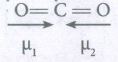
In this case \(\mu=\overrightarrow { { \mu }_{ 1 } } +\overrightarrow { { \mu }_{ 2 } } \quad \)
\(=\overrightarrow { { \mu }_{ 1 } } +\overrightarrow { ({ \mu }_{ 1 }) } =0\)
Incase of water net dipole moment is the vector sum of \(\mu_{1}+\mu_{2}\) as shown.
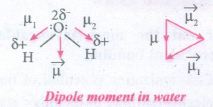
Dipole moment in water is found to be 1.85 D
4.
a) octahedral - sp3d2
b) tetrahedral - sp3
c) square planer - dsp2
5.
'When we write Lewis structures for a molecule, more than one valid Lewis structures are possible in certain cases. For exampte let us consider the Lewis structure of carbbnate ion [CO3]2- . The skeletal structure of carbonate ion (The oxygen atoms are denoted as OA, OB & Oc
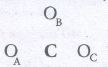
2. Total number of valence electrons = [1 x 4(carbon)] + [3 x 6 (oxygen)] + [2 (charge)] = 24 electrons.
3. Distribution of these valence electrons gives us the following structure.
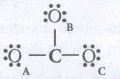
4. Complete the octet for carbon by moving a lone pair from one of the oxygens (OA) and write the charge of the ion (2-) on the upper right side.
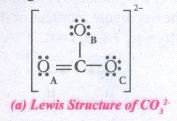
5. In this case, we can draw two additional Lewis structures by moving the lone pairs from the other two oxygens (OB & Oc) thus creating three similar structures as shown below in which the relative position of the atoms are same. They only differ in the position of bonding and lone pair of electrons. Such stnictures are called resonance structures (canonical structures) and this phenomenon is called resonance.
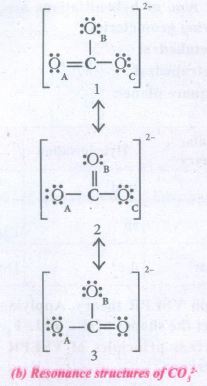
6. It is evident from the experimental results that all carbon-oxygen bonds in carbonate ion are equivalent. The actual structure of the molecules is said to be the resonance hybrid, an average of these three resonance forms. It is important to note that carbonate ion does not change from one structure to another and vice versa. It is not possible to picturise the resonance hybrid by drawing a single Lewis structure. However, the following structure gives a qualitative idea about the correct structure
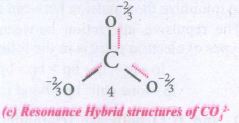
7. It is found that the energy of the resonance hybrid (structure 4) is lower than that of all possible canonical structures (Structure 1, 2 & 3). The difference in energy between structure 1 or 2 or 1 3, (most stable canonical structure) and structure 4 (resonance hybrid) is called resonance energy.

11th Standard Syllabus & Materials
11th Standard
TN 11th Tamil பீடு பெற நில் - செய்யுள் - காவடிச்சிந்து Important Questions And Answers Study Material - QB365 Set A
NEW11th Standard
TN 11th Tamil பீடு பெற நில் - உரைநடை - மலை இடப்பெயர்கள் : ஓர் ஆய்வு Important Questions And Answers Study Material - QB365 Set A
NEW11th Standard
TN 11th Tamil மாமழை போற்றுதும் - துணைப்பாடம் - யானை டாக்டர் Important Questions And Answers Study Material - QB365 Set A
NEW11th Standard
TN 11th Tamil மாமழை போற்றுதும் - செய்யுள் - ஐங்குறுநூறு Important Questions And Answers Study Material - QB365 Set A



Tamilnadu Stateboard 11th Standard Subjects

Maths

Commerce

Economics

Biology

Business Maths and Statistics

Accountancy

Computer Science

Physics
Chemistry
Maths
Biology
Economics
Physics
Chemistry

History
Business Maths and Statistics

Computer Science
Accountancy

Computer Applications
History
Computer Technology
Commerce
Computer Applications
Computer Technology

Tamil

English

French
Tamilnadu Stateboard Standards



