
 100% FREE ACCESS
11th Standard Syllabus & Materials
11th Standard
TN 11th Tamil இயற்கை வேளாண்மை,சுற்றுச்சூழல் -செய்யுள் - மனோன்மணீயம் Important Questions And Answers Study Material - QB365 Set A
NEW11th Standard
TN 11th Tamil என்னுயிர் என்பேன் -துணைப்பாடம் - இசைத்தமிழர் இருவர் Important Questions And Answers Study Material - QB365 Set A
NEW11th Standard
TN 11th Tamil மொழி கலை -செய்யுள் - ஒவ்வொரு புல்லையும் Important Questions And Answers Study Material - QB365 Set A
NEW11th Standard
TN 11th Tamil பீடு பெற நில் - இலக்கணம் - பகுபத உறுப்புகள் Important Questions And Answers Study Material - QB365 Set A
NEW11th Standard
TN 11th Tamil பீடு பெற நில் - துணைப்பாடம் - வாடிவாசல் Important Questions And Answers Study Material - QB365 Set A
NEW11th Standard
TN 11th Tamil பீடு பெற நில் - செய்யுள் - குறுந்தொகை Important Questions And Answers Study Material - QB365 Set A

Published on: 13/05/2022
QB365 provides detailed and simple solution for every
Creative Questions in class 11 Chemistry Subject. It will
helps to get more idea about question pattern in every Creative questions with solution.
Download Tamil Nadu 11th Standard Chemistry question papers, model tests, one-mark questions, important questions, and public exam papers in PDF format. Free study materials and answer keys for TN State Board students.
Questions + Answers key
Take MCQ Chemistry Test1.
Explain about the bonding in metals by molecular orbital theory.
2.
Explain about metallic bonding
3.
Explain about the salient features of molecular orbital theory.
4.
Explain about Kossel-Lewis approach to chemical bonding.
5.
Draw the M.OI. diagram of No molecule. Calculate its bond order and show that its paramagnetic.
1.
(i) According to molecular orbital theory the atomic orbitals of large number of atoms in a crystal overlap to form numerous bonding and anti-bonding molecular orbitals without any band gap.
(ii) The bonding molecular orbitals are completely filled with an electron pair in each and the anti-bonding molecular orbitals are empty.
(iii) Absence of band gap accounts for high electrical conductivity of metals.
(iv) High thermal conductivity is due to thermal excitation of many electrons from the valence band to the conduction band.
(v) With an increase in temperature, the electrical conductivity decreases due to vigorous thermal motion of lattice ions that disrupts.
2.
(i) The forces that keep the atoms of the metal so closely in a metallic crystal constitute what is known as metallic bond.
(ii) According to Drude and Lorentz, metallic crystal is an assemblage of positive ions immersed in a gas of free electrons. The free electrons are due to ionisation of the valence electrons of the atoms of the metal.
(iii) As the valence electrons of the atoms are freely shared by all the ions in the crystal, the metallic bonding is referred to as electronic bonding.
(iv) The electrostatic attraction between the metal ions and the free electrons yield a three dimensional close packed crystal with a large number of nearest metal ions. So metals have high density.
(v) As the close packed structure contains many slip planes along which movement can occur during mechanical loading, metal acquires ductility.
(vi) As metal ion is surrounded by electron cloud in all directions, the metallic bonding has no directional properties.
(vii) As the electrons are free to more around the positive ions, the metals exhibit high electrical and thermal conductivity.
(viii) The metallic lustre is due to the reflection of light by the electron cloud.
(ix) As the metallic bond is strong enough, the metal atoms are reluctant to break apart into a liquid or gas, so the metals have high melting and boiling points.
(x) High thermal conductivity of metals is due to thermal excitation of many electrons from the valence bond to the conduction band.
3.
(i) When atoms combine to form molecules, their individual atomic orbitals lose their identity and form new orbitals called molecular orbitals.
(ii) The shape of molecular orbitals depend upon the shapes of combining atomic orbitals.
(iii) The number of molecular orbitals formed is the same as the number of combining atomic orbitals. Half the number of molecular orbitals formed will have lower energy and are called bonding orbitals, while the remaining half molecular orbitals will have higher energy and are called anti-bonding molecular orbitals.
(iv) The bonding molecular orbitals are represented as σ" (sigma), π (Pi), ઠ(delta) and the corresponding anti-bonding orbitals are called σ*π"*, 7t* and ઠ*.
(v) The electrons in the molecule are accommodated in the newly formed molecular orbitals. The filling of electrons in these orbitals follow Aufbau's Principle, Pauli's exclusion principle and Hund's rule as in the case of filling of electrons in the atomic orbitals.
(vi) Bond order gives the number of covalent bonds between the two combining atoms. The bond order of a molecule can be calculated using the following equation:
\(Bond\quad order=\cfrac { { N }_{ b }-{ N }_{ a } }{ 2 } \)
Nb = Number of electrons in bonding molecular orbitals.
Na =; Number of electrons in anti-bonding molecular orbitals.
(vii) A bond order of zero value indicates that the molecule does not exist.
4.
(i) Kossel and Lewis approach to chemical bonding is based on the inertness of the noble gases which have little or no tendency to combine with other atoms.
(ii) They proposed that noble gases are stable due to their completely filled outer electronic configuration.
(iii) Elements other than noble gases try to attain the completely filled outer electronic configuration by losing, gaining or sharing one or more electrons from their outer shell.
(iv) For e.g., sodium loses one electron to form Na+ ion and chlorine accepts that electron to give chloride ion, ClrThese two ions are held together by electrostatic attractive forces, a bond known as an electrovalent bond.
\(\underset { \left[ Ne \right] { 3s }^{ ' } }{ Na } \longrightarrow { \underset { [Ne] }{ Na } }^{ + }+{ e }^{ - }\)
\(\underset { [Ne]3{ s }^{ 2 }{ 3p }^{ 2 } }{ Cl } +{ e }^{ - }\longrightarrow { \underset { [Ar] }{ Cl } }^{ - }\)
\({ Na }^{ + }+{ Cl }^{ - }\longrightarrow Nacl\)
(v) In diatomic molecules such as nitrogen and oxygen, they achieve the stable noble gas electronic configuration by mutual sharing of electrons.
(vi) Lewis introduced a scheme to represent the chemical bond and the electrons present in the outer shell of the atom called Lewis dot structure.
(vii) For example, the electronic configuration of nitrogen is 1s22s22p3. It has 5 electrons in its outer shell. The lewis structure of nitrogen is \(\cdot \overset { \cdot }{ N\cdot } \)
(viii) In N2 molecule, equal sharing of 3 electrons from each nitrogen atom takes place as follows: or N≡N
5.
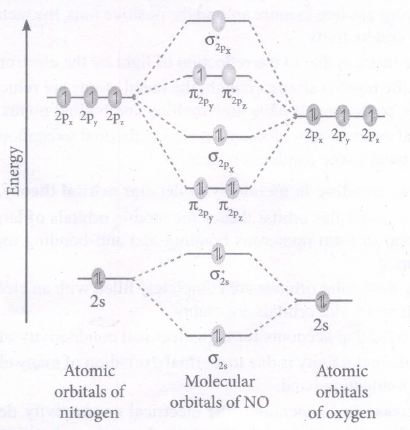
(i) Electronic configuration of N atom is 1s22s22p3
(ii) Electronic configuration of 0 atom is 1s22s22p4
(iii) Electronic configuration of NO molecule is
σls2 σ*1s2 σ2s2 a*2s2 π.2p2π.2py2.π2p2,π2py1
(iv) \(Bond\quad order=\cfrac { { N }_{ b }-{ N }_{ a } }{ 2 } =\cfrac { 10-5 }{ 2 } =2.5\)
Molecule has one unpaired electron, hence Atomic it is paramagnetic.

11th Standard Syllabus & Materials
11th Standard
TN 11th Tamil பீடு பெற நில் - செய்யுள் - காவடிச்சிந்து Important Questions And Answers Study Material - QB365 Set A
NEW11th Standard
TN 11th Tamil பீடு பெற நில் - உரைநடை - மலை இடப்பெயர்கள் : ஓர் ஆய்வு Important Questions And Answers Study Material - QB365 Set A
NEW11th Standard
TN 11th Tamil மாமழை போற்றுதும் - துணைப்பாடம் - யானை டாக்டர் Important Questions And Answers Study Material - QB365 Set A
NEW11th Standard
TN 11th Tamil மாமழை போற்றுதும் - செய்யுள் - ஐங்குறுநூறு Important Questions And Answers Study Material - QB365 Set A



Tamilnadu Stateboard 11th Standard Subjects

Maths

Commerce

Economics

Biology

Business Maths and Statistics

Accountancy

Computer Science

Physics
Chemistry
Maths
Biology
Economics
Physics
Chemistry

History
Business Maths and Statistics

Computer Science
Accountancy

Computer Applications
History
Computer Technology
Commerce
Computer Applications
Computer Technology

Tamil

English

French
Tamilnadu Stateboard Standards



