
 100% FREE ACCESS
11th Standard Syllabus & Materials
11th Standard
TN 11th Tamil இயற்கை வேளாண்மை,சுற்றுச்சூழல் -செய்யுள் - மனோன்மணீயம் Important Questions And Answers Study Material - QB365 Set A
NEW11th Standard
TN 11th Tamil என்னுயிர் என்பேன் -துணைப்பாடம் - இசைத்தமிழர் இருவர் Important Questions And Answers Study Material - QB365 Set A
NEW11th Standard
TN 11th Tamil மொழி கலை -செய்யுள் - ஒவ்வொரு புல்லையும் Important Questions And Answers Study Material - QB365 Set A
NEW11th Standard
TN 11th Tamil பீடு பெற நில் - இலக்கணம் - பகுபத உறுப்புகள் Important Questions And Answers Study Material - QB365 Set A
NEW11th Standard
TN 11th Tamil பீடு பெற நில் - துணைப்பாடம் - வாடிவாசல் Important Questions And Answers Study Material - QB365 Set A
NEW11th Standard
TN 11th Tamil பீடு பெற நில் - செய்யுள் - குறுந்தொகை Important Questions And Answers Study Material - QB365 Set A

Published on: 13/05/2022
QB365 provides detailed and simple solution for every
Creative Questions in class 11 Chemistry Subject. It will
helps to get more idea about question pattern in every Creative questions with solution.
Download Tamil Nadu 11th Standard Chemistry question papers, model tests, one-mark questions, important questions, and public exam papers in PDF format. Free study materials and answer keys for TN State Board students.
Questions + Answers key
Take MCQ Chemistry Test1.
Describe about adsorption chromatography.
2.
How will you prepare a standard solution ?
3.
Discuss the changes you observe in the reaction of I synthesis of ammonia with preference to effect of pressure.
4.
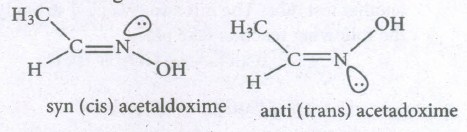
Write a note on cis-trans isomerism in oximes and azo compounds.
5.
8 g of methane is placed in a 5 litre container at 27° C. Find Boyle's constant.
6.
Define entropy of vapourisation.
7.
What is hydrogen bonding?
8.
The number of elements in the first period is only 2. Give reason.
9.
Categorise the redox reactions that occur in our daily life
10.
Calculate the total number of angular nodes and radial nodes present in 3p-orbital.
1.
(i) The principle involved is different compounds are adsorbed on an adsorbent to different degree.
(ii) Silica gel and alumina are the commonly used adsorbent. The components of the mixture move by varying distances over the stationary phase.
2.
1. A standard solution or a stock solution is a solution whose concentration is accurately known.
2. A standard solution of required concentration can be prepared by dissolving a required amount of a solute in a suitable amount of solvent.
3. It is done by transforming a known amount of solute to a standard flask of definite volume. A small amount of water is added to the flask and shaken well to dissolve the salt.
4.Then water is added to the flask to bring the solution level to the mark indicated at the top end of the flask.
5. The flask is stoppered and shaken well to make concentration uniform.
3.
The change in pressure has significant eect only on equilibrium systems with gaseous components.
When the pressure on the sysem EMI tI·S· Increased, the volume decreases proportionately and the system responds by shifting the equilibrium in a direction that has fewer moles of gaseous molecules. Let us consider the synthesis of ammonia from nitrogen and hydrogen
\({ N }_{ 2 }\left( g \right) +3{ H }_{ 2 }\left( g \right) \rightleftharpoons { 2NH }_{ 3 }\left( g \right) \)
Let the system, be allowed to attain equilibrium in a cylinder with a piston. If we press the piston down to increase the pressure, the volume decreases.
The system responds to this effect by reducing the number of gas molecules. i.e. it favours the formation of ammonia. If we pull the piston upwards to reduce the pressure, the volume increases. It favours the decomposition of ammonia
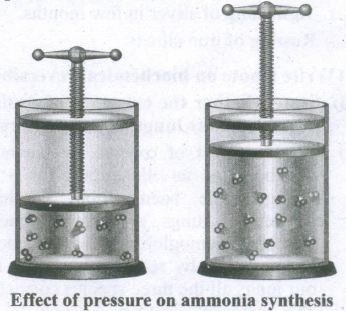
However, when the total number of the moles of the gaseous reactants and the gaseous products are equal, the change in pressure has no effect on system at equilibrium.
4.
Restricted rotation around C=N (oximes) gives rise· to geometrical isomerism in oximes. Here 'syn' and 'anti' are used instead of cis and trans respectively. In the syn isomer the H atom of a doubly bonded carbon and -OH group of doubly bonded nitrogen lie on the same side of the double bond, while in the anti isomer, they lie on the opposite side of the double bond. For Eg:
5.
PV = Boyle's constant.
But \(PV=nRT=\frac{w}{M}\times RT\)
=\(\frac{8}{10} mol \times0.0821 L atm K^{-1} mol^{-1}\times 300 K \)
= 12.315 L atm.
Hence Boyle's constant is 12.315 L atm.
6.
The heat absorbed, when one mole of liquid is boiled at its boiling point reversibly, is called molar heat of vapourisation. The entropy change is given by
\({ \triangle S }_{ v }=\frac { { \triangle H }_{ v } }{ { T }_{ b } } \)
where ΔHv is Molar heat of vaporisation. Tb is boiling point.
7.
Hydrogen bonding is because of dipole-dipole interactions between the molecule in which hydrogen atom is covalently bonded to a highly electronegative atom.
8.
The first period n= 1, it is the first energy level and has only 1s orbital which can accommodate a maximum of 2 electrons hence the number of elements in the first period is only 2.
9.
1. Fading of the colour of the clothes
2. Burning of cooking gas, fuel, wood, etc.
3. Rusting of Iron
4. Extraction of Metals
10.
For 3p-orbital n = 3, l = 1
Number of angular nodes = l = 1
Number of radial nodes = n - l -1 = 3 - 1 - 1 =1

11th Standard Syllabus & Materials
11th Standard
TN 11th Tamil பீடு பெற நில் - செய்யுள் - காவடிச்சிந்து Important Questions And Answers Study Material - QB365 Set A
NEW11th Standard
TN 11th Tamil பீடு பெற நில் - உரைநடை - மலை இடப்பெயர்கள் : ஓர் ஆய்வு Important Questions And Answers Study Material - QB365 Set A
NEW11th Standard
TN 11th Tamil மாமழை போற்றுதும் - துணைப்பாடம் - யானை டாக்டர் Important Questions And Answers Study Material - QB365 Set A
NEW11th Standard
TN 11th Tamil மாமழை போற்றுதும் - செய்யுள் - ஐங்குறுநூறு Important Questions And Answers Study Material - QB365 Set A



Tamilnadu Stateboard 11th Standard Subjects

Maths

Commerce

Economics

Biology

Business Maths and Statistics

Accountancy

Computer Science

Physics
Chemistry
Maths
Biology
Economics
Physics
Chemistry

History
Business Maths and Statistics

Computer Science
Accountancy

Computer Applications
History
Computer Technology
Commerce
Computer Applications
Computer Technology

Tamil

English

French
Tamilnadu Stateboard Standards



