
 100% FREE ACCESS
11th Standard Syllabus & Materials
11th Standard
TN 11th Tamil இயற்கை வேளாண்மை,சுற்றுச்சூழல் -செய்யுள் - மனோன்மணீயம் Important Questions And Answers Study Material - QB365 Set A
NEW11th Standard
TN 11th Tamil என்னுயிர் என்பேன் -துணைப்பாடம் - இசைத்தமிழர் இருவர் Important Questions And Answers Study Material - QB365 Set A
NEW11th Standard
TN 11th Tamil மொழி கலை -செய்யுள் - ஒவ்வொரு புல்லையும் Important Questions And Answers Study Material - QB365 Set A
NEW11th Standard
TN 11th Tamil பீடு பெற நில் - இலக்கணம் - பகுபத உறுப்புகள் Important Questions And Answers Study Material - QB365 Set A
NEW11th Standard
TN 11th Tamil பீடு பெற நில் - துணைப்பாடம் - வாடிவாசல் Important Questions And Answers Study Material - QB365 Set A
NEW11th Standard
TN 11th Tamil பீடு பெற நில் - செய்யுள் - குறுந்தொகை Important Questions And Answers Study Material - QB365 Set A

Published on: 13/05/2022
QB365 provides detailed and simple solution for every
Creative Questions in class 11 Chemistry Subject. It will
helps to get more idea about question pattern in every Creative questions with solution.
Download Tamil Nadu 11th Standard Chemistry question papers, model tests, one-mark questions, important questions, and public exam papers in PDF format. Free study materials and answer keys for TN State Board students.
Questions + Answers key
Take MCQ Chemistry Test1.
What is meant by boiling point and condensation point of the liquid?
2.
Explain why BeH2 molecule has a zero dipole moment although the Be - H bonds are polar.
3.
Graphically prove that Tb is greater than Tob
4.
Suggest and explain the method suitable to purify the organic compounds depending on their boiling points.
5.
What causes the temporary and permanent hardness of water?
6.
What are all the factors that influences electron gain enthalpy?
7.
Explain the Castner-Kellner process of manufacturing sodium hydroxide.
8.
Define the Heat of Transition
9.
Calculate the equivalent weight of H3PO4 and Ca(OH)2 on the basis of given reaction.
H3PO4 + NaOH \(\longrightarrow\) NaH2PO4 + H2O
Ca(OH)2 + HCl \(\longrightarrow\) Ca(OH)Cl + H2O
10.
In Rutherford's experiment, generally thin foil of heavy atoms, like gold, platinum etc. have been used to bombard the α-particles. If the thin foil of light atoms like aluminum is used, what difference would be observed from the above results?
1.
The temperature at which the liquid and vapour phases are at equilibrium is called the boiling point and condensation point of the liquid.
2.
The Lewis structure for BeH2 molecule is as follows : H : Be : H
There is no lone pair at the central atom (Be) and there are two bond pairs. Hence, BeH2 is of the type AB2. It has a linear structure.
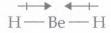
Dipole moments of each Be-H bond are equal and opposite in direction. Therefore, they nullify each other. Hence, BeH2 has a net zero dipole moment.
3.
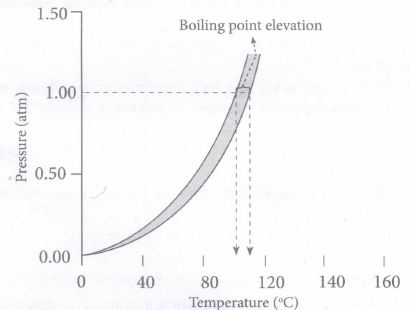
(i) The vapour pressure of the solution increases with increase in temperature. The variation of vapour pressure with respect to temperature of pure water is given by the curve-A.
(ii) At 100oC, the vapour pressure of water is equal to 1 atm. Hence, the boiling point of water is 100o-C (Tob)'
(iii) When a solute is added to water, the vapour pressure of the resultant solution is lowered. The variation of vapour pressure with respect to temperature for the solution is given by curve-B.
(iv) From the graph, it is evident that the vapour pressure of the solution is equal to 1 atm. pressure at the temperature Tb which is greater than Tob' The difference between these two temperatures (Tb - Tob) gives the elevation of boiling point.
\(\Delta { T }_{ b }={ T }_{ b }-{ { T }_{ b }^{ o } }\)
4.
This method is to purify liquids from non-volatile impurities, and used for separating the constituents of a liquid mixture which differ in their boiling points.
There are various methods of distillation depending upon the difference in the boiling points of the constituents. The methods are
(i) simple distillation
(ii) fractional distillation and
(iii) steam distillation.
The process of distillation involves the impure liquid when boiled gives out vapour and the vapour so formed is collected and condensed to give back the pure liquid in the receiver. is method is called simple distillation. Liquids with large difference in boiling point (about 40K) and do not decompose under ordinary pressure can be purified by simply distillation Eg. The mixture of C6H5NO2 (b.p 484K) & C6H6(354K) and mixture of diethyl ether (b.p 308K) and ethyl alcohol (b.p 351K)
5.
Temporary hardness of water is due to the presence of bicarbonates of calcium and magnesium in water i.e., Ca(HCO3)2 and Mg(HCO3) in water. Permanent hardness of water is due to the presence of soluble chlorides and sulphates of calcium and magnesium i.e., CaCI2, CaSO4, MgCl2 and MgSO4.
6.
(i) Size of the atom: The new electron which was added experiences stronger attraction to its nucleus if the atoms are smaller in size.
\(Atomic\ size \ \infty{1\over Electron \ gain \ enthalpy}\)
(ii) Nuclear charge: The new electron which was added experiences stronger attraction to its nucleus if the atom possess greater nuclear charge.
Nuclear charge \(\infty\) Electron gain enthalpy
(iii) Electronic configuration: An atom with stable electronic configuration has no tendency to gain an electron. Such atoms have zero or almost zero electron gain enthalpy.
7.
Sodium hydroxide is prepared commercially by the electrolysis of brine solution in Castner-Kellner cell using a mercury cathode and a carbon anode. Sodium metal is discharged at the cathode and combines with mercury to form sodium amalgam. Chlorine gas is evolved at the anode. The sodium amalgam thus obtained is treated with water to give sodium hydroxide.
At cathode: Na+ + e- ⟶ Na(amalgam)
At anode: Cl- ⟶ 1/2Cl2 ↑ + e-
2Na(amalgam) + 2H2O ⟶ 2NaOH + 2Hg + H2↑
8.
Heat of Transition: The heat of transition is defined as "The change in enthalpy when one mole of an element changes from one allotropic form to another. For example, the transition of diamond into graphite may be represented as
C(diamond) ⟶ C(graphite) ΔHtrans = + 13.81 KJ
S(monoclinic) ⟶ S(rhombic) ΔHtrans = -0.067 KJ
9.
Equivalent weight of H3PO4
= \(\frac { Molecular\ mass }{ No.of\ replaceable\ { H }^{ + } } =\frac { 98 }{ 1 } =98\)
Equivalent weight of Ca(OH)2
= \(\frac { Molecular\ mass }{ No.of\ replaceable\ {O H }^{ - } } =\frac { 74 }{ 1 } =74\)
10.
1. Heavy atoms like gold, platinum have heavy nucleus. Heavy nucleus contains large amount of positive charge.
2. When a beam of \(\alpha\)α-particles is shot at a thin gold foil, most of them pass through without much effect.
3. Some are deflected back due to enormous repulsive force of heavy nucleus.
4. If thin foil is made of light aluminium, then the number of \(\alpha\) α-particles deflected back will be negligible.

11th Standard Syllabus & Materials
11th Standard
TN 11th Tamil பீடு பெற நில் - செய்யுள் - காவடிச்சிந்து Important Questions And Answers Study Material - QB365 Set A
NEW11th Standard
TN 11th Tamil பீடு பெற நில் - உரைநடை - மலை இடப்பெயர்கள் : ஓர் ஆய்வு Important Questions And Answers Study Material - QB365 Set A
NEW11th Standard
TN 11th Tamil மாமழை போற்றுதும் - துணைப்பாடம் - யானை டாக்டர் Important Questions And Answers Study Material - QB365 Set A
NEW11th Standard
TN 11th Tamil மாமழை போற்றுதும் - செய்யுள் - ஐங்குறுநூறு Important Questions And Answers Study Material - QB365 Set A



Tamilnadu Stateboard 11th Standard Subjects

Maths

Commerce

Economics

Biology

Business Maths and Statistics

Accountancy

Computer Science

Physics
Chemistry
Maths
Biology
Economics
Physics
Chemistry

History
Business Maths and Statistics

Computer Science
Accountancy

Computer Applications
History
Computer Technology
Commerce
Computer Applications
Computer Technology

Tamil

English

French
Tamilnadu Stateboard Standards



