
 100% FREE ACCESS
11th Standard Syllabus & Materials
11th Standard
TN 11th Tamil இயற்கை வேளாண்மை,சுற்றுச்சூழல் -செய்யுள் - மனோன்மணீயம் Important Questions And Answers Study Material - QB365 Set A
NEW11th Standard
TN 11th Tamil என்னுயிர் என்பேன் -துணைப்பாடம் - இசைத்தமிழர் இருவர் Important Questions And Answers Study Material - QB365 Set A
NEW11th Standard
TN 11th Tamil மொழி கலை -செய்யுள் - ஒவ்வொரு புல்லையும் Important Questions And Answers Study Material - QB365 Set A
NEW11th Standard
TN 11th Tamil பீடு பெற நில் - இலக்கணம் - பகுபத உறுப்புகள் Important Questions And Answers Study Material - QB365 Set A
NEW11th Standard
TN 11th Tamil பீடு பெற நில் - துணைப்பாடம் - வாடிவாசல் Important Questions And Answers Study Material - QB365 Set A
NEW11th Standard
TN 11th Tamil பீடு பெற நில் - செய்யுள் - குறுந்தொகை Important Questions And Answers Study Material - QB365 Set A

Published on: 25/06/2021
QB365 provides detailed and simple solution for every
Creative Questions in class 11 Chemistry Subject. It will
helps to get more idea about question pattern in every Creative questions with solution.
Download Tamil Nadu 11th Standard Chemistry question papers, model tests, one-mark questions, important questions, and public exam papers in PDF format. Free study materials and answer keys for TN State Board students.
Questions + Answers key
Take MCQ Chemistry Test1.
At certain temperature and under a pressure of 4 atm, PCl5 is 10% dissociated. Calculate the pressure at which PCls will be 20% dissociated at temperature remaining constant.
2.
Explain about the bonding in metals by molecular orbital theory.
3.
(i) Prove that relative lowering of vapour pressure is a colligative property.
(ii) Write down the formula (and expand the terms) used for the determination of molar mass.
4.
Describe Solvay process (or) how is washing soda (or) sodium carbonate prepared in industries?
5.
Distinguish between electron affinity and electron negativity.
6.
Explain the angular distribution function of 1s, 2s, 3s, 2p, 3d and 4f orbits.
7.
Balance the following equations by oxidation number method.
KMnO4 + KOH + H2O2 ⟶ K2MnO4 + O2 + H2O
8.
Give the chemical properties of heavy water and water.
9.
Calculate the maximum % efficiency of thermal engine operating between 110o and 25o.
1.
Calculation of KP
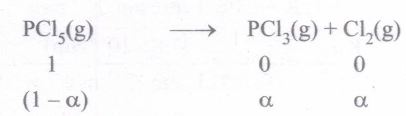
Total no. of moles in the equilibrium mixture = 1 - α + α + α = (1 + a) mol.
Let the total pressure of equilibrium mixture =p atm
Partial pressure of PCI5,\({ PCl }_{ 3 }=\cfrac { \alpha }{ 1+\alpha } \times p\quad atm\)
Partial pressure of \({ PCL }_{ 3 }=\cfrac { \alpha }{ 1+\alpha } \times p\quad atm\)
Partial pressure of Cl2=\({ PCl }_{ 2 }=\cfrac { \alpha }{ 1+\alpha } \)
\({ K }_{ P }=\cfrac { P_{ PCl_{ 3 } }\times { P }_{ cl_{ 2 } } }{ { P }_{ PC{ l }_{ 5 } } } =\cfrac { \left( \frac { \alpha }{ 1+\alpha } p\quad atm \right) \times \left( \cfrac { \alpha }{ 1+\alpha } p\quad atm \right) }{ \frac { 1-\alpha }{ 1+\alpha } p\quad atm } =\cfrac { { a }^{ 2 }p }{ 1-{ a }^{ 2 } } \)
P=4 atm and α.= 10%= \(\cfrac { 10 }{ 100 } =0.1\)
\({ K }_{ P }=\cfrac { \left( 0.1 \right) \times \left( 0.1 \right) \times \left( 4atm \right) }{ 1-\left( 0.1 \right) ^{ 2 } } =\cfrac { 0.04 }{ 0.99 } =0.004atm\)
= 0.96 atm
2.
(i) According to molecular orbital theory the atomic orbitals of large number of atoms in a crystal overlap to form numerous bonding and anti-bonding molecular orbitals without any band gap.
(ii) The bonding molecular orbitals are completely filled with an electron pair in each and the anti-bonding molecular orbitals are empty.
(iii) Absence of band gap accounts for high electrical conductivity of metals.
(iv) High thermal conductivity is due to thermal excitation of many electrons from the valence band to the conduction band.
(v) With an increase in temperature, the electrical conductivity decreases due to vigorous thermal motion of lattice ions that disrupts.
3.
(i) The vapour pressure of a solution containing a nonvolatile, non-electrolyte solute is always lower than the vapour pressure of the pure solvent. Consider a closed system in which a pure solvent is in equilibrium with its vapour. At equilibrium the molar Gibb's free energies of solvent in the liquid and gaseous phase are equal (\(\triangle\)G = 0). When a solute is added to this solvent, the dissolution takes place and its free energy (G) decreases due to increase in entropy. In order to maintain the equilibrium, the free energy of the vapour phase must also decrease. At a given temperature, the only way to lower the free energy of the vapour is to reduce its pressure. Thus the vapour pressure of the solution must decrease to maintain the equilibrium.
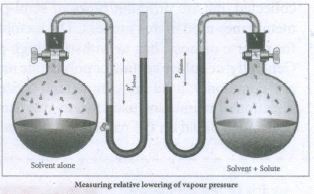
We know that from the Raoult's law the relative lowering of the vapour pressure is equal to the mole fraction of the solute From the above equation,it is clear that the relative lowering of vapour pressure depends only on the mole fraction of the solute (xB)and is independent of its nature. Therefore, relative lowering of vapour pressure is a colligative property.
(ii) \(\frac { \triangle P }{ { P }_{ A }^{ 0 } } =\frac { { W }_{ B }\times { M }_{ A } }{ { M }_{ B }\times { W }_{ A } } \)
\(\frac { \triangle P }{ { P }_{ A }^{ 0 } } \) - relative lowering of vapour pressure
WA and WB - weights of solvent and solute.
MA and MB - Molar masses of solvent and solute
4.
(i) Solvay process - in this process ammonia is converted to ammonium carbonate, which is then converted to ammonium bicarbonate by passing excess carbon dioxide in sodium chloride solution saturated with ammonia.
(ii) The ammonium bicarbonate formed reacts with soctium chloride to give sodium bicarbonate. As sodium bicarbonate has poor solubility, it gets precipitated.
(iii) The sodium bicarbonate is isolated and is heated to give sodium carbonate.
(iv) The equations involved in this process is as below:
i) \(2NH_3 + H_2O + CO_2 ⟶\underset{Ammonium\ carbonate}{ (NH_4)2CO_3}\)
ii) \((NH_4)2CO_3 + H_2O + CO_2 ⟶ \underset{Ammonium\ bicarbonate}{2NH_4HCO_3}\)
iii) \(NH_4HCO_3 + NaCl⟶\underset{Ammonium\ chloride}{NH_4Cl + NaHCO_3}\)
iv) \(2NaHCO_3\xrightarrowΔ\underset{Sodium\ carbonate}{Na_2CO_3 }+ CO_2 + H_2O\)
5.
| Electron affinity | Electron negativity | |
| 1. | It is the tendency of an isolated gaseous atom to gain an electron. | It is the tendency of an atom in a molecule to attract the shared pair of electrons. |
| 2. | It is the property of an isolated atom. | It is the property of bonded atom. |
| 3. | It does not change regularly in a period or a group. | It changes regularly in a period or a group. |
| 4. | ·It is measured in electron volts\atom or kcal\mole or kJ/mole. | It is a number and has no units. |
6.
The variation of the probability of locating the electron on a sphere with nucleus at its centre depends on the azimuthal quantum number of the orbital in which the electron is present.
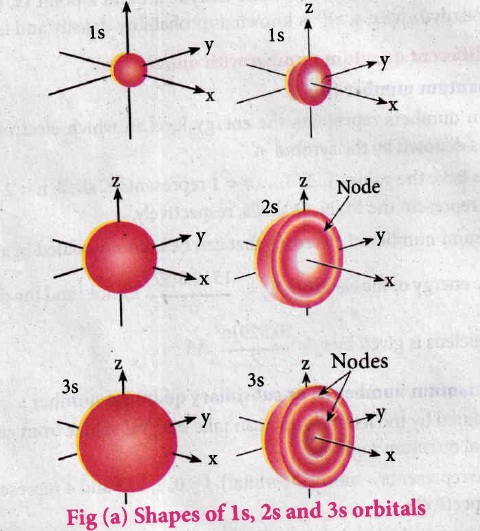
For 1s orbital, l = 0, m = 0,\(f(\theta)=\frac{1}{\sqrt 2}\)and \(g(\varphi)=\frac{1}{\sqrt 2\pi}\) Therefore, the angular distribution function is equal to \(\frac{1}{2\sqrt \pi }\)
i.e. it is independent of the angle \(\theta\) and \(\varphi\). Hence, the probability of finding the electron is independent of the direction from the nucleus. So, the shape of the s orbital is spherical.
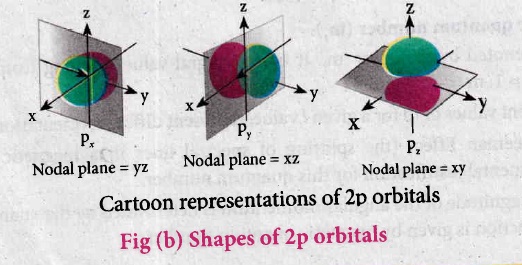
For p orbitals, l = 1 and the corresponding m values are -1, 0 and +1. The angular distribution functions are quite complex and are not discussed here, The shape of the p orbital is shown in Figure (b). The three different m values indicates that there are three different orientations possible for p orbitals. These orbitals are designated as Px, Py and Pz and the angular distribution for these orbitals shows that the lobes are along the x, y arid z axis respectively. As seen in the Figure the 2p orbitals have one nodal plane
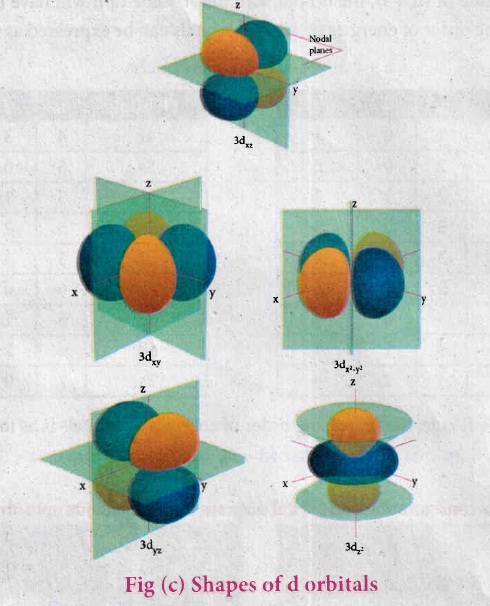
For 'd' orbital l = 2 and the corresponding m values are -2, -1, 0, +1, +2. The shape of the d orbital looks like a 'clover leaf'.
The five m values give rise to five d orbitals namely dxy, dyz, dzx, dx2-y2 and dz2. The 3d orbitals contain two nodal planes.
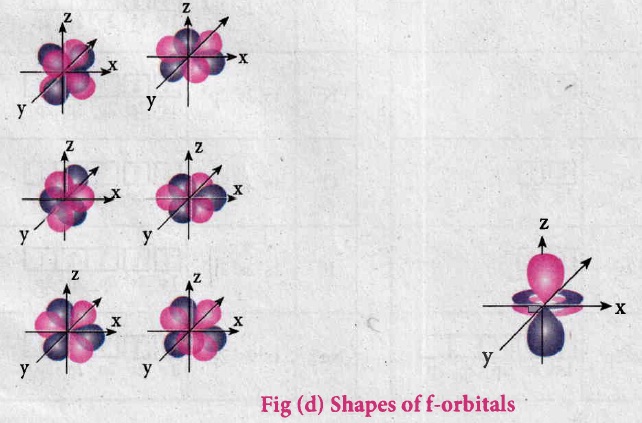
For 'f' orbital, l = 3 and the m values are -3, -2,-1,0, +1, +2, +3 corresponding to seven f orbitals. fz3, fxz2,fyz2,fxyz,fz(x2 - y2),fx(x2 - 3y2),fy(3x2 - y2) which are shown in Figure. There are 3 nodal planes in the f-orbitals.
7.
Step - 1 : To find out atoms undergoing change in O.N.
\(\overset { +1+7-2 }{ KMnO_{ 4 } } +\overset { +1-2+1 }{ KOH } +\overset { +1-1 }{ { H }_{ 2 }{ O }_{ 2 } } \rightarrow +\overset { +1+6-2 }{ K_{ 2 }MnO_{ 4 } } +\overset { 0 }{ { O }_{ 2 } } +\overset { +1-2 }{ { H }_{ 2 }O } \)
Step - 2 : To find out total increase and decrease in O.N .
\(\overset { +7 }{ KMnO_{ 4 } } \rightarrow \overset { +6 }{ K_{ 2 }MnO_{ 4 } } \) (decrease of 1 unit per atom)
\(\overset { -1 }{ { H }_{ 2 }{ O }_{ 2 } } \rightarrow \overset { 0 }{ { O }_{ 2 } } \) (increase of 1 unit per atom or 2 units per atom)
Total increase = 2
Total decrease = 2
Step - 3 : To balance the total increase and decrease in O.N, multiply KMnO4 by 2.
2KMnO4 + KOH + H2O2 ⟶ K2MnO4 + O2 + H2O
Step - 4 : To balance all atoms other than 'H' and 'O'
2KMnO4 + 2KOH + H2O2 ⟶ 2K2MnO4 + O2 + H2O
number of oxygen atoms on LHS = 12
number of oxygen atoms on RHS = 11
Hence, multiply H2O in RHS by 2. The equation becomes,
2KMnO4 + 2KOH + H2O2 ⟶ 2K2MnO4 + O2 + H2O
Hydrogen atoms balance by themselves. The balanced equation is
2KMnO4 + 2KOH + H2O2 ⟶ 2K2MnO4 + O2 + 2H2O
8.
Heavy water is chemically similar to ordinary water (H20). However D20 reacts more slowly than H20 in chemical reactions.
(i) When compounds containing hydrogen are treated with D20, hydrogen undergoes an exchange for deuterium
2NaOH + D20 \(\rightarrow\) 2NaOD + HOD
HCI + D20\(\rightarrow\) DCI + HOD
NH4CI + 4D20 \(\rightarrow\) ND4CI + 4HOD .
These exchange reactions are useful in determining the number of ionic hydrogens present in a given compound.
For example, when D20 is treated with of hypo-phosphorus acid only one hydrogen atom is exchanged with deuterium. It indicates that, it is a monobasic acid.
H3P02 + D20 \(\rightarrow\) H2DP02 + HDO
(ii) It is also used to prepare some deuterium compounds:
Al4C3 + 12D20 \(\rightarrow\) 4AI(OD)3 + 3CD4
CaC2 + 2 D20\(\rightarrow\) Ca(OD)2 + C2D2
Mg3N2 + 6D20 \(\rightarrow\) 3Mg(OD)2 + 2 ND3
Ca3P 2+ 6D20\(\rightarrow\) 3Ca(OD)2 +2PD3
9.
% Efficiency = \([\frac{T_1-T_2}{T_1}]\times100\)
T1=110+273=383 K.
T2=25+273=298 K.
% Efficiency = \([\frac{383-298}{383}]\times100\)
=22%.

11th Standard Syllabus & Materials
11th Standard
TN 11th Tamil பீடு பெற நில் - செய்யுள் - காவடிச்சிந்து Important Questions And Answers Study Material - QB365 Set A
NEW11th Standard
TN 11th Tamil பீடு பெற நில் - உரைநடை - மலை இடப்பெயர்கள் : ஓர் ஆய்வு Important Questions And Answers Study Material - QB365 Set A
NEW11th Standard
TN 11th Tamil மாமழை போற்றுதும் - துணைப்பாடம் - யானை டாக்டர் Important Questions And Answers Study Material - QB365 Set A
NEW11th Standard
TN 11th Tamil மாமழை போற்றுதும் - செய்யுள் - ஐங்குறுநூறு Important Questions And Answers Study Material - QB365 Set A



Tamilnadu Stateboard 11th Standard Subjects

Maths

Commerce

Economics

Biology

Business Maths and Statistics

Accountancy

Computer Science

Physics
Chemistry
Maths
Biology
Economics
Physics
Chemistry

History
Business Maths and Statistics

Computer Science
Accountancy

Computer Applications
History
Computer Technology
Commerce
Computer Applications
Computer Technology

Tamil

English

French
Tamilnadu Stateboard Standards



