
 100% FREE ACCESS
11th Standard Syllabus & Materials
11th Standard
TN 11th Tamil இயற்கை வேளாண்மை,சுற்றுச்சூழல் -செய்யுள் - மனோன்மணீயம் Important Questions And Answers Study Material - QB365 Set A
NEW11th Standard
TN 11th Tamil என்னுயிர் என்பேன் -துணைப்பாடம் - இசைத்தமிழர் இருவர் Important Questions And Answers Study Material - QB365 Set A
NEW11th Standard
TN 11th Tamil மொழி கலை -செய்யுள் - ஒவ்வொரு புல்லையும் Important Questions And Answers Study Material - QB365 Set A
NEW11th Standard
TN 11th Tamil பீடு பெற நில் - இலக்கணம் - பகுபத உறுப்புகள் Important Questions And Answers Study Material - QB365 Set A
NEW11th Standard
TN 11th Tamil பீடு பெற நில் - துணைப்பாடம் - வாடிவாசல் Important Questions And Answers Study Material - QB365 Set A
NEW11th Standard
TN 11th Tamil பீடு பெற நில் - செய்யுள் - குறுந்தொகை Important Questions And Answers Study Material - QB365 Set A

Published on: 13/05/2022
QB365 provides detailed and simple solution for every Book back Questions in class 11 Chemistry Subject. It will helps to get more idea about question pattern in every book back questions with solution.
latest Book back QuestionsDownload Tamil Nadu 11th Standard Chemistry question papers, model tests, one-mark questions, important questions, and public exam papers in PDF format. Free study materials and answer keys for TN State Board students.
Questions + Answers key
Take MCQ Chemistry Test1.
In the estimation of nitrogen present in an organic compound by Dumas method 0.35 g yielded 20.7 mL of nitrogen at 150 C and 760 mm pressure. Calculate the percentage of nitrogen in the compound.
2.
0.32 g of an organic compound, after heating with fuming nitric acid and barium nitrate crystals is a sealed tube game 0.466 g of barium sulphate. Determine the percentage of sulphur in the compound.
3.
0.30 g of a substance gives 0.88 g of carbon dioxide and 0.54 g of water calculate the percentage of carbon and hydrogen in it.
4.
Explain paper chromatography.
5.
Describe optical isomerism with suitable example.
1.
\( \mathrm{w} = 0.35 \mathrm{~g} \)
\(\mathrm{~V}_1 = 31.7 \mathrm{~mL}=31.7 \times 10^{-3} \mathrm{~L} \)
\(\mathrm{~T}_1 = 15^{\circ} \mathrm{C}=273+15=288 \mathrm{k} \)
\(\mathrm{P}_1 = 760-12.8=747.2 \mathrm{~atm} \)
\(\mathrm{~V}_0 = ? \)
\(\mathrm{P}_0 = 760 \mathrm{~atm} \mathrm{~T}_0 = 273 \mathrm{~K} \)
\( \frac{\mathrm{P}_0 \mathrm{~V}_0}{\mathrm{~T}_0}=\frac{\mathrm{P}_1 \mathrm{~V}_1}{\mathrm{~T}_1} \text { (or) } \mathrm{V}_0=\frac{\mathrm{P}_1 \mathrm{~V}_1}{\mathrm{~T}_1} \times \frac{\mathrm{T}_0}{\mathrm{P}_0} \)
\(\mathrm{~V}_0=\frac{747.2 \times 31.7 \times 10^{-3} \times 273}{288 \times 760}=2.95 \times 10^{-2} \mathrm{~L} \)
\(\therefore \% \mathrm{~N}=\ \frac{28}{22.4} \times \frac{\mathrm{V}_0}{\mathrm{w}} \times 100\)
2.
w = 0.32 g and x = 0.466 g
\(
\% \mathrm{~S} =\frac{32}{233} \times \frac{\mathrm{x}}{\mathrm{w}} \times 100
\)
\(=\frac{32}{233} \times \frac{0.466}{0.32} \times 100=20 \%\)
3.
W = 0.3 g
x = 0.54 g
y = 0.88 g
\(
\% \mathrm{C} =\frac{12}{44} \times \frac{\mathrm{y}}{\mathrm{w}} \times 100=\frac{12}{44} \times \frac{0.88}{0.30} \times 100=80 \%
\)
\(\% \mathrm{H}=\quad \frac{2}{18} \times \frac{\mathrm{x}}{\mathrm{w}} \times 100=\frac{2}{18} \times \frac{0.54}{0.30} \times 100=20 \%\)
4.
Partition Chromatography:
Paper chromatography (PC) is an example of partition chromatography. The same procedure is followed as in thin layer chromatography except that a strip of paper acts as an adsorbent is method involves continues differential portioning of components of a mixture between stationary and mobile phase. In paper chromatography, a special quality paper known as chromatography paper is used. This paper act as a stationary phase.
A strip of chromatographic paper spotted at the base with the solution of the mixture is suspended in a suitable solvent which act as the mobile phase solvent rises up and flows over the spot. The paper selectively retains different components according to their different partition in the two phases where a chromatogram is developed. The spots of the separated colored compounds are visible at different heights from the position of initial spots on the chromatogram. The spots of the separated colorless compounds may be observed either under ultraviolent light or by the use of an appropriate spray reagent.
5.
Optical isomerism:
Compounds having same physical and chemical property but differ only in the rotation of plane of the polarized light are known as optical isomers and the phenomenon is known as optical isomerism.
Some organic compounds such as glucose have the ability to rotate the plane of the plane polarized light and they are said to be optically active compounds and this property of a compound is called optical activity. The optical isomer, which rotates the plane of
the plane polarised light to the right or in cloclauisl direction is said to be dextrorotary (dexter means right) denoted by the sign (+), whereas the compound which rotates to the left or anticloclanrise is said to be leavo rotatory (leanues mean left) denoted by sign(-).
Dextrorotatory compounds are represented as 'd' or by sign (+) and lavorotatory compounds are ( - ) represented as 'l' or by sign (-).
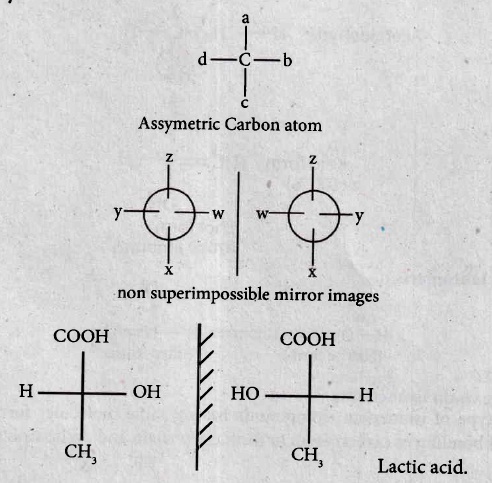
Enantiomerism and optical activity: An optically active substance may exist in two or more isomeric forms which have same physical and chemical properties but differ in terms of direction of rotation of plane polarized light, such optical isomers which rotate the plane of polarized light with equal angle but in opposite direction are known as enantiomers and the phenomenon is knovrrn as enantiomerism. Isomers which are non-super impossible mirror images of each other are called enantiomers.
conditions for enantiomerism or optical isomerism:
A carbon atom whose tetra vaiency is satisfied by four different substituents (atoms or groups) is called a symmetric carbon or chiral carbon. It is indicated by an asterisk as C*. A molecule Possessing chiral carbon atom and non-super impossible to its own mirror image is said to be a chiral molecule or asymmetric, and the pioperty is called chirality or dissymmetry.

11th Standard Syllabus & Materials
11th Standard
TN 11th Tamil பீடு பெற நில் - செய்யுள் - காவடிச்சிந்து Important Questions And Answers Study Material - QB365 Set A
NEW11th Standard
TN 11th Tamil பீடு பெற நில் - உரைநடை - மலை இடப்பெயர்கள் : ஓர் ஆய்வு Important Questions And Answers Study Material - QB365 Set A
NEW11th Standard
TN 11th Tamil மாமழை போற்றுதும் - துணைப்பாடம் - யானை டாக்டர் Important Questions And Answers Study Material - QB365 Set A
NEW11th Standard
TN 11th Tamil மாமழை போற்றுதும் - செய்யுள் - ஐங்குறுநூறு Important Questions And Answers Study Material - QB365 Set A



Tamilnadu Stateboard 11th Standard Subjects

Maths

Commerce

Economics

Biology

Business Maths and Statistics

Accountancy

Computer Science

Physics
Chemistry
Maths
Biology
Economics
Physics
Chemistry

History
Business Maths and Statistics

Computer Science
Accountancy

Computer Applications
History
Computer Technology
Commerce
Computer Applications
Computer Technology

Tamil

English

French
Tamilnadu Stateboard Standards



