
 100% FREE ACCESS
11th Standard Syllabus & Materials
11th Standard
TN 11th Tamil இயற்கை வேளாண்மை,சுற்றுச்சூழல் -செய்யுள் - மனோன்மணீயம் Important Questions And Answers Study Material - QB365 Set A
NEW11th Standard
TN 11th Tamil என்னுயிர் என்பேன் -துணைப்பாடம் - இசைத்தமிழர் இருவர் Important Questions And Answers Study Material - QB365 Set A
NEW11th Standard
TN 11th Tamil மொழி கலை -செய்யுள் - ஒவ்வொரு புல்லையும் Important Questions And Answers Study Material - QB365 Set A
NEW11th Standard
TN 11th Tamil பீடு பெற நில் - இலக்கணம் - பகுபத உறுப்புகள் Important Questions And Answers Study Material - QB365 Set A
NEW11th Standard
TN 11th Tamil பீடு பெற நில் - துணைப்பாடம் - வாடிவாசல் Important Questions And Answers Study Material - QB365 Set A
NEW11th Standard
TN 11th Tamil பீடு பெற நில் - செய்யுள் - குறுந்தொகை Important Questions And Answers Study Material - QB365 Set A

Published on: 25/06/2021
QB365 provides detailed and simple solution for every
Creative Questions in class 11 Chemistry Subject. It will
helps to get more idea about question pattern in every Creative questions with solution.
Download Tamil Nadu 11th Standard Chemistry question papers, model tests, one-mark questions, important questions, and public exam papers in PDF format. Free study materials and answer keys for TN State Board students.
Questions + Answers key
Take MCQ Chemistry Test1.
Suggest and explain the method suitable to purify the organic compounds depending on their boiling points.
2.
Explain how benzoic acid (or Naphthalene or camphor) purified. (or) Explain how a substance is purified by sublimation.
3.
(i) Give the test to predict the .presence of Cl, Br and I in an organic compound.
(ii) How will you eliminate in Nand S present in an organic halogen compund?
4.
How would you detect the presence of carbon and hydrogen in a compound?
5.
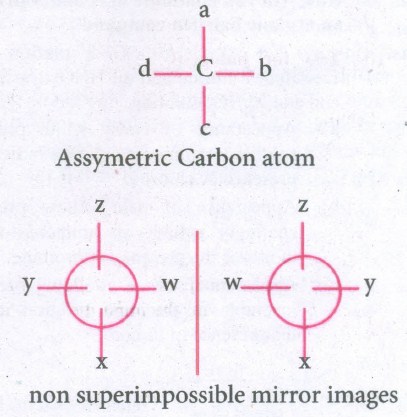
Discuss the conditions for optical isomerism.
1.
This method is to purify liquids from non-volatile impurities, and used for separating the constituents of a liquid mixture which differ in their boiling points.
There are various methods of distillation depending upon the difference in the boiling points of the constituents. The methods are
(i) simple distillation
(ii) fractional distillation and
(iii) steam distillation.
The process of distillation involves the impure liquid when boiled gives out vapour and the vapour so formed is collected and condensed to give back the pure liquid in the receiver. is method is called simple distillation. Liquids with large difference in boiling point (about 40K) and do not decompose under ordinary pressure can be purified by simply distillation Eg. The mixture of C6H5NO2 (b.p 484K) & C6H6(354K) and mixture of diethyl ether (b.p 308K) and ethyl alcohol (b.p 351K)
2.
Few substances like benzoic acid, naphthalene and camphor when heated pass directly from solid to vapor without melting (ie liquid). On cooling the vapours will give back solids. Such phenomenon is called sublimation. It is a useful technique to separate volatile and non-volatile solid. It has limited application because only a few substance will sublime.
Substances to be purified is taken in a beaker. It is covered with a watch glass. The beaker is heated for a while and the resulting vapours condense on the bottom of the watch glass. Then the watch glass is removed and the crystals are collected. This method is applicable for organic substance which has high vapour pressure at temperature below their melting point. Substances like naphthalene, benzoic acid can be sublimed quickly. Substance which has very small vapour pressure will decompose upon heating are puried by sublimation under reduced pressure. This apparatus consists of large heating and large cooling surface with small distance in between because the amount of the substance in the vapour phase is much too small in case of a substance with low vapour pressure.
3.
(i) Test for halogens:To a portion of the Lassaigne's filtrate add dil HNO3 warm gently and add AgNO3 solution.
a) Appearance of curdy white precipitate soluble in ammonia solution indicates the presence of chlorine.
b) Appearance of pale yellow precipitate sparingly soluble in ammonia solution indicates the presence of bromine.
c) Appearance of a yellow precipitate insoluble in ammonia solution indicates I the presence of iodine.
\(Na+\underset { from\quad organic\\ compound }{ X } \overset { heat }{ \rightarrow } \quad \quad Na{ X }_{ (Where\quad X=Cl,\quad Br,I) }\)
Nax + AgNO3 AgX + NaNO3
(ii) If N or S is present in the compound along with the halogen, we might obtain NaCN and Na2S in the solution, which interfere with the detection of the halogen in the AgNO3 test Therefore we boil the Lassaignes extract with HNO3 which decomposes NaCN and Na2S as
\(NaCN+{ HNO }_{ 3 }\overset { \Delta }{ \rightarrow } { NaNO }_{ 3 }+HCN\uparrow \)
\({ Na }_{ 2 }S+{ 2HNO }_{ 3 }\overset { \Delta }{ \rightarrow } { aNaNO }_{ 3 }+{ H }_{ 2 }S\uparrow \)
\(NaCN+{ AgNO }_{ 3 }\overset { further }{ \rightarrow } \underset { white\quad ppt\quad confusing\quad with\quad AgCl }{ AgCN } +{ NaNO }_{ 3 }\)
\(\\ { Na }_{ 2 }S+{ AgNO }_{ 3 }\rightarrow \underset { black\quad ppt }{ { Ag }_{ 2 }S } \downarrow { NaNO }_{ 3 }\)
4.
The organic substance is mixed with about three times its weight of dry copper oxide by grinding. The mixture is then placed in a hard glass test tube fitted with a bent delivery tube. The other end of which is dipping into lime water in an another test tube. The mixture is heated strongly and the following reaction take place.
\(C+2CuO\longrightarrow { CO }_{ 2 }+2Cu\)
\(2H+CuO\longrightarrow { H }_{ 2 }O+Cu\)
Thus if carbon is present, it is oxidized to CO2 which turns lime water milky. Ifhydrogen is also present, it will be oxidized to water which condenses in small droplets on the cooler wall of the test tube and inside the bulb. Water is collected on anhydrous CuSO4 which turns anhydrous CuSO4 blue. This confirms the presence of C and H in the compound
5.
A carbon atom whose tetra valency is satisfied by four different substituents (atoms or groups) is called asymmetric carbon or chiral carbon. It is indicated by an asterisk as C*. A molecule possessing chiral carbon atom and non-super impossible to its own mirror image is said to be a chiral molecule or asymmetric, and the property is called chirality or dissymmetry.

11th Standard Syllabus & Materials
11th Standard
TN 11th Tamil பீடு பெற நில் - செய்யுள் - காவடிச்சிந்து Important Questions And Answers Study Material - QB365 Set A
NEW11th Standard
TN 11th Tamil பீடு பெற நில் - உரைநடை - மலை இடப்பெயர்கள் : ஓர் ஆய்வு Important Questions And Answers Study Material - QB365 Set A
NEW11th Standard
TN 11th Tamil மாமழை போற்றுதும் - துணைப்பாடம் - யானை டாக்டர் Important Questions And Answers Study Material - QB365 Set A
NEW11th Standard
TN 11th Tamil மாமழை போற்றுதும் - செய்யுள் - ஐங்குறுநூறு Important Questions And Answers Study Material - QB365 Set A



Tamilnadu Stateboard 11th Standard Subjects

Maths

Commerce

Economics

Biology

Business Maths and Statistics

Accountancy

Computer Science

Physics
Chemistry
Maths
Biology
Economics
Physics
Chemistry

History
Business Maths and Statistics

Computer Science
Accountancy

Computer Applications
History
Computer Technology
Commerce
Computer Applications
Computer Technology

Tamil

English

French
Tamilnadu Stateboard Standards



