
 100% FREE ACCESS
11th Standard Syllabus & Materials
11th Standard
TN 11th Tamil இயற்கை வேளாண்மை,சுற்றுச்சூழல் -செய்யுள் - மனோன்மணீயம் Important Questions And Answers Study Material - QB365 Set A
NEW11th Standard
TN 11th Tamil என்னுயிர் என்பேன் -துணைப்பாடம் - இசைத்தமிழர் இருவர் Important Questions And Answers Study Material - QB365 Set A
NEW11th Standard
TN 11th Tamil மொழி கலை -செய்யுள் - ஒவ்வொரு புல்லையும் Important Questions And Answers Study Material - QB365 Set A
NEW11th Standard
TN 11th Tamil பீடு பெற நில் - இலக்கணம் - பகுபத உறுப்புகள் Important Questions And Answers Study Material - QB365 Set A
NEW11th Standard
TN 11th Tamil பீடு பெற நில் - துணைப்பாடம் - வாடிவாசல் Important Questions And Answers Study Material - QB365 Set A
NEW11th Standard
TN 11th Tamil பீடு பெற நில் - செய்யுள் - குறுந்தொகை Important Questions And Answers Study Material - QB365 Set A

Published on: 13/05/2022
QB365 provides detailed and simple solution for every
Creative Questions in class 11 Chemistry Subject. It will
helps to get more idea about question pattern in every Creative questions with solution.
Download Tamil Nadu 11th Standard Chemistry question papers, model tests, one-mark questions, important questions, and public exam papers in PDF format. Free study materials and answer keys for TN State Board students.
Questions + Answers key
Take MCQ Chemistry Test1.
How would you estimate the percentage of sulphur in an organic compound by Carius method?
2.
How would you estimate the percentage of carbon and hydrogen in an organic compound?
3.
Describe tautomerism with relevant examples.
4.
Explain the following with example.
(i) Fisher projection formula
(ii) Saw horse projection formula
(iii) Newman projection formula
5.
List down the characteristics possessed by the organic compounds.
1.
Carius method: A known mass of the organic substance is heated strongly with fuming HN03. C & H get oxidized to CO2& H2O while sulphur is oxidized to sulphuric acid as per the following reaction.
\(C\overset { fum.HN{ O }_{ 3 } }{ \longrightarrow } { CO }_{ 2 }\)
\(2H\overset { fum.HN{ O }_{ 3 } }{ \longrightarrow } { H }_{ 2 }O\)
\(\\ S\longrightarrow { SO }_{ 2 }\overset { O+{ H }_{ 2 }O }{ \longrightarrow } { H }_{ 2 }SO_{ 4 }\)
The resulting solution is treated with excess of BaCI2 solution H2SO4 present in the solution in quantitatively converted into BaSO4, from the mass of BaSO4, the mass of sulphur and hence the percentage of sulphur in the compound can be calculated.
Procedure:
A known mass of the organic compound is taken in clean carius tube and added a few mL of fuming HNO3. The tube is the sealed. It is then placed in an iron tube and heated for about 5 hours. The tube is allowed to cool to temperature and a small hole is made to allow gases produced inside to escape. The carius tube is broken and the content collected in a beaker. Excess of BaCl2 is added to the beaker H2SO4 acid formed as a result of the reaction is converted to BaSO4. The precipitate of BaSO4 is filtered, washed, dried and weighed. From the mass of BaSO4, percentage of S is found.
Mass of the organic compound = w g
Mass of the BaSO4 formed = x g
233g of BaSO4 contains 32 g of sulphur
\(\therefore \) x g of BaSO4 contain \(\left( \frac { 32 }{ 233 } \times \frac { x }{ w } \right) \)
Percentage of sulphur = \(\left( \frac { 32 }{ 233 } \times \frac { x }{ w } \times 100 \right) \)%
2.
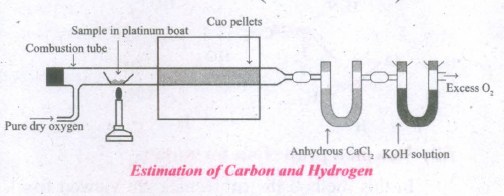
Both carbon and hydrogen are estimated by the same method. A known weight of the organic substance is burnt in excess of oxygen and the carbon and hydrogen present in it are oxidized to carbon dioxide and water, respectively.
The weight of carbon dioxide and water thus formed are determined and the amount of carbon and hydrogen in the organic substance is calculated. The apparatus employed for the purpose consists of three units
(1) oxygen supply
(2) combustion tube
(3) absorption apparatus.
(1) Oxygen supply: To remove the moisture from oxygen it is allowed to bubble through sulphuric acid and then passed through aV-tube containing soda lime to remove CO2. The oxygen gas free from moisture and carbondioxide enters the combustion tube.
(2) Combustion tube: A hard glass tube open at both ends is used for the combustion of the organic substance. It contains (i) an oxidized copper gauze to prevent the backward diffusion of the products of combustion (ii) a porcelain
boat containing a known weight of the organic substance (iii) coarse copper oxide on either side and (iv) an oxidized copper gauze placed towards the end of the combustion tube. The combustion tube is heated by a gas burner.
(3) Absorption Apparatus: The combustion products containing moisture and carbondioxide are then passed through the absorption apparatus which consists of (i) a weighed U'-tube packed with pumice soaked- in cone. H2SO4 to absorb water (ii) a set of bulbs containing a strong solution of KOH to absorb CO2 and finally (iii) a guard tube filled with anhydrous CaCI2 to prevent the entry of moisture from atmosphere. Procedure: The combustion tube is heated strongly to dry its content. It is then cooled slightly and connected to the absorption apparatus. The other end of the combustion tube is open for a while and the boat containing weighed organic substance is introduced. The tube is again heated strongly till the substance in the boat is burnt away. This takes about 2 hours. Finally, a strong current of oxygen is passed through the combustion tube to sweap away any traces of carbon dioxide or moisture which may be left in it. The If-tube and the potash bulbs are then detached and the increase in weight of each of them is determined.
Calculation:
Weight of the organic substance taken= w g
Increase in weight of H2O = xg
Increase in weight of CO2 =yg
18 g of H20 contain 2g of hydrogen
\(\therefore \) x g of H2O contain\(\left( \frac { 2 }{ 18 } \times \frac { x }{ w } \right) \) g of hydrogen
Percentage of hydrogen = \(\left( \frac { 2 }{ 18 } \times \frac { x }{ w } \times 100 \right) \)%
44g of CO2 contains 12g of carbon
\(\therefore \) y g of CO2 contain \(\left( \frac { 2 }{ 44 } \times \frac { y }{ w } \right) \) g of carbon
Percentage of carbon= \(\left( \frac { 2 }{ 44 } \times \frac { y }{ w } \times 100 \right) \)%
Note:
1. If the organic substance under investigation also contain N, it will produce oxides of nitrogen on combustion. A spiral of copper is introduced at the combustion tube, to reduce the oxides of nitrogen to nitrogen which escapes unabsorbed.
2. If the compound contains halogen a well, a spiral of silver is also introduced in the combustion tube. It converts halogen into dilver halide.
3. In case if the substance also contains sulphur, the copper oxide in the combustion tube is replaced by lead chromate. The SO2 formed during combustion is thus converted to lead sulphate and prevented from passing into the absorption unit.
3.
Tautomerism: It is a special type of functional isomerism in which a single compound exists in two readily inter convertible structures that differ markedly in the relative position of atleast one atomic nucleus, generally hydrogen. The two different structures are known as tautomers. ere are several types of tautomerism and the two important types are dyad and triad systems.
(a) Dyad system: In this system hydrogen atom oscillates between two directly linked polyvalent atoms.
In this example hydrogen atom oscillates between carbon and nitrogen atom
\(\underset { (hydrogencyanide) }{ H } -C\equiv N\longleftrightarrow \underset { (hydrogenisocyanide }{ H } -N\overset { \rightarrow }{ = } C\)
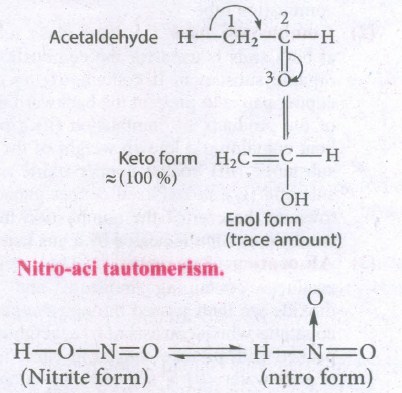
(b) Triad system: In this 'system hydrogen atom oscillates between three polyvalent atoms. It involves 1,3 migration of hydrogen atom from one polyvalent atom to other within the molecule. e most important type of triad system is keto-enol tautomerism and the two groups of tautomers are ketoform and enol-form. The polyvalent atoms involved are one oxygen and two carbon atoms. Enolisation is a process in which keto-form is converted to enol form. Both tautomeric forms are not equally stable. The less stable form is known as lable form
Example:
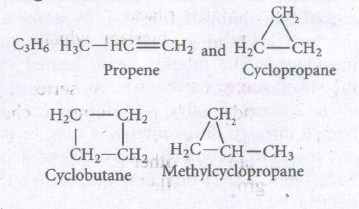
(c) Ring chain isomerism: In this type of isomerism, compounds having same molecular formula but differ in terms of bonding of carbon atom to form open chain and cyclic structures for eg:
4.
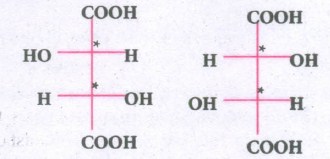
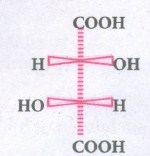
(i) Fisher projection formula:
This is a method of representing three dimensional structures in two dimension. In this method, the chiral atom(s) lies in the plane of paper. The horizontal substituents are pointing towards the observer and the vertical substituents are away from the observer. Fisher projection formula for tartaric acid is given below.
(ii) Sawhorse projection formula :
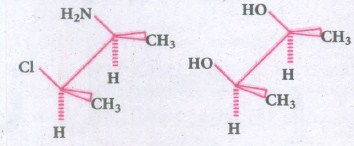
Here the bond between two carbon atoms is drawn diagonally and slightly elongated. The lower left hand carbon is considered lying towards the front and the upper right hand carbon towards the back. The Fischer projection inadequately portrays the spatial relationship between ligands attached to adjacent atoms. The sawhorse projection attempts to clarify the relative location of the groups.
(iii) Newman projection- formula:
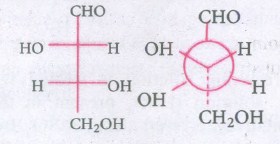
In this method the molecules are viewed from the front along the carbon-carbon bond axis. The two carbon atom forming the bond is represented by two circles. One behind the other so that only the front carbon is seen. The front carbon atom is shown by a point where as the carbon lying further from the eye is represented by the origin of the circle. Therefore, the C-H bonds of the front carbon are depicted from the circle while C-H bonds of the back carbon are drawn from the circumference of the circle with an angle of 1200 to each other.
5.
(i) They are covalent compounds of carbon and generally insoluble in water and readily soluble in organic solvent such as benzene, toluene, ether, chloroform, etc ...
(ii) Many of the organic compounds are inflammable (except CCI4).They possess low boiling and melting points due to their covalent nature.
(iii) Organic compounds are characterised by functional groups. A functional group is an atom or a specific combination of bonded atoms that react in a characteristic way, irrespective of the organic molecule in which it is present. In
almost all the cases, the reaction of an organic compound takes place at the functional group. They exhibit isomerism which is a unique phenomenon.
(iv) Homologous series: A series of organic compounds each containing a characteristic functional group and the successive members differ from each other in molecular formula by a CH2 group is called homologous series.
Alkanes: Methane (CH4) Ethane (C2H6) Propane (C3H8) etc.

11th Standard Syllabus & Materials
11th Standard
TN 11th Tamil பீடு பெற நில் - செய்யுள் - காவடிச்சிந்து Important Questions And Answers Study Material - QB365 Set A
NEW11th Standard
TN 11th Tamil பீடு பெற நில் - உரைநடை - மலை இடப்பெயர்கள் : ஓர் ஆய்வு Important Questions And Answers Study Material - QB365 Set A
NEW11th Standard
TN 11th Tamil மாமழை போற்றுதும் - துணைப்பாடம் - யானை டாக்டர் Important Questions And Answers Study Material - QB365 Set A
NEW11th Standard
TN 11th Tamil மாமழை போற்றுதும் - செய்யுள் - ஐங்குறுநூறு Important Questions And Answers Study Material - QB365 Set A



Tamilnadu Stateboard 11th Standard Subjects

Maths

Commerce

Economics

Biology

Business Maths and Statistics

Accountancy

Computer Science

Physics
Chemistry
Maths
Biology
Economics
Physics
Chemistry

History
Business Maths and Statistics

Computer Science
Accountancy

Computer Applications
History
Computer Technology
Commerce
Computer Applications
Computer Technology

Tamil

English

French
Tamilnadu Stateboard Standards



