
 100% FREE ACCESS
11th Standard Syllabus & Materials
11th Standard
TN 11th Tamil இயற்கை வேளாண்மை,சுற்றுச்சூழல் -செய்யுள் - மனோன்மணீயம் Important Questions And Answers Study Material - QB365 Set A
NEW11th Standard
TN 11th Tamil என்னுயிர் என்பேன் -துணைப்பாடம் - இசைத்தமிழர் இருவர் Important Questions And Answers Study Material - QB365 Set A
NEW11th Standard
TN 11th Tamil மொழி கலை -செய்யுள் - ஒவ்வொரு புல்லையும் Important Questions And Answers Study Material - QB365 Set A
NEW11th Standard
TN 11th Tamil பீடு பெற நில் - இலக்கணம் - பகுபத உறுப்புகள் Important Questions And Answers Study Material - QB365 Set A
NEW11th Standard
TN 11th Tamil பீடு பெற நில் - துணைப்பாடம் - வாடிவாசல் Important Questions And Answers Study Material - QB365 Set A
NEW11th Standard
TN 11th Tamil பீடு பெற நில் - செய்யுள் - குறுந்தொகை Important Questions And Answers Study Material - QB365 Set A

Published on: 13/05/2022
QB365 provides detailed and simple solution for every
Creative Questions in class 11 Chemistry Subject. It will
helps to get more idea about question pattern in every Creative questions with solution.
Download Tamil Nadu 11th Standard Chemistry question papers, model tests, one-mark questions, important questions, and public exam papers in PDF format. Free study materials and answer keys for TN State Board students.
Questions + Answers key
Take MCQ Chemistry Test1.
Explain Dumas method of estimation of nitrogen.
2.
How will you estimate phosphorous in an organic compound?
3.
Explain about the estimation of halogens by carius method.
4.
Explain about the estimation of carbon and hydrogen.
5.
Explain about lassaigne's test for detection of nitrogen in an organic compound.
1.
Dumas method:
Principle: This method is based on the fact that nitrogeneous compound when heated with cupric oxide in an atmosphere of CO2 yields free nitrogen.
\({ C }_{ x }{ H }_{ y }N_{ 2 }+\left( 2x+\cfrac { 1 }{ 2 } \right) CuO\longrightarrow x{ CO }_{ 2 }+\cfrac { y }{ 2 } { H }_{ 2 }O+\cfrac { z }{ 2 } { N }_{ 2 }+\left( 2x+\cfrac { y }{ 2 } \right) cu\)
Traces of nitrogen are reduced to elemental nitrogen by passing over heated copper spiral.
Description of the apparatus:
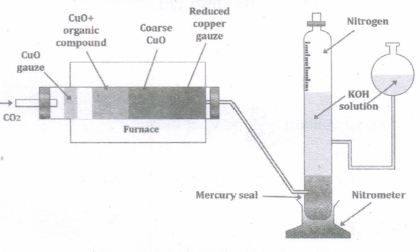
CO2 Generator: CO2 needed in this process is prepared by heating magnetite or sodium bicarbonate contained in a hard glass tube (or) by the action of dil. HCl on marble in a kipps apparatus. The gas is passed through the combustion tube after dried by bubbling through cone. H2SO4.
Combustion tube: The combustion tube is heated in a furnace is charged with
(a) A roll of oxidised copper gauze to prevent the back diffusion of products of combustion and to heat the organic substance mixed with CuO by radiation
(b) a weighed amount of organic substance mixed with excess of CuO
(c) a layer of CuO packed in about 2/3 length of the tube and kept in position by loose asbestos plug on either side and
(d) a reduced copper spiral which reduces any oxides of nitrogen formed during combustion of nitrogen.
Schiff's nitromete: The nitrogen gas obtained by the decomposition of the substance in the combustion tube is mixed with considerable excess of CO2. It is estimated by passing
nitro meter when CO2 is absorbed by KOH and the nitrogen gas gets collected in the upper part of the graduated tube.
Calculation:
Weight of the substance taken = Wg
Volume of nitrogen = V 1L
Room temperature = T 1K
Atmospheric pressure = P mm Hg
Aqueous tension at room temperature = P mm of Hg
\(\therefore\) Pressure of dry nitrogen = P-P' = P1mm Hg
Po'Vo and Tobe the pressure, volume and temperature respectively of dry nitrogen at S.T.P.
Then,\(\cfrac { { P }_{ o }{ V }_{ o } }{ { T }_{ o } } =\cfrac { P_{ 1 }{ V }_{ 1 } }{ { T }_{ 1 } } \)
\(\therefore { V }_{ o }=\cfrac { { P }_{ 1 }{ V }_{ 1 } }{ { T }_{ 1 } } \times \cfrac { { T }_{ o } }{ { P }_{ o } } \)
\({ V }_{ o }=\cfrac { { P }_{ 1 }{ V }_{ 1 } }{ { T }_{ 1 } } \times \cfrac { 273K }{ 760mm\quad Hg } \)
22.4 L of N2 at STP weigh 28 g of N2
\(\therefore\) VoL of N2 at STP weigh \(\cfrac { 28 }{ 22.4 } \times { V }_{ O }\)
W g of organic compound contain \(\cfrac { 28 }{ 22.4 } \times { V }_{ O }\ g\ of\ { N }_{ 2 }\)
\(\therefore\) 100 g of organic contain \(\cfrac { 28 }{ 22.4 } \times \cfrac { { V }_{ o } }{ w } \times 100=\%of\quad nitrogen\)
2.
Carius method:
Procedure: A known mass of organic compound (wg) containing phosphorus is heated with fuming HNO3 in a sealed tube where C is converted into CO2 and H to H2O. Phosphorous present in the organic compound is oxidised to phosphoric acid which is precipitated as ammonium phospho molybdate by heating with conc. HNO3 and by adding ammonium molybdate.
\({ H }_{ 3 }{ PO }_{ 4 }+12\left( NH_{ 4 } \right) _{ 2 }Mo{ O }_{ 4 }+Mo{ O }_{ 4 }\overset { \Delta }{ \longrightarrow } \left( { NH }_{ 4 } \right) { PO }_{ 4 }.12Mo{ O }_{ 3 }+21{ NH }_{ 4 }{ NO }_{ 3 }+12{ H }_{ 3 }O\)
The precipitate of ammonium phrospho molybdate is filtered, washed, dried and weighed
Calculation:
Mass of organic compound = Wg
Mass of ammonium phospho molybdate = x g
Molar mass of ammonium phospho molybdate = 1877 g
1877 g of ammonium phospho molybdate contains 31 g of phosphorous
\(\therefore\) x g of ammonium phospho molybdate contain \(\cfrac { 31 }{ 1877 } \) \(\times\) xg of phosphorous
\(\therefore\) % of phosphorous = \(\left( \cfrac { 31 }{ 1877 } \times \cfrac { x }{ w } \times 100 \right) \%\)
In an alternate method, phosphoric acid is precipitated as magnesium-ammonium phosphate by adding magnesia mixture. The ppt. is washed dried and ignited to get magnesium pyrophosphate which is washed, dried and weighed.
Weight of magnesium pyrophosphate = y g
Molar mass of magnesium pyrophosphate = 222 g
222 g of magnesium pyrophosphate contains 62g of P
\(\therefore\) y go f magnesiu.m pyrop hosphate contain = \(\cfrac { 62 }{ 222 } \times \ y\ g\ of\ P\)
% of phosphorous = \(\left( \cfrac { 62 }{ 222 } \times \cfrac { y }{ w } \times 100 \right) \)
3.
Carius method: A known mass of the substance is taken along with fuming HN03 and AgN03 taken in a clean carius tube. The open end of the carius tube is sealed and placed in a iron tube for 5 hours in a range at 530 to 540 K. Then the tube is allowed to cool and a small hole is made in the tube to allow the gases to excape. The tube is broken and the precipitate is filtered, washed, dried and weighed. From the mass of AgX produced percentage of halogen in the organic compound is calculated.
\(X\overset { Fuming\quad HN0_{ 3 } }{ \underset { AgNO_{ 3 } }{ \longrightarrow } } AgX\downarrow \)
Calculation:
Weight of the organic compound = Wg
Weight of AgCl = a g
143.5g AgCI contains 35.5g ofCI
\(\therefore\) a g of AgCl contain = \(\cfrac { 35 }{ 143.5 } \times 9g\quad of\quad Cl\)
W g of organic compound contains \(\cfrac { 35 }{ 143.5 } \times a\ g\ of\ cl\)
% of chlorine =\(\left( \cfrac { 35 }{ 143.5 } \times \cfrac { a }{ w } \times 100 \right)\% \)
Weight of silver bromide = b g
188 g of AgBr contains 80 g of Br
b g of AgBr contain =
% of Bromine
Weight of silver iodide = c g
235 g of AgI contains 127 g of
\(\therefore\) c g of AgI contain = \(\cfrac { 127 }{ 235 } \times c\ g\ of\ 1\)
\(\therefore\) % of Iodine = \(\left( \cfrac { 127 }{ 235 } \times \cfrac { c }{ w } \times 100 \right) \)
4.
(i) Principle: A known weight of organic substance is brunt in excess of oxygen and the carbon and hydrogen present in it are oxidised to CO2 and H2O respectively.
\({ C }_{ x }{ H }_{ y }+\underset { excess }{ { O }_{ 2 } } \longrightarrow { xCO }_{ 2 }+\cfrac { y }{ 2 } { H }_{ 2 }O\)
The weight of carbon dioxide and water thus formed are determined and the amount of carbon and hydrogen in the organic substance are calculated.
(ii) Description of the apparatus:
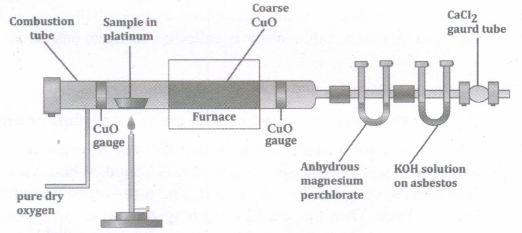
(a) The oxygen supply
(b) combustion tube
(c) Absorption tube
Oxygen supply: To remove the moisture from oxygen, it is allowed to bubble through sulphuric acid and then passed through a U-tube containing sodalime to remove CO2, The oxygen gas free from moisture and CO2 enters the combustion tube.
Combustion tube: A hard glass tube open at both ends used for the combustion. It contains
(i) an oxidized copper gauze to prevent the backward diffusion of the products of combustion
(ii) a porcelain boat containing a known weight of the organic substance
(iii) coarse copper oxide on either side and
(iv) an oxidised copper gauze placed towards the end of the combustion tube. The combustion tube is heated by a gas burner.
Absorption apparatus: The combustion products containing moisture and CO2 are then passed through the absorption apparatus which consists of
(i) a weighed If-tube packed with pumice soaked in cone. H2SO4 to absorb water
(ii) a set of bulbs containing a strong solution of KOH to absorb CO2 and finally
(iii) a guard tube filled with anhydrous CaCl2 to prevent the entry of moisture from atmosphere.
(iii) Procedure: The combustion tube is heated strongly to dry its content. It is then cooled and connected to absorption apparatus. The other end of the combustion tube is open for a while and the boat containing weighed organic substance is introduced. The tube is again heated strongly till all the substance in the boat is burnt away. This takes about 2 hours. Finally a strong current of oxygen is passed. Then the If-tube and potash bulbs are then detached and increase in weight of each of them is determined.
(iv) Calculation:
Weight of organic substance = Wg
Increase in weight of H2O = xg
Increase in weight of CO2 = yg
18g of H2O contains 2g of hydrogen
\(\therefore\) x g of H2O contain \(\cfrac { 2 }{ 18 } \times x\ g\ of\ hydrogen\)
\(\therefore\) Percentage of hydrogen\(\left( \cfrac { 2 }{ 18 } \times \cfrac { x }{ w } \times 100 \right) \)
44g of CO2 contains 12g of carbon
\(\therefore\) y g of CO2 contain\(\cfrac { 12 }{ 44 } \times y\ g\ of\ carbon\)
\(\therefore\) Percentage of carbon =\(\left( \cfrac { 12 }{ 44 } \times \cfrac { y }{ w } \times 100 \right)\%\)
5.
I step: Preparation of sodium fusion extract: A small piece of Na dried by pressing between the folds of filter paper is taken in"a fusion tube and it is heated. When it melts to a shining globule, a pinch of organic compound is added to it. The tube is then heated till the reaction ceases and becomes red hot. Then the test tube is plunged in about 50 ml of distilled water taken in a china dish and break the bottom of the tube by striking against the dish. The contents of the dish is boiled for about 10 minutes and then filtered. This filtrate is known as lassaigne's extract (or) sodium fusion extract.
II step: Test for Nitrogen: If Nitrogen is present, it gets converted to sodium cyanide which reacts with freshly prepared ferrous sulphate and ferric ion followed by cone. HCI and gives a Prussian blue colour (or) green coloured precipitate. It confirms the presence of nitrogen. HCI is added to dissolve the greenish precipitate of ferrous hydroxide produced by the action of NaOH on FeSO4 which would otherwise mark the Prussian blue precipitate. Reactions involved.
\(Na+C+N\longrightarrow NaCN\)
\({ FeSO }_{ 4 }+2NaOH\longrightarrow Fe\left( OH \right) _{ 2 }+{ Na }_{ 2 }{ SO }_{ 4 }\)
\(\underset { Sodiumferrocyanide }{ 6NaCN+Fe\left( OH \right) _{ 2 }\longrightarrow { Na }_{ 4 }\left[ Fe\left( CN \right) _{ 6 } \right] +2NaOH } \)
\(\underset { Ferric\quad ferro\quad cyanide\\ (Prussianblue) }{ 3{ Na }_{ 4 }\left[ Fe\left( CN \right) _{ 6 } \right] \longrightarrow { Fe }_{ 4 }\left[ Fe\left( CN \right) _{ 6 } \right] +12Nacl } \)
If both N & S are present, a blood red colour is obtained due to the following reactions.
\(Na+C+N+S\overset { \Delta }{ \longrightarrow } \underset { Sodium\quad sulphocyanide }{ NACNS } \)
\(3NaCNS+FeCl_{ 3 }\longrightarrow Fe\left( CNS \right) _{ 3 }+3Nacl\)
\(3NaCNS+FeCl_{ 3 }\longrightarrow \underset { Ferric\quad sulphocyanide\\ (Blood\quad red\quad colour)\qquad }{ Fe\left( CNS \right) _{ 3 }+3Nacl } \)

11th Standard Syllabus & Materials
11th Standard
TN 11th Tamil பீடு பெற நில் - செய்யுள் - காவடிச்சிந்து Important Questions And Answers Study Material - QB365 Set A
NEW11th Standard
TN 11th Tamil பீடு பெற நில் - உரைநடை - மலை இடப்பெயர்கள் : ஓர் ஆய்வு Important Questions And Answers Study Material - QB365 Set A
NEW11th Standard
TN 11th Tamil மாமழை போற்றுதும் - துணைப்பாடம் - யானை டாக்டர் Important Questions And Answers Study Material - QB365 Set A
NEW11th Standard
TN 11th Tamil மாமழை போற்றுதும் - செய்யுள் - ஐங்குறுநூறு Important Questions And Answers Study Material - QB365 Set A



Tamilnadu Stateboard 11th Standard Subjects

Maths

Commerce

Economics

Biology

Business Maths and Statistics

Accountancy

Computer Science

Physics
Chemistry
Maths
Biology
Economics
Physics
Chemistry

History
Business Maths and Statistics

Computer Science
Accountancy

Computer Applications
History
Computer Technology
Commerce
Computer Applications
Computer Technology

Tamil

English

French
Tamilnadu Stateboard Standards



