
 100% FREE ACCESS
11th Standard Syllabus & Materials
11th Standard
TN 11th Tamil இயற்கை வேளாண்மை,சுற்றுச்சூழல் -செய்யுள் - மனோன்மணீயம் Important Questions And Answers Study Material - QB365 Set A
NEW11th Standard
TN 11th Tamil என்னுயிர் என்பேன் -துணைப்பாடம் - இசைத்தமிழர் இருவர் Important Questions And Answers Study Material - QB365 Set A
NEW11th Standard
TN 11th Tamil மொழி கலை -செய்யுள் - ஒவ்வொரு புல்லையும் Important Questions And Answers Study Material - QB365 Set A
NEW11th Standard
TN 11th Tamil பீடு பெற நில் - இலக்கணம் - பகுபத உறுப்புகள் Important Questions And Answers Study Material - QB365 Set A
NEW11th Standard
TN 11th Tamil பீடு பெற நில் - துணைப்பாடம் - வாடிவாசல் Important Questions And Answers Study Material - QB365 Set A
NEW11th Standard
TN 11th Tamil பீடு பெற நில் - செய்யுள் - குறுந்தொகை Important Questions And Answers Study Material - QB365 Set A

Published on: 13/05/2022
QB365 provides detailed and simple solution for every Book back Questions in class 11 Chemistry Subject. It will helps to get more idea about question pattern in every book back questions with solution.
latest Book back QuestionsDownload Tamil Nadu 11th Standard Chemistry question papers, model tests, one-mark questions, important questions, and public exam papers in PDF format. Free study materials and answer keys for TN State Board students.
Questions + Answers key
Take MCQ Chemistry Test1.
Explain the following observation
Aerated water bottles are kept under water during summer
2.
Explain whether a gas approaches ideal behavior or deviates from ideal behaviour if
it is compressed to a smaller volume at constant temperature.
3.
Derive the values of critical constants in terms of van der Waals constants.
4.
Write the Van der Waals equation for a real gas. Explain the correction term for pressure and volume.
1.
Aerated water bottle contains excess dissolved oxygen/CO2 bottled at high pressure. During summer due to high temperature, O2/CO2 escapes from the solution increasing the pressure inside the bottle which may cause bursting of the bottle. To maintain low T, it is kept under water
2.
The gas deviates from ideal gas behaviour and will be a real gas only. In the compressed state, the inter molecular forces will be very high as the molecules are very close.
3.
The van der Waals equation for n moles is
\(\left( P+\frac { { an }^{ 2 } }{ { v }^{ 2 } } \right) \left( v-nb \right) =nRT\) ....(1)
For 1 mole
\(\left( P+\frac { { a }^{ 2 } }{ { v }^{ 2 } } \right) \left( v-b \right) =RT\) ...(2)
From the equation we can derive the values of critical constants Pc, Vc and Tc, in terms of a and b, the van der Waals constants, On expanding the above equation
\(pv+\frac { a }{ v } -pb-\frac { ab }{ { v }^{ 2 } } -RT=0\) ...(3)
Multiply equation (3) by V2 / P
\(\frac { { v }^{ 2 } }{ p } \left( Pv+\frac { a }{ v } -pb-\frac { ab }{ { v }^{ 2 } } -RT \right) =0\)
\({ v }^{ 3 }+\frac { av }{ p } +-{ bv }^{ 2 }-\frac { ab }{ { v }^{ 2 } } -\frac { { RTV }^{ 2 } }{ p } \) ...(4)
When the above equation is rearranged in powers of Y.
\({ v }^{ 3 }-\left[ \frac { RT }{ P } +b \right] { v }^{ 2 }+\left[ \frac { a }{ p } \right] v-\left[ \frac { ab }{ p } \right] =0\) ...(5)
The equation (5) is a cubic equation in V. On solving this equation,
we will get three solutions. At the critical point all these three solutions of V are equal to the critical volume VC. The pressure and temperature becomes Pc and Tc respectively
i.e., V = Vc
V - Vc = 0
(V - VC)3 = 0
V3 - 3VCV2 + 3Vc2V - Vc3 = 0 .....(6)
As equation (5) is identical with equation (6), we can equate the coefficients of V2, V and constant terms in (5) and (6).
\(-3{ v }_{ c }{ v }^{ 2 }=-\left[ \frac { { RT }_{ c } }{ { p }_{ c } } +b \right] { v }^{ 2 }\)
\(3{ v }_{ c }=\frac { { RT }_{ c } }{ { p }_{ c } } +b\) .....(7)
\(3{ v }_{ c }^{ 2 }=\frac { a }{ { p }_{ c } } \) ......(8)
\(3{ v }_{ c }^{ 2 }=\frac { ab }{ { p }_{ c } } \) ...(9)
Divide equation (9) by equation (8)
\(\frac { { v }_{ c }^{ 3 } }{ 3{ v }_{ c }^{ 2 } } =\frac { ab/{ p }_{ c } }{ a/{ p }_{ c } } \)
\(\frac { { V }_{ c } }{ 3 } =b\)
i.e. Vc = 3b .....(10)
when equation (10) is substituted in (8)
\(3{ v }_{ c }^{ 2 }=\frac { a }{ { p }_{ c } } \)
\({ p }_{ c }=\frac { a }{ 3{ v }_{ c }^{ 2 } } =\frac { a }{ 3\left( { 3b }^{ 2 } \right) } =\frac { a }{ { 3\times 9b }^{ 2 } } =\frac { a }{ { 27 }b^{ 2 } } \)
\({ p }_{ c }=\frac { a }{ { 27 }b^{ 2 } } \) ...(11)
substituting the values of Vc and Pc in equation (7),
\(3vc=b+\frac { { RT }_{ c } }{ p } \)
\(3\left( 3b \right) =b+\frac { { RT }_{ c } }{ \left( \frac { a }{ { 27b }^{ 2 } } \right) } \)
\(9b-b=\left( \frac { { RT }_{ c } }{ a } \right) 27{ b }^{ 2 }\)
\(8b=\frac { { t }_{ c }R{ 27b }^{ 2 } }{ a } \)
\(\therefore { T }_{ c }=\frac { 8ab }{ 27R{ b }^{ 2 } } =\frac { 8a }{ 27Rb } \)
\({ T }_{ c }=\frac { { 8 }_{ a } }{ 27Rb } \) ......(12)
The critical constants can be calculated using the values of van der Waals constant of a gas and vice versa.
\(a=3{ V }_{ C }^{ 2 }{ P }_{ C }\quad and\quad b=\frac { { V }_{ C } }{ 3 } \)
4.
The van der Waals equation for a real gas is
\(\left( P+{{{am}^{2}}\over{{V}^{2}}} \right)(V-nb)=nRT\)
Pressure, Correction:
The pressure of a gas is directly proportional to the force created by the bombardment of molecules on the walls of the container. The speed of a molecule moving towards the wall of the container is reduced by the attractive forces exerted by its neighbours. Hence, the measured gas pressure is lower than the ideal pressure of the gas. Hence, van der Waals introduced a correction term to this effect.
Van der Waals found out the forces of attraction experienced by a molecule near the wall are directly proportional to the square of the density of the gas.
\(P^{\prime} \propto \rho^{2} ; \quad \rho=\frac{n}{v}\)
where n is the number of moles of gas and
V is the volume of the container
\( \Rightarrow p^{\prime} \alpha \frac{n^{2}}{V^{2}} \)
\(\Rightarrow p^{\prime}=a \frac{n^{2}}{V^{2}}\)
where a is proportionality constant and depends on the nature of gas
Therefore \(P_{\text {ideal }}=P+\frac{\operatorname{an}^{2}}{V^{2}}\)
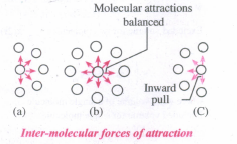
Volume Correction
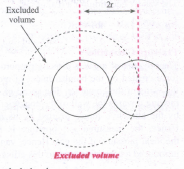
As every individual molecule of a gas occupies a certain volume, the actual volume is less than the volume of the container,
V. Van der Waals introduced a correction factor V' to this effect. Let us calculate the correction term by considering gas molecules as spheres.
V = excluded volume
Excluded volume for two molecules
\(=\frac{4}{3} \pi(2 r)^{3}=8\left(\frac{4}{3} \pi r^{3}\right)=8 V_{m}\)
Where Vm it a volume of a single molecule
Excluded volume for single molecule = \(\frac{8 \mathrm{~V}_{\mathrm{m}}}{2}=4 \mathrm{~V}_{\mathrm{m}}\)
Excluded volume for n molecule = n(4Vm) = nb
Where b is van der Waals constant which is equal to 4Vm
\( \Rightarrow V^{\prime}=n b \)
\(V_{\text {ideal }}=V-n b\)
Replacing the corrected pressure and volume in the ideal gas equation PV = nRT we get the Van der Waals equation of state for real gases as below,
\(\left(p+\frac{a^{2}}{V^{2}}\right)(V-n b)=n R T\)
The constants a and b are van der Waals constant and their values vary with the nature of the gas. It is an approximate formula for the non-ideal gas.

11th Standard Syllabus & Materials
11th Standard
TN 11th Tamil பீடு பெற நில் - செய்யுள் - காவடிச்சிந்து Important Questions And Answers Study Material - QB365 Set A
NEW11th Standard
TN 11th Tamil பீடு பெற நில் - உரைநடை - மலை இடப்பெயர்கள் : ஓர் ஆய்வு Important Questions And Answers Study Material - QB365 Set A
NEW11th Standard
TN 11th Tamil மாமழை போற்றுதும் - துணைப்பாடம் - யானை டாக்டர் Important Questions And Answers Study Material - QB365 Set A
NEW11th Standard
TN 11th Tamil மாமழை போற்றுதும் - செய்யுள் - ஐங்குறுநூறு Important Questions And Answers Study Material - QB365 Set A



Tamilnadu Stateboard 11th Standard Subjects

Maths

Commerce

Economics

Biology

Business Maths and Statistics

Accountancy

Computer Science

Physics
Chemistry
Maths
Biology
Economics
Physics
Chemistry

History
Business Maths and Statistics

Computer Science
Accountancy

Computer Applications
History
Computer Technology
Commerce
Computer Applications
Computer Technology

Tamil

English

French
Tamilnadu Stateboard Standards



