
 100% FREE ACCESS
11th Standard Syllabus & Materials
11th Standard
TN 11th Tamil இயற்கை வேளாண்மை,சுற்றுச்சூழல் -செய்யுள் - மனோன்மணீயம் Important Questions And Answers Study Material - QB365 Set A
NEW11th Standard
TN 11th Tamil என்னுயிர் என்பேன் -துணைப்பாடம் - இசைத்தமிழர் இருவர் Important Questions And Answers Study Material - QB365 Set A
NEW11th Standard
TN 11th Tamil மொழி கலை -செய்யுள் - ஒவ்வொரு புல்லையும் Important Questions And Answers Study Material - QB365 Set A
NEW11th Standard
TN 11th Tamil பீடு பெற நில் - இலக்கணம் - பகுபத உறுப்புகள் Important Questions And Answers Study Material - QB365 Set A
NEW11th Standard
TN 11th Tamil பீடு பெற நில் - துணைப்பாடம் - வாடிவாசல் Important Questions And Answers Study Material - QB365 Set A
NEW11th Standard
TN 11th Tamil பீடு பெற நில் - செய்யுள் - குறுந்தொகை Important Questions And Answers Study Material - QB365 Set A

Published on: 25/06/2021
QB365 provides detailed and simple solution for every
Creative Questions in class 11 Chemistry Subject. It will
helps to get more idea about question pattern in every Creative questions with solution.
Download Tamil Nadu 11th Standard Chemistry question papers, model tests, one-mark questions, important questions, and public exam papers in PDF format. Free study materials and answer keys for TN State Board students.
Questions + Answers key
Take MCQ Chemistry Test1.
Explain Andrews' isotherm.
2.
Define the following terms.
3.
Using the ideal gas equation how will you calculate the values of R ?
4.
Derive the ideal gas equation by combining the empirical gas laws.
5.
Explain P-V relationship experiments of Robert Boyle.
1.
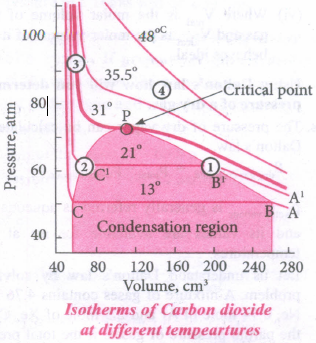
Thomas Andrews gave the first complete data on Pressure - volume - temperature of a substance in the gaseous and liquid states. He plotted isotherms of carbon dioxide at different temperatures which is shown in the following figure.
(i) From the plots we can infer the following.
(ii) At low temperature isotherms, for example, at 13°C as the pressure increases, the volume decreases along AB and is a gas until the point B is reached.
(iii) At B, a liquid separates along the line BC, both the liquid and gas co-exist and the pressure remains constant.
(iv) At C, the gas is completely converted into liquid. If the pressure is higher than at C, only the liquid is compressed so, there is no significant change in the volume.
(v) The volume range in which the liquid and gas coexist becomes shorter.
(vi) At the temperature of 31.1 °C the length of the shorter portion is reduced to zero at point P.
(vii) The CO2 gas is liquefied completely at this point. This temperature is known as the liquefaction temperature or critical temperature of CO2,
(viii) At this point the pressure is 73 atm.
(ix) Above this temperature CO2 remains as a gas at all pressure values. It is then proved that many real gases behave in a similar manner to carbon dioxide.
2.
(i) Isotherm:
At any constant temperature when pressure is increased, volume is decreased and vice versa. Such P - V curves at constant temperature are known as isotherms.
(ii) Critical Temperature: (Tc)
It is defined as the characteristic temperature of a gas above which no liquefaction occurs.
(iii) Critical Pressure: (Pc)
It is defined as the minimum pressure required to liquefy 1 mole of a gas present at its critical temperature.
(iv) Critical volume: (Vc)
The volume occupied by 1 mole of a gas at its critical pressure and at critical temperature is the critical volume of the gas
(v) Compressibility factor:
The deviation of real gases from ideal behaviour is measured in terms of a ratio of PV to nRT. This is termed as compressibility factor.
\(Z=\frac { PV }{ nRT } \)
3.
We can calculate R using the equation,
\(R=\frac { PV }{ nT } \)
(i) P is 1 atm., volume 22.414 dm3. for 1 mole at 273.15 K.
R=\(\frac { 1\quad atm.\times 22.414\quad { dm }^{ 3 } }{ 1\quad mol.\times 273.15K } \)
= 0.0821 dm3 atm. mol-1 K-1
(ii) (STP),
Where P = 1 bar (105 pascal),
V = 22.71 \(\times\) 10-3 m3 for 1 mole of a gas at 273.15 K
\(R=\frac { { 10 }^{ 5 }Pa\times 22.71\times { 10 }^{ -3 }{ m }^{ 3 } }{ 1\quad mol.\times 273.15\quad K } \)
= 8.314 Pa m3 K-1 mol-1
= 8.314 \(\times\) 10-5bar m3 K-1 mol-1
= 8.314 \(\times\) 10-2 bar dm3 K-1 mol-1
= 8.314 \(\times\) 10-2 bar L K-1 mol-1
= 8.314 J K-1 mol-1
4.
The gaseous state is described completely using the following four variables T,P, V and n and their relationships were governed by the gas laws studied so far.
Boyle's law \(\mathrm{V} \propto \frac{1}{\mathrm{P}}\)
Charles law \(\mathrm{V} \propto T\)
Avogadro's law \(\mathrm{V} \propto n\)
We can combine these equations into the following general equation that describes the physical behaviour of all gases.
\(
\mathrm{V} \propto \frac{\mathrm{nT}}{\mathrm{P}}
\)
\(\mathrm{V}=\frac{\mathrm{nRT}}{\mathrm{P}}\)
Where, R is the proportionality constant called universal gas constant. The above equation can be rearranged to give the ideal gas equation
PV = nRT
5.
Robert Boyle performed a series of experiments to study the relation between the Pressure and volume of gases. The schematic of the apparatus used by him is shown in figure.
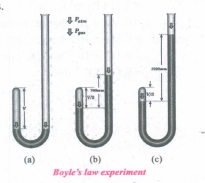
Mercury was added through the open end of the apparatus such that the mercury level on both ends are equal as shown in the figure. Add more amount of mercury until the volume of the trapped air is reduced to half of its original volume as shown in figure. The pressure exerted on the gas by the addition of excess mercury is given by the difference in mercury levels of the tube. Initially the pressure exerted by the gas is equal to 1 atm as the difference in mercury levels to 760 mm. Now the pressure exerted by the gas is equal to 2 atm. It led him to conclude that at a given temperature the volume occupied by fixed mass of a gas is inversely proportional to its Pressure.
Mathematically, the Boyle's law can be written as
\(V \alpha{{l}\over{P}}\) ....(1)
(T and n are fixed, T-temperature, n- number of moles)
\(V=k\times{{1}\over{P}}\) .....(2)
k - proportionality constant
When we rearrange equation (2)
PV = k at constant temperature and mass
Therefore, for a given mass of a gas under two different sets of conditions at constant temperature we can write
P1V1 = P2V2 = k ..............(3)
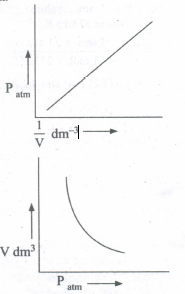
Graphical representation of Boyle's law

11th Standard Syllabus & Materials
11th Standard
TN 11th Tamil பீடு பெற நில் - செய்யுள் - காவடிச்சிந்து Important Questions And Answers Study Material - QB365 Set A
NEW11th Standard
TN 11th Tamil பீடு பெற நில் - உரைநடை - மலை இடப்பெயர்கள் : ஓர் ஆய்வு Important Questions And Answers Study Material - QB365 Set A
NEW11th Standard
TN 11th Tamil மாமழை போற்றுதும் - துணைப்பாடம் - யானை டாக்டர் Important Questions And Answers Study Material - QB365 Set A
NEW11th Standard
TN 11th Tamil மாமழை போற்றுதும் - செய்யுள் - ஐங்குறுநூறு Important Questions And Answers Study Material - QB365 Set A



Tamilnadu Stateboard 11th Standard Subjects

Maths

Commerce

Economics

Biology

Business Maths and Statistics

Accountancy

Computer Science

Physics
Chemistry
Maths
Biology
Economics
Physics
Chemistry

History
Business Maths and Statistics

Computer Science
Accountancy

Computer Applications
History
Computer Technology
Commerce
Computer Applications
Computer Technology

Tamil

English

French
Tamilnadu Stateboard Standards



