
 100% FREE ACCESS
11th Standard Syllabus & Materials
11th Standard
TN 11th Tamil இயற்கை வேளாண்மை,சுற்றுச்சூழல் -செய்யுள் - மனோன்மணீயம் Important Questions And Answers Study Material - QB365 Set A
NEW11th Standard
TN 11th Tamil என்னுயிர் என்பேன் -துணைப்பாடம் - இசைத்தமிழர் இருவர் Important Questions And Answers Study Material - QB365 Set A
NEW11th Standard
TN 11th Tamil மொழி கலை -செய்யுள் - ஒவ்வொரு புல்லையும் Important Questions And Answers Study Material - QB365 Set A
NEW11th Standard
TN 11th Tamil பீடு பெற நில் - இலக்கணம் - பகுபத உறுப்புகள் Important Questions And Answers Study Material - QB365 Set A
NEW11th Standard
TN 11th Tamil பீடு பெற நில் - துணைப்பாடம் - வாடிவாசல் Important Questions And Answers Study Material - QB365 Set A
NEW11th Standard
TN 11th Tamil பீடு பெற நில் - செய்யுள் - குறுந்தொகை Important Questions And Answers Study Material - QB365 Set A

Published on: 25/06/2021
QB365 provides detailed and simple solution for every
Creative Questions in class 11 Chemistry Subject. It will
helps to get more idea about question pattern in every Creative questions with solution.
Download Tamil Nadu 11th Standard Chemistry question papers, model tests, one-mark questions, important questions, and public exam papers in PDF format. Free study materials and answer keys for TN State Board students.
Questions + Answers key
Take MCQ Chemistry Test1.
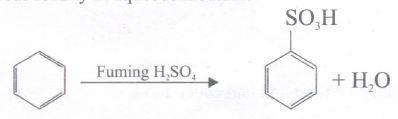
Explain the sulphonation of benzene.
2.
Explain the industrial preparation of benzene from coal tar.
3.
Why benzene undergoes substitution reaction rather than addition reactions under normal conditions?
4.
Discuss the Kekule's structure of benzene.
5.
Explain the polymerisation of acetylene. write notes on
i) Linear polymerisation ii) Cyclic polymerisation
1.
Benzene reacts with fuming sulphuric acid and give benzene sulphonic acid. Although S03 molecule it does not have positive charge, yet it is a strong electrophile. This is because the octet of electrons around the sulphur atom is not reacted. This reached is reversible and desulphonation occus readily in aqueous medium.
2.
Coal tar is a viscous liquid obtained by the pyrolysis of coal. During fractional distillation, coal tar is heated and distills away its volatile compounds, namely, benzene, toluene, xylene in the temperature range of 350 K to 443 K. These vapours are collected at the upper part of the fractionating column.
| Name of the fraction | Temperature Range | Name of the component | |
| 1. | Crude light oil | 350 - 443 K | Benzene, Toluene, Xylene |
| 2 | Middle oil | 443 - 503 K | Phenol, Naphthalene |
| 3. | Heavy oil | 503 - 543 K | Naphthalene, Cresol |
| 4. | Green oil | 543 - 633 K | Anthracene |
| 5. | Pitch oil | 633 K | Residue |
3.
(i) Each carbon atom in benzene possess an unhybridised p-orbital containing one electron. The lateral overlap of their p-orbitals produces 3n-bond, six electrons of the p-orbitals over all the six carbon atoms and are said to be delocalised.
(ii) Due to delocalisation, strong rt-bond is formed which makes the molecule stable. Hence unlike alkenes and alkynes, benzene undergoes substitution reactions rather than addition reactions under normal conditions
4.
Kekule suggested that benzene consists of a cyclic planar structure of six carbon with alternate single and double bonds.
There were two objections:
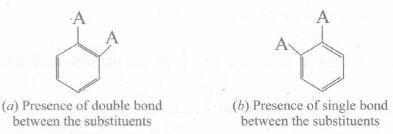
(i) Benzene forms only one ortho disubstituted products whereas the Kekule's structure predicts two ortho disubstituted products as shown:
(ii) Kekule's structure failed to explain why benzene with three double bonds did not give addition reaction like alkenes.
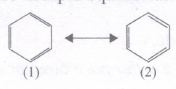
To overcome this objection, Kekule suggested that benzene was a resonance hybrid of two forms(l and 2) which are in rapid equilibrium.
5.
Alkyne undergoes two types of potymerisation reaction
(i) Linear polymerisation: Acetylene forms linear polymer, when passed into a solution of cuprous chloride and ammonium chloride
\(2CH\equiv CH\overset { { Cu }_{ 2 }{ Cl }_{ 2 } }{ \underset { { NH }_{ 4 }Cl }{ \longrightarrow } } \underset { (vinyl\quad acetylene) }{ { { CH }_{ 2 } }=\underset { \overset { | }{ C\equiv CH } }{ CH } } \)
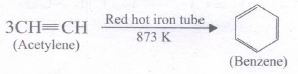
(ii) Cyclic polymerisation: Acetylene undergoes cyclic polymerisation on passing through red hot iron tube. Three molecules of acetylene polymerises to form benzene.

11th Standard Syllabus & Materials
11th Standard
TN 11th Tamil பீடு பெற நில் - செய்யுள் - காவடிச்சிந்து Important Questions And Answers Study Material - QB365 Set A
NEW11th Standard
TN 11th Tamil பீடு பெற நில் - உரைநடை - மலை இடப்பெயர்கள் : ஓர் ஆய்வு Important Questions And Answers Study Material - QB365 Set A
NEW11th Standard
TN 11th Tamil மாமழை போற்றுதும் - துணைப்பாடம் - யானை டாக்டர் Important Questions And Answers Study Material - QB365 Set A
NEW11th Standard
TN 11th Tamil மாமழை போற்றுதும் - செய்யுள் - ஐங்குறுநூறு Important Questions And Answers Study Material - QB365 Set A



Tamilnadu Stateboard 11th Standard Subjects

Maths

Commerce

Economics

Biology

Business Maths and Statistics

Accountancy

Computer Science

Physics
Chemistry
Maths
Biology
Economics
Physics
Chemistry

History
Business Maths and Statistics

Computer Science
Accountancy

Computer Applications
History
Computer Technology
Commerce
Computer Applications
Computer Technology

Tamil

English

French
Tamilnadu Stateboard Standards



