
 100% FREE ACCESS
11th Standard Syllabus & Materials
11th Standard
TN 11th Tamil இயற்கை வேளாண்மை,சுற்றுச்சூழல் -செய்யுள் - மனோன்மணீயம் Important Questions And Answers Study Material - QB365 Set A
NEW11th Standard
TN 11th Tamil என்னுயிர் என்பேன் -துணைப்பாடம் - இசைத்தமிழர் இருவர் Important Questions And Answers Study Material - QB365 Set A
NEW11th Standard
TN 11th Tamil மொழி கலை -செய்யுள் - ஒவ்வொரு புல்லையும் Important Questions And Answers Study Material - QB365 Set A
NEW11th Standard
TN 11th Tamil பீடு பெற நில் - இலக்கணம் - பகுபத உறுப்புகள் Important Questions And Answers Study Material - QB365 Set A
NEW11th Standard
TN 11th Tamil பீடு பெற நில் - துணைப்பாடம் - வாடிவாசல் Important Questions And Answers Study Material - QB365 Set A
NEW11th Standard
TN 11th Tamil பீடு பெற நில் - செய்யுள் - குறுந்தொகை Important Questions And Answers Study Material - QB365 Set A

Published on: 13/05/2022
QB365 provides detailed and simple solution for every
Creative Questions in class 11 Chemistry Subject. It will
helps to get more idea about question pattern in every Creative questions with solution.
Download Tamil Nadu 11th Standard Chemistry question papers, model tests, one-mark questions, important questions, and public exam papers in PDF format. Free study materials and answer keys for TN State Board students.
Questions + Answers key
Take MCQ Chemistry Test1.
Explain in detail about the addition of hydrogen halide to an unsymmetrical alkene.
2.
How is the structure of benzene elucidated?
3.
How are alkene's obtained by Kolbe's electrolytic method (or) How will you Prepare ethene fro Potassium succinate?
4.
Discuss in detail about the conformations exhibited by ethane.
5.
Explain various methods of preparation of alkane.
1.
Additional HBr to unsymmetrical alkene:
In the addition of hydrogen halide to an unsymmetrical alkene, two products are obtained.
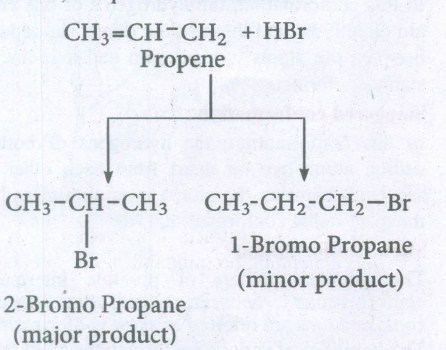
Mechanism:
Consider addition of HBr to propene
Step 1: Formation of electrophile:
In H-Br, Br is more electronegative than H. When bonded electron' moves toward Br, polarity is developed and creates an electrophile H+.which attaches the double bond to form carbocation, as shown below.
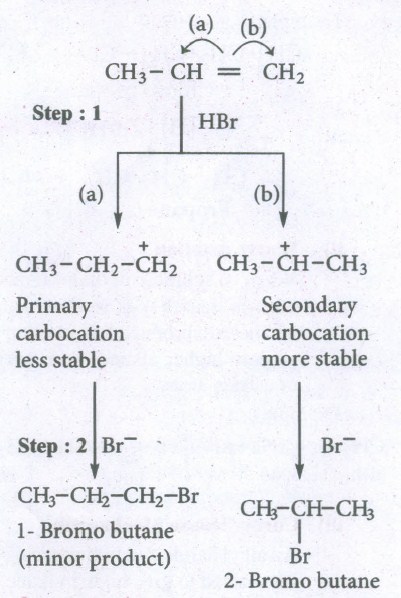
Step 2: Secondary carbocation is more stable than primary carbocation and it predominates over a the primary carbocation.
Step 3: The Br-ion attack the 2° carbocation to from 2-Bromobutane, the major product.
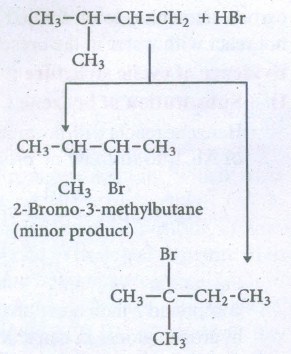
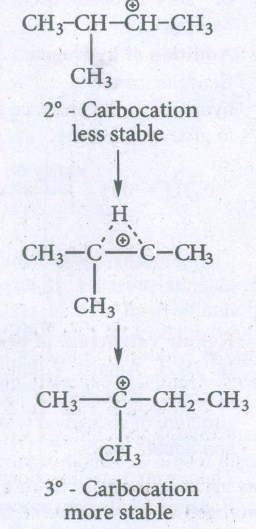
Consider addition of HBr to 3-methyl-l-butene. Here the expected product according to Markovnikoff's rule is 2-bromo-3-methyl butane but the actual major product is 2-Bromo- 2-methyl butane. This is because, the secondary carbocation formed during the reaction rearranged to more stable tertiary carbocation. attack of Br- on this tertiary carbocation gives the major product 2-bromo-2-methyl butane.
Carbocation rearrangement
Anti-Markovnikoff's Rule (Or) Peroxide Effect (Or) Kharasch Addition:
The addition of HBr to an alkene in the presence of organic peroxide, gives the anti Markovniko's product. This effect is called peroxide effect.
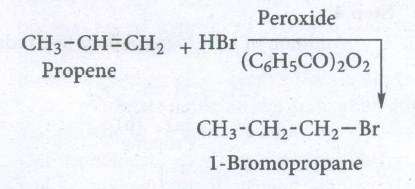
Mechanism:
The reaction proceeds via free radical mechanism.
Step 1:
The weak O-O single bond linkages of peroxides undergoes homolytic cleavage to generate free radical
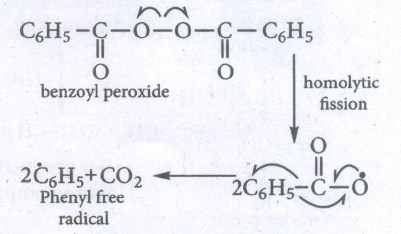
Step 2:
The radicals abstracts a hydrogen from HBr thus generating bromine radical.
\(\overset { . }{ { C }_{ 6 } } { H }_{ 5 }+HBr\longrightarrow { C }_{ 6 }{ H }_{ 6 }+\overset { . }{ Br } \)
Step 3:
The bromine radical adds to the double bond in the way to form more stable alkyl free radical.
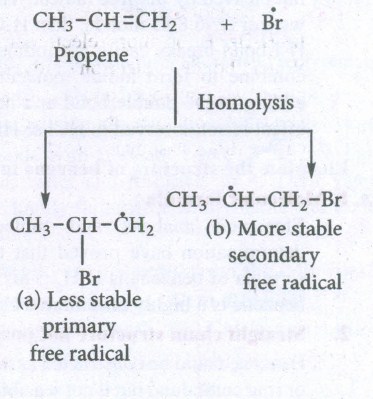
Step 4:
Addition of HBr to secondary free radical
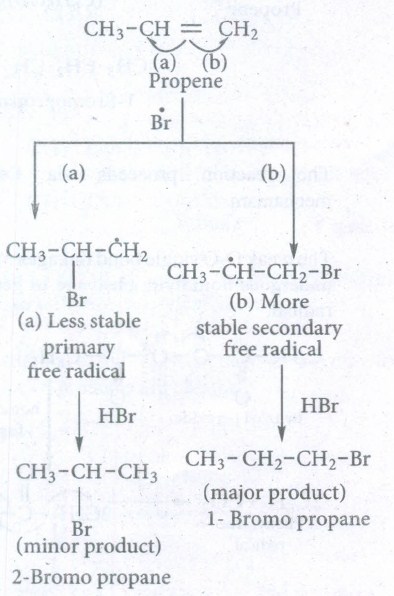
The H-CI bond is stronger (430.5 kJmol-1) than H-Br bond (363.7 kJmol-1), thus H-CI is not cleaved by the free radical. The H-I bond is weaker (296.8 kJ mol-1), than H-CI bond. Thus H-I bond breaks easily but iodine free radicals combine to form iodine molecules instead of adding to the double bond and hence peroxide effect is not observed in HCI & HI.
2.
1. Molecular formula:
Elemental analysis and molecular weight determination have proved that the molecular formula of benzene is C6H6. This indicates that benzene is a highly unsaturated compound.
2. Straight chain structure not possible:
Benzene could be constructed as a straight chain or ring compound but it not feasible since it does not show the properties of alkenes or alkynes. for example, it did not decolourise bromine in carbon tetrachloride or acidied KMnO4. It did not react with water in the presence of acid.
3. Evidence of cyclic structure :
I) Substitution of benzene:
Benzene reacts with bromine in the presence of AICl3 to form mono bromobenzene.
\({ C }_{ 6 }{ H }_{ 6 }+3{ Br }_{ 2 }\overset { { AICI }_{ 3 } }{ \longrightarrow } { C }_{ 6 }{ H }_{ 5 }Br+HBr\)
Bromobenzene
Formation of only one monobromo compound indicates that all the six hydrogen atoms in benzene were identical. is is possible only if it has a cyclic structure of six carbons each containing one hydrogen.
II) Addition of hydrogen:
Benzene can add on to three moles of hydrogen in the presence of nickel catalyst to give cyclohexane.
\({ C }_{ 6 }{ H }_{ 6 }+3{ H }_{ 2 }\overset { Raney\quad Ni }{ \longrightarrow } { C }_{ 6 }{ H }_{ 12 }+HBr\)
Cyclohexane
This confirms cyclic structure of benzene and the presence of three carbon-carbon double bond.
4. Kekule's structure of benzene:
In 1865, August Kekule suggested that benzene consists of a cyclic planar structure of six carbon with alternate single and double bonds.
There were two objections :
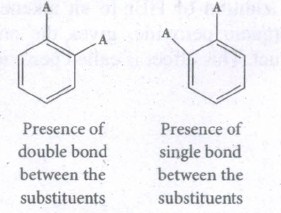
(i) Benzene forms only one orthodisubstituted products whereas the Kekule's structure predicts two o-di substituted products as shown below.
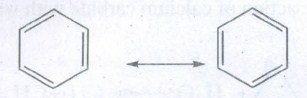
(ii) Kekule's structure failed to explain why benzene with three double bonds did not give addition reactions like other alkenes. To overcome this objection, Kekule suggested that benzene was mixture of two forms (1 and 2) which are in rapid equilibrium.
5. Resonance description of benzene:
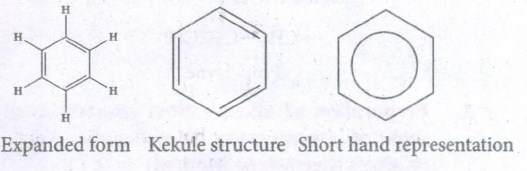
The phenomenon in which two or more structures can be written for a substance which has identical position of atoms is called I resonance. The actual structure of the molecule is said to be resonance hybrid of various possible alternative structures. In benzene, Kekule's structures I & II represented the resonance structure, and structure III is the resonance hybrid of structure I &II
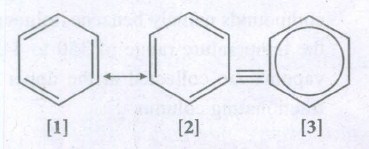
The structures 1 and 2 exist only in theory. The actual structure of benzene is the hybrid of two hypothetical resonance structures.
6. Spectroscopic measurements:
Spectroscopic measurements show that benzene is planar and all of its carbon-carbon bonds are of equal length 1.40 A°. This value lies between carbon-carbon single bond length 1.54A° and carbon-carbon double bond length 1.34A°.
7. molecular orbital structure:
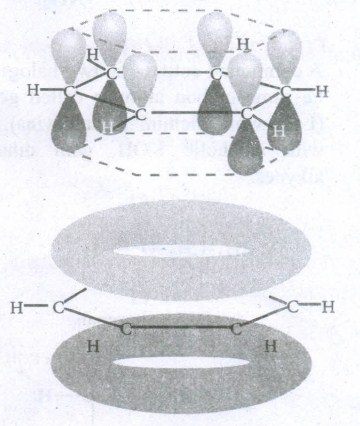
The structure of benzene is best described in terms of the molecular orbital theory. All the six carbon atoms of benzene are Sp2 hybridized. Six Sp2 hybrid orbitals of carbon linearly overlap with six one is orbitals of hydrogen atoms to form six C - H sigma bonds. Overlap between the remaining Sp2 hybrid orbitals of carbon forms six C-C sigma bonds.
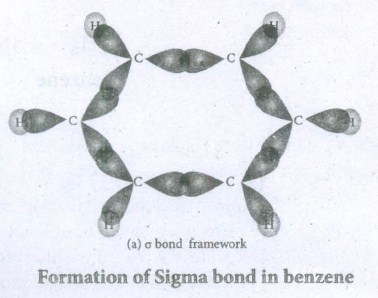
All the bonds in benzene lie in one plane with bond angle 120°. Each carbon atom in benzene possess an unhybridized p-orbital containing one electron. The lateral overlap of their p-orbital produces 3 \(\pi\)-bond. The six electrons of the p-orbitals cover all the six carbon atoms and are said to be delocalised.
Due to delocalization, strong -bond is formed which makes the molecule stable. Hence unlike alkenes and alkynes benzene undergoes substitution reactions rather addition reactions under normal conditions.
8. Representation of benzene:
Hence, there are three ways in which benzene can be represented.
Benzene and its homologous series
Benzene and its homologous series are colorless liquids with pleasant odour. They are lighter than water and insoluble in it. Their vapours are highly flammable, and volatile and toxic in nature.
3.
Preparation of ethene by kolbe's electrolytic method:
When an aqueous solution of potassium succinate is electrolyzed between two platinum electrodes, ethene is produced at the anode.
\(\overset { { CH }_{ 2 }-COOK }{ \underset { { CH }_{ 2 }-COOK }{ | } } \overset { Electrolysis }{ \longrightarrow } \overset { { CH }_{ 2 }-CO{ O }^{ - } }{ \underset { { CH }_{ 2 }-CO{ O }^{ - } }{ | } } +2{ K }^{ + }\)
At anode
\(\overset { { CH }_{ 2 }-CO{ O }^{ - } }{ \underset { { CH }_{ 2 }-COOK }{ | } } \longrightarrow \overset { { CH }_{ 2 } }{ \underset { \underset { Ethene }{ { CH }_{ 2 } } }{ || } } +{ CO }_{ 2(g) }+2{ e }^{ - }\)
4.
(i) Conformations of ethane:
The two tetrahedral methyl groups can rotate about the carbon - carbon bond axis yielding several arrangements called conformers. e extreme conformations are staggered and eclipsed conformation. There can be number of.other arrangements between staggered and eclipsed forms and their arrangements are known as skew forms.
Eclipsed conformation :
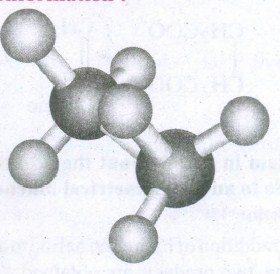
In this conformation, the hydrogen's of one carbon are directly behind those of the other. The repulsion between the atoms is maximum and it is the least stable conformer
Staggered conformation :
In this conformation, the hydrogens of both the carbon atoms are far apart from each other. The repulsion between the atoms is minimum and it is the most stable conformation.
Skew Conformation :
The infinite numbers of possible intermediate conformations between the two extreme conformations are referred as skew conformations. The stabilities of various conformations of ethane are
Staggered> Skew> Eclipsed
The potential energy difference between the . staggered and eclipsed conformation of ethane is around 12.5 kJmol-1. The various conformations can be represented by new man projection formula.
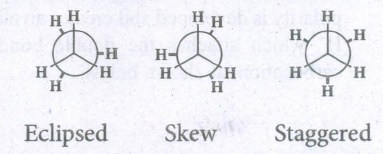
Newman projection formula for Ethane.
5.
Preparation of al anes from catalytic reduction of unsaturated hydro-carbons.
When a mixture hydrogen gas with alkane or : alkyne gas is passed over a catalysts such as I platinum or palladium at room temperature, an alkane is produced. This process of addition I of H2 to unsaturated compounds is known as 1 hydrogenatione above process can be catalysed : by nickel at 298K. is reaction is known as : Sabatier- Sendersens reaction.
Example :
\(\underset { Propene }{ { CH }_{ 3 } } -CH={ CH }_{ 2 }+{ H }_{ 2 }\overset { pt }{ \longrightarrow } { CH }_{ 3 }-\underset { Propene }{ { CH }_{ 2 } } -{ CH }_{ 3 }\)
\(\underset { Propene }{ { CH }_{ 2 } } ={ CH }_{ 2 }+{ H }_{ 2 }\overset { Ni }{ \underset { 298K }{ \longrightarrow } } \underset { Ethane }{ { CH }_{ 3 } } -{ CH }_{ 3 }\)
2.Preparation of alkanes from carboxylic acids:
i) Decarboxylation of sodium salt of carboxylic acid
When a mixture of sodium salt of carboxylic acid and soda lime (sodium hydroxide + calcium oxide) is heated, alkane is formed. The alkane formed has one carbon atom less than carboxylic acid. This process of eliminating carboxylic group is known as decarboxylation.
Example:
\(\underset { Sodium \ acetate }{ { CH }_{ 3 }COONa } +NaOH\overset { CaO }{ \underset { \triangle }{ \longrightarrow } } { CH }_{ 4 }+\underset { Methane }{ { Na }_{ 2 }{ CO }_{ 3 } } \)
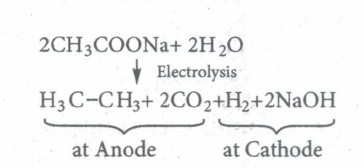
i) Kolbt's Electrolytic method:
When sodium or potassium salt of carboxylic acid is electrolyzed, a higher alkane is formed. The decarboxylative dimerization of two carboxylic acid occurs. This method is suitable for preparing symmetrical alkanes(R-R).
3. Preparation of alkanes using alkyl halides (or) halo alkanes:
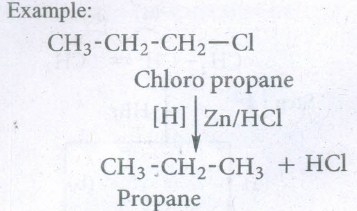
i) By reduction with nascent hydrogen :
Except alkyl fluorides, other alkyl halides can be converted to alkanes by reduction with nascent hydrogen. The hydrogen for reduction may be obtained by using any of the following reducing agents: Zn+HCI, Zn+CH3COOH, Zn-Cu couple in ethanol, LiAlH4 etc.,
ii) Wurtz reaction:
When a solution of halo alkanes in dry ether is treated with sodium metal, higher alkanes are produced. is reaction is used to prepare higher alkanes with even number of carbon atoms.
Example :
\(\underset { Methyl \ bromide }{ { CH }_{ 3 } } -Br+2Na+Br-{ CH }_{ 3 }\underset { dry\\ Ether }{ \longrightarrow } CH_{ 3 }-{ CH }_{ 3 }+\underset { Ethane }{ NaBr } \)
iii) Corey- House Mechanism :
An alkyl halide and lithium di alkyl cuprate are reacted to give higher alkane.
4) Preparation of Alkanes from Grignard reagents:
Halo alkanes reacts with magnesium in the pres~nce of dry ethers to give alkyl magnesium halide which is known as Grignard reagents. Here the alkyl group is directly attached to the magnesium metal make it to behave as carbanion. So, any compound with easily replaceable hydrogen reacts with Grignard reagent to.give corresponding alkanes.
Example:
\(\underset { Chloromethane }{ { CH }_{ 3 } } -Cl+Mg\overset { Dryether }{ \longrightarrow } \underset { Methyl \ magnesium \ bromide }{ { CH }_{ 3 }MgCl } \)
\({ CH }_{ 3 }MgCl+{ H }_{ 2 }O\longrightarrow \underset { Methane }{ { CH }_{ 4 } } +Mg(OH)Cl\)

11th Standard Syllabus & Materials
11th Standard
TN 11th Tamil பீடு பெற நில் - செய்யுள் - காவடிச்சிந்து Important Questions And Answers Study Material - QB365 Set A
NEW11th Standard
TN 11th Tamil பீடு பெற நில் - உரைநடை - மலை இடப்பெயர்கள் : ஓர் ஆய்வு Important Questions And Answers Study Material - QB365 Set A
NEW11th Standard
TN 11th Tamil மாமழை போற்றுதும் - துணைப்பாடம் - யானை டாக்டர் Important Questions And Answers Study Material - QB365 Set A
NEW11th Standard
TN 11th Tamil மாமழை போற்றுதும் - செய்யுள் - ஐங்குறுநூறு Important Questions And Answers Study Material - QB365 Set A



Tamilnadu Stateboard 11th Standard Subjects

Maths

Commerce

Economics

Biology

Business Maths and Statistics

Accountancy

Computer Science

Physics
Chemistry
Maths
Biology
Economics
Physics
Chemistry

History
Business Maths and Statistics

Computer Science
Accountancy

Computer Applications
History
Computer Technology
Commerce
Computer Applications
Computer Technology

Tamil

English

French
Tamilnadu Stateboard Standards



