
 100% FREE ACCESS
11th Standard Syllabus & Materials
11th Standard
TN 11th Tamil இயற்கை வேளாண்மை,சுற்றுச்சூழல் -செய்யுள் - மனோன்மணீயம் Important Questions And Answers Study Material - QB365 Set A
NEW11th Standard
TN 11th Tamil என்னுயிர் என்பேன் -துணைப்பாடம் - இசைத்தமிழர் இருவர் Important Questions And Answers Study Material - QB365 Set A
NEW11th Standard
TN 11th Tamil மொழி கலை -செய்யுள் - ஒவ்வொரு புல்லையும் Important Questions And Answers Study Material - QB365 Set A
NEW11th Standard
TN 11th Tamil பீடு பெற நில் - இலக்கணம் - பகுபத உறுப்புகள் Important Questions And Answers Study Material - QB365 Set A
NEW11th Standard
TN 11th Tamil பீடு பெற நில் - துணைப்பாடம் - வாடிவாசல் Important Questions And Answers Study Material - QB365 Set A
NEW11th Standard
TN 11th Tamil பீடு பெற நில் - செய்யுள் - குறுந்தொகை Important Questions And Answers Study Material - QB365 Set A

Published on: 13/05/2022
QB365 provides detailed and simple solution for every
Creative Questions in class 11 Chemistry Subject. It will
helps to get more idea about question pattern in every Creative questions with solution.
Download Tamil Nadu 11th Standard Chemistry question papers, model tests, one-mark questions, important questions, and public exam papers in PDF format. Free study materials and answer keys for TN State Board students.
Questions + Answers key
Take MCQ Chemistry Test1.
Explain about th formation of solid-liquid equilibrium with suitable example.
2.
What inferences do you observe by the values of Q andKc?
3.
Write a note on Haber's process emphasizing the idea of effect of a catalyst in an equilibrium reaction.
4.
Discuss the changes you observe in the reaction of I synthesis of ammonia with preference to effect of pressure.
5.
What happens when the' concentration of H2 and I2 are increased in the reaction \({ H }_{ 2 }+{ I }_{ 2 }\rightleftharpoons 2HI?\)
1.
(i) on sider melting of ice in a closed container at 273K. This system reach a state of physical equilibrium in which the amount of water in the solid phase and liquid phase does not change with time.
(ii) In this procedure, the total number of water molecules leaving from and returning to thelid ph at any in tant are equal.
(iii) If m ice cube and water are placed in a thermos flask (at 273K and 1 atm) then there will be no change in the mass of ice and water.
(iv) the equilibrium: Rate of melting of ice ⇌ Rate of freezing of water.
\({ H }_{ 2 }O\rightleftharpoons { H }_{ 2 }O(l)\)
2.
If Q = Kc the reaction is in equilibrium state.
If Q > Kc the reaction will proceed in the reverse direction i.e., formation of reactants.
If Q < Kc the reaction will proceed in the forward direction i.e., formation of products.
3.
Addition of a catalyst does not affect the state of the equilibrium. The catalyst increases the rate of both the forward and the reverse reactions to the same extent. Hence, it does not change the equilibrium composition of the reaction mixture. However, it speeds up the attainment of equilibrium by providing a new pathway having a lower activation energy.
For example, in the synthesis of NH3 by the Haber's process iron is used as a catalyst. Similarly, in the contact process of manufacturing SO3 platinum or V2OS is used as a catalyst.
4.
The change in pressure has significant eect only on equilibrium systems with gaseous components.
When the pressure on the sysem EMI tI·S· Increased, the volume decreases proportionately and the system responds by shifting the equilibrium in a direction that has fewer moles of gaseous molecules. Let us consider the synthesis of ammonia from nitrogen and hydrogen
\({ N }_{ 2 }\left( g \right) +3{ H }_{ 2 }\left( g \right) \rightleftharpoons { 2NH }_{ 3 }\left( g \right) \)
Let the system, be allowed to attain equilibrium in a cylinder with a piston. If we press the piston down to increase the pressure, the volume decreases.
The system responds to this effect by reducing the number of gas molecules. i.e. it favours the formation of ammonia. If we pull the piston upwards to reduce the pressure, the volume increases. It favours the decomposition of ammonia
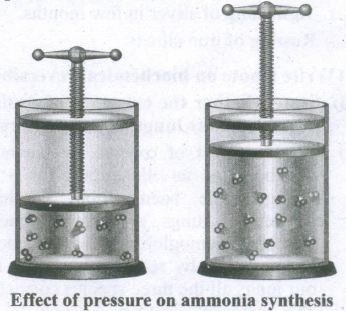
However, when the total number of the moles of the gaseous reactants and the gaseous products are equal, the change in pressure has no effect on system at equilibrium.
5.
According to Le Chatelier's principle, the effect of increase in concentration of a substance is to shift the equilibrium in a direction that consumes the added substance.
Let us consider the reaction
\({ H }_{ 2 }\left( g \right) +{ I }_{ 2 }\left( g \right) \rightleftharpoons 2HI\left( g \right) \)
The addition of H2 or I2to the equilibrium mixture, disturbs the equilibrium. In order to minimize the stress, the system shifts the reaction in a direction where H2 and I2 are consumed i.e., the formation of additional HI would balance the effect of added reactant. Hence, the equilibrium this to the right (forward direction) i.e. the forward reaction takes place until the equilibrium is re established. Similarly, removal of HI (product) also favours the forward reaction.

11th Standard Syllabus & Materials
11th Standard
TN 11th Tamil பீடு பெற நில் - செய்யுள் - காவடிச்சிந்து Important Questions And Answers Study Material - QB365 Set A
NEW11th Standard
TN 11th Tamil பீடு பெற நில் - உரைநடை - மலை இடப்பெயர்கள் : ஓர் ஆய்வு Important Questions And Answers Study Material - QB365 Set A
NEW11th Standard
TN 11th Tamil மாமழை போற்றுதும் - துணைப்பாடம் - யானை டாக்டர் Important Questions And Answers Study Material - QB365 Set A
NEW11th Standard
TN 11th Tamil மாமழை போற்றுதும் - செய்யுள் - ஐங்குறுநூறு Important Questions And Answers Study Material - QB365 Set A



Tamilnadu Stateboard 11th Standard Subjects

Maths

Commerce

Economics

Biology

Business Maths and Statistics

Accountancy

Computer Science

Physics
Chemistry
Maths
Biology
Economics
Physics
Chemistry

History
Business Maths and Statistics

Computer Science
Accountancy

Computer Applications
History
Computer Technology
Commerce
Computer Applications
Computer Technology

Tamil

English

French
Tamilnadu Stateboard Standards



