
 100% FREE ACCESS
11th Standard Syllabus & Materials
11th Standard
TN 11th Tamil இயற்கை வேளாண்மை,சுற்றுச்சூழல் -செய்யுள் - மனோன்மணீயம் Important Questions And Answers Study Material - QB365 Set A
NEW11th Standard
TN 11th Tamil என்னுயிர் என்பேன் -துணைப்பாடம் - இசைத்தமிழர் இருவர் Important Questions And Answers Study Material - QB365 Set A
NEW11th Standard
TN 11th Tamil மொழி கலை -செய்யுள் - ஒவ்வொரு புல்லையும் Important Questions And Answers Study Material - QB365 Set A
NEW11th Standard
TN 11th Tamil பீடு பெற நில் - இலக்கணம் - பகுபத உறுப்புகள் Important Questions And Answers Study Material - QB365 Set A
NEW11th Standard
TN 11th Tamil பீடு பெற நில் - துணைப்பாடம் - வாடிவாசல் Important Questions And Answers Study Material - QB365 Set A
NEW11th Standard
TN 11th Tamil பீடு பெற நில் - செய்யுள் - குறுந்தொகை Important Questions And Answers Study Material - QB365 Set A

Published on: 13/05/2022
QB365 provides detailed and simple solution for every
Creative Questions in class 11 Chemistry Subject. It will
helps to get more idea about question pattern in every Creative questions with solution.
Download Tamil Nadu 11th Standard Chemistry question papers, model tests, one-mark questions, important questions, and public exam papers in PDF format. Free study materials and answer keys for TN State Board students.
Questions + Answers key
Take MCQ Chemistry Test1.
What is the equilibrium concentration of each of the substances in the equilibrium when the initial concentration of ICI was 0.78 M?
2 ICI(g) ⇌ I2(g) + Cl2(g); KC = 0.14
2.
At certain temperature and under a pressure of 4 atm, PCl5 is 10% dissociated. Calculate the pressure at which PCls will be 20% dissociated at temperature remaining constant.
3.
(i) Describe the effect of
(a) addition of H2,
(b) addition of CH30H
(c) removal of CO
(d) removal ofCH3OH on the equilibrium of
the reaction, \({ 2H }_{ 2(g) }+{ CO }_{ (g) }\rightleftharpoons { CH }_{ 3 }{ OH }_{ (g) }\)
(ii) What happens to an equilibrium in a reversible reaction if a catalyst is added to it?
4.
Derive the expressions for Kc and Kp for the dissociation of PCI5
5.
Derive the Kp and Kc for the following equilibrium reaction.
\({ H }_{ 2\left( g \right) }+{ I }_{ 2\left( g \right) }\rightleftharpoons { 2HI }_{ \left( g \right) }\)
1.
Suppose at equilibrium, the molar concentration of both I2(g) and Clig) is x mol L-I

\({ K }_{ C }=\cfrac { \left[ { I }_{ 2 }\left( g \right) \right] \left[ { { Cl }_{ 2 }\left( g \right) } \right] }{ \left[ ICI(g) \right] ^{ 2 } } =\cfrac { \left( x \right) \times \left( x \right) }{ \left( 0.78-2x \right) ^{ 2 } } \)
\(\cfrac { x }{ \left( 0.78-2x \right) } ={ (0.14) }^{ \frac { 1 }{ 2 } }=0.374\) or x = 0.374 (0.78 - 2x)
x = 0.292 - 0.748x or x = 1.748x = 0.292;\(x=\cfrac { 0.292 }{ 1.748 } =0.167\)
[ICI] = (0.78 - 2 x 0.167) = (0.78 -0.334) = 0.446 M
[I2]= 0.167 M; [CI2] = 0.167 M
2.
Calculation of KP
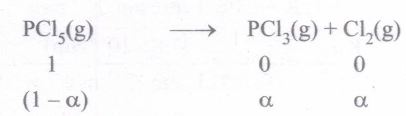
Total no. of moles in the equilibrium mixture = 1 - α + α + α = (1 + a) mol.
Let the total pressure of equilibrium mixture =p atm
Partial pressure of PCI5,\({ PCl }_{ 3 }=\cfrac { \alpha }{ 1+\alpha } \times p\quad atm\)
Partial pressure of \({ PCL }_{ 3 }=\cfrac { \alpha }{ 1+\alpha } \times p\quad atm\)
Partial pressure of Cl2=\({ PCl }_{ 2 }=\cfrac { \alpha }{ 1+\alpha } \)
\({ K }_{ P }=\cfrac { P_{ PCl_{ 3 } }\times { P }_{ cl_{ 2 } } }{ { P }_{ PC{ l }_{ 5 } } } =\cfrac { \left( \frac { \alpha }{ 1+\alpha } p\quad atm \right) \times \left( \cfrac { \alpha }{ 1+\alpha } p\quad atm \right) }{ \frac { 1-\alpha }{ 1+\alpha } p\quad atm } =\cfrac { { a }^{ 2 }p }{ 1-{ a }^{ 2 } } \)
P=4 atm and α.= 10%= \(\cfrac { 10 }{ 100 } =0.1\)
\({ K }_{ P }=\cfrac { \left( 0.1 \right) \times \left( 0.1 \right) \times \left( 4atm \right) }{ 1-\left( 0.1 \right) ^{ 2 } } =\cfrac { 0.04 }{ 0.99 } =0.004atm\)
= 0.96 atm
3.
(i) \({ 2H }_{ 2(g) }+{ CO }_{ (g) }\rightleftharpoons { CH }_{ 3 }{ OH }_{ (g) }\)
According to Le-Chatelier's principle,
(a) addition of H2 (increase in concentration of reactants) shifts the equilibrium in forward direction (more product is formed).
(b) addition of CH3OH . (increase In concentration of preduct) shifts the equilibrium in backward direction.
(c) removal of CO also shifts the equilibrium in backward direction.
(d) removal ofCH2OH shifts the equilibrium in forward direction.
(ii) When catalyst is added, the state of equilibrium is not disturbed but equilibrium is attained quickly, This is because the 'catalyst increases the rate offorward and backward reaction to the same extent.
4.
Consider that 'a' moles of PCI5 is taken in a container of volume V. Let 'x' moles of PCl5 be dissociatedinto x moles of PC1, and x moles of Cl2 .
\(\mathrm{PCl}_{5(\mathrm{~g})} \rightleftharpoons \mathrm{PCl}_{3(\mathrm{~g})}+\mathrm{Cl}_{2(\mathrm{~g})}\)
| H2 | I2 | HI | |
| Initial number of moles | a | b | 0 |
| Number of moles reached | x | x | 0 |
| Number of moles at equilibrium | a - x | b - x | 2x |
| Active mass or molar concentration at equilibrium | \(\cfrac { a-x }{ V } \) | \(\cfrac { b-x }{ V } \) | \(\cfrac { 2x }{ V } \) |
Applying law of mass action
\({ K }_{ c }=\cfrac { \left[ { PCI }_{ 3 } \right] \left[ { CI }_{ 2 } \right] }{ { \left[ { PCI }_{ 5 } \right] } } =\cfrac { \left( \cfrac { x }{ V } \right) \left( \cfrac { x }{ V } \right) }{ \left( \cfrac { a-x }{ V } \right) } =\cfrac { { x }^{ 2 } }{ \left( a-x \right) V } \)
The equilibrium constant Kp can also be calculated as follows:
We know the relationship between the Kc and K p
\(K_{p}=K_{c}(R T)\left(\Delta n_{g}\right)\)
Here the \(\Delta n_{g}=n_{p}-n_{r}=2-1=1\)
Hence Kp = Kc (RT)
We know that PV = nRT
\(RT=\cfrac { PV }{ n } \)
Where n is the total number of moles at equilibrium.
n = (a - x) + x + x = (a + x)
= \({ K }_{ p }=\cfrac { { x }^{ 2 } }{ \left( a-x \right) V } \cfrac { PV }{ n } \)
= \({ K }_{ p }=\cfrac { { x }^{ 2 } }{ \left( a-x \right) V } \cfrac { PV }{ \left( a+x \right) } \)
= \({ K }_{ p }=\cfrac { { x }^{ 2 }P }{ \left( a-x \right) \left( a+x \right) } \)
5.
Let us consider the formation of HI in which, 'a' moles of hydrogen and 'b' moles of iodine gas are allowed to react in a container of volume V. Let 'x' moles of each of H2 and I2react together to form 2x moles of HI.
\({ H }_{ 2\left( g \right) }+{ I }_{ 2\left( g \right) }\rightleftharpoons { 2HI }_{ \left( g \right) }\)
| H2 | I2 | HI | |
| Initial number of moles | a | b | 0 |
| Number of moles reached | x | x | 0 |
| Number of moles at equilibrium | a-x | b-x | 2x |
| Active mass or molar concentration at equilibrium | \(\cfrac { a-x }{ V } \) | \(\cfrac { b-x }{ V } \) | \(\cfrac { 2x }{ V } \) |
Applying law of mass action,
\({ K }_{ C }=\cfrac { { \left[ HI \right] }^{ 2 } }{ { \left[ H \right] }_{ 2 }\left[ { I }_{ 2 } \right] } \)
= \(\cfrac { \left( \cfrac { 2x }{ V } \right) ^{ 2 } }{ \left( \cfrac { a-x }{ V } \right) \left( \cfrac { b-x }{ v } \right) } =\cfrac { { 4x }^{ 2 } }{ \left( a-x \right) \left( b-x \right) } \)
The equilibrium constant Kp can also be calcu•lated as follows:
We know }he \rer~tionship between the Kc and Kp
Here the \(\Delta n_{ g }\)=np -nr = 2 - 2 =0
Hence K = Kc ;\({ K }_{ p }=\cfrac { { 4x }^{ 2 } }{ \left( a-x \right) \left( b-x \right) } \)

11th Standard Syllabus & Materials
11th Standard
TN 11th Tamil பீடு பெற நில் - செய்யுள் - காவடிச்சிந்து Important Questions And Answers Study Material - QB365 Set A
NEW11th Standard
TN 11th Tamil பீடு பெற நில் - உரைநடை - மலை இடப்பெயர்கள் : ஓர் ஆய்வு Important Questions And Answers Study Material - QB365 Set A
NEW11th Standard
TN 11th Tamil மாமழை போற்றுதும் - துணைப்பாடம் - யானை டாக்டர் Important Questions And Answers Study Material - QB365 Set A
NEW11th Standard
TN 11th Tamil மாமழை போற்றுதும் - செய்யுள் - ஐங்குறுநூறு Important Questions And Answers Study Material - QB365 Set A



Tamilnadu Stateboard 11th Standard Subjects

Maths

Commerce

Economics

Biology

Business Maths and Statistics

Accountancy

Computer Science

Physics
Chemistry
Maths
Biology
Economics
Physics
Chemistry

History
Business Maths and Statistics

Computer Science
Accountancy

Computer Applications
History
Computer Technology
Commerce
Computer Applications
Computer Technology

Tamil

English

French
Tamilnadu Stateboard Standards



