
 100% FREE ACCESS
11th Standard Syllabus & Materials
11th Standard
TN 11th Tamil இயற்கை வேளாண்மை,சுற்றுச்சூழல் -செய்யுள் - மனோன்மணீயம் Important Questions And Answers Study Material - QB365 Set A
NEW11th Standard
TN 11th Tamil என்னுயிர் என்பேன் -துணைப்பாடம் - இசைத்தமிழர் இருவர் Important Questions And Answers Study Material - QB365 Set A
NEW11th Standard
TN 11th Tamil மொழி கலை -செய்யுள் - ஒவ்வொரு புல்லையும் Important Questions And Answers Study Material - QB365 Set A
NEW11th Standard
TN 11th Tamil பீடு பெற நில் - இலக்கணம் - பகுபத உறுப்புகள் Important Questions And Answers Study Material - QB365 Set A
NEW11th Standard
TN 11th Tamil பீடு பெற நில் - துணைப்பாடம் - வாடிவாசல் Important Questions And Answers Study Material - QB365 Set A
NEW11th Standard
TN 11th Tamil பீடு பெற நில் - செய்யுள் - குறுந்தொகை Important Questions And Answers Study Material - QB365 Set A

Published on: 13/05/2022
QB365 provides detailed and simple solution for every
Creative Questions in class 11 Chemistry Subject. It will
helps to get more idea about question pattern in every Creative questions with solution.
Download Tamil Nadu 11th Standard Chemistry question papers, model tests, one-mark questions, important questions, and public exam papers in PDF format. Free study materials and answer keys for TN State Board students.
Questions + Answers key
Take MCQ Chemistry Test1.
Discuss the comparison between Raoult's law and Henry's law.
2.
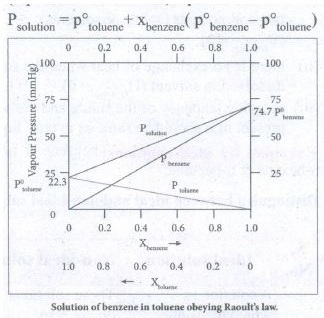
With the help of a graph discuss the variation of vapour pressure of benzene in toluene.
3.
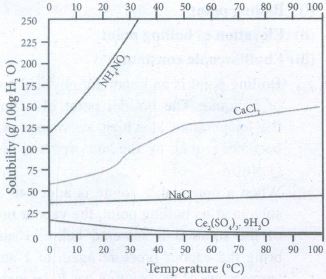
Explain the above variation in solubility with respect to temperature for selective compounds.
4.
Write a note on solubility of solute and brief out the formation of a saturated solution with an example.
5.
Enlist the advantages using standard solutions.
1.
According to Raoult's law, for a solution containing a nonvolatile solute
psolute = \({ p }_{ solute }^ { 0 }\) xsolute
According to Henry's law
psolute = KHxsolute in solution
The difference between the above two expressions is the proportionality constant poA (Raoults Law) and KH'(Henry's law). Henry's law is applicable to solution containing gaseous solute in liquid solvent, while the Raoult's law is applicable to nonvolatile solid solute in a liquid solvent. If the solute is non volatile then the Henry's law constant will become equal to the vapour of the pure solvent (\({ p }_{ A }^{ 0 }\)) and thus, Raoult's law becomes a special case of Henry's law. For very dilute solutions the solvent obeys Raoult's law and the solute obeys Henry's law.
2.
Let us consider the liquid solution containing toluene (solute) in benzene (solvent).
The variation of vapour pressure of pure benzene and toluene with its mole fraction is given in the graph. The vapour pressures of pure toluene and pure benzene are 22.3 and 74.7 mmllg, respectively. The above graph shows, the partial vapour pressure of the pure components increases linearly with the increase in the mole fraction of the respective components. The total pressure at any composition of the solute and solvent is given by the following straight line (represented as red line) equation.
3.
The solubilities er ammonium nitrate, calcium chloride, eerie sulphate nano-hydrate and sodium chloride in water at different temperatures are given. in the following graph.
The following conclusions are drawn from the above graph.
(i) The solubility of sodium chloride does not vary appreciably as the maximum solubility is achieved at normal temperature. In fact, there is only 10 % increase in solubility between 0 ° to 100°C.
(ii) The dissolution process of ammonium nitrate : is endothermic, the solubility increases steeply I with increase in temperature.
(iii) In the case of eerie sulphate, the dissolution is exothermic and the solubility decreases with increase in temperature.
(iv) Even though the dissolution of. calcium chloride is exothermic, the solubility increases moderately with increase in temperature. Here, the entropy factor also plays a signicant role in deciding the position of the equilibrium
4.
(i) Solubility of a solute is the maximum amount of solute that can be dissolved in a specie amount of solvent at a specied temperature.
(ii) When maximum amount of solute is dissolved in a solvent, any more addition of solute will result in precipitation at a given temperature and pressure. Such a solution is called as a saturated solution.
(iii) The solubility of a substance at a given temperature is dened as the amount of the solute that can be dissolved in 100 g of the solvent at a given temperature to form a saturated solution.
5.
(i) The error due to weighing the solute can be minimised by using concentrated stock solution that requires large quantity of solute.
(ii) We can prepare working standards of different concentrations by diluting the stock solution, which is more efficient since consistency is maintained.
(iii) Some of the concentrated solutions are more stable and are less likely to support microbial growth than working standards used in the experiments.

11th Standard Syllabus & Materials
11th Standard
TN 11th Tamil பீடு பெற நில் - செய்யுள் - காவடிச்சிந்து Important Questions And Answers Study Material - QB365 Set A
NEW11th Standard
TN 11th Tamil பீடு பெற நில் - உரைநடை - மலை இடப்பெயர்கள் : ஓர் ஆய்வு Important Questions And Answers Study Material - QB365 Set A
NEW11th Standard
TN 11th Tamil மாமழை போற்றுதும் - துணைப்பாடம் - யானை டாக்டர் Important Questions And Answers Study Material - QB365 Set A
NEW11th Standard
TN 11th Tamil மாமழை போற்றுதும் - செய்யுள் - ஐங்குறுநூறு Important Questions And Answers Study Material - QB365 Set A



Tamilnadu Stateboard 11th Standard Subjects

Maths

Commerce

Economics

Biology

Business Maths and Statistics

Accountancy

Computer Science

Physics
Chemistry
Maths
Biology
Economics
Physics
Chemistry

History
Business Maths and Statistics

Computer Science
Accountancy

Computer Applications
History
Computer Technology
Commerce
Computer Applications
Computer Technology

Tamil

English

French
Tamilnadu Stateboard Standards



