
 100% FREE ACCESS
11th Standard Syllabus & Materials
11th Standard
TN 11th Tamil இயற்கை வேளாண்மை,சுற்றுச்சூழல் -செய்யுள் - மனோன்மணீயம் Important Questions And Answers Study Material - QB365 Set A
NEW11th Standard
TN 11th Tamil என்னுயிர் என்பேன் -துணைப்பாடம் - இசைத்தமிழர் இருவர் Important Questions And Answers Study Material - QB365 Set A
NEW11th Standard
TN 11th Tamil மொழி கலை -செய்யுள் - ஒவ்வொரு புல்லையும் Important Questions And Answers Study Material - QB365 Set A
NEW11th Standard
TN 11th Tamil பீடு பெற நில் - இலக்கணம் - பகுபத உறுப்புகள் Important Questions And Answers Study Material - QB365 Set A
NEW11th Standard
TN 11th Tamil பீடு பெற நில் - துணைப்பாடம் - வாடிவாசல் Important Questions And Answers Study Material - QB365 Set A
NEW11th Standard
TN 11th Tamil பீடு பெற நில் - செய்யுள் - குறுந்தொகை Important Questions And Answers Study Material - QB365 Set A

Published on: 13/05/2022
QB365 provides detailed and simple solution for every
Creative Questions in class 11 Chemistry Subject. It will
helps to get more idea about question pattern in every Creative questions with solution.
Download Tamil Nadu 11th Standard Chemistry question papers, model tests, one-mark questions, important questions, and public exam papers in PDF format. Free study materials and answer keys for TN State Board students.
Questions + Answers key
Take MCQ Chemistry Test1.
Explain the various factors which are responsible for the deviation of solution from Raoult's law.
2.
(i) When does a non-ideal solution is said to show a negative deviation?
(ii) Analyse the deviation observed in the solution of phenol and aniline.
3.
Explain the nature of non - ideal solution with positive deviation from Raoult,s law.
4.
"Rate of vapourisation is reduced by presence of non-volatile solute"- Explain,
5.
How does the change in temperature affect the solubility of a solute in a liquid solvent and gaseous solute in liquid solvent? Explain.
1.
(i) Solute - solvent interactions :
For an ideal solution, the interaction between the solvent molecules (A-A),the solute molecules (B-B) and between the solvent & solute molecules (A-B) are expected to be similar. If these interactions are dissimilar, then there will be a deviation from ideal behavior.
(ii) Dissociation of solute:
When a solute present in a solution dissociates to give its constituent ions, the resultant ions interact strongly with the solvent and cause deviation from Raoult's law.
A solution of potassium chloride in water deviates from ideal behavior because the solute dissociates to give K+ and cr ion which form strong ion-dipole interaction with water molecules.
KCI(S) + H2O(1) \(\rightarrow\)K+ (aq) + Cl- (aq)
(iii) Association of solute :
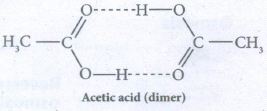
Association of solute molecules can also cause deviation from ideal behaviour. For example, in solution, acetic acid exists as a dimer by forming intermolecular hydrogen bonds, and hence deviates from Raoult's law
(iv) Temperature:
An increase in temperature of the solution increases the average kinetic energy of the molecules present in the solution which causes decrease in the attractive force between them. As result, the solution deviates from ideal behaviour.
(v) Pressure:
At high pressure the molecules tend to stay close to each other and therefore there will be an increase in their intermolecular attraction. us, a solution deviates from Raoult's law at high pressure.
(vi) Concentration:
If a solution is suffciently dilute there is no pronounced solvent-solute interaction because the number of solute molecules are very low compared to the solvent.When the concentration is increased by adding solute, the solvent-solute interaction becomes significant. This causes deviation from the Raoult's law.
2.
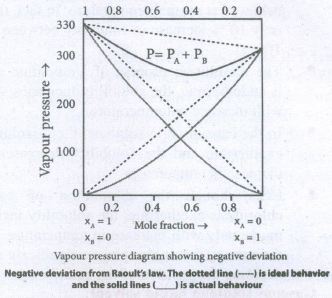
(i) The escaping tendency of A and B will be lower when compared with an ideal solution formed by A and B. Hence, the vapour pressure of such solutions will be lower than the sum of the vapour pressure of A and B. is type of deviation is called negative deviation. For the negative deviation \({ p }_{ A }>{ p }_{ A }^{ 0 }{ x }_{ A }\) and \(< p^0_Bx_B.\)
(ii) Let us consider a solution of phenol and aniline. Both phenol and aniline form hydrogen bonding interactions amongst themselves. However, when mixed with aniline, the phenol molecule forms hydrogen bonding interactions with aniline, which are stronger than the hydrogen bonds formed amongst themselves. Formation of new hydrogen bonds considerably reduce the escaping tendency of phenol and aniline from the solution. As a result, the vapour pressure of the solution is less and there is a slight decrease in volume (\(\triangle\)Vmixing < 0) on mixing , during this process evolution of heat takes place (i.e ) \(\triangle\) Hmixing < 0 (exothermic)
Examples for non-ideal solutions showing negative deviation : Acetone Chloroform + diethyl ether, aniline,Chloroform + Benzene.
3.
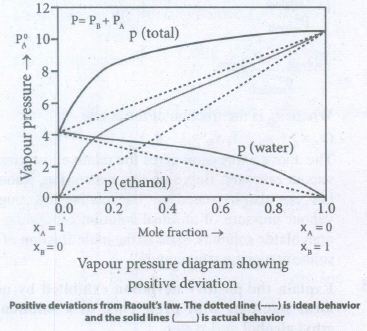
The nature of the deviation from the Rauolt's law can be explained in terms of the intermolecular interactions between solute (A) and solvent (B). Consider a case in which the intermolecular attractive forces between A and B are weaker than those between the molecules of A (A - A) and molecules of B (B - B). The molecules present in such a solution have a greater tendency to escape from the solution when compared to the ideal solution formed by A and B, in which the intermolecular attractive forces (A - A, B - B, A - B) are almost similar. Consequently, the vapour pressure of such non-ideal solution increases and it is greater than the sum of the vapour pressure of A and B as predicted by the Raoult's law. This type of deviation is called positive deviation.
Here, \({ p }_{ A }>{ p }_{ A }^{ 0 }{ x }_{ A }\) and \({ p }_{ B }>{ p }_{ A }{ x }_{ B }\)
Hence \({ p }_{ total }>{ p }_{ A }^{ 0 }{ x }_{ A }+{ p }_{ B }^{ 0 }{ x }_{ B }\)
Letus understand the positive deviation by considering a solution of ethyl alcohol and water. In this solution the hydrogen bonding interaction between ethanol and water is weaker than those hydrogen bonding interactions amongst themselves (ethyl alcohol-ethyl alcohol and water-water interactions). This results in the increased evaporation of both components from the aqueous solution of ethanol. Consequently, the vapour pressure of the solution is greater than the vapour pressure predicted by Raoult's law. Here, the mixing process is endothermic i.e. \(\triangle\)Hmixing > 0 and there will be a slight increase in volume (\(\triangle\)Vmixing > 0).
Examples for non - ideal solutions showing postive deviations:
Ethyl alcohol & cyclohexane, Benzene & acetone, Carbon tetrachloride & chloroform, Acetone & ethyl alcohol, Ethyl alcohol & water.
4.
When a nonvolatile solute is dissolved in a pure solvent, the vapour pressure of the pure solvent will decrease. In such solutions, the vapour pressure of the solution will depend only on the solvent molecules as the solute is nonvolatile.
For example, when sodium chloride is added to the water, the vapour pressure of the salt solution is lowered. The vapour pressure of the solution is determined by the number of molecules of the solvent present in the surface at any time and is proportional to the mole fraction of the solvent.
\({ P }_{ Solution }\infty { X }_{ A }\)
Where xA is the mole fraction of the solvent
Psolution = K XA
When XA = 1, K = \({ P }_{ solvent }^ {0 }\)
\({ P }_{ solvent }^ {0 }\) is the partial pressure of pure solvent)
Psolution = \({ P }_{ solvent }^ {0 }\) XA
\(\frac { { P }_{ Solution } }{ { P }_{ solvent }^{ 0 } } \) = XA
\(1-\frac { { P }_{ Solution } }{ { P }_{ solvent }^{ 0 } } \) = 1 - XA
\(\frac { { P }_{ solvent }^{ 0 }-{ P }_{ Solution } }{ { P }_{ solvent }^{ 0 } } \) = XB
Where xB is the fraction of the solute
(:: x A+ xB = 1, xB = 1 - xA)
The above expression gives the relative lowering of . vapour pressure. Based on this expression, Raoult's law can also be stated as "the relative lowering of vapour pressure of an ideal solution containing the nonvolatile solute is equal to the mole fraction of the solute at a given temperature".
5.
Solid solute in liquid solvent:
Generally, the solubility of a solid solute in a-liquid solvent increases with increase in temperature. When the temperature is increased, the average kinetic energy of the molecules of the solute and the solvent increases. The increase in kinetic energy facilitates the solvent molecules to break the intermolecular attractive forces that keep the solute molecules together and hence the solubility increases.
When a solid is added to a solvent, it begins to dissolve. (i.e.) the solute leaves from the solid state (dissolution). After some time, some of the dissolved solute returns back to the solid state (recrystallisation). If there is excess of solid present, the rate of both these processes becomes equal at a particular stage. At this stage an equilibrium is established between the solid solute molecules and dissolved solute molecules.
Solute (solid) \(\rightleftharpoons \) Solute (dissolved)
According to Le-Chatelier principle, if the dissolution process is endothermic, the increase in temperature will shift the equilibrium towards left (i.e) solubility increases. For an exothermic reaction, the increase ill temperature decreases the solubility. The solubilities of ammonium nitrate, calcium chloride, ceric sulphate nano-hydrate and sodium chloride in watei at different temperatures are given in the following graph.
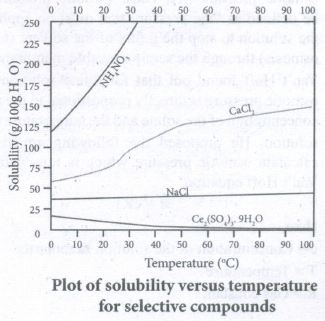
The following conclusions are drawn from the above graph.
(i) The solubility of sodium chloride does not vary appreciably as the maximum solubility is achieved at normal temperature. In fact, there is only 10 % increase in solubility between 0 ° to 100°C.
(ii) The dissolution process of ammonium nitrate is endothermic, the solubility increases steeply with increase in temperature.
(iii) In the case of eerie sulphate, the dissolution is exothermic and the solubility decreases with increase in temperature.
(iv) Even though the dissolution of calcium chloride is exothermic, the solubility increases 'moderately with increase in temperature. Here, the entropy factor also plays a significant role in deciding the position of the equilibrium.
Gaseous solute in liquid solvent :
In the case of gaseous solute in liquid solvent, the solubility decreases with increase in temperature. When a gaseous solute dissolves in a liquid solvent, its molecules interact with solvent molecules with weak intermolecular forces. When the temperature increases, the average kinetic energy of the molecules present in the solution also increases. The increase in kinetic energy breaks the weak intermolecular forces between the gaseous solute and liquid solvent which results in the release of the dissolved gas molecules to the gaseous state. Moreover, the dissolution of most of the gases in liquid solvents is an exothermic process, and in such processes, the increase in temperature decreases the dissolution of gaseous I molecules.

11th Standard Syllabus & Materials
11th Standard
TN 11th Tamil பீடு பெற நில் - செய்யுள் - காவடிச்சிந்து Important Questions And Answers Study Material - QB365 Set A
NEW11th Standard
TN 11th Tamil பீடு பெற நில் - உரைநடை - மலை இடப்பெயர்கள் : ஓர் ஆய்வு Important Questions And Answers Study Material - QB365 Set A
NEW11th Standard
TN 11th Tamil மாமழை போற்றுதும் - துணைப்பாடம் - யானை டாக்டர் Important Questions And Answers Study Material - QB365 Set A
NEW11th Standard
TN 11th Tamil மாமழை போற்றுதும் - செய்யுள் - ஐங்குறுநூறு Important Questions And Answers Study Material - QB365 Set A



Tamilnadu Stateboard 11th Standard Subjects

Maths

Commerce

Economics

Biology

Business Maths and Statistics

Accountancy

Computer Science

Physics
Chemistry
Maths
Biology
Economics
Physics
Chemistry

History
Business Maths and Statistics

Computer Science
Accountancy

Computer Applications
History
Computer Technology
Commerce
Computer Applications
Computer Technology

Tamil

English

French
Tamilnadu Stateboard Standards



