
 100% FREE ACCESS
11th Standard Syllabus & Materials
11th Standard
TN 11th Tamil இயற்கை வேளாண்மை,சுற்றுச்சூழல் -செய்யுள் - மனோன்மணீயம் Important Questions And Answers Study Material - QB365 Set A
NEW11th Standard
TN 11th Tamil என்னுயிர் என்பேன் -துணைப்பாடம் - இசைத்தமிழர் இருவர் Important Questions And Answers Study Material - QB365 Set A
NEW11th Standard
TN 11th Tamil மொழி கலை -செய்யுள் - ஒவ்வொரு புல்லையும் Important Questions And Answers Study Material - QB365 Set A
NEW11th Standard
TN 11th Tamil பீடு பெற நில் - இலக்கணம் - பகுபத உறுப்புகள் Important Questions And Answers Study Material - QB365 Set A
NEW11th Standard
TN 11th Tamil பீடு பெற நில் - துணைப்பாடம் - வாடிவாசல் Important Questions And Answers Study Material - QB365 Set A
NEW11th Standard
TN 11th Tamil பீடு பெற நில் - செய்யுள் - குறுந்தொகை Important Questions And Answers Study Material - QB365 Set A

Published on: 25/06/2021
QB365 provides detailed and simple solution for every
Creative Questions in class 11 Chemistry Subject. It will
helps to get more idea about question pattern in every Creative questions with solution.
Download Tamil Nadu 11th Standard Chemistry question papers, model tests, one-mark questions, important questions, and public exam papers in PDF format. Free study materials and answer keys for TN State Board students.
Questions + Answers key
Take MCQ Chemistry Test1.
Explain with a suitable diagram and appropriate example, why some non-ideal solution shows positive deviation from Raoult's
2.
What are ideal and non-ideal solutions ? Explain with suitable diagram the behaviour of ideal solutions.
3.
Derive an expression for molecular weight of the solute from osmotic Pressure.
4.
How will you obtain the molecular mass of a solute from relative lowering of vapour pressure ?
5.
Explain about the factors that are responsible for deviation from Raoult's law.
1.
Some non-ideal solutions show positive deviation from Raoult's law. Consider a solution of two components A and B. If A-B interactions in the solution are weaker than the A-A and B-B interactions in the two liquids forming the solution, then the escaping tendency of molecules A and B from the solution become more than in pure liquids. The total vapour pressure will be greater than the corresponding vapour pressure as expected on the basis of Raoult's law. This type of behaviour of solution is called positive deviation from Raoult's law. Tbe boiling point of such solutions are lowered. Mathematically,
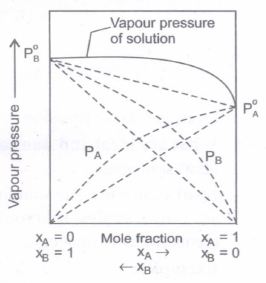
PA < poAX xA
PB < poB x xB
The total vapour pressure is less than PA + PB
P
P < PoAX xA + P0B xB
P1 = PA
P2 = PB
Examples of solutions showing positive deviations:
(i) Etbyl alcobol and water
(ii) Benzene and acetone
(iii) Ethyl alcohol and cyclobexane
(iv) Carbon tetrachloride and chlorofor
2.
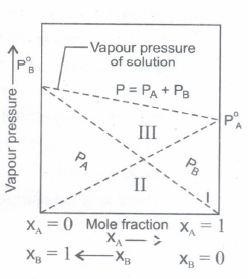
Ideal solutions: The solutions which obey Raoult's law over the entire range of concentration are known as ideal solutions. Ideal solutions are formed by mixing the two components which are identical in molecular size, in structure and have almost identical intermolecular forces.
Examples:
(i) Benzene and toluene
(ii) n-Hexane and n-Heptane
(iii) Chlorobenzene and bromobenzene.
Characteristics:
(i) They must obey Raoult's law.
(ii) ΔH mixing should be zero.
(iii)ΔV mixing should be zero, i.e. volume change on mixing is zero.
Non-ideal solutions : The solutions which do not obey Raoult's law are called non-ideal solutions. In case of non-ideal solutions there is change in volume and heat energy when the two componnts are mixed.
Characterstics :
(i) They does not Rault's law.
(ii)△V = mix ≠ 0
(iii) △H mix ≠ 0
Behaviour of Ideal Solutions: A plot of PI or P2 versus the mole fraction x1 and x2 for an ideal solution gives a linear plot. These Lines (I and II) pass through the points and respectively when x I and x2 is equal to unity. Similarly the plot (Line III) of Ptotal versus x2 is also linear. The minimum value of Ptotal is Ptotal and the maximum value is P20, assuming that component I is less volatile than component 2, i.e. P1 O < P2 O
3.
According to van't Hoff equation
\(\pi =CRT\)
\(C=\cfrac { n }{ V } \)
Here n = number of moles of solute dissolved in 'V' litre of the solution
\(\pi =\cfrac { n }{ V } .RT\Rightarrow \pi V=nRT\)
If the solution is prepared by dissolving WB of the non-volatile solute in WA g of solvent, then the number of moles of 'n' is
\(n=\cfrac { { W }_{ B } }{ M_{ B } } \) where, MB = molar mass of the solute
Substituting n value, we get
\(\pi =\cfrac { { W }_{ B } }{ V } .\cfrac { RT }{ { M }_{ B } } \)
\(\therefore\)\({ M }_{ B }=\cfrac { { W }_{ B } }{ V } .\cfrac { RT }{ \pi } \)
4.
(i) The measurement of relative lowering of vapour pressure can be used to determine the molar mass of a non-volatile solute.
(ii) A known mass of the solute is dissolved in a known quantity of solvent. The relative lowering of vapour pressure is measured experimentally.
(iii) According to Raoult's law, the relative lowering of vapour pressure is
\(\cfrac { { P }_{ solvent }^{ o }-{ P }_{ solution } }{ { P }_{ solvent }^{ o } } =xB\)
WA = weight of solvent, WB = weight of solute
MA= Molar mass of solvent, MB = molar mass of solute
\(\therefore { x }_{ B }=\cfrac { { n }_{ B } }{ { n }_{ A }+{ n }_{ B } } \)
where nA= number of moles of solvent, nB = number of moles of solute.
For dilute solution, nA>> nB, nA + nB≈nA.
Then ,\({ x }_{ B }=\cfrac { { n }_{ B } }{ { n }_{ A } } \)
Number of moles of solvent and solute are
\({ n }_{ A }=\cfrac { { W }_{ A } }{ { M }_{ A } } .{ n }_{ B }=\cfrac { { W }_{ B } }{ { M }_{ B } } \)
\(\therefore { x }_{ B }=\cfrac { \frac { { W }_{ b } }{ { M }_{ B } } }{ \frac { { W }_{ A } }{ { M }_{ A } } } \)
Thus, relative lowering of vapour pressure = \(\cfrac { \frac { { W }_{ B } }{ { M }_{ B } } }{ \frac { { W }_{ A } }{ { M }_{ A } } } \)
Relative lowering of vapour pressure = \(\cfrac { { P }^{ o }-P }{ { P }^{ o } } \)
\(\cfrac { { P }^{ o }-P }{ { P }^{ o } } =\cfrac { { W }_{ B }-{ M }_{ A } }{ { W }_{ A }\times { M }_{ B } } \)
From the above equation, molar mass of the solute MB can be calculated using the known values of WA'WB' MAand the measured relative lowering of vapour pressure.
5.
(i) Solute-solvent interactions: For an ideal solution, the interaction between the solvent molecules (A-A), the solute molecules (B-B) and between the solvent and solute molecules (A-B) are expected to be similar. If these interactions are dissimilar, there will be a deviation from ideal behaviour.
(ii) Dissolution of solute: When a solute present in a solution dissociates to give its constituent ions, the resultant ions interact strongly with the solvent and causes deviation from Raoult's law. e.g., KCI in water deviates from ideal behaviour due to dissociation as K+ and Cl" ion which form strong ion-dipole interaction with water molecules.
(iii) Association of solute: Association of solute molecules can also cause deviation from ideal behaviour. For example in solution acetic acid exists as a dimer by forming intermolecular hydrogen bonds and hence deviates from Raoult's law.
(iv) Temperature: An increase in temperature of the solution increases the average kinetic energy of the molecules present in the solution which cause decrease in the attractive force between them. As result, the solution deviates from Raoult's law.
(v) Pressure: At high pressure, the molecules tends to stay close to each other and therefore there will be an increase in their intermolecular attraction. Thus a solution deviates from Raoult's law at high pressure.
(vi) Concentration: When the concentration is increased by adding solute, the solvent-solute interaction becomes significant. This causes deviation from Raoult's law.

11th Standard Syllabus & Materials
11th Standard
TN 11th Tamil பீடு பெற நில் - செய்யுள் - காவடிச்சிந்து Important Questions And Answers Study Material - QB365 Set A
NEW11th Standard
TN 11th Tamil பீடு பெற நில் - உரைநடை - மலை இடப்பெயர்கள் : ஓர் ஆய்வு Important Questions And Answers Study Material - QB365 Set A
NEW11th Standard
TN 11th Tamil மாமழை போற்றுதும் - துணைப்பாடம் - யானை டாக்டர் Important Questions And Answers Study Material - QB365 Set A
NEW11th Standard
TN 11th Tamil மாமழை போற்றுதும் - செய்யுள் - ஐங்குறுநூறு Important Questions And Answers Study Material - QB365 Set A



Tamilnadu Stateboard 11th Standard Subjects

Maths

Commerce

Economics

Biology

Business Maths and Statistics

Accountancy

Computer Science

Physics
Chemistry
Maths
Biology
Economics
Physics
Chemistry

History
Business Maths and Statistics

Computer Science
Accountancy

Computer Applications
History
Computer Technology
Commerce
Computer Applications
Computer Technology

Tamil

English

French
Tamilnadu Stateboard Standards



