
 100% FREE ACCESS
11th Standard Syllabus & Materials
11th Standard
TN 11th Tamil இயற்கை வேளாண்மை,சுற்றுச்சூழல் -செய்யுள் - மனோன்மணீயம் Important Questions And Answers Study Material - QB365 Set A
NEW11th Standard
TN 11th Tamil என்னுயிர் என்பேன் -துணைப்பாடம் - இசைத்தமிழர் இருவர் Important Questions And Answers Study Material - QB365 Set A
NEW11th Standard
TN 11th Tamil மொழி கலை -செய்யுள் - ஒவ்வொரு புல்லையும் Important Questions And Answers Study Material - QB365 Set A
NEW11th Standard
TN 11th Tamil பீடு பெற நில் - இலக்கணம் - பகுபத உறுப்புகள் Important Questions And Answers Study Material - QB365 Set A
NEW11th Standard
TN 11th Tamil பீடு பெற நில் - துணைப்பாடம் - வாடிவாசல் Important Questions And Answers Study Material - QB365 Set A
NEW11th Standard
TN 11th Tamil பீடு பெற நில் - செய்யுள் - குறுந்தொகை Important Questions And Answers Study Material - QB365 Set A

Published on: 08/06/2021
QB365 provides detailed and simple solution for every Book back Questions in class 11 Chemistry Subject. It will helps to get more idea about question pattern in every book back questions with solution.
Download Tamil Nadu 11th Standard Chemistry question papers, model tests, one-mark questions, important questions, and public exam papers in PDF format. Free study materials and answer keys for TN State Board students.
Questions + Answers key
Take MCQ Chemistry Test1.
Calculate the entropy change in the system, and surroundings, and the total entropy change in the universe during a process in which 245 J of heat flow out of the system at 77°C to the surrounding at 33°C.
2.
List the characteristics of Gibbs free energy
3.
Derive the relation between ΔH and ΔU for an ideal gas. Explain each term involved in the equation.
4.
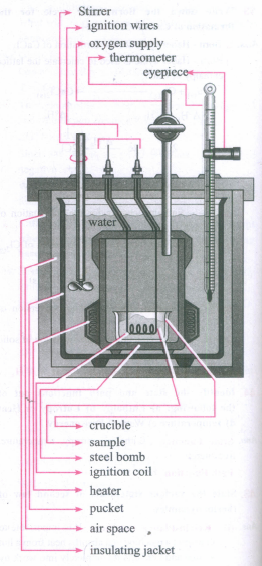
Explain how heat absorbed at constant volume is measured using bomb calorimeter with a neat diagram.
5.
Write down the Born-Haber cycle for the formation of CaCl2
1.
Tsys=77°C = (77 + 273) = 350 K
Tsurr=33°C = (33 + 273) = 306 K
q=245 J
ΔSsys=\(\frac{q}{T_{sys}}=\frac{-245}{350}=-0.7JK^{-1}\)
ΔSsurr=\(\frac{q}{T_{sys}}=\frac{+245}{350}=0.8JK^{-1}\)
ΔSuniv=ΔSsys+ΔSsurr
ΔSuniv=-0.7 JK-1+ 0.8 JK-1
ΔSuniv=0.1 JK-1.
2.
(i) Free energy is defined as G = H - TS. 'G' is a state function.
(ii) G- Extensive property; ΔG - intensive property. When mass remains constant between initial and final states of system.
(iii) 'G' has a single value for the thermodynamic state of the system.
(iv) G and ΔG values correspond to the system only.
| Process | Spontaneous | Equilibrium | Non-Spontaneous |
| ΔG | -Ve | Zero | +Ve |
(v) Gibbs free energy and the net work done by the system:
For any system at constant pressure and temperature
ΔG = ΔH - TΔS .....(1)
We know that,
ΔH = ΔU + PΔV
ΔG =ΔU + PΔV-TΔS
from first law of thermodynamics
ΔU = q +w
from second law of thermodynamics
Δ S=\(\frac{q}{T}\) Δ G=q+w+PΔ V-T\((\frac{q}{T}) \)
Δ G = w+PΔV
-ΔG = -w - PΔV ......(2)
But -PΔV represents the work done due to expansion against a constant external pressure.
3.
When the system at constant pressure undergoes changes from an initial state with H1, U1 and, V1 to a final state with H2, U2 and V2 the change in enthalpy ΔH, can be calculated as follows:
H = U+PV
In the initial state
H1 = U1 +PV1 ........(1)
In the final state
H2 = U2 +PV2 ........(2)
change in enthalpy is (2) - (1)
(H2 - H1) = (U2 - U1) + P(V2 - V1)
ΔH = ΔU+PΔV
As per first law of thermodynamics,
ΔV = q+w
Equation (3) becomes
ΔH = q+w+PΔV
w = -PΔV
ΔH = qp-PΔV+PΔV
ΔH = qp....(4)
qp - is the heat absorbed at constant pressure and is p considered as heat content. Consider a closed system of gases which are chemically reacting to form gaseous products at constant temperature and pressure with Vi and Vf as the total volumes of the reactant and product gases respectively, and n i and nf as the number of moles of gaseous reactants and products, then,
For reactants (initial state) :
PVi = ni RT ...(5)
For products (final state) :
PVf = nfRT .........(6)
(6) - (5)
P(Vf - Vi) = (nf - ni) RT
PΔV = Δn(g) RT ...........(7)
Substituting in (7) in (3)
ΔH = ΔV +Δn(g) RT ........(8)
4.
(i) Heat evolved at constant volume, is measured in a bomb calorimeter.
(ii) Apparatus setup: The inner vessel (the bomb) and its cover are made of strong steel. The cover is fitted tightly to the vessel by means of metal lid and screws.
(iii) Experiment: A weighed amount of the substance is taken in a platinum cup connected with electrical wires for striking an arc instantly to kindle combustion. The bomb is then tightly closed and pressurized with excess oxygen. The bomb is immersed in water, in the inner volume of the calorimeter. A stirrer is placed in the space between the wall of the calorimeter and the bomb, so that water can be stirred, uniformly. The reaction is started by striking the substance through electrical heating.
(iv) Calculation: A known amount of combustible substance is burnt in oxygen in the bomb. Heat evolved during the reaction is absorbed by the calorimeter as well as the water in which the bomb is immersed. The change in temperature is measured using a Beckman thermometer. Since the bomb is sealed its volume does not change and hence the heat measurements is equal to the heat of combustion at a constant volume (ΔU)c
The amount of heat produced in the reaction (ΔU)c is equal to the sum of the heat absorbed by the calorimeter and water.
Heat absorbed by the calorimeter q1 = k.ΔT
where k is a calorimeter constant equal to mc Cc (mc is mass of the calorimeter and Cc is heat capacity of calorimeter)
Heat absorbed by the water q2 = mw Cw ΔT
where mw is molar mass of water
Cw is molar heat capacity of water (4,184 kJ K-1mol-1)
Therefore ΔUc = q1 + q2
=k.ΔT + m w Cw ΔT
=(k+m w Cw) ΔT
Calorimeter constant can be determined by burning a know.n mass of standard sample (benzoic acid) for which the heat of combustion is known (-3227 kJmol-1)
The enthalpy of combustion at constant pressure of the substance is calculated from the equation (7.17)
\(\Delta { H }_{ C(pressure) }^{ 0 }=\Delta { U }_{ C(vol) }^{ o }+\Delta { n }_{ g }RT\)
5.
Born - Haber cycle for the formation of CaCl2
Born - Haber cycle is used to calculate the lattice enthalpy of CaCl2
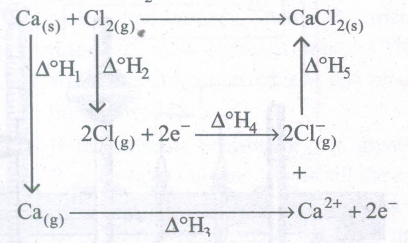
ΔoH1 - Enthalpy change for the sublimation of Ca(s) to Ca(g)
ΔoH2 - Enthalpy change for dissociation of Cl2(g) to 2Cl(g)
ΔoH3 - Ionisation energy for Ca(g) to Ca2+(g)
ΔoH4 - Electron affinity for the conversion of 2Cl(g) to 2Cl-(g)
ΔoH5 - Lattice enthalpy for the formation of solid CaCl2·
ΔoHf =ΔoH1+ΔoH2+ΔoH3+ΔoH4+ΔoH5

11th Standard Syllabus & Materials
11th Standard
TN 11th Tamil பீடு பெற நில் - செய்யுள் - காவடிச்சிந்து Important Questions And Answers Study Material - QB365 Set A
NEW11th Standard
TN 11th Tamil பீடு பெற நில் - உரைநடை - மலை இடப்பெயர்கள் : ஓர் ஆய்வு Important Questions And Answers Study Material - QB365 Set A
NEW11th Standard
TN 11th Tamil மாமழை போற்றுதும் - துணைப்பாடம் - யானை டாக்டர் Important Questions And Answers Study Material - QB365 Set A
NEW11th Standard
TN 11th Tamil மாமழை போற்றுதும் - செய்யுள் - ஐங்குறுநூறு Important Questions And Answers Study Material - QB365 Set A



Tamilnadu Stateboard 11th Standard Subjects

Maths

Commerce

Economics

Biology

Business Maths and Statistics

Accountancy

Computer Science

Physics
Chemistry
Maths
Biology
Economics
Physics
Chemistry

History
Business Maths and Statistics

Computer Science
Accountancy

Computer Applications
History
Computer Technology
Commerce
Computer Applications
Computer Technology

Tamil

English

French
Tamilnadu Stateboard Standards



