
 100% FREE ACCESS
11th Standard Syllabus & Materials
11th Standard
TN 11th Tamil இயற்கை வேளாண்மை,சுற்றுச்சூழல் -செய்யுள் - மனோன்மணீயம் Important Questions And Answers Study Material - QB365 Set A
NEW11th Standard
TN 11th Tamil என்னுயிர் என்பேன் -துணைப்பாடம் - இசைத்தமிழர் இருவர் Important Questions And Answers Study Material - QB365 Set A
NEW11th Standard
TN 11th Tamil மொழி கலை -செய்யுள் - ஒவ்வொரு புல்லையும் Important Questions And Answers Study Material - QB365 Set A
NEW11th Standard
TN 11th Tamil பீடு பெற நில் - இலக்கணம் - பகுபத உறுப்புகள் Important Questions And Answers Study Material - QB365 Set A
NEW11th Standard
TN 11th Tamil பீடு பெற நில் - துணைப்பாடம் - வாடிவாசல் Important Questions And Answers Study Material - QB365 Set A
NEW11th Standard
TN 11th Tamil பீடு பெற நில் - செய்யுள் - குறுந்தொகை Important Questions And Answers Study Material - QB365 Set A

Published on: 13/05/2022
QB365 provides detailed and simple solution for every
Creative Questions in class 11 Chemistry Subject. It will
helps to get more idea about question pattern in every Creative questions with solution.
Download Tamil Nadu 11th Standard Chemistry question papers, model tests, one-mark questions, important questions, and public exam papers in PDF format. Free study materials and answer keys for TN State Board students.
Questions + Answers key
Take MCQ Chemistry Test1.
Calculate the lattice energy of MgBr2 from the given data
2.
The enthalpy of combustion for H2, C(graphite) and CH4 are -285.8, -393.5 and -890.4 kJ mol-1respectively. Calculate the standard enthalpy of formation \(\Delta { H }_{ f }^{ 0 }\) for CH4
3.
Explain the measurement of heat change at constant pressure with a neat diagram.
4.
Write down the conventions that are followed while framing a thermochemical equation
5.
Discuss in detail about the variation of internal energy with respect to various thermodynamic processes
1.
\({ Mg }_{ (s) }+{ Br }_{ 2(I) }\longrightarrow { MgBr }_{ 2(s) }\) \({ \Delta H }_{ f }^{ o }=-524\quad KJ{ mol }^{ -1 }\)
Sublimation : \({ Mg }_{ (s) }\longrightarrow { Mg }_{ (s) }\quad { \Delta H }_{ 1 }^{ o }=+148\quad KJ{ mol }^{ -1 }\)
Ionisation : \({ Mg }_{ (g) }\longrightarrow { { Mg }^{ 2+ } }_{ (g) }\quad { \Delta H }_{ 2 }^{ o }=+2187\quad KJ{ mol }^{ -1 }\)
Vapourisation : \({ Br }_{ 2(I) }\longrightarrow { Br }_{ 2(g) }\quad { \Delta H }_{ 3 }^{ o }=+31\quad KJ{ mol }^{ -1 }\)
Dissociation : \({ Br }_{ 2(g) }\longrightarrow { 2Br }_{ (g) }\quad { \Delta H }_{ 4 }^{ o }=+193\quad KJ{ mol }^{ -1 }\)
Electron affinity : \({ 2Br }_{ (g) }+{ 2e }^{ - }\longrightarrow { 2{ Br }^{ - } }_{ (g) }\quad { \Delta H }_{ 5 }^{ o }=-662\quad KJ{ mol }^{ -1 }\)
Lattice enthalpy: \({ Mg }_{ (g) }+2{ Br }_{ (g) }^{ - }\longrightarrow { MgBr }_{ 2(s) }\quad { \Delta H }_{ 6 }^{ o }=?\)
\({ \Delta H }_{ f }^{ o }={ \Delta H }_{ 1 }^{ o }+{ \Delta H }_{ 2 }^{ o }+{ \Delta H }_{ 3 }^{ o }+{ \Delta H }_{ 4 }^{ o }+{ \Delta H }_{ 5 }^{ o }+{ \Delta H }_{ 6 }^{ o }\)
-524 = 148 + 2187 + 31 + 193 - 662 + \({ \Delta H }_{ 6 }^{ o }\)
\({ \Delta H }_{ 6 }^{ o }\) = -2421 KJ mol-1
\({ Mg }_{ (g) }^{ 2+ }+{ 2Br }_{ (g) }^{ - }\longrightarrow { MgBr }_{ 2(s) }{ \Delta H }_{ 6 }^{ o }=-2421\quad KJ\quad { mol }^{ -1 }\)
\({ MgBr }_{ 2(s) }\longrightarrow { Mg }_{ (g) }^{ - }+{ 2Br }_{ (g) }^{ - }={ \Delta H }_{ 6 }^{ 0 }=-2421\quad KJ\quad { mol }^{ -1 }\)
2.
\({ H }_{ 2(g) }+\frac { 1 }{ 2 } { O }_{ 2 }\longrightarrow { H }_{ 2 }{ O }_{ (1) }\quad \quad { \Delta H }^{ o }=-285.8\quad KJ\quad (1)\)
\({ C }_{ 9graphite) }+{ O }_{ 2 }\longrightarrow { CO }_{ 2 }\quad { \Delta H }^{ o }=-393.5\quad KJ\quad (2)\)
\({ CH }_{ 4(g) }+{ 2O }_{ 2 }\longrightarrow { CO }_{ 2(g) }+{ 2H }_{ 2 }{ O }_{ (1) }\quad { \Delta H }^{ o }=-890\quad KJ\quad (3)\)
equation (1) X2 + (2) - (3)
\({ C }_{ (graphite) }+{ 2H }_{ 2(g) }\longrightarrow { CH }_{ 4(g) }\quad { \Delta H }_{ f }^{ o }=-74.7\quad KJ\)
(2 x -285.8) + (-393.5) - (-890.4)
= -571.6 - 393.5 + 890.4
= -965.1 + 890.4
= -74.7 KJ
3.
Heat change at constant pressure (at atmospheric pressure) can be measured using a coffee cup calorimeter. A schematic representation of a coffee cup calorimeter is given in Figure. Instead of bomb, a styrofoam cup is used in this calorimeter. It acts as good adiabatic wall and doesn't allow transfer of heat produced during the reaction to its surrounding. This entire heat energy is absorbed by the water inside the cup. This method can be used for the reactions where there is no appreciable change in volume. The change in the temperature of water is measured and used to calculate the amount of heat that has been absorbed or evolved in the reaction using the following expression.
q =mw CwΔT
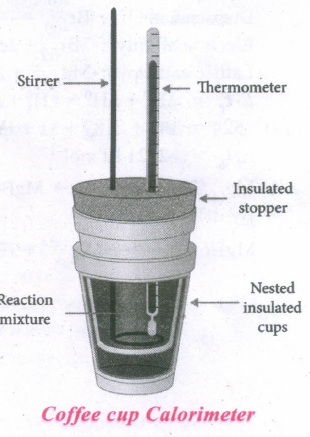
where mw is the molar mass of water and Cw is the molar heat capacity of water (4184 kJ K-1 mol-1)·
4.
A thermo chemical equation is a balanced stoichiometric chemical equation that includes the enthalpy change (ΔH)
The following conventions necessarily adopted in thermo chemical equations:
(i) The coefficients in a balanced thermo chemical equation refer to number of moles of reactants and products involved in the reaction.
(ii) The enthalpy change of the reaction ΔHr has unit KJ.
(iii) When the chemical reaction is reversed the value of ΔH is reversed in sign with the same magnitude.
(iv) Physical states of all species must be specified in a thermo chemical reaction.
(v) If the thermo chemical equation is multiplied throughout by a number, the enthalpy change is also be multiplied by the same number.
(vi) The negative sign of ΔHr indicates an is exothermic and the positive sign of ΔHr indicates an endothermic type of reaction.
For example, consider the following reaction,
2H2(g) + O2(g) ⟶ 2H2O(g) ΔHro=-967.4 kJ
2H2O(g) ⟶2H2(g) + O2(g) ⟶ ΔHro= + 967.4 kJ
5.
Mathematical statement of the first law of thermodynamics is
ΔU = q+w
Case 1: For a cyclic process involving isothermal expansion of an ideal gas
ΔU= 0; ∴q = -w
In other words, during a cyclic process, the amount of heat absorbed by the system is equal to work done by the system.
Case 2: For an isochoric process (no change in volume) there is no work of expansion.
ΔV= 0, w =0, ΔU=qv
In other words, during isochoric process, the amount of heat supplied to the system is converted to its internal energy.
Case 3: For an adiabatic process there is no change in heat. i.e. q = O. Hence
q =0;ΔU=w
In other words, in an adiabatic process, the decrease in internal energy is exactly equal to the work done by the system on its surroundings.
Case 4: For an isobaric process. There is no change in the pressure. P remains constant. Hence
ΔU=q+w
ΔU = q-PΔV
In other words, in an isobaric process a part of heat absorbed by the system is used for PV expansion work and the remaining is added to the internal energy of the system.

11th Standard Syllabus & Materials
11th Standard
TN 11th Tamil பீடு பெற நில் - செய்யுள் - காவடிச்சிந்து Important Questions And Answers Study Material - QB365 Set A
NEW11th Standard
TN 11th Tamil பீடு பெற நில் - உரைநடை - மலை இடப்பெயர்கள் : ஓர் ஆய்வு Important Questions And Answers Study Material - QB365 Set A
NEW11th Standard
TN 11th Tamil மாமழை போற்றுதும் - துணைப்பாடம் - யானை டாக்டர் Important Questions And Answers Study Material - QB365 Set A
NEW11th Standard
TN 11th Tamil மாமழை போற்றுதும் - செய்யுள் - ஐங்குறுநூறு Important Questions And Answers Study Material - QB365 Set A



Tamilnadu Stateboard 11th Standard Subjects

Maths

Commerce

Economics

Biology

Business Maths and Statistics

Accountancy

Computer Science

Physics
Chemistry
Maths
Biology
Economics
Physics
Chemistry

History
Business Maths and Statistics

Computer Science
Accountancy

Computer Applications
History
Computer Technology
Commerce
Computer Applications
Computer Technology

Tamil

English

French
Tamilnadu Stateboard Standards



