
 100% FREE ACCESS
11th Standard Syllabus & Materials
11th Standard
TN 11th Tamil இயற்கை வேளாண்மை,சுற்றுச்சூழல் -செய்யுள் - மனோன்மணீயம் Important Questions And Answers Study Material - QB365 Set A
NEW11th Standard
TN 11th Tamil என்னுயிர் என்பேன் -துணைப்பாடம் - இசைத்தமிழர் இருவர் Important Questions And Answers Study Material - QB365 Set A
NEW11th Standard
TN 11th Tamil மொழி கலை -செய்யுள் - ஒவ்வொரு புல்லையும் Important Questions And Answers Study Material - QB365 Set A
NEW11th Standard
TN 11th Tamil பீடு பெற நில் - இலக்கணம் - பகுபத உறுப்புகள் Important Questions And Answers Study Material - QB365 Set A
NEW11th Standard
TN 11th Tamil பீடு பெற நில் - துணைப்பாடம் - வாடிவாசல் Important Questions And Answers Study Material - QB365 Set A
NEW11th Standard
TN 11th Tamil பீடு பெற நில் - செய்யுள் - குறுந்தொகை Important Questions And Answers Study Material - QB365 Set A

Published on: 30/09/2018
Important 3mark -chapter 7,8
Download Tamil Nadu 11th Standard Chemistry question papers, model tests, one-mark questions, important questions, and public exam papers in PDF format. Free study materials and answer keys for TN State Board students.
Questions + Answers key
Take MCQ Chemistry Test
1.
The equilibrium constant at 298 K for a reaction is 100.
A + B \(\rightleftharpoons \) C + D
If the initial concentration of all the four species is 1 M, the equilibrium concentration of D (in mol lit-1) will be
2.
Define the following terms
(a) isothermal process (b) adiabatic process
(c) isobaric process (d) isochoric process
3.
To study the decomposition of hydrogen iodide, a student fills an evacuated 3 litre flask with 0.3 mol of HI gas and allows the reaction to proceed at 500o C. At equilibrium he found the concentration of HI which is equal to 0.05 M. Calculate KC and KP for this reaction.
4.
For the reaction
SrCO3 (s) ⇌ SrO (s) + CO2(g),
the value of equilibrium constant KP = 2.2 x 10⁻⁴ at 1002 K. Calculate KC for the reaction.
5.
One mole of PCl5 is heated in one litre closed container. If 0.6 mole of chlorine is found at equilibrium, calculate the value of equilibrium constant.
6.
For the reaction,
A2(g) + B2(g) ⇌ 2AB(g) ; ΔH is –ve.
the following molecular scenes represent different reaction mixture (A – green, B – blue)
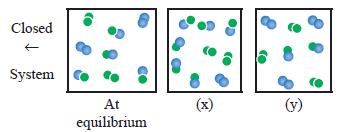
i) Calculate the equilibrium constant KP and (KC).
ii) For the reaction mixture represented by scene (x), (y) the reaction proceed in which directions?
iii) What is the effect of increase in pressure for the mixture at equilibrium.
7.
For an equilibrium reaction Kp = 0.0260 at 25° C ΔH= 32.4 kJmol-1, calculate Kp at 37° C
8.
9.
One mole of H2 and one mole of I2 are allowed to attain equilibrium in 1 lit container. If the equilibrium mixture contains 0.4 mole of HI. Calculate the equilibrium constant.
10.
The value of Kc for the reaction
N2O2(g) \(\rightleftharpoons \) 2NO2(g)
11.
The value of Kc for the following reaction at 717 K is 48.
12.
Calculate \(\triangle_r{G}^{\ominus}\) for conversion of oxygen to ozone, \({3\over 2}{O}_{{2}_{(g)}}\rightarrow{O}_{{3}_{(g)}}\) at 298 K. If Kp for this conversion is 2.47 X 10⁻²⁹.
13.
Prove that for an ideal gas, Cp is greater than Cv.
14.
(a) Under what condition, the heat evolved or absorbed in a reaction is equal to its free energy change?
(b) Calculate the entropy change for the following reversible process.
\(H_2 O \rightleftharpoons H_2O_{I} \) Δfus H is 6 kJ mol-1
15.
The enthalpy of formation of methane at constant pressure and 300 K is - 78.84 k.l, What will be the enthalpy of formation at constant volume?
16.
Calculate the value of \(\Delta\)U and \(\Delta\)H on heating 128 g of oxygen from O°C to 100°C. Cv and Cp on an average are 21 and 29 J mol-1 K-1. (The difference is 8 J mol-1 K-1 which is approximately equal to R)
17.
The standard enthalpies of formation of \(C_2 H_5 OH_{I}, CO_{2{g}}\) and \(H_2 O(_{I})\) are -277, -393.5 and -285.5 kJ mol-1 respectively. Calculate the standard enthalpy change for the reaction \(C_2O_5 OH_{(I)}+3O_{2{g}} \rightarrow 2CO_{2{g}}+3 H_2 O_{(I)}\). The enthalpy of formation of O2(g) in the standard state is zero, by definition.
18.
A gas contained in a cylinder fitted with a frictionless piston expands against a constant external pressure of 1 atm from a volume of 5 litres to a volume of 10 litres. In doing so it absorbs 400 J of thermal energy from its surroundings. Determine the change in internal energy of system.
19.
Urea on hydrolysis produces ammonia and carbon dioxide. The standard entropies of urea, H2O, CO2, NH3 are 173.8, 70, 213.5 and 192.5 J mole-1K-1 respectively. Calculate the entropy change for this reaction.
20.
Enthalpies of formation of CO(g),CO2(g), N2O(g) and N2O4(g) are -110, -393, + 81 and + 9.7 kJ mol respectively. Find the value of \(\Delta\)H for the reaction. N2O4(g) + 3CO(g) \(\rightarrow\) N2O(g) + 3CO2(g).
21.
5 moles of an ideal gas expand isothermally and reversibly from a pressure of 10 atm to 2 atm at 300K. Calculate the work done by the system.
22.
What is the nature of the reaction for the following?
(i) ΔG>0
(ii) ΔG<0
(iii) ΔG=0
23.
Identify processes under the following conditions
(i) dT = 0
(ii) dP = 0
(iii) dV = 0
24.
Bring out the differences between extensive and intensive properties.
25.
One mole of a gaseous system absorbs 100 J of heat and does work equivalent to 50 J. Calculate the change in the internal energy of the system.
26.
Predict the change in internal energy for an isolated system at constant volume.
27.
Define the following terms.
28.
The equilibrium constant of a reaction is 10, what will be the sign of ΔG? Will this reaction be spontaneous?
29.
What are state and path functions? Give two examples
30.
Define Standard Entropy.
1.
Given data:
[A] = [B] = [C]= [D] =1 M
Kc = 100
[D]eq = ?
Solution:
Let x be the no moles of reactants reacted
| A | B | C | D | |
|---|---|---|---|---|
| Initial concentration | 1 | 1 | 1 | 1 |
| At equilibrium (as per reaction stoichiometry) |
1-x | 1-x | 1-x | 1-x |
\(K_c={[C][D]\over [A][B]}\)
\(100={(1+x)(1+x)\over (1-x)(1-x)}\)
\(\sqrt{100}=\sqrt{{(1+x)(1+x)\over (1-x)(1-x)}}\)
\(10={1+x\over 1-x}\)
10(1 - x) = 1 + x
10 - 10x - 1 - x = 0
9 - 11x = 0
11x = 9
\(x={9\over 11}=0.818\)
[D]eq = 1+x = 1 + 0.818 = 1.818M.
2.
(a) Isothermal process: An isothermal process is defined as one in which the temperature of the system remains constant, during the change from its initial to final state. The system exchanges heat with its surroundings and the temperature of the system remains constant.
For an isothermal process dT = 0
(b) Adiabatic process: An adiabatic process is defined as one in which there is no exchange of heat (q) between the system and surrounding during the process. For an adiabatic process q = 0
(c) Isobaric process: An isobaric process is defined as one in which the pressure of the system remains constant during its change from the initial to final state. For an isobaric process dP = 0 .
(d) Isochoric process: An isochoric process IS defined as the one in which the volume of system remains constant during its change from initial to final state. For an isochoric process, dV= 0.
3.
V = 3L
\([HI]_{initial}={0.3\ mol\over 3L}=0.1\ M\)
[HI]eq = 0.05 M
2HI(g) ⇌ H2(g) + I2(g)
| HI(g) | H2(g) | I2(g) | |
| Initial Concentration | 0.1 | - | - |
| Reacted | 0.05 | - | - |
| Equilibrium concentration | 0.05 | 0.025 | 0.025 |
\(K_c={[H_2][I_2]\over [HI]^2}\)
\(={0.025\times 0.025\over 0.05\times 0.05}\)
Kc = 0.25
KP = KC (RT)Δng
Δng = 2 – 2 = 0
KP = 0.25 (RT)o
KP = 0.25
4.
for the reaction,
SrCO3 (S) ⇌ SrO(S) + CO2(S)
Δng = 1 – 0 = 1
\(\therefore\) KP = KC (RT)
2.2 x 10–24 = KC (0.0821) (1002)
\(K_c={2.2\times 10^{-4}\over 0.0821\times 1002}\)
KC = 2.674 x 10⁻⁶
5.
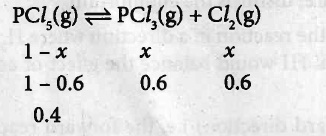
\( \therefore\left[\mathrm{PCl}_{5}\right]_{\mathrm{eq}}=0.4 \mathrm{~mol} \mathrm{dm}^{-3} ; \quad\left[\mathrm{PCl}_{3}\right]_{\mathrm{eq}}=0.6 \mathrm{~mol} \mathrm{dm}^{-3} ; \quad\left[\mathrm{Cl}_{2}\right]_{\mathrm{eq}}=0.6 \mathrm{~mol}^{-3} \)
\(\mathrm{K}_{c}=\frac{\left[\mathrm{PCl}_{3}\right]\left[\mathrm{Cl}_{2}\right]}{\left[\mathrm{PCl}_{5}\right]}=\frac{0.6 \times 0.6}{0.4}\)
Kc = 0.9 mol dm-3
6.
\(K_c={[AB]^2\over [A_2][B_2]}\)
A - green
B - blue
Given that 'V' is constant (closed system)
At equilibrium
\(K_c={({4\over V})^2\over ({2\over V})({2\over V})}={16\over 4}=4\)
KP = KC (RT)Δn
KP = 4(RT)o = 4
At Stage 'x'
\(Q={({6\over V})^2\over ({2\over V})({1\over V})}={36\over 2}=18\)
Q > KC ie., reverse reaction is favoured
At Stage 'y'
\(Q={({3\over V})^2\over ({3\over V})({3\over V})}={9\over 3\times 3}=1\)
KC > Q ie., forward reaction is favoured.
7.
T1 = 25 + 273 = 298 K
T2 = 37 + 273 = 310 K
ΔH = 32.4 KJmol-1 = 32400 Jmol-1
R = 8.314 JK-1 mol-1
KP1 = 0.0260
Kp2 = ?
\(\log {K_2\over K_1}={\Delta H^o\over 2.303R}[{T_2-T_1\over T_2T_1}]\)
\(\log {K_2\over K_1}={32400\over 2.303\times 8.314}({310-298\over 310\times 298})\)
\(={32400\times 10\over 2.303\times 8.314\times 310\times 298}\)
= 0.2198
\({K_2\over K_1}=\) antilog 0.2198 = 1.6588
K2 = 1.6588 x 0.026 = 0.0431
8.
9.
H2(g) + I2(g) \(\rightleftharpoons \) 2HI(g)
At equilibrium, [HI] = 0.4 mol L-1 Kc= ?
| H2 | I2 | HI | |
|---|---|---|---|
| Initial number of moles | 1 | 1 | - |
| Number of moles at equilibrium | 1 - x | 1 - x | 2x = 0.4 x = 0.2 |
| 0.8 | 0.8 | 0.4 |
\(\therefore K_c={[HI]^2\over [H_2[I_2]]}={0.4\times 0.4\over 0.8\times 0.8}=0.25\)
10.
N2O2(g) \(\rightleftharpoons \) 2NO2(g)
Kc = 0.21 at 373 K. The concentrations N2O4 and NO2 are found to be 0.125 mol dm-3 and 0.5 mol dm-3 respectively at a given time. From the above information we can predict the direction of reaction as follows.
\(Q={[NO_2]^2\over [N_2O_4]}={0.5\times 0.5\over 0.125}=2\)
The Q value is greater than Kc. Hence, the reaction will proceed in the reverse direction until the Q value reaches 0.21.
11.
H2(g) + I2(g) \(\rightleftharpoons \) 2HI(g)
At a particular instant, the concentration of H2, I2and HI are found to be 0.2 mol L-1, 0.2 mol L-1 and 0.6 mol L-1 respectively. From the above information we can predict the direction of reaction as follows.
\(Q={[HI]^2\over[H_2][I_2]}={0.6\times 0.6\over 0.2\times 0.2}=9\)
Since Q < Kc, the reaction will proceed in the forward direction.
12.
We know \(\triangle_r{G}^{\ominus}\) = -2.303 RO log Kp
and R = 8.314 JK-1 mol-1
Therefore, \(\triangle_r{G}^{\ominus}\) = -2.303 (8.314 J K-1 mol-1) x (log 2.47 x 10⁻²⁹)
= 163000 J mol-1 = 163 mol-1
13.
(i) It is clear that two heat capacities are not equal and Cp is greater than Cv by a factor which is related to the work done.
(ii) At a constant pressure, a part of heat absorbed by the system is used up in increasing the internal energy of the system and the other for doing work by the system.
(iii) At constant volume, the whole of heat absorbed is utilized in increasing the temperature
of the system as there is no work done by the system.
Thus CP is greater than CV.
\(C_{P}=\frac{dH}{dT}; C_{V}=\frac{dU}{dT}\)
iv) By definition, H = U +PV for 1 mole of an ideal gas
H= U + RT
By differentiating this equation with respect to temperature T, we get,
\(\frac{dH}{dT}=\frac{dU}{dT}+R\)
\(C_P=C_V+R\)
\(C_P-C_V=R\)
Thus for an ideal gas, CP is greater than CV by the gas constant R.
14.
H2O \(\rightleftharpoons\) H2O(1) \(\triangle_{fus}\) H is 6 kJ mol-1
(a) ΔG=ΔH-TΔS
When the reaction is carried out at 0°K
or ΔS=0
ΔG=ΔH
(b) \(H_2O_{s} \rightleftharpoons H_2O{_{(I)}}\)
\(\Delta_{fus}H= 6\) kJ mol-1
= 6000 kJ mol-1
\(\Delta_{fus}H= 6\) kJ mol-1
= 6000 J mol-1
15.
The equation representing the enthalpy of formation of methane is:
\(C_{(s)}+2H_{2_{(g)}} \rightarrow CH_{4_{(g)}}\) ΔH = -78.84 kJ
ΔH = 78.84 kJ; Δng = 1 - 2 = -1 mol
R= \(8.314 \times 10 ^{-3}\)kJ-1 K-1 mol-1; T=300 K
According to the relation,
ΔH = ΔU + Δng RT
ΔU = ΔH + Δng RT
=(-78.84 kJ) - (1 mol) x (\(8.314 \times 10 ^{-3}\)kJ K-1 mol-1) х 300 K
= -78.84-2.49 = -81.35 kJ.
16.
We know ΔU=n CV(T2-T1)
ΔH=n CP(T2-T1)
Here \(n=\frac{128}{32}=4\)moles;
T2 = 100°C = 373 K; T1 = 0°C = 273 K
ΔU = n CV (T2 - T1)
ΔU = 4 x 21 x (373-273)
ΔU = 8400 J
ΔU = 8.4 kJ
ΔH =n Cp(T2-T1)
ΔH = 4 x 29 x (373 - 273)
ΔH = 11600 J
ΔH = 11.6 kJ
17.
The standard enthalpy change for the combustion of ethanol can be calculated from the standard enthalpies of formation of \(C_2 H_5 OH_{I}, \)\(CO_{2{g}}\) and \(H_2 O(_{I})\). The enthalpies of formation are -277, - 393.5 and -285.5 kJ mol-1 respectively.
\(C_2O_5 OH_{(I)}+3O_{2{g}} \rightarrow 2CO_{2{g}}+3 H_2 O_{(I)}\)
\(\Delta H^{0}_{1} = [(\Delta H^{0}_{f})_{products}-(\Delta H^{0}_{f})_{reactants})]\)
\(\Delta H^{0}_{r}=[2(\Delta H^{0}_{f})_{CO_{2}}+3(\Delta H^{0}_{f})_{H_2O}]-[1(\Delta H^{0}_{f})_{C_2H_5OH}+3(\Delta H^{0}_{f})_{O_2}]\)
\(\triangle {H}_{r}^{0}=\begin{bmatrix} 2\ mol(-393.5)\ kJ\ {mol}^{-1} \\ +3\ mol(-285.5)\ kJ\ {mol}^{-1} \end{bmatrix}-\begin{bmatrix} 1\ mol(-227)\ kJ\ {mol}^{-1} \\ +3\ mool(0)\ kJ\ {mol}-1^{} \end{bmatrix}\)
= [-787-856.5]-[-277]
=-1643.5+277
\(\Delta H^{0}_{r}\)= -1366.5 kJ
18.
Given data q = 400 J; V1= 5L; V2 = 10L
Δu = q- w (heat is given to the system (+q); work is done by the system(-w)
Δu=q-PdV
=400 J - 1 atm (10 - 5)L
= 400 J - 5 atm L
[∴ 1L atm=101.33 J]
= 400 J - 5 x 10l.33 J
= 400 J - 506.65 J
= - 106.65 J
19.
Given:
S0 (urea) = 173.8 J mol-1 K-1
S0 (H2O) = 70 J mol-1 K-1
S0 (CO2) = 213.5 J mol-1K-1
S0 (NH3) = 192.5 J mol-1K-1
NH2 - CO - NH2 + H2O ⟶ 2NH3 + CO2
ΔSr0 = Σ(S0)products - Σ(S0)reactants
ΔSr0 = [2 S0(NH3) + S0(CO2)] - [S0(urea) + S0(H2O)]
ΔSr0 = [2 x 192.5 + 213.5]-[173.8+70]
ΔSr0 = [598.5] - [243.8]
ΔSr0 = 354.7 J mol-1K-1.
20.
\(\Delta { H }_{ f }^{ o }({ N }_{ 2 }{ O }_{ 4 })=+9.7\quad J\quad mol^{ -1 }\)
\(\Delta { H }_{ f }^{ O }(CO)=-110\quad kJ\quad mol^{ -1 }\)
\(\Delta { H }_{ f }^{ o }({ N }_{ 2 }O)=+81.0\quad kJ\quad { mol }^{ -1 }\)
\(\Delta { H }_{ f }^{ O }({ CO }_{ 2 })=-393\quad kJ\quad { mol }^{ -1 }\)
\(\Delta H°=\sum { \Delta { H }_{ f }^{ o } } (products)-\sum { \Delta { H }_{ f }^{ o } } (reactants)\)
\(=\left[ \Delta { H }_{ f }^{ o }({ N }_{ 2 }O)+3\Delta { H }_{ f }^{ o }{ CO }_{ 2 } \right] -\left[ \Delta { H }_{ f }^{ o }({ N }_{ 2 }{ O }_{ 4 })-3\Delta { H }_{ f }^{ 0 }(CO) \right] \)
= [81+3(-393)]-[9.7+3(-110)]
=-777.7 KJ
21.
w=- 2.303 nRT log \(\frac { { P }_{ 1 } }{ { P }_{ 2 } } \)
= -2.303 \(\times\) 5 \(\times\)8.314 \(\times\)300 log\(\frac { 10 }{ 2 } \)
= -20.075 \(\times\) 103 J
22.
(i) ΔG>0: The process is non-spontaneous and non-feasible.
(ii) ΔG<0: The process is spontaneous and feasible.
(iii) ΔG=0: The process is in equilibrium.
23.
(i) Isothermal process: Isothermal process is defined as one in which the temperature of the system remains constant, during the change from its initial to final states.
For an isothermal process dT = 0
(ii) Isobaric process: Isobaric process is defined as one in which the pressure of the system remains constant during its change from the initial to final state.
For an isobaric process dP = 0.
(iii) Isochoric process: Isochoric process is defined as one in which the volume of system remains constant during its change from initial to final state of the process.
For an isochoric processes dV = 0.
24.
| EXTENSIVE PROPERTIES | INTENSIVE PROPERTIES |
| 1. The properties that depend on mass or size of the system are called extensive properties | The properties that are independent on the mass or size of the system are known as intensive properties. |
| 2. Eg: volume, mass, energy, internal energy, etc. | Eg: refractive index, surface tension, density, temperature, etc |
25.
ΔU=q-w
= 100 - 50 = 50J
Since work is done by the system, it is -ve.
26.
No transfer of heat or work is observed in an isolated system.
∴ΔU=q+w
ΔU=0+0=0.
27.
(i) System: A system is defined as any portion of matter (or universe) under thermodynamic.consideration, which is separated from the rest of the universe by real or imaginary boundaries.
(ii) Surroundings: Everything in the universe that is not the part of system and can interact with system is called as surroundings.
(iii) Boundary: Anything which separates the system from its surroundings is called boundary.
28.
Given Keq= 10
Gas constant R = 8.314 JK-1 mol-1
T=300K
The relationship between Free energy change ΔG and equilibrium constant K is ΔGo=-RTlnK
Since K, T and R are positive values, ΔGo will be negative.
When ΔG is -ve, the process is spontaneous and feasible
29.
(i) State function: A state function is a thermodynamic property of a system, which has a specific value for a given state and does not depend on the path (or manner) by which the particular state is reached.
Example: Pressure (P), Volume (V), Temperature(T)
(ii) Path functions: A path function is a thermodynamic property of the system whose value depends on the path by which the system changes from its initial to final states.
Example: Work (w), Heat (q).
30.
The absolute entropy of a substance at 298 K and one atmosphere pressure is called the standard entropy S0.

11th Standard Syllabus & Materials
11th Standard
TN 11th Tamil பீடு பெற நில் - செய்யுள் - காவடிச்சிந்து Important Questions And Answers Study Material - QB365 Set A
NEW11th Standard
TN 11th Tamil பீடு பெற நில் - உரைநடை - மலை இடப்பெயர்கள் : ஓர் ஆய்வு Important Questions And Answers Study Material - QB365 Set A
NEW11th Standard
TN 11th Tamil மாமழை போற்றுதும் - துணைப்பாடம் - யானை டாக்டர் Important Questions And Answers Study Material - QB365 Set A
NEW11th Standard
TN 11th Tamil மாமழை போற்றுதும் - செய்யுள் - ஐங்குறுநூறு Important Questions And Answers Study Material - QB365 Set A



Tamilnadu Stateboard 11th Standard Subjects

Maths

Commerce

Economics

Biology

Business Maths and Statistics

Accountancy

Computer Science

Physics
Chemistry
Maths
Biology
Economics
Physics
Chemistry

History
Business Maths and Statistics

Computer Science
Accountancy

Computer Applications
History
Computer Technology
Commerce
Computer Applications
Computer Technology

Tamil

English

French
Tamilnadu Stateboard Standards
