
 100% FREE ACCESS
11th Standard Syllabus & Materials
11th Standard
TN 11th Tamil இயற்கை வேளாண்மை,சுற்றுச்சூழல் -செய்யுள் - மனோன்மணீயம் Important Questions And Answers Study Material - QB365 Set A
NEW11th Standard
TN 11th Tamil என்னுயிர் என்பேன் -துணைப்பாடம் - இசைத்தமிழர் இருவர் Important Questions And Answers Study Material - QB365 Set A
NEW11th Standard
TN 11th Tamil மொழி கலை -செய்யுள் - ஒவ்வொரு புல்லையும் Important Questions And Answers Study Material - QB365 Set A
NEW11th Standard
TN 11th Tamil பீடு பெற நில் - இலக்கணம் - பகுபத உறுப்புகள் Important Questions And Answers Study Material - QB365 Set A
NEW11th Standard
TN 11th Tamil பீடு பெற நில் - துணைப்பாடம் - வாடிவாசல் Important Questions And Answers Study Material - QB365 Set A
NEW11th Standard
TN 11th Tamil பீடு பெற நில் - செய்யுள் - குறுந்தொகை Important Questions And Answers Study Material - QB365 Set A

Published on: 30/09/2018
Important 5mark -chapter 7,8
Download Tamil Nadu 11th Standard Chemistry question papers, model tests, one-mark questions, important questions, and public exam papers in PDF format. Free study materials and answer keys for TN State Board students.
Questions + Answers key
Take MCQ Chemistry Test
1.
A sealed container was filled with 1 mol of A2 (g), 1 mol B2 (g) at 800 K and total pressure 1.00 bar. Calculate the amounts of the components in the mixture at equilibrium given that K = 1 for the reaction
A2 (g) + B2 (g) ⇌ 2AB (g)
2.
28 g of Nitrogen and 6 g of hydrogen were mixed in a 1 litre closed container. At equilibrium 17 g NH3 was produced. Calculate the weight of nitrogen, hydrogen at equilibrium.
3.
At particular temperature KC = 4 x 10⁻² for the reaction
H2S(g) ⇌ H2(g) + ½ S2(g)
Calculate KC for each of the following reaction
i) 2H2S (g) ⇌ 2H2 (g) + S2 (g)
ii) 3H2S (g) ⇌ 3H2 (g) + 3/2 S2(g)
4.
Write the various definition of first law of thermodynamics.
5.
Explain about the characteristics of work.
6.
List the characteristics of entropy:
7.
Calculate ΔG0 for the reaction. CO(g)+ \(\\ \frac { 1 }{ 2 } \)O2(g) ⟶ CO2(g), ΔH0 = - 282.84 kJ Given, S0(C02) =213.8Jk-1 mol-1, So (CO) = 197.9 Jk-1 mol-1 S0(O2) = 205.0 Jk-1 mol-1
8.
Compute the standard free energy of the reaction at 270C for the combustion of methane using the given data: CH4(g) + 2O2(g) ⟶ CO2(g) + 2H2O(l)
9.
The enthalpy of combustion for H2, C(graphite) and CH4 are -285.8, -393.5 and -890.4 kJ mol-1respectively. Calculate the standard enthalpy of formation \(\Delta { H }_{ f }^{ 0 }\) for CH4
10.
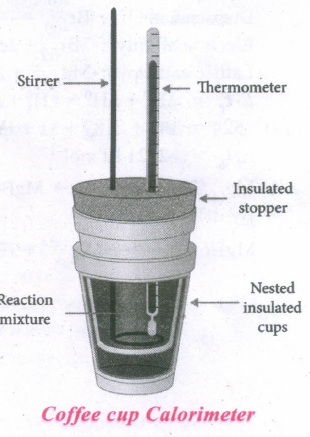
Explain the measurement of heat change at constant pressure with a neat diagram.
11.
Discuss in detail about the variation of internal energy with respect to various thermodynamic processes
12.
Write a short note on the following terms.
(i) Open System
(ii) Closed System
(iii) Isolated System
(iv) Homogeneous System
(v) Heterogeneous System
13.
Distinguish between reversible and irreversible process
14.
The standard heat of formation of H2O(l) from its elements and O2 is -290.83 kJ mol-1 and the standard entropy change for the same reaction is -330 JK-I at 25°C. Will the reaction be spontaneous at 25°C.
Given: \(\Delta{H^{o}}\)= -290.83 kJ mol-1
= -290830 J mol-1
\(\Delta{S^{o}}\) = -330 JK-1
T = 25°C = 298 K
15.
The heat of combustion of solid naphthalene (C10H10) at constant volume was -4984 kJ mol-1 at 298 K. Calculate the value of enthalpy change.
Given:
C10H8(s)+12O2(g) ➝ 10CO2(g)+4H2O(l)
\(\Delta U\)=-4984 kJ mol-1
\(\Delta U\)=-4984 kJ mol-1,R=8.314 JK-1 mol-1
T=298 K
16.
If an automobile engine burns petrol at a temperature of 816° C and if the surrounding temperature is 21° C, calculate its maximum possible efficiency
17.
Calculate the standard heat of formation of propane, if its heat of combustion is -2220.2 kJ mol-1.. The heats of formation of CO2(g) and H2O(l) are -393.5 and -285.8 kJ mol-1 respectively
18.
The equilibrium constant for the following reaction is 0.15 at 298 K and 1 atm pressure.
N2O4(g) ⇌ 2NO2(g);
\(\Delta \mathrm{H}_{\mathrm{f}}^{\circ}=57.32 \mathrm{KJmol}^{-1}\)
The reaction conditions are altered as follows.
a) The reaction temperature is altered to 100o C keeping the pressure at 1 atm, Calculate the equilibrium constant.
19.
Calculate the entropy change when 1 mole of ethanol is evaporated at 351 K The molar heat of vaporisation of ethanol is 39.84 kJ mol-1.
20.
Consider the following reaction
Fe3+(aq) + SCN–(aq) ⇌ [Fe(SCN)]2+(aq)
A solution is made with initial Fe3+, SCN- concentration of 1 x 10⁻³ M and 8 x 10⁻⁴ M respectively. At equilibrium [Fe(SCN)]2+ concentration is 2 x 10⁻⁴ M. Calculate the value of equilibrium constant.
1.
A2(g) + B2(g) ⇌ 2AB(g)
| A2 | B2 | AB | |
| Initial Concentration | 1 | 1 | - |
| No.of moles reacted | x | x | - |
| No.of moles at equilibrium | 1 - x | 1 - x | 2x |
Total no. of moles = 1 – x + 1 – x + 2x = 2
\(K_p={(P_{AB})^2\over (P_{A_2})(P_{B_2})}={({2x\over 2}\times p)^2\over ({(1-x)\over 2}\times p)({1-x\over 2}\times p)}\)
\(K_p={4x^2\over (1-x)^2}\)
Given that Kp = 1; \({4x^2\over (1-x)^2}=1\)
\(\Rightarrow \) 4x2 = (1 - x)2
\(\Rightarrow \) 4x2 = 1 + x2 - 2x
3x2 + 2x - 1 = 0
\(X={-2\pm\sqrt{4-4\times 3\times -1}\over 2(3)}\)
\(X={-2\pm\sqrt{4+12}\over 6}\)
\(={-2\pm\sqrt{16}\over 6}\)
\(={-2+4\over 6};{-2-4\over 6}\)
\(={2\over 6};{-6\over 6}\)
X = 0.33 ; -1 (not possible)
\(\therefore\) [A2]eq = 1 - x = 1 - 0.33 = 0.67
[B2]eq = 1 - x = 1 - 0.33 = 0.67
[AB]eq = 2X = 2 x 0.33 = 0.66.
2.
Given \(m_{N_2}\) = 28 g \(m_{H_2}\) = 6g
V = 1 L
\((n_{N_2})_{initial}={28\over 28}=1\ mol\)
\((n_{H_2})_{initial}={6\over 2}=3\ mol\)
N2(g) + 3H2(g) ⇌ 2 NH3(g)
| N2(g) | H2(g) | NH3(g) | |
| Initial concentration | 1 | 3 | - |
| Reacted | 0.5 | 1.5 | - |
| Equilibrium concentration | 0.5 | 1.5 | 1 |
\([NH_3]=({17\over 17})=1\ mol=1\ mol\)
Weight of N2 = (no. of moles of N2) × molar mass of N2
= 0.5 x 28 = 14 g
Weight of H2 = (no. of moles of H2) × molar mass of H2
= 1.5 x 2 = 3 g
3.
KC = 4 x 10⁻² for the reaction,
H2S(g) ⇌ H2(g) + 1/2 S2(g)
\(K_c={[H_2][S_2]^{1/2}\over [H_2S]}\)
\(\Rightarrow 4\times 10^{-2}={[H_2][S_2]^{1/2}\over [H_2S]}\)
For the reaction,
2H2S(g) ⇌ 2H2(g) + S2(g)
\(K_c={[H_2]^2[S_2]\over [H_2S]}=(4\times 10^{-2})^2=16\times 10^{-4}\)
For the reaction,
3H2S(g) ⇌ 3H2(g) + 3/2 S2(g)
\(K_c={[H_2]^3[S_2]^{3/2}\over [H_2S]^3}=(4\times 10^{-2})^3=64\times 10^{-6}\)
4.
First law of thermodynamics:
(i) The total energy of an isolated system remains constant though it may change from one form to another.
(ii) Whenever energy of a particular type disappears equivalent amount of another type must be produced.
(iii) Total energy of a system and surroundings remains constant.
(iv) Energy can neither be created nor destroyed, but may be converted from one form to another.
(v) The change in the internal energy of a closed system is equal to the energy that passes through its boundary as heat or work.
(vi) Heat and work are equivalent ways of changing a system's internal energy.
5.
Characteristics of work:
(i) Work is defined as the force (F) multiplied by the displacement(x).
-w = F.x ......(1)
The - ve sign is introduced to indicate that the work has been done by the system by spending a part of its internal energy.
(ii) Work is a path function.
(iii) Work appears only at the boundary of the system.
(iv) Work appears during the change in the state of the system.
(v) Work brings a permanent effect in the surroundings.
(vi) Units of work: The SI unit of work is the joule (J) or Kilojoule (KJ).
(vii) If work done by the system, the energy of the system decreases, hence by convention work is taken to be negative (- w).
(viii) If work done by the system, the energy of the system increases, hence by convention work is taken to be positive (+ w).
6.
Characteristics of entropy:
(i) Entropy is a thermodynamic state function that is a measure of the randomness or disorderliness of the system.
(ii) In general, the entropy of gaseous system is greater than liquids and greater than solids. The symbol of entropy is S.
(iii) Entropy is defined as for a reversible change taking place at a constant temperature (T), the change in entropy (\(\Delta\)S) of the system is equal to heat energy absorbed or evolved (q) by the system divided by the constant temperature (T).
\(\Delta S_{sys}=\frac{q_{rev}}{T}\)
(iv) If heat is absorbed, then \(\Delta\)S is positive and there will be increase in entropy. If heat is evolved, \(\Delta\)S is negative and there is a decrease in entropy.
(v)The change in entropy of a process represented by \(\Delta\) S and is given by the equation.
\(\Delta S_{sys}=S_f-S_i\)
(vi) If Sf > Si, \(\Delta\)S is positive, the reaction is spontaneous and reversible.
If Sf < Si, \(\Delta\)S is negative, the reaction is non-spontaneous and irreversible.
(vii) Unit of entropy: SI unit of entropy is J K-1.
7.
ΔS0 = ΣS 0 (products) - ΣS 0 (reactants)
= [S0(CO2) - S0(CO) + \(\\ \frac { 1 }{ 2 } \)S0(O2)]
= 213.8 - [197.9 + \(\\ \frac { 1 }{ 2 } \)x205]
= - 86.6 Jk-1 mol-1
we know, ΔG0 = ΔH0 - FΔS0
= - 282.84 - 298 x (- 86.6 x 10⁻³)
= - 282.84 + 25.807
= - 257.033 kJ
8.
| Species | CH4 | O2 | CO2 | H2O |
| ΔH0Jk mol-1 | -74.8 | - | -393.5 | -285.8 |
| S0Jk-1 mol-1 | 186 | 205 | 214 | 70 |
ΔH0 = ΔHf0 (CO2) + 2 ΔHf0 (H2O) - ΔHf0 (CH4)
= - 393.5 + 2 x (- 285.8) - (-74.8)
= - 890 kJ mol-1
ΔS0 = S0(CO2) + 2S0(H2O) - S0(CH4) - 2S0(O2)
= 214 x 2 x 70 -186 - 2 x 205
= - 242 Jk-1 mol-1
ΔG0 = ΔH0 - TΔS0
= - 890 -300 x(-242 x 10-3)
= - 890 + 72.6 = - 817.4 kJ mol-1
9.
\({ H }_{ 2(g) }+\frac { 1 }{ 2 } { O }_{ 2 }\longrightarrow { H }_{ 2 }{ O }_{ (1) }\quad \quad { \Delta H }^{ o }=-285.8\quad KJ\quad (1)\)
\({ C }_{ 9graphite) }+{ O }_{ 2 }\longrightarrow { CO }_{ 2 }\quad { \Delta H }^{ o }=-393.5\quad KJ\quad (2)\)
\({ CH }_{ 4(g) }+{ 2O }_{ 2 }\longrightarrow { CO }_{ 2(g) }+{ 2H }_{ 2 }{ O }_{ (1) }\quad { \Delta H }^{ o }=-890\quad KJ\quad (3)\)
equation (1) X2 + (2) - (3)
\({ C }_{ (graphite) }+{ 2H }_{ 2(g) }\longrightarrow { CH }_{ 4(g) }\quad { \Delta H }_{ f }^{ o }=-74.7\quad KJ\)
(2 x -285.8) + (-393.5) - (-890.4)
= -571.6 - 393.5 + 890.4
= -965.1 + 890.4
= -74.7 KJ
10.
Heat change at constant pressure (at atmospheric pressure) can be measured using a coffee cup calorimeter. A schematic representation of a coffee cup calorimeter is given in Figure. Instead of bomb, a styrofoam cup is used in this calorimeter. It acts as good adiabatic wall and doesn't allow transfer of heat produced during the reaction to its surrounding. This entire heat energy is absorbed by the water inside the cup. This method can be used for the reactions where there is no appreciable change in volume. The change in the temperature of water is measured and used to calculate the amount of heat that has been absorbed or evolved in the reaction using the following expression.
q =mw CwΔT
where mw is the molar mass of water and Cw is the molar heat capacity of water (4184 kJ K-1 mol-1)·
11.
Mathematical statement of the first law of thermodynamics is
ΔU = q+w
Case 1: For a cyclic process involving isothermal expansion of an ideal gas
ΔU= 0; ∴q = -w
In other words, during a cyclic process, the amount of heat absorbed by the system is equal to work done by the system.
Case 2: For an isochoric process (no change in volume) there is no work of expansion.
ΔV= 0, w =0, ΔU=qv
In other words, during isochoric process, the amount of heat supplied to the system is converted to its internal energy.
Case 3: For an adiabatic process there is no change in heat. i.e. q = O. Hence
q =0;ΔU=w
In other words, in an adiabatic process, the decrease in internal energy is exactly equal to the work done by the system on its surroundings.
Case 4: For an isobaric process. There is no change in the pressure. P remains constant. Hence
ΔU=q+w
ΔU = q-PΔV
In other words, in an isobaric process a part of heat absorbed by the system is used for PV expansion work and the remaining is added to the internal energy of the system.
12.
(i) Open System: A System which can exchange both matter and energy with its surroundings is called an open system. Hot water contained in an open beaker is an example for open system.
(ii) Closed System: A system which can exchange only energy but not matter with its surroundings is called a closed system. A gas contained in a cylinder fitted with a piston constitutes a closed system.
(iii) Isolated System: System which can exchange neither matter and nor energy with its surroundings is called an isolated system. Hot water contained in a thermos flask.
(iv) Homogeneous System: A system is called homogeneous if physical states of all its matter are uniform. Example: mixture of gases, completely miscible mixture of liquids etc.
(v) Heterogeneous System: A system is called heterogeneous if physical states of all its matter are not uniform.
13.
| S.No | REVERSIBLE PROCESS | IRREVERSIBLE PROCESS |
| 1 | It takes place in both forward and backward direction | It takes place in one direction only |
| 2 | The driving force for reversible process is small. | There is a definite driving force required |
| 3 | Work done in a reversible process is greater. | Work done in a irreversible process is always lower |
14.

= -290830 - 298 (-330)
= -290830 + 98340 = -192490
\(\Delta{G^{o}}\)=-192490 J mol-1
Since \(\Delta{G^{o}}\) is negative, the reaction is spontaneous.
15.
\(\Delta n\)=10-12=-2 mol
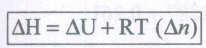
=-4984x103J+8.314 JK-1 mol-1x298kx(-2)mol.
=-4984000 J-4955.144J=-4988955.144J
\(\Delta H\)=-4988.955 kJ
16.
% Efficiency =\(\left[ \frac { { T }_{ 1 }-{ T }_{ 2 } }{ { T }_{ 1 } } \right] \times 100\)
Here
T1 = 816+273=1089 K;
T2 = 21+273 = 294 K
% Efficiency= \(\left( \frac { 1089-294 }{ 1089 } \right) \times 100\)
% Efficiency = 73%
17.
C3H8+5O2\(\rightarrow \)3CO2+4H2O
\(\triangle { H }_{ C }^{ 0 }=-2220.2KJ\quad mo{ l }^{ -1 }\)....(1)
C+O 2\(\rightarrow \)3CO2
\(\triangle { H }_{F}^{0 }=-393.5KJ\quad mo{ l }^{ -1 }\)....(2)
\({ H }_{ 2 }+\frac { 1 }{ 2 } { O }_{ 2 }\rightarrow { H }_{ 2 }O\)
\(\triangle { H }_{F}^{0 }=-285.8KJ\quad mo{ l }^{ -1 }\)...(3)
3C+4H2\(\rightarrow \)C3H8
\(\triangle { H }_{ C }^{ 0 }\)=?
(2) X3 \(\Rightarrow \)3C+3O2 \(\rightarrow \)3CO2
\(\triangle { H }_{F}^{0 }= \) -1180.5 KJ ....(4)
(3)X4\(\Rightarrow \) 4H2 +2O2 \(\rightarrow \)4H2O
\(\triangle { H }_{F}^{0 }= \) -1143.2KJ ....(5)
(4)+(5)-(1)\(\Rightarrow \) 3C+3O2+4H2+2O2+3CO2 +4H2O\(\rightarrow \)3CO2+4H2O+C3H8+5O2
\(\triangle { H }_{F}^{0 }= \) -1180.5-1143.2-(-2220.2)KJ
3C+4H2\(\rightarrow \)C3H8
\(\triangle { H }_{F}^{0 }= \) -103.5KJ
Standard heat of formation of propane is
\(\triangle { H }_{ R }^{ 0 }\left( { C }_{ 3 }{ H }_{ 8 } \right) =-103.5KJ\)
18.
N2O4(g) ⇌ 2NO2(g)
T1 = 298 K KP1 = 0.15
T2 = 100o C = 100 + 273 = 373 K ;
KP2 = ?
\(\log({K_2\over K_1})={\Delta H^o\over 2.303R}[{T_2-T_1\over T_1T_2}]\)
K2 > K1 and T2 > T1
\(\log({K_{p_2}\over 0.15})={57.2KJ\ mol^{-1}\over 2.303\times 8.314JK^{-1}\ mol^{-1}}[{373-298\over 373\times 298}]\)
\(\log({K_{P_2}\over 0.15})={57.2\times 10^{+3}\times 75\over 2.303\times 8.314\times 373\times 298}\)
\(\log({K_{p_2}\over 0.15})=2.02\)
\({K_{p_2}\over 0.15}=104.7\)
\(K_{p_2}=104.7\times 0.15\)
\(K_{p_2}=15.705\)
19.
Tb = 351 K
ΔHvap = 39840 Jmol-1
ΔSV = ?
ΔSv = \(\frac { { \triangle H }_{ vap } }{ { T }_{ b } } \)
ΔSv = \(\frac { 39840 }{ 351 } \)
ΔSv = 113.5 JK-1 mol-1
20.
| Fe3+ | SCN- | [Fe(SCN)2+ | |
| Initial concentration (M) | 1x 10⁻³ (10 x 10-4) | 8 x 10⁻⁴ | - |
| Reacted | 2 x 10⁻⁴ | 2 x 10⁻⁴ | - |
| Equilibrium concentration | 8 x 10⁻⁴ | 6 x 10⁻⁴ | 2 x 10⁻⁴ |
\(K_{eq}={[Fe(SCN)]^{2+}\over [Fe^{3+}][SCN^-]}\)
\(={2\times 10^{-4}M\over 8\times 10^{-4}M\times 6\times 10^{-4}M}\)
= 0.0416 x 10⁴
Keq = 41.6 x 10² M-1

11th Standard Syllabus & Materials
11th Standard
TN 11th Tamil பீடு பெற நில் - செய்யுள் - காவடிச்சிந்து Important Questions And Answers Study Material - QB365 Set A
NEW11th Standard
TN 11th Tamil பீடு பெற நில் - உரைநடை - மலை இடப்பெயர்கள் : ஓர் ஆய்வு Important Questions And Answers Study Material - QB365 Set A
NEW11th Standard
TN 11th Tamil மாமழை போற்றுதும் - துணைப்பாடம் - யானை டாக்டர் Important Questions And Answers Study Material - QB365 Set A
NEW11th Standard
TN 11th Tamil மாமழை போற்றுதும் - செய்யுள் - ஐங்குறுநூறு Important Questions And Answers Study Material - QB365 Set A



Tamilnadu Stateboard 11th Standard Subjects

Maths

Commerce

Economics

Biology

Business Maths and Statistics

Accountancy

Computer Science

Physics
Chemistry
Maths
Biology
Economics
Physics
Chemistry

History
Business Maths and Statistics

Computer Science
Accountancy

Computer Applications
History
Computer Technology
Commerce
Computer Applications
Computer Technology

Tamil

English

French
Tamilnadu Stateboard Standards
