
 100% FREE ACCESS
11th Standard Syllabus & Materials
11th Standard
TN 11th Tamil இயற்கை வேளாண்மை,சுற்றுச்சூழல் -செய்யுள் - மனோன்மணீயம் Important Questions And Answers Study Material - QB365 Set A
NEW11th Standard
TN 11th Tamil என்னுயிர் என்பேன் -துணைப்பாடம் - இசைத்தமிழர் இருவர் Important Questions And Answers Study Material - QB365 Set A
NEW11th Standard
TN 11th Tamil மொழி கலை -செய்யுள் - ஒவ்வொரு புல்லையும் Important Questions And Answers Study Material - QB365 Set A
NEW11th Standard
TN 11th Tamil பீடு பெற நில் - இலக்கணம் - பகுபத உறுப்புகள் Important Questions And Answers Study Material - QB365 Set A
NEW11th Standard
TN 11th Tamil பீடு பெற நில் - துணைப்பாடம் - வாடிவாசல் Important Questions And Answers Study Material - QB365 Set A
NEW11th Standard
TN 11th Tamil பீடு பெற நில் - செய்யுள் - குறுந்தொகை Important Questions And Answers Study Material - QB365 Set A

Published on: 17/11/2018
UNIT TEST 8
Download Tamil Nadu 11th Standard Chemistry question papers, model tests, one-mark questions, important questions, and public exam papers in PDF format. Free study materials and answer keys for TN State Board students.
Questions + Answers key
Take MCQ Chemistry Test
1.
The partial pressure of carbon dioxide in the reaction
CaCO3 (s) ⇌ CaO (s) + CO2(g) is 1.017 × 10⁻³ atm at 5000C. Calculate Kp at 6000C for the reaction. ΔH for the reaction is 181 KJ mol–1 and does not change in the given range of temperature.
2.
Deduce the Vant Hoff equation.
3.
1 mol of CH4, 1 mole of CS2 and 2 mol of H2S are 2 mol of H2 are mixed in a 500 ml flask. The equilibrium constant for the reaction KC = 4 x 10⁻² mol2 lit–2. In which direction will the reaction proceed to reach equilibrium ?
4.
Oxidation of nitrogen monoxide was studied at 200o C with initial pressures of 1 atm NO and 1 atm of O2. At equilibrium partial pressure of oxygen is found to be 0.52 atm calculate KP value.
5.
To study the decomposition of hydrogen iodide, a student fills an evacuated 3 litre flask with 0.3 mol of HI gas and allows the reaction to proceed at 500o C. At equilibrium he found the concentration of HI which is equal to 0.05 M. Calculate KC and KP for this reaction.
6.
For the reaction
SrCO3 (s) ⇌ SrO (s) + CO2(g),
the value of equilibrium constant KP = 2.2 x 10⁻⁴ at 1002 K. Calculate KC for the reaction.
7.
One mole of PCl5 is heated in one litre closed container. If 0.6 mole of chlorine is found at equilibrium, calculate the value of equilibrium constant.
8.
What is the effect of added inert gas on the reaction at equilibrium at constant volume.
9.
Explain how will you predict the direction of a equilibrium reaction.
10.
State Le-Chatelier principle.
11.
For the reaction,
A2(g) + B2(g) ⇌ 2AB(g) ; ΔH is –ve.
the following molecular scenes represent different reaction mixture (A – green, B – blue)
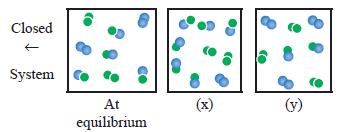
i) Calculate the equilibrium constant KP and (KC).
ii) For the reaction mixture represented by scene (x), (y) the reaction proceed in which directions?
iii) What is the effect of increase in pressure for the mixture at equilibrium.
12.
When the numerical value of the reaction quotient (Q) is greater than the equilibrium constant (K), in which direction does the reaction proceed to reach equilibrium?
13.
For a gaseous homogeneous reaction at equilibrium, number of moles of products are greater than the number of moles of reactants. Is KC is larger or smaller than KP.
14.
What is the relation between KP and KC. Give one example for which KP is equal to KC.
15.
The equilibrium constant for the following reaction is 0.15 at 298 K and 1 atm pressure.
N2O4(g) ⇌ 2NO2(g);
\(\Delta \mathrm{H}_{\mathrm{f}}^{\circ}=57.32 \mathrm{KJmol}^{-1}\)
The reaction conditions are altered as follows.
a) The reaction temperature is altered to 100o C keeping the pressure at 1 atm, Calculate the equilibrium constant.
16.
1 mol of PCl5, kept in a closed container of volume 1 dm3 and was allowed to attain equilibrium at 423 K. Calculate the equilibrium composition of reaction mixture. (The Kc value for PCl5 dissociation at 423 K is 2)
17.
The following water gas shift reaction is an important industrial process for the production of hydrogen gas.
CO(g) + H2O(g) ⇌ CO2(g) + H2(g)
At a given temperature Kp = 2.7. If 0.13 mol of CO, 0.56 mol of water, 0.78 mol of CO2 and 0.28 mol of H2 are introduced into a 2 L flask, and find out in which direction must the reaction proceed to reach equilibrium
18.
For an equilibrium reaction Kp = 0.0260 at 25° C ΔH= 32.4 kJmol-1, calculate Kp at 37° C
19.
20.
One mole of H2 and one mole of I2 are allowed to attain equilibrium in 1 lit container. If the equilibrium mixture contains 0.4 mole of HI. Calculate the equilibrium constant.
21.
The value of Kc for the reaction
N2O2(g) \(\rightleftharpoons \) 2NO2(g)
22.
The value of Kc for the following reaction at 717 K is 48.
23.
The equilibrium constant KP for the reaction
N2(g) + 3H2(g) ⇌ 2NH3(g) is 8.19 x 10² at 298 K and 4.6 x 10⁻¹ at 498 K. Calculate ΔHo for the reaction
24.
A sealed container was filled with 1 mol of A2 (g), 1 mol B2 (g) at 800 K and total pressure 1.00 bar. Calculate the amounts of the components in the mixture at equilibrium given that K = 1 for the reaction
A2 (g) + B2 (g) ⇌ 2AB (g)
25.
The equilibrium for the dissociation of XY2 is given as,
2XY2 (g) ⇌ 2XY (g) + Y2(g)
if the degree of dissociation x is so small compared to one. Show that 2 KP = PX3 where P is the total pressure and KP is the dissociation equilibrium constant of XY2.
26.
28 g of Nitrogen and 6 g of hydrogen were mixed in a 1 litre closed container. At equilibrium 17 g NH3 was produced. Calculate the weight of nitrogen, hydrogen at equilibrium.
27.
At particular temperature KC = 4 x 10⁻² for the reaction
H2S(g) ⇌ H2(g) + ½ S2(g)
Calculate KC for each of the following reaction
i) 2H2S (g) ⇌ 2H2 (g) + S2 (g)
ii) 3H2S (g) ⇌ 3H2 (g) + 3/2 S2(g)
28.
Derive the relation between KP and KC.
29.
Write a balanced chemical equation for equilibrium reaction for which the equilibrium constant is given by expression
\(K_c={[NH_3]^4[O_2]^5\over [NO]^4[H_2O]^6}\)
30.
Derive a general expression for the equilibrium constant KP and KC for the reaction
3H2(g) + N2(g) ⇌ 2NH3(g).
31.
The equilibrium constant at 298 K for a reaction is 100.
A + B \(\rightleftharpoons \) C + D
If the initial concentration of all the four species is 1 M, the equilibrium concentration of D (in mol lit-1) will be
32.
State law of mass action.
33.
Consider the following reactions,
H2(g) + I2(g) ⇌ 2 HI(g)
In each of the above reaction find out whether you have to increase (or) decrease the volume to increase the yield of the product.
34.
For a given reaction at a particular temperature, the equilibrium constant has constant value. Is the value of Q also constant? Explain.
35.
If there is no change in concentration, why is the equilibrium state considered dynamic?
36.
The atmospheric oxidation of NO
2NO(g) + O2(g) ⇌ 2NO2(g)
was studied with initial pressure of 1 atm of NO and 1 atm of O2. At equilibrium, partial pressure of oxygen is 0.52 atm calculate Kp of the reaction.
37.
Consider the following reaction
Fe3+(aq) + SCN–(aq) ⇌ [Fe(SCN)]2+(aq)
A solution is made with initial Fe3+, SCN- concentration of 1 x 10⁻³ M and 8 x 10⁻⁴ M respectively. At equilibrium [Fe(SCN)]2+ concentration is 2 x 10⁻⁴ M. Calculate the value of equilibrium constant.
38.
A 20 litre container at 400 K contains CO2 (g) at pressure 0.4 atm and an excess of SrO (neglect the volume of solid SrO). The volume of the container is now decreased by moving the movable piston fitted in the container. The maximum volume of the container, when pressure of CO2 attains its maximum value will be: Given that: SrCO3 (S) ⇌ SrO (S) + CO2(g)
KP = 1.6 atm
2 litre
5 litre
10 litre
4 litre
39.
The equilibrium constants of the following reactions are:
| N2 + 3H2 ⇌ 2NH3 : | K1 |
| N2 + O2 ⇌ 2NO : | K2 |
| H2 + ½O2 ⇌ H2O : | K3 |
The equilibrium constant (K) for the reaction ;
\({ 2NH }_{ 3 }+5/2{ O }_{ 2 }\overset { K }{ \rightleftharpoons } 2NO+{ 3H }_{ 2 }{ O },\) will be
\(K_2^3{K_3\over K_1}\)
\(K_1{K_3^3\over K_2}\)
\(K_2{K_3^3\over K_1}\)
\(K_2{K_3\over K_1}\)
40.
[Co(H2O)6]2+ (aq) (pink) + 4Cl– (aq) ⇌ [CoCl4]2– (aq) (blue) + 6 H2O (l)
In the above reaction at equilibrium, the reaction mixture is blue in colour at room temperature. On cooling this mixture, it becomes pink in colour. On the basis of this information, which one of the following is true?
ΔH > 0 for the forward reaction
ΔH = 0 for the reverse reaction
ΔH < 0 for the forward reaction
Sign of the ΔH cannot be predicted based on this information
41.
Consider the following reversible reaction at equilibrium, A + B ⇌ C, If the concentration of the reactants A and B are doubled, then the equilibrium constant will ___________
be doubled
become one fourth
be halved
remain the same
42.
Match the equilibria with the corresponding conditions,
| i) Liquid ⇌ Vapour | 1) melting point |
| ii) Solid ⇌ Liquid | 2) Saturated solution |
| iii) Solid ⇌ Vapour | 3) Boiling point |
| iv) Solute (s) ⇌ Solute (Solution) | 4) Sublimation point |
| 5) Unsaturated solution |
| (i) | (ii) | (iii) | (iv) |
| 1 | 2 | 3 | 4 |
| (i) | (ii) | (iii) | (iv) |
| 3 | 1 | 4 | 2 |
| (i) | (ii) | (iii) | (iv) |
| 2 | 1 | 3 | 4 |
| (i) | (ii) | (iii) | (iv) |
| 3 | 2 | 4 | 5 |
43.
For the formation of Two moles of SO3(g) from SO2 and O2, the equilibrium constant is K1. The equilibrium constant for the dissociation of one mole of SO3 into SO2 and O2 is __________
\(1/K_1\)
\(K_1^2\)
\(({1\over K_1})^{1/2}\)
\({K_1\over 2}\)
44.
Which of the following is not a general characteristic of equilibrium involving physical process ___________
Equilibrium is possible only in a closed system at a given temperature
The opposing processes occur at the same rate and there is a dynamic but stable condition
All the physical processes stop at equilibrium
All measurable properties of the system remains constant
45.
In a chemical equilibrium, the rate constant for the forward reaction is 2.5 \(\times\)102 and the equilibrium constant is 50. The rate constant for the reverse reaction is ____________
11.5
5
2 x 10²
2 x 10⁻³
46.
Equimolar concentrations of H2 and I2 are heated to equilibrium in a 1 litre flask. What percentage of initial concentration of H2 has reacted at equilibrium if rate constant for both forward and reverse reactions are equal ____________
33%
66%
(33)2%
16.5%
47.
Consider the reaction where KP = 0.5 at a particular temperature
PCl5(g) ⇌ PCl3 (g) + Cl2 (g)
if the three gases are mixed in a container so that the partial pressure of each gas is initially 1 atm, then which one of the following is true ____________
more PCl3 will be produced
more Cl2 will be produced
more PCl5 will be produced
none of these
48.
In the reaction,
Fe (OH)3 (s) ⇌ Fe3+(aq) + 3OH–(aq),
if the concentration of OH– ions is decreased by ¼ times, then the equilibrium concentration of Fe3+ will
not changed
also decreased by ¼ times
increase by 4 times
increase by 64 times
49.
The values of KP1 and KP2 for the reactions
X ⇌ Y + Z
A ⇌ 2B are in the ratio 9 : 1 if degree of dissociation and initial concentration of X and A be equal then total pressure at equilibrium P1 and P2 are in the ratio __________
36 : 1
1 : 1
3 : 1
1 : 9
50.
If x is the fraction of PCl5 dissociated at equilibrium in the reaction
PCl5 ⇌ PCl3 + Cl2
then starting with 0.5 mole of PCl5, the total number of moles of reactants and products at equilibrium is ___________
0.5 - x
x + 0.5
2x + 0.5
x + 1
51.
In which of the following equilibrium, KP and KC are not equal ?
2 NO(g) ⇌ N2(g) + O2(g)
SO2 (g) + NO2 ⇌ SO3(g) + NO(g)
H2(g) + I2(g) ⇌ 2HI(g)
PCl5 (g) ⇌ PCl3(g) + Cl2(g)
52.
For the reaction AB (g) ⇌ A(g) + B(g), at equilibrium, AB is 20% dissociated at a total pressure of P, The equilibrium constant KP is related to the total pressure by the expression __________
P = 24 KP
P = 8 KP
24 P = KP
none of these
53.
\({K_c\over K_p}\) for the reaction,
N2(g) + 3H2(g) ⇌ 2NH3(g) is ___________
\({1\over RT}\)
\(\sqrt{RT}\)
RT
(RT)2
54.
An equilibrium constant of 3.2\(\times\)10–6 for a reaction means, the equilibrium is _____________
largely towards forward direction
largely towards reverse direction
never established
none of these
55.
In the equilibrium,
2A(g) ⇌ 2B(g) + C2(g)
the equilibrium concentrations of A, B and C2 at 400 K are 1\(\times\)10–4 M, 2.0 \(\times\)10–3 M, 1.5 \(\times\)10–4 M respectively. The value of KC for the equilibrium at 400 K is ________
0.06
0.09
0.62
3 x 10⁻²
56.
K1 and K2 are the equilibrium constants for the reactions respectively.
\({ N }_{ 2 }(g)+{ O }_{ 2 }(g)\overset { { K }_{ 1 } }{ \rightleftharpoons } 2NO(g)\)
\(2NO(g)+{ O }_{ 2 }(g)\overset { { K }_{ 2 } }{ \rightleftharpoons } { 2NO }_{ 2 }(g)\)
What is the equilibrium constant for the reaction NO2(g) ⇌ ½N2(g) + O2(g)
\({1\over \sqrt{K_1K_2}}\)
(K1 = K2)1/2
\({1\over 2K_1K_2}\)
\(({1\over K_1K_2})^{3/2}\)
57.
Which one of the following is incorrect statement?
for a system at equilibrium, Q is always less than the equilibrium constant
equilibrium can be attained from either side of the reaction
presence of catalyst affects both the forward reaction and reverse reaction to the same extent
Equilibrium constant varied with temperature
58.
Solubility of carbon dioxide gas in cold water can be increased by ____________
increase in pressure
decrease in pressure
increase in volume
none of these
59.
The formation of ammonia from N2(g) and H2(g) is a reversible reaction
N2(g) + 3H2(g) ⇌ 2NH3(g) + Heat
What is the effect of increase of temperature on this equilibrium reaction ______________
equilibrium is unaltered
formation of ammonia is favoured
equilibrium is shifted to the left
reaction rate does not change
60.
The equilibrium constant for a reaction at room temperature is K1 and that at 700 K is K2. If K1 > K2, then _____________
The forward reaction is exothermic
The forward reaction is endothermic
The reaction does not attain equilibrium
The reverse reaction is exothermic
61.
At a given temperature and pressure, the equilibrium constant values for the equilibria
\({ 3A }_{ 2 }+{ B }_{ 2 }+2C\overset { { K }_{ 1 } }{ \rightleftharpoons } { 2A }_{ 3 }BC\) and
\({ A }_{ 3 }BC\overset { { K }_{ 2 } }{ \rightleftharpoons } 3/2\left[ { A }_{ 2 } \right] +\frac { 1 }{ 2 } { B }_{ 2 }+C\)
The relation between K1 and K2 is ___________
\(K_1={1\over \sqrt{K_2}}\)
\(K_2=K_1^{-1/2}\)
\(K_1^2=2K_2\)
\({K_1\over 2}=K_2\)
62.
If Kb and Kf for a reversible reactions are 0.8 x 10⁻⁵ and 1.6 x 10⁻⁴ respectively, the value of the equilibrium constant is __________
20
0.2 x 10⁻⁴
0.05
none of these
1.
\(P_{CO_2}\) = 1.017 x 10⁻³ atm T = 500oC
Kp = \(P_{CO_2}\)
\(\therefore K_{P_1}\) = 1.017 x 10⁻³ T = 500 + 273 = 773 K
\(K_{P_2}\) = ? T = 600 + 273 = 873 K
\(\Delta H^o=181\ KJ\ mol^{-1}\)
\(\log({K_{P_1}\over K_{P_1}})={\Delta H^o\over 2.303\ R}({T_2-T_1\over T_1T_2})\)
\(\log({K_{P_2}\over 1.017\times 10^{-3}})={181\times 10^3\over 2.303\times 8.314}({873-773\over 873\times 773})\)
\(\log({K_{P_2}\over 1.017\times 10^{-3}})={181\times 10^3\times 100\over 2.303\times 8.314\times 873\times 773}\)
\({K_{P_2}\over 1.017\times 10^{-3}}=\) anti log of (1.40)
\({K_{P_2}\over 1.017\times 10^{-3}}=25.12\)
\(\Rightarrow K_{P_2}=\) 25.12 x 1.017 x 10-3
\(K_{P_2}=\) 25.54 x 10⁻³.
2.
This equation gives the quantitative temperature dependence of equilibrium constant (K). The relation between standard free energy change (\(\triangle\)GO) and equilibrium constant is
\(\Delta { G }^{ 0 }=-RTln\ K\) ...(1)
We know that
\(\Delta { G }^{ 0 }=\Delta { H }^{ 0 }-T\Delta { S }^{ 0 }\)
Substituting (1) in equation (2)
\(-RTln\ K\ =\Delta { H }^{ 0 }-T\Delta { s }^{ 0 }\)
Rearranging
In \(K=\cfrac { -\Delta H^{ 0 } }{ RT } +\cfrac { { \Delta S }^{ 0 } }{ R } \) ...(3)
Differentiating equation (3) with respect to temperature
\(\cfrac { d\left( In\quad K \right) }{ dT } =\cfrac { \Delta { H }^{ 0 } }{ { RT }^{ 2 } } \) ...(4)
Equation 4 is known as differential form of Van't Hoff equation.
On integrating the equation 4, between T1 and T2 with their respective equilibrium constants K1 and K2.
\(\int _{ { k }_{ 1 } }^{ { K }_{ 2 } }{ d\left( In\ K \right) =\cfrac { \Delta { H }^{ 0 } }{ R } \int _{ { T }_{ 2 } }^{ { { T }_{ 2 } } }{ \cfrac { dT }{ { T }^{ 2 } } } } \)
\(\left[ In\quad K \right] _{ { K }_{ 1 } }^{ { K }_{ 2 } }=\cfrac { \Delta { H }^{ 0 } }{ R } \left[ -\cfrac { 1 }{ T } \right] ^{ { T }_{ 2 } }_{ { T }_{ 1 } }\)
\(In\quad { K }_{ 2 }-In\quad { K }_{ 1 }=\cfrac { \Delta { H }^{ 0 } }{ R } -\left[ \cfrac { 1 }{ { T }_{ 2 } } +\cfrac { 1 }{ { T }_{ 2 } } \right] \)
\(In\quad \cfrac { { K }_{ 2 } }{ { K }_{ 1 } } =\cfrac { \Delta { H }^{ 0 } }{ R } \left[ \cfrac { { T }_{ 2 }-{ T }_{ 1 } }{ { T }_{ 2 }{ T }_{ 1 } } \right] \)
\(log\quad \cfrac { { K }_{ 2 } }{ { K }_{ 1 } } =\cfrac { \Delta { H }^{ 0 } }{ 2.303R } \left[ \cfrac { { T }_{ 2 }-{ T }_{ 1 } }{ { T }_{ 2 }{ T }_{ 1 } } \right] \) ...(5)
Equation (5) is known as integrated form of Van't Hoff equation.
3.
CH4(g) + 2H2S(g) ⇌ CS2(g) + 4H2(g)
KC = 4 x 10⁻² mol lit–2
Volume = 500 ml = 1/2 L
\(\left[\mathrm{CH}_{4}\right]_{\text {in }}=\frac{2 \mathrm{~mol}}{1 / 2 \mathrm{~L}} \)
= 2 mol L-1
\(\left[\mathrm{CS}_{2}\right]_{\text {in }}=\frac{1 \mathrm{~mol}}{1 / 2 \mathrm{~L}}\)
= 2 mol L-1
\( {\left[\mathrm{H}_{2} \mathrm{~S}\right]_{\text {in }}=\frac{2 \mathrm{~mol}}{1 / 2 \mathrm{~L}}=4 \mathrm{~mol} \mathrm{~L}^{-1} \quad\left[\mathrm{H}_{2}\right]=\frac{2 \mathrm{~mol}}{1 / 2 \mathrm{~L}}=4 \mathrm{~mol} \mathrm{~L}^{-1}} \)
\(\mathrm{Q}=\frac{\left[\mathrm{CS}_{2}\right]\left[\mathrm{H}_{2}\right]^{4}}{\left[\mathrm{CH}_{4}\right]\left[\mathrm{H}_{2} \mathrm{~S}\right]^{2}}=\frac{2 \times(4)^{4}}{(2) \times(4)^{2}}=16 \)
Q > Kc
\(\therefore \) The reaction will proceed in the reverse direction to reach the equilibrium.
4.
2NO (g) + O2(g) ⇌ 2NO2(g)
| NO | O2 | NO2 | |
| Initial pressure | 1 | 1 | - |
| Reacted | 0.96 | 0.48 | - |
| Equilibrium partial pressure | 0.04 | 0.52 | 0.96 |
\(K_p={(p_{NO_2})^2\over (P_{NO})^2(P_{o_2})}={0.96\times 0.96\over 0.04\times 0.04\times 0.52}\)
Kp = 1.017 x 10³.
5.
V = 3L
\([HI]_{initial}={0.3\ mol\over 3L}=0.1\ M\)
[HI]eq = 0.05 M
2HI(g) ⇌ H2(g) + I2(g)
| HI(g) | H2(g) | I2(g) | |
| Initial Concentration | 0.1 | - | - |
| Reacted | 0.05 | - | - |
| Equilibrium concentration | 0.05 | 0.025 | 0.025 |
\(K_c={[H_2][I_2]\over [HI]^2}\)
\(={0.025\times 0.025\over 0.05\times 0.05}\)
Kc = 0.25
KP = KC (RT)Δng
Δng = 2 – 2 = 0
KP = 0.25 (RT)o
KP = 0.25
6.
for the reaction,
SrCO3 (S) ⇌ SrO(S) + CO2(S)
Δng = 1 – 0 = 1
\(\therefore\) KP = KC (RT)
2.2 x 10–24 = KC (0.0821) (1002)
\(K_c={2.2\times 10^{-4}\over 0.0821\times 1002}\)
KC = 2.674 x 10⁻⁶
7.
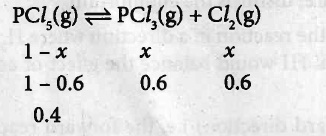
\( \therefore\left[\mathrm{PCl}_{5}\right]_{\mathrm{eq}}=0.4 \mathrm{~mol} \mathrm{dm}^{-3} ; \quad\left[\mathrm{PCl}_{3}\right]_{\mathrm{eq}}=0.6 \mathrm{~mol} \mathrm{dm}^{-3} ; \quad\left[\mathrm{Cl}_{2}\right]_{\mathrm{eq}}=0.6 \mathrm{~mol}^{-3} \)
\(\mathrm{K}_{c}=\frac{\left[\mathrm{PCl}_{3}\right]\left[\mathrm{Cl}_{2}\right]}{\left[\mathrm{PCl}_{5}\right]}=\frac{0.6 \times 0.6}{0.4}\)
Kc = 0.9 mol dm-3
8.
Addition of an inert gas to a reaction at equilibrium, at constant volume has no effect.
9.
If we know the value of kc and Q, the reaction quotient, we can predict the direction of a reaction
If Q = Kc; the reaction is in equilibrium state.
If Q > Kc: the reaction will proceed in the reverse direction i.e., formation of reactants.
If Q < Kc: the reaction will proceed in the forward direction i.e., formation of products.
10.
If a system at equilibrium is disturbed, then the system shifts itself in a direction that nullifies the effect of that disturbance.
11.
\(K_c={[AB]^2\over [A_2][B_2]}\)
A - green
B - blue
Given that 'V' is constant (closed system)
At equilibrium
\(K_c={({4\over V})^2\over ({2\over V})({2\over V})}={16\over 4}=4\)
KP = KC (RT)Δn
KP = 4(RT)o = 4
At Stage 'x'
\(Q={({6\over V})^2\over ({2\over V})({1\over V})}={36\over 2}=18\)
Q > KC ie., reverse reaction is favoured
At Stage 'y'
\(Q={({3\over V})^2\over ({3\over V})({3\over V})}={9\over 3\times 3}=1\)
KC > Q ie., forward reaction is favoured.
12.
If Q > Kc; the reaction will proceed in the reverse direction (ie) formation of reactants to proceed to reach equilibrium.
13.
\(\Delta n_{g}=\sum n p_{(g)}-\sum n R_{(g)}\)
As \(\Delta n_{p}(g)\) is greater \(\Delta n_{g}=+v e\)
\( \therefore K_{p}=K_{c}(R T)^{+v e} \)
\(\therefore K_{p}>K_{c} \)
So K is smaller than Kp.
14.
i) \(K_{p}=K_{c}(R T)^{\Delta n_{g}}\)
Kp = Equilibrium constant in term of partial Pressures.
Kc = Equilibrium constant in term of concentration.
R = Gas constant; T = Temperature
\(\Delta \mathrm{n}_{\mathrm{g}}\) = Difference between the sum of number of moles of products and the sum of number of moles of reactants in gas phases.
ii) Synthesis of HI:
\( \mathrm{H}_{2(\mathrm{~g})}+\mathrm{I}_{2(\mathrm{~g})} \rightleftharpoons 2 \mathrm{HI}_{(\mathrm{g})} \)
\(\Delta n_{g}=0 \therefore K_{p}=K_{c}(R T) \Delta n_{g}\)
\(K_{p}=K_{c}(R T)^{\circ} \)
\(K_{p}=K_{c} \text {. }\)
15.
N2O4(g) ⇌ 2NO2(g)
T1 = 298 K KP1 = 0.15
T2 = 100o C = 100 + 273 = 373 K ;
KP2 = ?
\(\log({K_2\over K_1})={\Delta H^o\over 2.303R}[{T_2-T_1\over T_1T_2}]\)
K2 > K1 and T2 > T1
\(\log({K_{p_2}\over 0.15})={57.2KJ\ mol^{-1}\over 2.303\times 8.314JK^{-1}\ mol^{-1}}[{373-298\over 373\times 298}]\)
\(\log({K_{P_2}\over 0.15})={57.2\times 10^{+3}\times 75\over 2.303\times 8.314\times 373\times 298}\)
\(\log({K_{p_2}\over 0.15})=2.02\)
\({K_{p_2}\over 0.15}=104.7\)
\(K_{p_2}=104.7\times 0.15\)
\(K_{p_2}=15.705\)
16.
PCl5 ⇌ PCl3 + Cl2
Given that [PCl5]initial = 1 mol; V = 1 dm3; KC = 2
| PCl5 | PCl3 | Cl2 | |
| Initial no.of moles | 1 | - | - |
| No.of moles | x | - | - |
| No.of moles at equilibrium | 1 - x | x | x |
| Equilibrium concentration | \({1-x\over 1}\) | \({x\over 1}\) | \({x\over 1}\) |
\(K_c={[PCl_3][Cl_2]\over [PCl_5]}\)
\(2={x\times x\over (1-x)}\)
2 - 2x = x2|
x2 + 2x - 2 = 0
Solution for a quadratic equation
\(a x^{2}+b x+c=0 \text { are }, x=\frac{-b-\sqrt{b^{2}-4 a c}}{2 a}\)
a- = 1 b = 2 c = -2
\(x=\frac{-2-\sqrt{4-4 \times 1 \times-2}}{2 \times 1} \)
\(x=\frac{-2-\sqrt{12}}{2}=\frac{-2-\sqrt{4 \times 3}}{2}\)
\( x =\frac{-2-2 \sqrt{3}}{2} \)
\(=\frac{-2+2 \sqrt{3}}{2}, \frac{-2-2 \sqrt{3}}{2} \)
\(x =-1+\sqrt{3} ;-1-\sqrt{3} \)
\(=-1-\sqrt{3} \text { not possible } \)
Since x is + ve,
x = -1 + 1.732
x = 0.732
Equilibrium concentration of
\( {\left[\mathrm{PCl}_{5}\right]_{\mathrm{eq}}=\frac{1-x}{1}=1-0.732=0.268 \mathrm{M}} \)
\({\left[\mathrm{PCl}_{3}\right]_{\mathrm{eq}}=\frac{x}{1}=\frac{0.732}{1}=0.732} \)
\({\left[\mathrm{Cl}_{2}\right]_{\mathrm{eq}}=\frac{x}{1}=\frac{0.732}{1}=0.732} \)
17.
CO(g) + H2O(g) ⇌ CO2 (g) + H2(g) Given KP = 2.7
[CO] = 0.13, [H2O] = 0.56
[CO2] = 0.78 ; [H2] = 0.28
V = 2L
KP = KC (RT)
2.7 = KC (RT)o
KC = 2.7
\(Q_c={[CO_2][H_2]\over [CO][H_2O]}\)\(={({0.78\over 2})({0.28\over 2})\over ({0.13\over 2})({0.56\over 2})}\)
Q = 3
Q > Kc, Hence the reaction proceed in the reverse direction.
18.
T1 = 25 + 273 = 298 K
T2 = 37 + 273 = 310 K
ΔH = 32.4 KJmol-1 = 32400 Jmol-1
R = 8.314 JK-1 mol-1
KP1 = 0.0260
Kp2 = ?
\(\log {K_2\over K_1}={\Delta H^o\over 2.303R}[{T_2-T_1\over T_2T_1}]\)
\(\log {K_2\over K_1}={32400\over 2.303\times 8.314}({310-298\over 310\times 298})\)
\(={32400\times 10\over 2.303\times 8.314\times 310\times 298}\)
= 0.2198
\({K_2\over K_1}=\) antilog 0.2198 = 1.6588
K2 = 1.6588 x 0.026 = 0.0431
19.
20.
H2(g) + I2(g) \(\rightleftharpoons \) 2HI(g)
At equilibrium, [HI] = 0.4 mol L-1 Kc= ?
| H2 | I2 | HI | |
|---|---|---|---|
| Initial number of moles | 1 | 1 | - |
| Number of moles at equilibrium | 1 - x | 1 - x | 2x = 0.4 x = 0.2 |
| 0.8 | 0.8 | 0.4 |
\(\therefore K_c={[HI]^2\over [H_2[I_2]]}={0.4\times 0.4\over 0.8\times 0.8}=0.25\)
21.
N2O2(g) \(\rightleftharpoons \) 2NO2(g)
Kc = 0.21 at 373 K. The concentrations N2O4 and NO2 are found to be 0.125 mol dm-3 and 0.5 mol dm-3 respectively at a given time. From the above information we can predict the direction of reaction as follows.
\(Q={[NO_2]^2\over [N_2O_4]}={0.5\times 0.5\over 0.125}=2\)
The Q value is greater than Kc. Hence, the reaction will proceed in the reverse direction until the Q value reaches 0.21.
22.
H2(g) + I2(g) \(\rightleftharpoons \) 2HI(g)
At a particular instant, the concentration of H2, I2and HI are found to be 0.2 mol L-1, 0.2 mol L-1 and 0.6 mol L-1 respectively. From the above information we can predict the direction of reaction as follows.
\(Q={[HI]^2\over[H_2][I_2]}={0.6\times 0.6\over 0.2\times 0.2}=9\)
Since Q < Kc, the reaction will proceed in the forward direction.
23.
Kp1 = 8.19 x 10² T1 = 298K
Kp2 = 4.6 x 10⁻¹ T2 = 498K
\(\log({K_{p_2}\over K_{P_1}})={\Delta H^o\over 2.303\times 8.314}({T_2-T_1\over T_1T_2})\)
\(\log({4.6\times 10^{-1}\over 8.19\times 10^2})={\Delta H^o\over 2.303\times 8.314}({498-298\over 498\times 298})\)
\({-3.2505\times 2.303\times 8.314\times 498\times 298\over 200}=\Delta H^o\)
\(\Delta H^o=\) -46181 J mol-1
\(\Delta H^o=\) -46.18 J mol-1.
24.
A2(g) + B2(g) ⇌ 2AB(g)
| A2 | B2 | AB | |
| Initial Concentration | 1 | 1 | - |
| No.of moles reacted | x | x | - |
| No.of moles at equilibrium | 1 - x | 1 - x | 2x |
Total no. of moles = 1 – x + 1 – x + 2x = 2
\(K_p={(P_{AB})^2\over (P_{A_2})(P_{B_2})}={({2x\over 2}\times p)^2\over ({(1-x)\over 2}\times p)({1-x\over 2}\times p)}\)
\(K_p={4x^2\over (1-x)^2}\)
Given that Kp = 1; \({4x^2\over (1-x)^2}=1\)
\(\Rightarrow \) 4x2 = (1 - x)2
\(\Rightarrow \) 4x2 = 1 + x2 - 2x
3x2 + 2x - 1 = 0
\(X={-2\pm\sqrt{4-4\times 3\times -1}\over 2(3)}\)
\(X={-2\pm\sqrt{4+12}\over 6}\)
\(={-2\pm\sqrt{16}\over 6}\)
\(={-2+4\over 6};{-2-4\over 6}\)
\(={2\over 6};{-6\over 6}\)
X = 0.33 ; -1 (not possible)
\(\therefore\) [A2]eq = 1 - x = 1 - 0.33 = 0.67
[B2]eq = 1 - x = 1 - 0.33 = 0.67
[AB]eq = 2X = 2 x 0.33 = 0.66.
25.
2XY2(g) ⇌ 2XY(g) + Y2(g)
| XY2 | XY | Y2 | |
| Initial no.of moles | 1 | - | - |
| No.of moles dissociated | x | - | - |
| No.of moles at equilibrium | (1-x) \(\cong \) 1 | x | x/2 |
Total No. of moles = 1 – x + x + x/2 = 1 + x/2 \(\cong \) 1
[∵ Given that x < < 1 ; 1 – x \(\cong \) 1 and 1 + x/2 \(\cong \) 1]
\(K_p={(P_{XY})^2(P_{Y_2})\over (P_{XY_2})^2}={({x\over 1}\times p)^2({x/2\over 1}\times P)\over ({1\over1}\times P)^2}\)
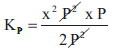
\(\Rightarrow\) 2Kp = x3P.
26.
Given \(m_{N_2}\) = 28 g \(m_{H_2}\) = 6g
V = 1 L
\((n_{N_2})_{initial}={28\over 28}=1\ mol\)
\((n_{H_2})_{initial}={6\over 2}=3\ mol\)
N2(g) + 3H2(g) ⇌ 2 NH3(g)
| N2(g) | H2(g) | NH3(g) | |
| Initial concentration | 1 | 3 | - |
| Reacted | 0.5 | 1.5 | - |
| Equilibrium concentration | 0.5 | 1.5 | 1 |
\([NH_3]=({17\over 17})=1\ mol=1\ mol\)
Weight of N2 = (no. of moles of N2) × molar mass of N2
= 0.5 x 28 = 14 g
Weight of H2 = (no. of moles of H2) × molar mass of H2
= 1.5 x 2 = 3 g
27.
KC = 4 x 10⁻² for the reaction,
H2S(g) ⇌ H2(g) + 1/2 S2(g)
\(K_c={[H_2][S_2]^{1/2}\over [H_2S]}\)
\(\Rightarrow 4\times 10^{-2}={[H_2][S_2]^{1/2}\over [H_2S]}\)
For the reaction,
2H2S(g) ⇌ 2H2(g) + S2(g)
\(K_c={[H_2]^2[S_2]\over [H_2S]}=(4\times 10^{-2})^2=16\times 10^{-4}\)
For the reaction,
3H2S(g) ⇌ 3H2(g) + 3/2 S2(g)
\(K_c={[H_2]^3[S_2]^{3/2}\over [H_2S]^3}=(4\times 10^{-2})^3=64\times 10^{-6}\)
28.
Let us consider the general reaction in which all reactants and products are ideal gases
\(xA+yB\rightleftharpoons IC+mD\)
The equilibrium constant, Kc is
\({ K }_{ c }=\cfrac { \left[ C \right] ^{ I }\left[ D \right] ^{ m } }{ \left[ A \right] ^{ x }\left[ B \right] ^{ y } } \) .......(1)
and Kp is
\({ K }_{ p }=\cfrac { { p }_{ c }^{ I }\times { p }_{ D }^{ m } }{ { p }_{ a }^{ x }\times { p }_{ B }^{ y } } \) ..........(2)
The ideal gas equation is
PY = nRT
or
\(P=\cfrac { n }{ V } RT\)
Since Active mass = molar concentration = n/V
p = active mass\(\times\)RT
Based on the above expression the partial pressure of the reactants and products can be expressed as,
\({ p }_{ A }^{ x }=\left[ A \right] ^{ x }\left[ RT \right] ^{ x }\)
\({ p }_{ B }^{ y }=\left[ B \right] ^{ y }\left[ RT \right] ^{ y }\)
\({ p }_{ C }^{ 1 }=\left[ C \right] ^{ I }\left[ RT \right] ^{ 1 }\)
\({ p }_{ D }^{ m }=\left[ D \right] ^{ m }\left[ RT \right] ^{ m }\)
On substitution in eqn. 2,
\({ K }_{ p }=\cfrac { { \left[ C \right] }^{ 1 }{ \left[ RT \right] }^{ 1 }{ \left[ D \right] }^{ m }{ \left[ RT \right] }^{ m } }{ { \left[ A \right] }^{ x }{ \left[ RT \right] }^{ x }{ \left[ B \right] }^{ y }{ \left[ RT \right] }^{ y } } \) .........(3)
\({ K }_{ p }=\cfrac { { \left[ C \right] }^{ 1 }{ \left[ D \right] }^{ m }{ \left[ RT \right] }^{ I+m } }{ { \left[ A\quad \right] }^{ x }{ \left[ B \right] }^{ y }{ \left[ RT \right] }^{ x+y } } \)
\({ K }_{ p }=\cfrac { { \left[ C \right] }^{ I }{ \left[ D \right] }^{ m } }{ { \left[ A \right] }^{ x }{ \left[ B \right] }^{ y } } \left[ RT \right] ^{ \left( 1+m \right) -\left( x+y \right) }\) ...........(4)
Sub (1) in (4)
\({ K }_{ p }={ K }_{ C }\left( RT \right) ^{ \left( \Delta { n }_{ g } \right) }\)
where,
\({ \Delta n }_{ g }\) is the difference between the sum of number of moles of products and the sum of number of moles of reactants in the gas phase.
29.
\(K_c={[NH_3]^4[O_2]^5\over [NO]^4[H_2O]^6}\)
\(4 \mathrm{NO}_{(\mathrm{g})}+6 \mathrm{H}_{2} \mathrm{O}_{(\mathrm{g})} \rightleftharpoons 4 \mathrm{NH}_{3(\mathrm{~g})}+5 \mathrm{O}_{2(\mathrm{~g})}\)
30.
Let us consider the formation of ammonia in which, 'a' moles nitrogen and 'b' moles hydrogen gas are allowed to react in a container of volume V. Let 'x' moles of nitrogen react with 3x moles of hydrogen to give 2x moles of ammonia.
\({ N }_{ 2 }\left( g \right) +3{ H }_{ 2 }\left( g \right) \rightleftharpoons { 2NH }_{ 3 }\left( g \right) \)
| N2 | H2 | NH3 | |
| Initial number of moles | a | b | 0 |
| number of moles reacted | x | 3x | 0 |
| Number of moles at equilibrium | a - x | b - 3x | 2x |
| Active mass or molaroncentration at equilibrium | \(\cfrac { a-x }{ V } \) | \(\cfrac { b-3x }{ V } \) | \(\cfrac { 2x }{ V } \) |
Applying law of mass action
\({ K }_{ C }=\cfrac { \left[ { NH }_{ 3 } \right] ^{ 2 } }{ \left[ { N }_{ 2 } \right] \left[ { H }_{ 2 } \right] ^{ 3 } } \)
= \(\cfrac { \left( \cfrac { 2x }{ V } \right) ^{ 2 } }{ \left( \cfrac { a-x }{ V } \right) \left( \cfrac { b-3x }{ V } \right) ^{ 3 } } \)
= \(\cfrac { \left( \cfrac { 4x }{ V } \right) ^{ 2 } }{ \left( \cfrac { a-x }{ V } \right) \left( \cfrac { b-3x }{ V } \right) ^{ 3 } } \)
\({ K }_{ C }=\cfrac { 4{ x }^{ 2 }{ V }^{ 2 } }{ \left( a-x \right) \left( b-3x \right) ^{ 2 } } \)
The equilibrium constant Kp can also be calculated as follows:
\({ K }_{ p }={ K }_{ C }\left( RT \right) ^{ \left( \Delta { n }_{ g } \right) }\)
\(\Delta \)ng =np - nr = 2 - 4 = -2
\({ K }_{ p }=\cfrac { { 4x }^{ 2 }{ V }^{ 2 } }{ \left( a-x \right) \left( b-3x \right) ^{ 3 } } \left( RT \right) ^{ -2 }\)
Total number of moles at equilibrium,
n = a - x + b - 3x + 2x = a + b - 2x
\({ K }_{ p }=\cfrac { { 4x }^{ 2 }{ V }^{ 2 } }{ \left( a-x \right) \left( b-3x \right) ^{ 3 } } \times \left[ \cfrac { PV }{ n } \right] ^{ -2 }\)
\({ K }_{ p }=\cfrac { { 4x }^{ 2 }{ V }^{ 2 } }{ \left( a-x \right) \left( b-3x \right) ^{ 3 } } \times \left[ \cfrac { n }{ PV } \right] ^{ 2 }\)
\({ K }_{ p }=\cfrac { { 4x }^{ 2 }{ V }^{ 2 } }{ \left( a-x \right) \left( b-3x \right) ^{ 3 } } \times \left[ \cfrac { a+b-2x }{ PV } \right] ^{ 2 }\)
\({ K }_{ p }=\cfrac { 4{ x }^{ 2 }\left( a+b\quad -2x \right) ^{ 2 } }{ { P }^{ 2 }\left( a-x \right) \left( b-3x \right) ^{ 3 } } \)
31.
Given data:
[A] = [B] = [C]= [D] =1 M
Kc = 100
[D]eq = ?
Solution:
Let x be the no moles of reactants reacted
| A | B | C | D | |
|---|---|---|---|---|
| Initial concentration | 1 | 1 | 1 | 1 |
| At equilibrium (as per reaction stoichiometry) |
1-x | 1-x | 1-x | 1-x |
\(K_c={[C][D]\over [A][B]}\)
\(100={(1+x)(1+x)\over (1-x)(1-x)}\)
\(\sqrt{100}=\sqrt{{(1+x)(1+x)\over (1-x)(1-x)}}\)
\(10={1+x\over 1-x}\)
10(1 - x) = 1 + x
10 - 10x - 1 - x = 0
9 - 11x = 0
11x = 9
\(x={9\over 11}=0.818\)
[D]eq = 1+x = 1 + 0.818 = 1.818M.
32.
At any instant, the rate of a chemical reaction, at a given temperature is directly proportional to the product of the active masses of the reactants at that instant.
Rate of the reaction \(\alpha \) [Reactant]x
33.
\( \mathrm{H}_{2(\mathrm{~g})}+\mathrm{I}_{2(\mathrm{~g})} \rightleftharpoons 2 \mathrm{HI}_{(\mathrm{g})} \)
\(\mathrm{K}_{\mathrm{c}}=\frac{4 x^{2}}{(a-x)(b-x)}\)
This expression doesn't involve, V. So, increase or decrease of volume will not affect the equilibrium and hence the yield of the product.
34.
The equilibrium constant is a constant and it is for equilibrium condition. But 'Q', the reaction quotient is not a constant as it is for non - equilibrium condition. 'Q' is the ratio of the product of active masses of a reaction products raised to the respective stoichiometric coefficients in the balanced chemical equation to that of the reactants, under non - equilibrium conditions.
i) If Q = Kc; it is equilibrium
ii) If Q > Kc.; the reaction will proceed in reverse direction
iii) If Q < Kc ; the reaction will proceed in forward direction
35.
This condition is not static and is dynamic, because both the forward and reverse reactions are still occurring with the same rate. No macroscopic change is observed.
36.
2 NO(g) + O2 (g) ⇌ 2NO2(g)
| NO2 | O2 | NO2 | |
| Initila Partial Pressure | 1 | 1 | - |
| Reacted | 0.96 | 0.96 | - |
| Equilibrium Partial Pressure | 0.04 | 0.52 | 0.96 |
\(K_p={P^2_{NO_2}\over P^2_{NO_2}.Po_2}\)
\(={0.96\times 0.96\over 0.04\times 0.04\times 0.52}\)
= 11.07 x 10² (atm)-1
Keq = 41.6 x 10² M-1.
37.
| Fe3+ | SCN- | [Fe(SCN)2+ | |
| Initial concentration (M) | 1x 10⁻³ (10 x 10-4) | 8 x 10⁻⁴ | - |
| Reacted | 2 x 10⁻⁴ | 2 x 10⁻⁴ | - |
| Equilibrium concentration | 8 x 10⁻⁴ | 6 x 10⁻⁴ | 2 x 10⁻⁴ |
\(K_{eq}={[Fe(SCN)]^{2+}\over [Fe^{3+}][SCN^-]}\)
\(={2\times 10^{-4}M\over 8\times 10^{-4}M\times 6\times 10^{-4}M}\)
= 0.0416 x 10⁴
Keq = 41.6 x 10² M-1
38.
(b)
5 litre
39.
(c)
\(K_2{K_3^3\over K_1}\)
40.
(a)
ΔH > 0 for the forward reaction
41.
(d)
remain the same
42.
(b)
| (i) | (ii) | (iii) | (iv) |
| 3 | 1 | 4 | 2 |
43.
(c)
\(({1\over K_1})^{1/2}\)
44.
(c)
All the physical processes stop at equilibrium
45.
(b)
5
46.
(a)
33%
47.
(c)
more PCl5 will be produced
48.
(d)
increase by 64 times
49.
(a)
36 : 1
50.
(b)
x + 0.5
51.
(d)
PCl5 (g) ⇌ PCl3(g) + Cl2(g)
52.
(a)
P = 24 KP
53.
(d)
(RT)2
54.
(b)
largely towards reverse direction
55.
(a)
0.06
56.
(a)
\({1\over \sqrt{K_1K_2}}\)
57.
(a)
for a system at equilibrium, Q is always less than the equilibrium constant
58.
(a)
increase in pressure
59.
(c)
equilibrium is shifted to the left
60.
(a)
The forward reaction is exothermic
61.
(b)
\(K_2=K_1^{-1/2}\)
62.
(a)
20

11th Standard Syllabus & Materials
11th Standard
TN 11th Tamil பீடு பெற நில் - செய்யுள் - காவடிச்சிந்து Important Questions And Answers Study Material - QB365 Set A
NEW11th Standard
TN 11th Tamil பீடு பெற நில் - உரைநடை - மலை இடப்பெயர்கள் : ஓர் ஆய்வு Important Questions And Answers Study Material - QB365 Set A
NEW11th Standard
TN 11th Tamil மாமழை போற்றுதும் - துணைப்பாடம் - யானை டாக்டர் Important Questions And Answers Study Material - QB365 Set A
NEW11th Standard
TN 11th Tamil மாமழை போற்றுதும் - செய்யுள் - ஐங்குறுநூறு Important Questions And Answers Study Material - QB365 Set A



Tamilnadu Stateboard 11th Standard Subjects

Maths

Commerce

Economics

Biology

Business Maths and Statistics

Accountancy

Computer Science

Physics
Chemistry
Maths
Biology
Economics
Physics
Chemistry

History
Business Maths and Statistics

Computer Science
Accountancy

Computer Applications
History
Computer Technology
Commerce
Computer Applications
Computer Technology

Tamil

English

French
Tamilnadu Stateboard Standards
