
 100% FREE ACCESS
11th Standard Syllabus & Materials
11th Standard
TN 11th Tamil இயற்கை வேளாண்மை,சுற்றுச்சூழல் -செய்யுள் - மனோன்மணீயம் Important Questions And Answers Study Material - QB365 Set A
NEW11th Standard
TN 11th Tamil என்னுயிர் என்பேன் -துணைப்பாடம் - இசைத்தமிழர் இருவர் Important Questions And Answers Study Material - QB365 Set A
NEW11th Standard
TN 11th Tamil மொழி கலை -செய்யுள் - ஒவ்வொரு புல்லையும் Important Questions And Answers Study Material - QB365 Set A
NEW11th Standard
TN 11th Tamil பீடு பெற நில் - இலக்கணம் - பகுபத உறுப்புகள் Important Questions And Answers Study Material - QB365 Set A
NEW11th Standard
TN 11th Tamil பீடு பெற நில் - துணைப்பாடம் - வாடிவாசல் Important Questions And Answers Study Material - QB365 Set A
NEW11th Standard
TN 11th Tamil பீடு பெற நில் - செய்யுள் - குறுந்தொகை Important Questions And Answers Study Material - QB365 Set A

Published on: 19/02/2019
+1 Second Revision Test 2019
Download Tamil Nadu 11th Standard Commerce question papers, model tests, one-mark questions, important questions, and public exam papers in PDF format. Free study materials and answer keys for TN State Board students.
Questions + Answers key
Take MCQ Commerce Test1.
What is International Finance?
2.
What is Monorail?
3.
How did the remonetisation carried out in India in the year 2016?
4.
Give the meaning of Trade?
5.
6.
What is the composition of Private Capital?
7.
Name the activity which facilitates buying and selling. Explain briefly about it?
8.
Who are called stakeholders?
9.
Write any two advantages of MNC's.
10.
For which of the following types of business do you think a sole proprietorship form of organisation would be more suitable, and why?
(a) Grocery Store
(b) Medical store
(c) Craft centre
(d) Legal consultancy
(e) Internet cafe
11.
A contract is .....................
a legal obligation
an agreement plus a legal obligation
consensus ad idem
an agreement plus a legal object
12.
The debenture holders of a joint-stock company gets a fixed rate of______________.
dividend
subscription
interest
discount
13.
When goods are loaded, the captain of the ship issue a receipt known as_________.
Dock challan
Mate's receipt
Bill of lading
Clear bill of lading
14.
General insurance means_______ Insurance.
Fire
Marine
Miscellaneous
All the above
15.
Refusal by the banker to make payment on the cheque presented is called _____of cheque.
crossing
endorsement
dishonour
honour
16.
Tamil Nadu Corporation for Development of Women Limited (TNCDW) was established in the year_______.
1983
1984
1985
1995
17.
Compensation received for loss of trading asset is a _______________
Capital receipt
Revenue receipt
a casual receipt
None of the above
18.
Suitable goods for Mail Order Business _______
Dairy product
Vegetables
Fruits
Watches
19.
The word ' Ethics ' is derived from _________ word.
French
Latin
Greek
Tamil
20.
21.
22.
23.
Registration of partnership is _________
compulsory
optional
not necessary
none of the above
24.
Debenture holders are entitled to a fixed rate of ________.
Dividend
Profits
Interest
Ratios
25.
Warehouses removes the hindrance of _________
Person
Time
Risk
Knowledge
26.
A ________ is a mercantile agent to whom goods are entrusted for sale by a principal and takes physical possession of the goods, but does not obtain ownership.
Broker
Factor
warehouse-keeper
Commission agent
27.
Membership in a Cooperative organization is :
Not open to all
Selective
Open to all
None of them
28.
A continuing relationship which provides a license privileges to do business and provides training, merchandising for a consideration is called _____.
Franchising
Factoring
Supply chain Management
Exchange
29.
Which of the following is not a function of a Central Bank?
Guiding and regulating the Banking system of a Country
Deal with general public
Acts essentially as Government banker
Maintains deposit accounts of all other banks
30.
Trade and Commerce was common to ____________ Dynasty.
Pallava
Chola
Pandya
Chera
31.
Show the classification of contract by a flow chart.
32.
Enumerate the objectives of export trade.
33.
Under what circumstances can a partnership be dissolved by the court? Dissolution through court (Sec. 44):
34.
State some cases, in which the court grants specific performance.
35.
36.
What is the role and significance of MSMEs in Indian Economy?
37.
What is Marine Insurance? What are its features?
38.
Briefly Explain the Diversified banking services of Commercial banks.
39.
Write a note on Agricultural Income.
40.
41.
Describe the demerits of Foreign Trade.
42.
Explain Corporate Social Responsibility in India with an example:
43.
Compare Factoring with Forfeiting:
44.
Write a note on Inland Waterways.
45.
What are all the reasons for not granting the specific performance by the court?
46.
What are the Quantitative Method of Credit Control? Explain.
47.
What are the characteristics of commerce?
48.
State any three limitations of departmental stores
49.
Write down the functions of WTO.
50.
51.
52.
Explain the classification of contract on the basis of the formation.
53.
Write a note on consumer Co-operative Society ?
54.
Explain the development of Commerce and Trade in North India.
1.
International finance is a branch of financial economics that deals with the monetary interactions that occur between two or more countries.
2.
A monorail is like a train, but instead of having two sets of wheels that balances on a railway track, the monorail is balanced on top of one rail. Monorails are often used to transport people around large cities.
3.
The remonetisation was carried out by issuing new Rs. 2000 and Rs. 500 currency notes.
4.
The buying and selling of goods and services consists of trade. The essence of trade is to make goods and services available to those persons who need them and are able and willing to pay for them.
5.
6.
Private Capital consists of Foreign Investments, long-term loans, and Foreign Currency Deposits.
7.
(i) Business refers to those activities, which are connected with production, purchase and sale of goods or supply of services with the main object of earning profits.
(ii) People engaged in business are called businessman. They earn income in the form of Profits.
8.
A business organisation is a coalition of several interest groups or stakeholders like shareholders, customers, employees, suppliers, etc.
9.
Improvement in Balance of Payment Position:
i. MNCs help the host countries to increase their exports.
ii. As such, they help the host country to improve upon its Balance of Payment position
Improvement in Standard of Living:
By providing super quality products and services, MNCs help to improve the standard of living of people of host countries.
10.
Legal consultancy - because the organisation would rely solely on an individual's talent and therefore he need not consult anybody else regarding his business.
11.
(b)
an agreement plus a legal obligation
12.
(c)
interest
13.
(b)
Mate's receipt
14.
(d)
All the above
15.
(c)
dishonour
16.
(a)
1983
17.
(a)
Capital receipt
18.
(d)
Watches
19.
(c)
Greek
20.
(a)
21.
(c)
22.
(d)
23.
(b)
optional
24.
(c)
Interest
25.
(b)
Time
26.
(b)
Factor
27.
(c)
Open to all
28.
(a)
Franchising
29.
(b)
Deal with general public
30.
(c)
Pandya
31.
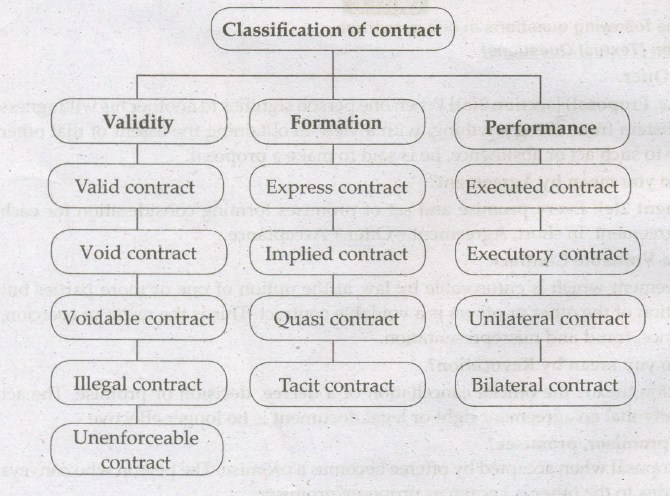
32.
The important objectives of the export trade are :
(i) Facilitating selling of goods to countries which desperately need such goods.
(ii) Expanding the market for goods by producing them on a large scale.
(iii) Earning foreign exchange through exports.
(iv) Helping a country increase the national income.
(v) Creating employment opportunity in a country by promoting of export - oriented and export related enterprises.
(vi) Generating revenue for the Government in the form of customs and excise duties.
(vii) Promoting mutual understanding and co-operation among the nations.
(viii) Achieving optimum utilization of resources by large scale production of goods
33.
Any partner may bring a suit in a court of law to get the partnership dissolved on any of the following grounds:
(i) Partner's insanity,
(ii) Permanent incapacity,
(iii) Persistent breach of agreement,
(iv) Misconduct of a partner,
(v) Transfer of share without consent of other partners,
(vi) Continuous loss,
(vii) Just and equitable grounds.
34.
1. When the act agreed to be done is such that compensation in money for its non-performance is not sufficient.
2. When it is probable that compensation in money cannot be received for the non- performance of the act agreed to be done.
3. When there is no standard for ascertaining the actual damage caused by the non-performance of the act agreed to be done.
35.
36.
The MSME sector contributes about 8% to Gross Domestic Product (GDP) besides 45% to the total manufacturing output and 40% to the exports from the country on the production of more than 6000 products. This sector consists of 36 million units and provides employment to over 8 crore people.
37.
(i) Marine insurance is a contract of insurance under which the insurer undertakes to indemnify the insured in the manner and to the extent thereby agreed against marine losses.
(ii) The insured pays the premium in consideration of the insurer's (underwriter's) guarantee to make good the losses arising from marine perils or perils of the sea.
(iii) Marine perils can be collision of ship with the rock, fire, ship attacked by the enemies, etc. These perils cause damage, destruction or disappearance of the ship and cargo and nonpayment of freight.
(iv) Through marine insurance policy, the insurer undertakes to compensate the owner of a ship or cargo'for complete or partial loss at sea.
The Essential' elements of Marine Insurance Contracts are:
1. It is based on the principle of indemnity
2. The contract is based on utmost good faith.
3. The insurable interest must exist at the time of loss.
4. The principle proximate cause will apply to marine loss only.
38.
Diversified banking functions:
Competition in the banking industry has reduced their profits. Therefore the commercial banks started identifying and offering new and diversified financial services. They are purely other than banking services. Providing all such banking and other financial services is also called universal banking.
39.
(i) Any rent or revenue derived from land which is situated in India and is used for agricultural purpose.
(ii) Agricultural income is fully exempted from tax u/s 10(1) and as such does not form part of total income.
40.
41.
The demerits of Foreign Trade are:
(i) Complicated procedure:
Export and import procedures are very complicated. A layman cannot understand them easily.
(ii) Economic dependence:
The underdeveloped country has to depend on the exporting country which leads to the exploitation of the developing country.
(iii) Adverse effect on the home industry:
International trade provides a threat to the smalland cottage industries at home. These industries cannot stand in competition to the developed countries products.
(iv) Import of harmful goods:
Import of luxury goods and harmful drugs hamper the well being of the people,
(v) World war:
Due to unhealthy competition, enmity among the countries may increase. This may lead to war between countries.
(vi) Political dependence:
It may make one country a slave of other country. Because economic dependence endangers the political stability of the dependent country.
(vii) Exhaust of natural resources:
With the intention of earning more money excessive use of natural resources may take place. This will cause the economic downfall of the country in the long run.
42.
Tata Group is the best example for the corporate social responsibility in India. The Tata Group conglomerate in India carries out various CSR projects, most of which are community improvement and poverty alleviation programs. Through self-help groups, it is engaged in women empowerment activities, income generation, rural community development, and other social welfare programs. In the field of education, the Tata Group provides scholarships and endowments for numerous institutions.
43.
| Characteristics | Factoring | Forfeiting |
| Basis of financing | Financing is dependent on exporter's credit standing | Financing is dependent on the availing bank's financial standing |
| Cost | Cost is borne by the seller | Cost is borne by the overseas buyer |
| Suitability | For transaction of short-term maturity period | For transactions of medium-term maturity period |
| Extend of financing | Only a certain percent of receivables factored is advanced | Full finance is available |
| Risk | Risk can be transferred to seller | All risks borne by the forfeiter |
44.
Inland Waterways comprise of rivers, canals, and lakes. It is also known as internal water transport. Rivers that are naturally navigable are called natural waterways. Canals and canalized rivers belong to the category of 'Artificial Waterways'. Generally small boats and steamers are operated on rivers to transport people and goods. Where rivers are deep enough, large ships can also play on them. Canals are manmade waterways, constructed for the twin purposes of navigation and irrigation.
45.
The court does not grant specific performance in the following cases:
1. Damages are an adequate remedy
2. The contract is not certain
3. The contract is inequitable to either party
4. The contract is of revocable nature
5. The contract is made by the trustee in breach of trust
6. The contract is of personal nature i.e., contract to marry
7. The contract made by a company ultra-vires of its Memorandum of Association
8. The court cannot supervise its carrying out.
46.
The methods which influence the total volume of credit in Indian economy are called quantitative or general methods. An increase in the first three measures will reduce the volume of money in circulation in India and vice versa.
i. Bank Rate Policy:
Bank rate refers to the rate at which the RBI rediscounts the bills given by the Scheduled banks.
ii. Cash Reserve Ratio (CRR):
It is the ratio of Cash reserves with the RBI kept by Scheduled bank in proportion to the total Time and Demand Liabilities with them.
iii. Statutory Liquidity Ratio (SLR):
It is the ratio of money and money equivalents kept within the bank in proportion to the total Time and Demand Liabilities with them.
IV. Open Market Operations:
The RBI directly buys or sells the securities and bills in the money market either to decrease or to increase the total volume of money.
47.
The following are the characteristics of Commerce.
(i) Economic activities:
(1) All economic activities are undertaken to earn Profit. commerce deals with all economic activities undertaken for profit.
(2) So, commerce is concerned with all economic activities directed towards earning profit.
(ii) Exchange of goods and services :
(1) Commerce involves an exchange of goods and services for profit.
(2) Goods may be produced for the purpose of resale to the consumers.
(iii) Earning motive :
(1) Profit is an incentive for undertaking all commercial activities.
(2) Any activity, which does not have the incentive of profit, will not be a part of commerce.
For Example: If a trader gives some goods as Charity.
(iv) Creation of Utility:
Commerce creates form, place and time utility in goods.
(v) Regularity of transaction:
The transaction should be regular. No isolated transaction will be a part of commerce.
48.
(i) High cost of operation :
(1) A departmental store requires a large building with ample parking at a central place. It has to incur heavy expenditure on salaries, maintenance of building, customer services, advertising, etc
(2) As a result, establishment and overhead cost of operation are very high
(ii) Higher Prices:
(i) Due to high operating costs, prices of goods in a departmental store are comparatively high.
(ii) Only rich persons can afford to buy goods at a departmental store.
(iii) Distance:
It is located at a central place of a city, away from people living in suburban areas have to travel a long distance to reach the store.
(iv) Lack of Personal Touch:
(i) The management of a store finds it very difficult to maintain personal contact with the consumers.
(ii) The salaried staff may not take interest in securing the satisfaction and goodwill of the consumers.
(v) Difficult to Establish:
A large amount of Capital investment and a large number of specialised persons are required to establish a departmental store.
(vi) High Risk:
Due to Central Location and large-scale operations, risk of loss is very high. Moreover, change in tastes and fashion and market fluctuations may lead to heavy loss
49.
Functions/Role of WTO:
WTO performs the following functions:
(i) It is a forum for negotiation and formalisation of trade agreement among the member countries.
(ii) It settles disputes and grievances relating to trade among the member countries.
(iii) It frames commonly accepted code of conduct in order to reduce trade barriers.
(iv) It holds consultation with IMF and World Bank (IBRD) and its affiliates to bring about a greater understanding and co-operation in global economic policymaking.
(v) It supervises the operation of agreement relating to General Agreement on Tariffs and Trade (GATT) and Trade-related intellectual properties Rights (TRIPS).
(vi) It regulates trade between participating countries.
50.
51.
52.
On the Basis of the Formation:
1. Express Contract:
i) A contract made by word spoken or written.
ii) According to Section 9, in so far as the proposal or acceptance of any promise is made in words, the promise is said to be express.
iii) For example P says to Q "will you buy my bicycle for Rs.1,000?" Q says to P "Yes".
2. Implied Contract:
i) The implied contract is one, which is not expressly written but understood by the conduct of parties.
ii) Where the proposal or acceptance of any promise is made otherwise than in words, the promise is said to be implied.
iii) For example A gets into a public bus. There is an implied contract that he will pay the bus fare.
3. Quasi Contract:
i) It is a contract created by law. Actually, there is no contract.
ii) It is based on the principle that "a person shall not be allowed to enrich himself unjustly at the expense of the other".
iii) In other words it is an obligation of one party to another imposed by law independent of an agreement between the parties
4. Tacit Contract:
i) A contract is said to be tacit when it has to be inferred from the conduct of the parties.
ii) For example obtaining cash through automatic teller machine, sale by fall of hammer of an auction sale.
53.
1. Consumer cooperatives are organized by consumers that want to achieve better prices or quality in the goods or services they purchase.
2. In contrast to traditional retail stores, or service providers, a consumer cooperative exists to deliver goods or services rather than to maximize profit from selling those goods or services.
3. Nationally, the most widely used cooperative form is the credit union, with some 90 million members.
4. Credit union assets have grown a hundred-fold in three decades.
5. Credit unions are essentially cooperatives of people that use banking services.
6. Students' cooperative stores, Cooperative provision stores, and supermarkets set up on cooperative societies of India are examples of this type.
54.
Commerce and Trade in North India:
1. India was prosperous even during medieval period from 12th to 16th centuries despite political upheavals.
2. Balban was first sultan who paved the way in the dense forest and helped traders and their commercial caravans to move from one market place to others.
3. Alauddin Khilji brought the price to a very low ebb.
4. He encouraged import of foreign goods from Persia and subsidised the goods.
5. Arabs were dominant players in India's foreign trade.
6. They never discouraged Indian traders like Tamils, Gujaratis, etc.
7. The trade between the coastal ports were in the hands of Marwaris and Gujaratis.
8. The overland trade with central and west Asia was in the hands of Multanis who were Hindus and Khurasanis who were Afghans, Iranians and so on.
9. During Sultanate period, trade flourished due to the establishment of currency system based on silver and copper.
10. Moorish traveller described the teeming market of big cities in the Gangetic plains, Malwa, Gujarat and South India.
11. The important trade centres were Delhi, Mumbai, Ahmedabad, Sonar, Sonargoon, Jaunpur, Lahore and so on. The burgeoning foreign trade led to the development of market place in the towns and villages.
12. India's handicraft commanded a good foreign market. India imported horses, dry fruits, precious stones, glassware, high grade textiles, raw silk, corals, scented oil, velvets, etc.. from Kabul, Arabia, Europe, West Asia and China.
13. Indian products were exported to East Africa, Malaya, China and Far East.
14. Trade was conducted through overland routes with Afghanistan, Central Asia and Persia. India conducted foreign trade via land route with Quetta, Khyber pass, Iraq and Bukhara.
15. The traders of Malabar, Gujarat and foreign settlers in the ports of Calicut, Khambhat and Mangalore controlled a major business sector in port cities.

11th Standard Syllabus & Materials
11th Standard
TN 11th Tamil பீடு பெற நில் - செய்யுள் - காவடிச்சிந்து Important Questions And Answers Study Material - QB365 Set A
NEW11th Standard
TN 11th Tamil பீடு பெற நில் - உரைநடை - மலை இடப்பெயர்கள் : ஓர் ஆய்வு Important Questions And Answers Study Material - QB365 Set A
NEW11th Standard
TN 11th Tamil மாமழை போற்றுதும் - துணைப்பாடம் - யானை டாக்டர் Important Questions And Answers Study Material - QB365 Set A
NEW11th Standard
TN 11th Tamil மாமழை போற்றுதும் - செய்யுள் - ஐங்குறுநூறு Important Questions And Answers Study Material - QB365 Set A



Tamilnadu Stateboard 11th Standard Subjects

Maths
Commerce

Economics

Biology

Business Maths and Statistics

Accountancy

Computer Science

Physics

Chemistry
Maths
Biology
Economics
Physics
Chemistry

History
Business Maths and Statistics

Computer Science
Accountancy

Computer Applications
History
Computer Technology
Commerce
Computer Applications
Computer Technology

Tamil

English

French
Tamilnadu Stateboard Standards

